
Why This Childish Programming Meme Got 23K+ Upvotes on Reddit
Today, bored from my daily programming task, I googled programming humor.
I ended up on this Reddit thread, which had the most upvote count in the 1.6M strong programming humor community.
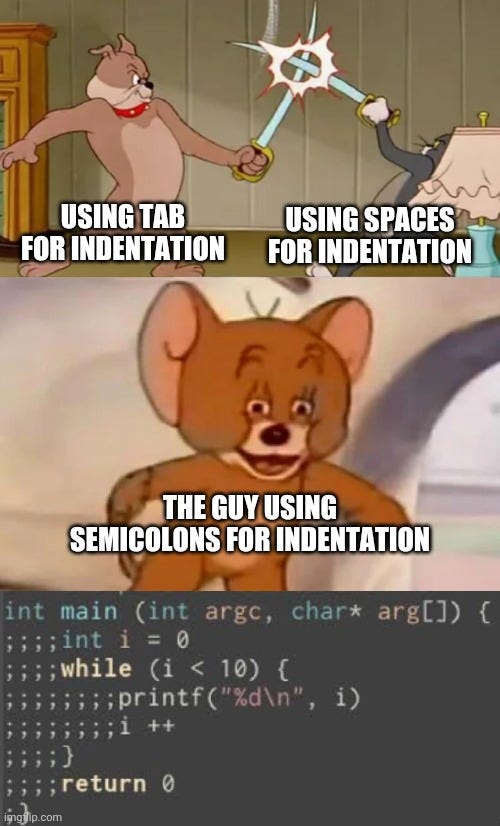
And not just this. I daily come across at least one programming meme on Facebook (yes, it knows I am a programmer without my declaring it) that does one of the following:
- Loathes/Loves python for its indentation rules
- Put a strong opinion in favor of tab/space, and watch the house burn
If you think about it carefully, this is exactly the kind of thing kids would laugh at. In fact, today’s kids are even capable of coming up with such memes.
Why do adult programmers find it so humorous?
Coding style standards are the new factory rules:
Before 10 years, in almost every company I worked for, there were no style guides. When they existed, they were merely kept for auditors.
Forget indentation — even if I complained to someone about their bad variable naming, they would scoff at me: If you understood the purpose of the code, why do you care?
“Readability is important.” I would meekly say.
“How much time this same piece of code is going to be read? Provide me 3 use cases that will make a future coder go through this same piece of code.”
“Well, I can come up with that…” I mumbled.
“Forget it — will the customer ever read this code?”
At which, I was disarmed.
Not anymore. “A code must be readable. Fix that bad indentation.” Even my junior peers would assert, without much support for the arguments.
Whenever I get this argument, I wait for 30 seconds to know an expiry date for the code during which it will be read a thousand times, but they don’t offer anything to me. Nor do they provide any guarantees if it won’t be refactored with certain readability.
Programmers who get continually rattled by readability enforcement vent their frustrations at the indentation meme above, and many others like it.
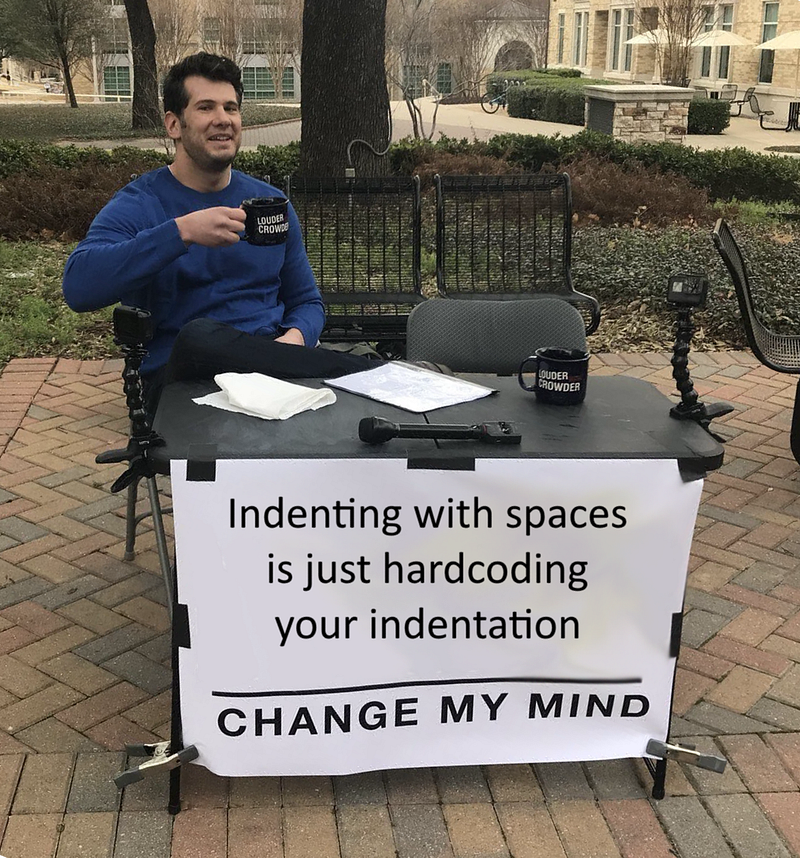
But beyond this insistence for style, there are deeper things going on.
Behind every humor hides another emotion:
Kids enjoy humor effortlessly because they visualize things as they are represented.
For adults, every humor contains an alternate (often stronger) underlying emotion. As a result, adults are able to enjoy a variety of humor that includes:
1 — Irony: Irony describes situations that are strange or funny because things happen in a way that seems to be the opposite of what you expected.
2 —Satire: Satire means making fun of people by imitating them in ways that expose their stupidity or flaws.
3 —Sarcasm: Sarcasm depends on the listener or reader to be in on the joke. Sarcasm is insincere speech. Your mom asks if you’re excited to start cleaning the kitchen and you say, “Yeah, right,” when you mean “Heck no.”
Behind every reason to laugh, there is often an admission of pain or guilt.
So what’s going on with the indentation rule?
Something as trivial as an indentation rule evokes stronger emotions within programmers, than, let’s say design decisions such as:
- OOP or FP?
- Pointers or references?
- Design patterns: Yes or No?
- JS or Typescript?
The above wars are fought nonetheless, but with mass valor that is little compared to the indentation one. If anyone has anecdotal stats that oppose this hypothesis, feel free to provide them in comments.
The reason for such an amount of attention is not just the underlying topic, but many facets of programmers’ lives.
We shall outline a few factors that support this theory.
What really makes them laugh at indentation meme:
Early programmers were free thinkers. They were like scientists and mathematicians.
They got little processes and infinite freedom.
They worked hard. They had to tinker a lot with machines. But to make it count, they also got infinite opportunities for experimentation. When I say this, I am not saying in terms of budget, but in terms of time and liberty.
There were no or very few frameworks. Bits and bytes and terminals filled with memory dumps/call stacks frequented a programmer’s dream. They visit today’s programmers too, but today’s tools are smart enough to make it easier.
Due to exponential growth in open source and productivity, expectations from today’s programmers are completely reduced to meeting the business objectives.
Programming is a job of continuous choices. Programmers (today’s included) are taught to fight for those choices among each other, and not without serious damage to their own careers while the managers watch their stock holdings multiply.
When those choices impact masses in a good way, despite the blood that they spill bettering the products, programmers are the happiest people on earth.
However, the way a programmer’s job is executed currently, she has got no real choices.
Nonsensical meetings announce they are supplied with the proper requirements (no matter how much documentation sucks).
A number of unsuitable design decisions by previous developers become a huge technical debt to the new programmers. They get no liberty or time to refactor to reset the code quality to 0 until they decide to live with it, or quit the company.
Many great programmers often suffer from a lack of communication skills. They can make things work with 2 days of hard work, but they cannot direct a better path with a few sentences’ exchange with managers or senior colleagues.
Irrelevant culture-building events (intern hackathons, Friday beer, or lunch with CXOs) are all designed to make them laugh forcibly, only to acknowledge the company’s efforts to take care of their well-being.
Bereft of any impact-making choices, a programmer is left with nothing but to show her disagreement with something that has little or no negative emotional fallout with their managers and colleagues.
If not even that, at least laugh at it.
Indentation fits that box quite perfectly.
Conclusion:
On many Friday beer nights, my programmer friends would get heavily drunk. Beyond the point of mental recovery, everyone would start uttering whimsical stuff about everyone else.
The discussions ranged from the cutest female colleague to guessing the POTUS that will order a nuclear attack on XYZ country.
At the time of departure, quite cutely, they would all say: You should not take such humor seriously.
(sometimes knowing fully the truths behind their drunken state rhetoric)
In a way, they were right. Humor is a point where one is already past the pain acceptance stage. If you keep getting serious, you aren’t abstracted enough. You must go back to programming school, learn to apply abstraction to human emotions, and only come back after being successful at it.
If you can’t fix it, laugh at it and live your life.