
AWS is Chasing Engineers

In August 2021, I was going through the worst time of my career: An 18-month long rejection stint. That’s when I earned my first AWS certification.
It was soon after the time Andy Jassy (AWS CEO till that time) took over as Amazon CEO from Jeff Bezos.
That’s when I decided to apply for the Amazon AWS Architect job position. While preparing, I learned many aspects of a senior developer job role.
I relentlessly made Q & A notes. Firstly, there were STAR format questions (inspired by the 16 Amazon Leadership principles). There were non-STAR questions (e.g tell me about yourself), too.
All of them required me to study the principles of organizational behavior in an intensely critical manner.
My analysis enabled me to write an eBook about how to tackle senior developer interviews that aims to help FAAMG+ aspirants. (the link includes a 50% discount for the next 30 Medium readers).
The Amazon AWS Interview process:
At the time of my application, an AWS architect position involved the following interview rounds in the EU position:
Techno-analytical Assessment (60–120 minutes):
This round is handled by a 3rd party platform, and everything including it up to this point is automated. There are two parts to the assessment.
Part 1:
In the first part, there are multiple-choice questions surrounding reading comprehension, problem analysis, and priority.
A typical and popular question is:
Given the courier delivery schedules of Bob, Peter, Alice, and Johanna tell us who is the most efficient, and who must be given a rest.
The questions are multiple-choice, and there could be more than one correct answer.
Another example question could also involve a situation, and 5 potential solutions (A, B, C,D, E). You must choose the order in which you will apply 3 out of 5 solutions. The priority of your choice is also a consideration, so B, C, and D could be the right answer, and C, D, and B could be wrong.
The questions are easy, but running against time sometimes stress-tests a candidate.
Part 2:
These are multiple-choice questions again. The content is based on the AWS role you are applying for. The question content will rely upon the relevant AWS certification exam. (Solution Architect vs Solution Associate etc)
The best source to prepare for this is the job description, where a certification might be mentioned. You must cover the entire syllabus of the certification.
Loop Interview:
I made the mistake of spending too much time preparing for the Loop Interview and got overconfident about the previous round. The result was that I was thrown out in the first round itself.
My dreaded Loop Interview runs for at least 4+ hours, and it is conducted by AWS interviewers. It contains scenario-based questions — which must be answered in the famous STAR (Situation, Task, Action, Resolution) format. For truly good candidates, it also runs longer to contain the infamous bar-raiser round. As part of this, a candidate is continually asked stress-inducing questions, to assess his/her composure and customer-handling capabilities.
Last but not the least, from my online research, the Loop interview doesn’t solely contain behavioral questions. It contains at least one technical round to cover AWS technologies, depending upon the job position.
AWS was already lousy in hiring engineers:
The AWS rejection I mentioned above was my 2nd one. I was unhappy, not because I was rejected twice, but because I received no feedback from my assessment.
After I finished the evaluation round, I was quite confident about clearing it. However, I heard nothing from the recruitment team. I first thought they had plenty to choose from, but that wasn’t the case. The position remained open on LinkedIn throughout the year. And there weren’t many AWS professionals in my location to assume the competition was tough.
Turned out I was banging my head against a robot, all along.
I also thought I could not have met the minimum bar. But in the absence of any feedback/rating, it was simply an assumption.
When I followed up with an email mentioned in the assessment, I heard back nothing.
Then, I searched for an AWS guy who gave me some vague feedback the last year. To my surprise, he was working in South Africa, and not the EU. I shot him a follow-up email. He luckily reverted back, but he had no idea about my application.
After a couple of days, he was able to extract my assessment result from the guy who was responsible (or a computer, probably? I have no idea). It was the bad news anyway. Not that I cared too much, but it would have been nice to know how much short I fell. I got no additional information.
I wrote a final follow-up email to ask how long before I could apply again, but again, I got no feedback at all.
Turned out I was banging my head against a robot, all along. The recruiters no longer treated candidates like customers.
So much for the customer obsession.
AWS is chasing engineers (But they aren’t keen):
Recently, I came across a LinkedIn post that wasn’t appreciated by many programming professionals.
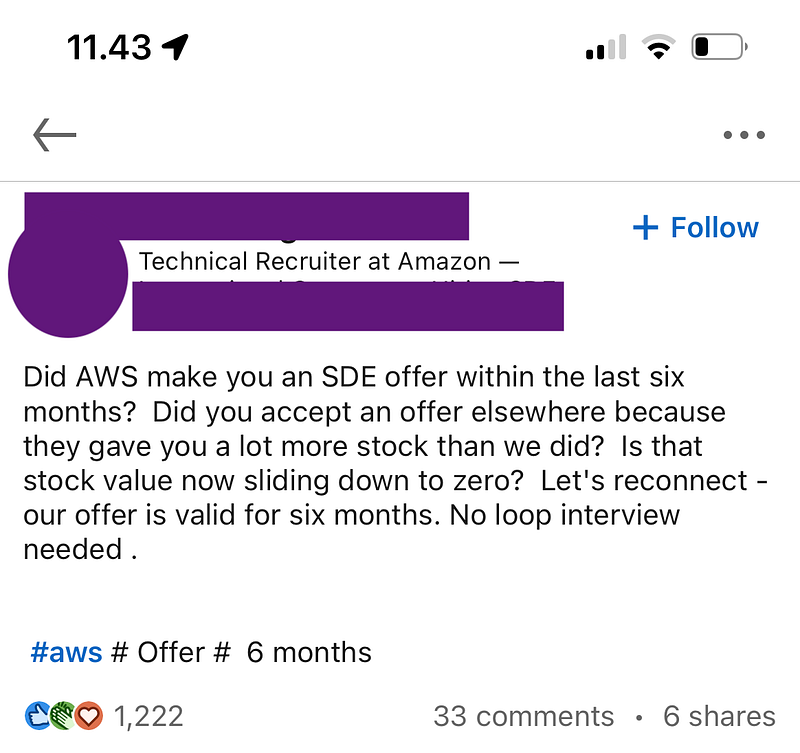
Why are engineers not keen on joining the top tech giant, with lucrative salaries and generous stock options?
Is AWS not competitive enough?
Or is it about the bad work atmosphere inside AWS?
From my first-hand experience dealing with AWS staff, I think it’s the latter. Amazon probably keeps them on the toe, just like Netflix. In the case of Netflix, though, the competition is technical. In the case of Amazon, it’s the stress of the sales-like job. In other words, Amazon hires engineers but treats them like sales staff.
I have often observed that AWS staff is exceptionally responsive (just like Amazon retail customer care), but the quality of response is quite low — due to the technical nature of the underlying services.
The mumbo-jumbo surrounding leadership principles makes them frequent responders, which often results in customer dissatisfaction because technical customers expect a different quality of service than retail ones.
Amazon hires engineers but treats them like sales staff
A typical AWS guy mostly works like customer care professional. In 9/10 cases, this continually harms one’s self-esteem. One is constantly faced with a dilemma:
- If I do not respond, my case could automatically be escalated
- If I do respond with intermediate status (case in progress), and the customer berates the response, my average feedback will go down.
I thought I was an isolated customer to deduce this from the outside. I was also of the thought this was restricted to AWS. But I was wrong on both counts.
The prime factor behind Amazon burnout is an intense data-driven management
This Bloomberg article (published in 2022) mentions Amazon employee turnover is 50%. Employees constantly feel threatened due to cut-throat competition.
Horror stories about Amazon burnout date back to 2014, at least in my Google search results. The earliest credible source I could find was this article from Slate, where the reasons behind Amazon engineer burnout are explained in detail. The prime factor behind it is intense data-driven management (frequent rating-based employee evaluation), which has huge margins of errors, and no human angle.
If you know how it is in Amazon retail, this is the same factor that exploits small-scale Amazon sellers too. A few negative ratings could put one’s entire Amazon storefront in jeopardy, and financial future.
Conclusion:
Amazon is one of the most profitable companies on earth. It brags a trillion-dollar market cap.
However, it is not the only one in this category. Apple, Microsoft, Alphabet, and Tesla have been there, too. And none of them have drawn as much criticism against their workplace satisfaction as Amazon does.
It is time Amazon throws its 14 out of 16 leadership principles out of the window and focuses on just two:
- Strive to be Earth’s Best Employer
- Success and Scale Bring Broad Responsibility
And do it with heart, not documents.
Pen Magnet is the author of the popular senior developer interview eBook:
Comprehensive Approach to Senior Developer Interview (40+ example questions) (For the next 30 Medium readers, the discount is 50%)