
Does ADHD Get Worse Or Better With Age?
Yes.
The answer is c, all of the above
The severity and impact of our ADHD symptoms can either decrease or increase with age, depending on a number of factors. I’m sure there are many, but I will discuss three of those factors here.
I’m not a neuroscientist, so this will be a lay person’s summary, however I am an expert on ADHD, and have a deep understanding of its impact on neurochemistry and neurocircuitry.
Life changes
As we get older, our level of responsibility fluctuates. Perhaps we graduate from high school and go on to College or University, where the demands on our intellect and executive functioning skills are much greater, and the supports may be fewer.
I say may be, because the opposite was true for me. I had a lot more support and options available to me throughout University than I ever did in grade school.
Maybe we start our first “real” job, one where we have greater responsibility and have to work full time. We might start a family, and have greater demands on every single facet of our lives while raising children.
Later, these responsibilities may decline when we retire from work, our children leave home, or other circumstances offer us new and differing perspective, challenges, and opportunities.
Increased skills
When you’ve lived with one brain your whole life, you get to know yourself really well. Having experienced a lifetime of similar challenges, we may develop additional and more effective tools and strategies for managing those difficulties.
Cognitive development
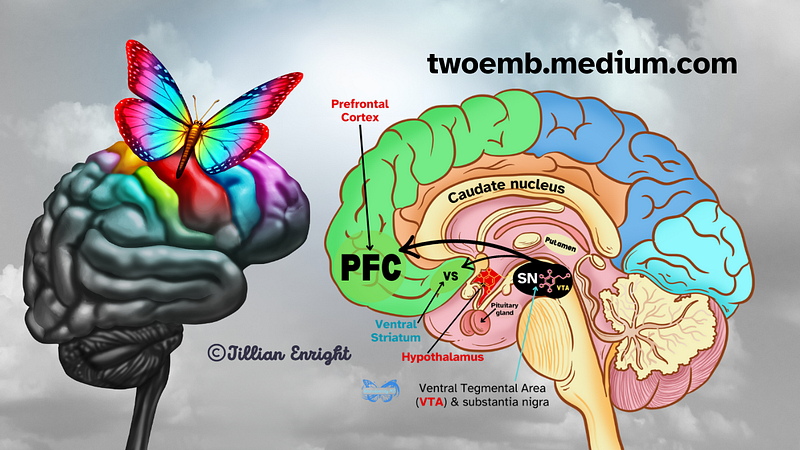
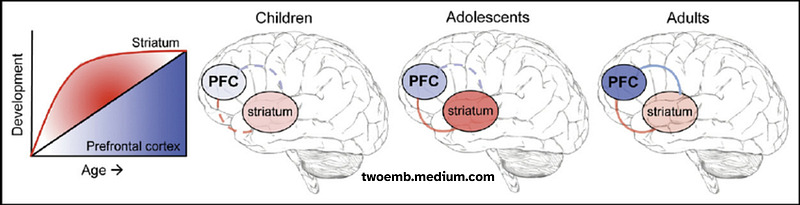
It is estimated that our brains finish maturing somewhere between the ages of 25 and 30. For people with ADHD, the Prefrontal Cortex (PFC) develops, on average, 30% later than for those without ADHD.
That’s significant.
That delay means an ADHDer’s PFC doesn’t finish developing until approximately 32–39 years of age. No wonder I didn’t really feel like a real adult until my late thirties: neurologically speaking, I wasn’t an adult until that decade of my life.
The PFC is primarily responsible for something called Executive Functioning (EF). In essence, EFs help us with important skills such as organization, inhibition, mental flexibility, working memory, and emotional regulation.
Depending on all the other factors at play, reaching middle-age and finally having a fully-developed PFC may make life a little easier, particularly where EFs are involved.
Hormonal fluctuation
All human hormones fluctuate throughout the day, week, month, and lifetime. People who menstruate are particularly vulnerable to hormonal fluctuations which impact ADHD symptoms.
- Estrogen levels begin to increase on the first day menstruation starts.
- Estrogen can affect dopamine, serotonin, and norepinephrine levels — specifically, increased estrogen means more effective processing of dopamine, potentially decreasing ADHD symptoms.
- These neurotransmitters play an important role in ADHD because they impact our memory, focus, and mood.
- When ovulation occurs (10–17 days after the first day of menstruation), estrogen levels take a dive and progesterone levels increase.
- In the last days of the monthly cycle, both estrogen and progesterone drop.
- During the third and fourth week of the menstrual cycle, progesterone decreases the beneficial effects of estrogens on the brain, possibly decreasing the effectiveness of ADHD medications as well.
During perimenopause and menopause, those estrogen levels decline even further, causing dopamine to decrease as well.
Dopamine is involved in important processes such as executive functioning, motor control, motivation, alertness, and reward. Dopamine also plays a vital role in emotion regulation, attention, and impulsivity.
All of these processes are also impacted by ADHD, hence the worsening of ADHD symptoms alongside hormonal changes.

(That song’s going to be stuck in my head for hours).
In conclusion
Like anything else in life, things come in waves.
And perimenopause sucks.
© Jillian Enright, Neurodiversity MB
Related Articles
Ways to support my work
You can leave a “tip” on Ko-Fi at https://Ko-Fi.com/NeurodiversityMB
Become a paid subscriber to my SubStack publication.
Check out my online store at https://NeurodiversityMB.ca/shop
Read and share my articles from twoemb.medium.com

References
Antoniou, E., Rigas, N., Orovou, E., Papatrechas, A., & Sarella, A. (2021). ADHD Symptoms in Females of Childhood, Adolescent, Reproductive and Menopause Period. Materia socio-medica, 33(2), 114–118. https://doi.org/10.5455/msm.2021.33.114-118
Arain, M., Haque, M., Johal, L., Mathur, P., Nel, W., Rais, A., Sandhu, R., & Sharma, S. (2013). Maturation of the adolescent brain. Neuropsychiatric disease and treatment, 9, 449–461. https://doi.org/10.2147/NDT.S39776
Arnsten A. F. (2009). The Emerging Neurobiology of Attention Deficit Hyperactivity Disorder: The Key Role of the Prefrontal Association Cortex. The Journal of pediatrics, 154(5), I–S43. https://doi.org/10.1016/j.jpeds.2009.01.018
Barth, C., Villringer, A., & Sacher, J. (2015). Sex hormones affect neurotransmitters and shape the adult female brain during hormonal transition periods. Frontiers in neuroscience, 9, 37. https://doi.org/10.3389/fnins.2015.00037
Casey, B.j. & Jones, R. (2010). Neurobiology of the adolescent brain and behavior: implications for substance use disorders. Journal of the American Academy of Child and Adolescent Psychiatry. 49, 1189–201. https://doi.org/10.1016/j.jaac.2010.08.017
Curatolo, P., D’Agati, E., Moavero, R. (2010). The neurobiological basis of ADHD. Italian Journal of Pediatrics 36, 79. https://doi.org/10.1186/1824-7288-36-79
He, Z., Jiang, Y., Gu, S., Wu, D., Qin, D., Feng, G., Ma, X., Huang, J.H., Wang, F. (2021). The Aversion Function of the Limbic Dopaminergic Neurons and Their Roles in Functional Neurological Disorders. Frontiers in Cell and Developmental Biology, 9, 713762. https://doi.org/10.3389/fcell.2021.713762
Mehta, T.R., Monegro, A., Nene, Y., Fayyaz, M., Bollu, P.C. (2019). Neurobiology of ADHD: A Review. Current Developmental Disorders Reports 6, 235–240. https://doi.org/10.1007/s40474-019-00182-w
Rege, S. (2023, March 4). Neurobiology of Attention Deficit Hyperactivity Disorder (ADHD) — A Primer. Psych Scene Hub. https://psychscenehub.com/psychinsights/neurobiology-of-adhd
Quinn, P.O. (2005). Treating adolescent girls and women with ADHD: gender-specific issues. Journal of Clinical Psychology, 61(5), 579–87. https://doi.org/10.1002/jclp.20121
Roberts, B., Eisenlohr-Moul, T., & Martel, M. M. (2018). Reproductive steroids and ADHD symptoms across the menstrual cycle. Psychoneuroendocrinology, 88, 105–114. https://doi.org/10.1016/j.psyneuen.2017.11.015
Yale University. (2000, December 5). Estrogen Deprivation Leads To Death Of Dopamine Cells In The Brain. Science Daily. https://sciencedaily.com/releases/2000/12/001204072446.htm