
Do I Benefit From ‘Ugly Privilege’?
As a person who isn’t considered “conventionally attractive” by society’s standards, does beautyism ever help me gain anything?

A common assumption is that people who are considered to be conventionally beautiful receive many advantages in life. I’ve never really fallen into this category, so I can’t speak from firsthand experience.
But beauty privilege is real. I’ve seen it with my own eyes.
Often, these systemic and social dynamics are referred to as “lookism.” Now, I personally find that term to be awkward and sloppy, so I don’t use it. I prefer the term “beautyism” to describe how people are treated differently throughout society due to their perceived beauty.
Writing for The Nigerian Tribune in August 2021, Tunde Adeleke provides several examples of how beauty privilege can work. Those who are considered “beautiful” by an industry’s standards will become the recipients of gifts, media representation, sartorial access, presumptive “chivalry,” and employment opportunities.
Those of us not considered “hot enough” or “gorgeous enough,” by society’s standards, won’t see ourselves reflected in digital or commercial venues as regularly as “hunks” and “babes” do. Those perks or that deference aren’t so readily bestowed upon us by power brokers and gatekeepers.
On the other hand, like any set of privileges or advantages — there can also be a nefarious inversion of these seemingly-endless benefits.
“Pretty people” can be burdened with unfair expectations. In terms of their potential intelligence or brilliance, they are accustomed to being underestimated due to attractive exterior qualities. They’ll get objectified and harassed under the assumption that they crave such attention by default.
How many times do we witness a conventionally-beautiful individual dismissed, from the onset, as being nothing more than a “bimbo” or a “himbo”?
I still remember how the Cancel Culture Brigade came for actress Mayim Bialik back during 2017 when the #MeToo movement first took off.
Bialik had initially penned a New York Times op-ed piece commenting on the Harvey Weinstein scandal. Many people took issue with her remarks that appeared to be victim-blaming the targets of assault and sexual harassment:
I still make choices every day as a 41-year-old actress that I think of as self-protecting and wise. I have decided that my sexual self is best reserved for private situations with those I am most intimate with. I dress modestly. I don’t act flirtatiously with men as a policy.
Now, I can definitely see how those comments, when taken by themselves, sound problematic. Bialik was forced to clarify, in follow-up interviews, how nobody deserves to be sexually assaulted. She also placed blame on the Entertainment Industry for shaming women who wear revealing or provocative clothing after the industry itself has pressured them to conform to those standards.
So, although I definitely agree that Bialik should have couched those words with better context, I also find that many of her critics were cherrypicking quotations while ignoring other things she’d said. Bialik had acknowledged how Americans live in a misogynistic culture of double standards while expressing that, in an ideal world, women should be able to dress however they want without judgment.
Bialik also touched upon her belief that she receives a certain degree of privilege from being viewed as “plain” by so many powerful people. One upside of the beautyism directed against her is the reality that she has never had creepy, perverted men invite her to be alone with them in their hotel rooms.
Again, while I wish Bialik would have worded her initial essay more carefully, I can relate to the twisted flavor of liberation that us folks who aren’t “a perfect ten” force ourselves to carve out of our outcast statuses.
Read more closely what Bialik actually said:
Those of us in Hollywood who don’t represent an impossible standard of beauty have the ‘luxury’ of being overlooked and, in many cases, ignored by men in power unless we can make them money.
So, yes — Bialik, myself, and our fellow “ugly” people of the world are trying to take back our power…calling out the media gatekeepers who put “beautiful” folks in such an unfair and vulnerable position while those decision-makers simultaneously leave us “hideous” folks out to dry.
People tell me I’m not ugly. Maybe they’re just trying to be nice. Maybe they have subjectively-offbeat standards. Maybe they wish to reject the labels of “beautiful” and “ugly” altogether.
Let me show you a recent picture of myself, which I used for my recent Online Reality Game (ORG) that I’d hosted…
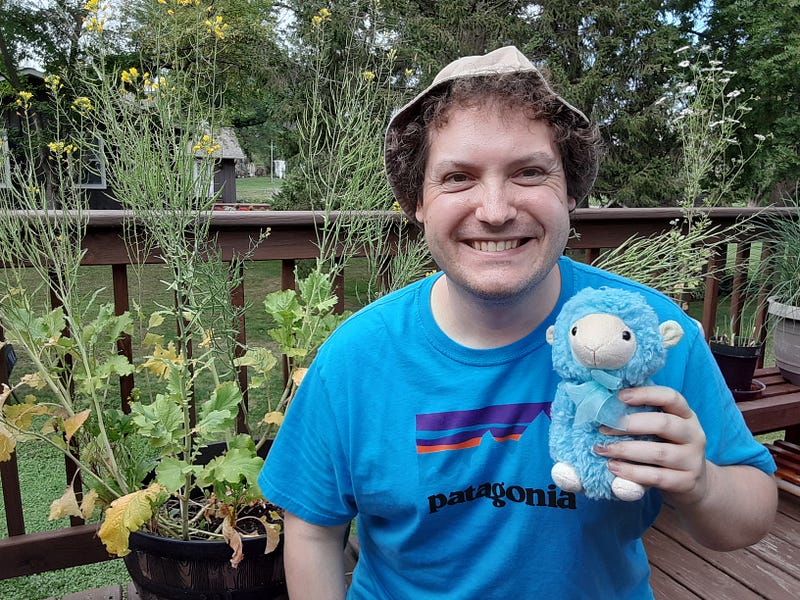
I think this is a somewhat better photo of me than what gets captured on most occasions when I’m photographed. But that’s because I had a certain degree of control over the photography, in this scenario. I decided what I’d be wearing, to what extent I’d shaved, and how combed my hair was. I instructed my sister specifically where to stand when she took this photo of me.
I wish I was thinner in this photo. I hate the way that the light and shadows deceptively make my hair appear “grayer” and “whiter,” in select spots, than it actually is.
Gray hair looks good on some people. I don’t feel it looks good on me. And, after four decades of my life, most of my hair is still brown. I barely have any actual gray hairs (yet!) — but I’m still self-conscious about how the angles and lighting of this photo seem to prematurely “age” me.
Also, you wouldn’t know this just from looking at that specific photo…but I have acne scars, cellulite, and stretch marks all over my body. Far more than the so-called “average” man is statistically believed to brandish.
I’ve written about this before — I use the term “cellulism” to refer to dermatological oppression. Or, looking at it another way: the privilege retained by people whose bodies have a minimum amount of scars, blemishes, rashes, birthmarks, welts, veins, wrinkles, or burns.
Okay then, Eeyore, you’re probably wondering, so how exactly are you ‘privileged’ when you’re bitching so much about your cosmetic appearance?
Why, thank you for asking!
I’ll start off by admitting that I’m not everyone’s favorite person. But there are two archetypes, in particular, who seem to especially loathe me.
One would be the MAGA/incel derivative…along with their lackeys and sycophants.
Another would be the hyperwoke “neofeminist” caricature (and their self-appointed “allies”).
Folks who have those defective personalities tend to dismiss me as “too liberal” or “too conservative,” depending on from which end of the political spectrum they’re operating.
But, as we all know: these numskulls don’t represent a majority of the world’s population.
I’m also well-aware that I’m not going to be recruited by any modeling agencies anytime soon. Putting aside my individual lack of interest in someday becoming a model, this sour reality can have its own advantages.
For example, when I’m interacting with “conventionally-beautiful” men, very few of them appear to feel threatened by me.
This could be because I present as the floppy-haired, neurotic, average-looking sidekick. Yet, if they don’t view me as competition in the dating world, they can refocus their attention on the substance of my words, actions, and beliefs.
Additionally, my fellow “average-looking” men find me approachable because they relate to my aesthetic shortcomings. We empathize with one another, knowing what it’s like to wrestle with jealousy toward those who thrive due to their superficial assets.
There are many women (of any perceived beauty level) who don’t view me as a threat, when interacting with me, because the absence of preening and meticulous grooming from my daily routine is probably a visual cue that I’m not obsessed with trying to use my appearance to impress other people.
Oh, and when they learn/confirm that I’m gay…it would just reinforce that possible assumption.
On top of that, I can also speak openly about character and inner beauty without cynics shouting “You’re just a Ken doll; what do you know?” in my direction.
I can dress casually and sloppily, because nobody expects me to be dressed handsomely.
Am I a “7”?
A “5”?
A “3”?
You tell me.
It gives me the bizarre “privilege” of becoming observant, in many situations, without the distraction of feeling as though I have to impress someone for courtship purposes (as either a rival or a prize).
This is a weird dynamic.
Despite being gay and gender-nonconforming, I feel that I can relate to other men more easily than to women. It’s why I call myself a “masculist” and promote the concept of “nutric masculinity.”
At the same time, many women tend to confide in me and/or express that they feel comfortable around me in social situations. I suspect this can be attributed, at least in part, to how they sense I’m not a Lothario or a Don Juan in how I approach life.
I’m utterly baffled by the trend of “dick pics.”
Don’t be fooled: I’m damn vain!
My vanity just tends to take the form of internalized beautyism. Naturally judging my own body based on ridiculous standards — while doing my best to avoid holding the people around me to those same admittedly futile expectations.
Click here to subscribe to my stories.


