
Difference between JWT, OAuth, and SAML for Authentication and Authorization in Web Apps?
Understanding the differences between Popular Web Authentication and Authorization Standards: JWT, OAuth, and SAML
Hello folks, one of the most common question on Java developer interviews now a days is difference between JWT, OAuth2.0, and SAML? and when to use them. If you are preparing for Java developer interviews and asked this question and looking for answer then you have come to the right place.
In the past, I have shared several resources for Java interviews like 21 Software Design Pattern questions, 10 Microservice Scenario based questions, 20 SQL queries from Interviews, 50 Microservices questions, 60 Tree Data Structure Questions, 15 System Design Questions, and 35 Core Java Questions and 21 Lambda and Stream questions and in this article, I am going to to answer this frequently asked question once for all.
While JWT, OAuth, and SAML are all well known standards that are used for authentication and authorization purposes in web applications there are many differences between them.
For example, JWT stands for JSON Web Token and it is a standard for securely transmitting information between parties as a JSON object. It is used to authenticate and authorize users and is commonly used in modern web applications. JWTs are digitally signed, so they can be verified and trusted.
On the other hand, OAuth (Open Authorization) is an open standard for authorization that allows third-party applications to access user data without requiring the user to share their login credentials. It is commonly used in applications that need to access data from external services, such as social media platforms or APIs.
Similarly, SAML (Security Assertion Markup Language) is another standard for exchanging authentication and authorization data between parties, specifically between an identity provider (IdP) and a service provider (SP). It is commonly used in enterprise applications to provide single sign-on (SSO) functionality.
One of the most popular example of SAML is SingPass authentication used Singapore Government to access government websites like Vaccination certificate, CPF, IRAS etc.
Now that, we know the basics, its time to deep dive and learn them in more detail so that you can answer the any follow-up questions.
By the way, if you are new to Spring Framework and want to learn Spring in depth and looking for resources then you can also checkout following online courses:
- Spring Master Class — Beginner to Expert
- Spring & Hibernate for Beginners
- Learn Spring: The Certification Class
- Master Microservices with Spring Boot and Spring Cloud
All of these are top rated courses to learn Spring framework in depth but if you need free resources you can also checkout these free Spring framework courses:
What is JWT (JSON Web Token)? When to use it?
As I said, JWT stands for JSON Web Token, which is a type of token that is used for securely transmitting information between parties. JWTs are commonly used for authentication and authorization purposes in web applications.
A JWT is composed of three parts: a header, a payload, and a signature. The header specifies the type of token and the signing algorithm used, while the payload contains the actual data being transmitted.
The signature is created by combining the header and payload with a secret key known only to the server.

JWTs are commonly used in web applications as a means of transmitting user authentication data between the client and the server. When a user logs in, the server generates a JWT containing the user’s ID and any relevant permissions or roles. This token is then sent back to the client, where it is stored and included in subsequent requests to the server.
The server can then verify the authenticity of the JWT and use the information contained within to determine whether the user is authorized to perform the requested action.
JWTs are also useful in distributed systems where multiple services need to share user authentication information. Instead of each service maintaining its own authentication system, a single JWT can be used to authenticate users across all services.
Overall, JWTs are useful when you need to transmit sensitive information between parties in a secure and efficient manner, especially in situations where traditional session-based authentication is not feasible.
Here is a nice diagram which explains how JWT (JSON Web Tokens) works in a web application:

What is OAuth2.0? When to use it?
OAuth2.0 is a protocol used for authorization and authentication in web and mobile applications. It allows users to grant third-party applications access to their resources, such as their social media accounts or other online services, without giving away their credentials or passwords.
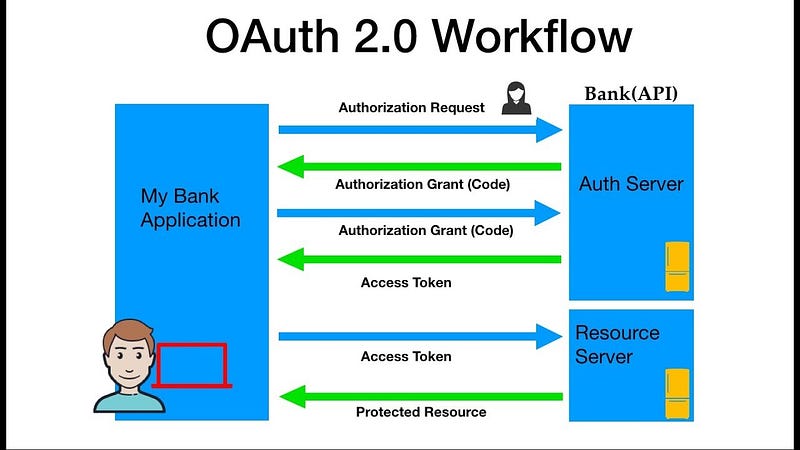
OAuth2.0 works by establishing a trust relationship between the user, the third-party application, and the resource server. The process involves several steps:
- The user initiates the process by attempting to access a protected resource on the resource server, such as logging in to a social media account.
- The resource server responds by redirecting the user to an authorization server, where they can grant permission for the third-party application to access their resources.
- The user then logs in to the authorization server and grants permission for the third-party application to access their resources.
- The authorization server generates an access token and sends it to the third-party application.
- The third-party application uses the access token to request and access the user’s resources on the resource server.
OAuth2.0 is useful in situations where users want to grant third-party applications access to their resources, but do not want to give away their credentials or passwords. It is commonly used in web and mobile applications, especially those that rely on external APIs or services for data and functionality.
Here is a nice diagram which explains OAuth2.0 workflow and working:
OAuth2.0 is also useful for ensuring that users retain control over their resources and can revoke access at any time. It provides a secure and standardized way for users to share their data and resources with third-party applications, while maintaining their privacy and security.
For example, most of the website now allow you to login using Twitter, Facebook, or Google accounts, where you don’t need to create new username or passowrd, neither you have to share your Google, Twitter, or Facebook password to access any resource on third-party website but you can still use it using OAuth.
What is SAML? When to use it?
SAML stands for Security Assertion Markup Language is an XML-based protocol used for exchanging authentication and authorization data between parties, such as identity providers (IdPs) and service providers (SPs).
SAML works by establishing a trust relationship between the IdP and SP. The IdP is responsible for authenticating the user and generating a SAML assertion, which contains information about the user’s identity and authentication status. The SP relies on the SAML assertion to make authorization decisions and grant access to protected resources.
SAML can be used in a variety of scenarios, such as single sign-on (SSO) and federation.
In SSO, SAML is used to allow users to access multiple applications or services with a single set of credentials. When a user logs in to one application or service, the IdP generates a SAML assertion, which can be used to authenticate the user to other applications or services without requiring the user to log in again.
In federation, SAML is used to enable trust relationships between organizations, allowing users to access resources across multiple organizations using a single set of credentials.
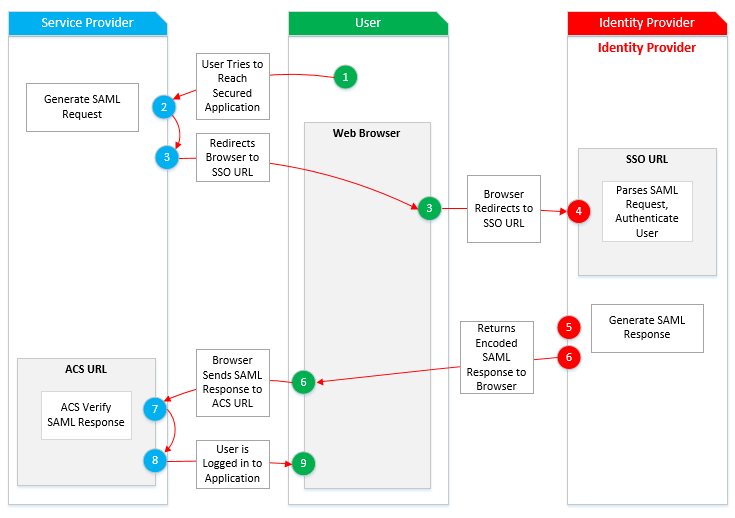
SAML is often used in enterprise environments, where users need to access multiple applications and services across different domains or organizations. It offers a standardized way to exchange authentication and authorization data, making it easier to manage access control and ensure the security of sensitive resources.
One of the popular example of SAML usage is SingPass authentication system by Singapore Government which allows you to access all government websites like CPF and IRAS using Singapss login.
Overall, SAML is a powerful tool for enabling secure and seamless access to resources across different organizations and applications, making it a popular choice for many enterprises and organizations
Difference between JWT, OAuth, and SAML for Authentication and Authorization in Web Applications
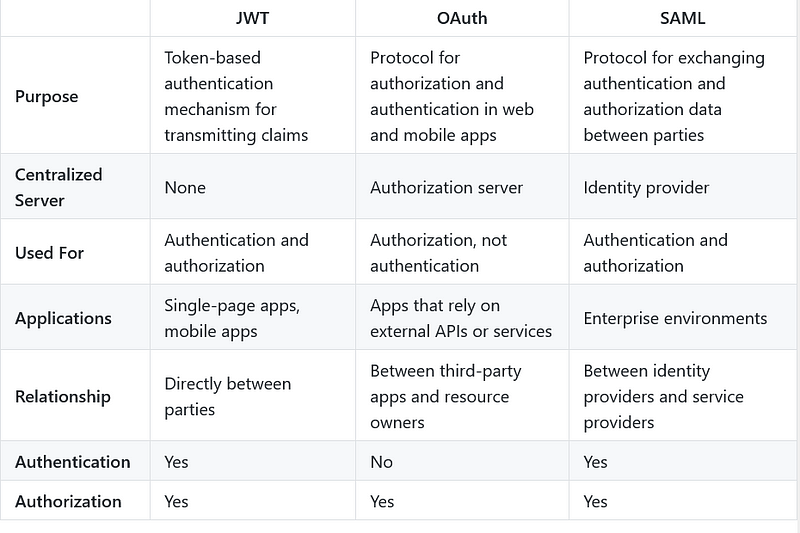
Now that we know what they are an how they works and where they are used, its time to revise the key differences between them. Here are some key differences between JWT, OAuth, and SAML in point format:
JWT
- JWT is a token-based authentication mechanism.
- It is used for transmitting claims (user identity, permissions, etc.) between parties.
- It does not rely on a centralized authentication server or session state.
- It is commonly used in single-page applications (SPAs) and mobile applications.
- It can be used for authentication and authorization.
OAuth
- OAuth is a protocol used for authorization and authentication in web and mobile applications.
- It is used for granting third-party applications access to resources on behalf of the user.
- It relies on a centralized authorization server.
- It is commonly used in applications that rely on external APIs or services for data and functionality.
- It is used for authorization, not authentication.
SAML
- SAML is a protocol used for exchanging authentication and authorization data between parties, such as identity providers (IdPs) and service providers (SPs).
- It is used for establishing trust relationships between organizations and enabling single sign-on (SSO) and federation.
- It relies on a centralized identity provider (IdP).
- It is commonly used in enterprise environments.
- It is used for both authentication and authorization.
Here is a nice table which you can print to remember these differences between JWT, SAML, and OAuth2.0
In summary, JWT is a token-based authentication mechanism used for transmitting claims, OAuth is a protocol used for granting third-party applications access to resources on behalf of the user, and SAML is a protocol used for exchanging authentication and authorization data between parties to establish trust relationships between organizations.
That’s all about difference between JWT, OAuth, and SAML for authentication and authorization. In short, JWT is a standard for transmitting data securely between parties, while OAuth is a standard for authorization that allows third-party applications to access user data.
SAML is a standard for exchanging authentication and authorization data between an IdP and an SP, typically used in enterprise applications. Each of these standards serves a different purpose, and they can all be used together to provide a secure and efficient authentication and authorization process for web applications.
By the way, if you are new to Spring Framework and want to learn Spring in depth and looking for resources then you can also checkout following online courses:
- Spring Master Class — Beginner to Expert
- Spring & Hibernate for Beginners
- Learn Spring: The Certification Class
- Master Microservices with Spring Boot and Spring Cloud
All of these are top rated courses to learn Spring framework in depth but if you need free resources you can also checkout these free Spring framework courses:
Other Java Interview Questions you may like


