
Twilight of the Skeptics, Part III
UFO Skeptics and the Straw Men They Fight
It’s Debunking 101. When all else fails and the facts fall in uncomfortable places, ignore the research because the researchers are ‘Pro-UFO.’
This is the third article in an occasional series Trail of the Saucers is publishing this fall looking at Skeptical Inquirer magazine’s latest round of finger-wagging at those who dare entertain the hypothesis that non-human intelligence might be behind the UFO phenomenon. — The Editors (Bryce Zabel, David Bates)
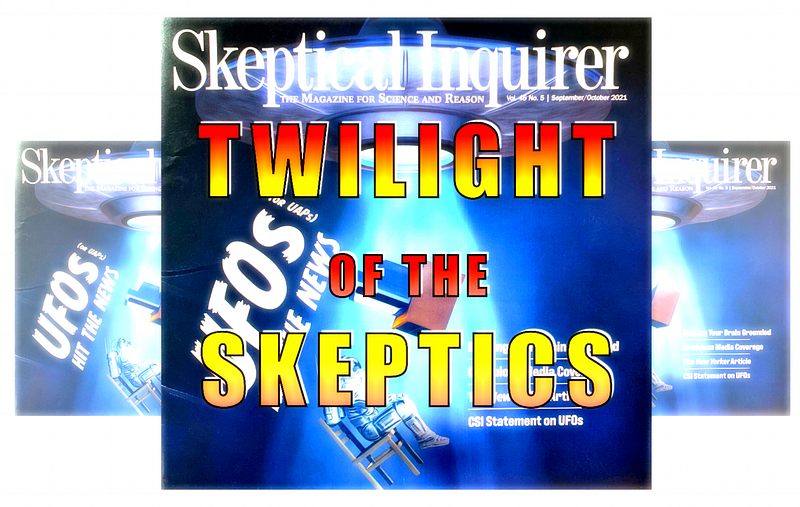
Skeptical Inquirer, the “magazine for science and reason,” put UFOs on the cover of the September/October issue under the banner of “UFOs (or UAPs) Hit the News.” Inside are nearly half a dozen articles taking on the “credulity” of mainstream media coverage of UFOs, which exploded this year in the run-up to the Pentagon’s report on UAPs, and extolling the virtues of “skepticism.”
Our first installment looked at how UFO skeptic Robert Sheaffer’s take on the 1965 Kecksburg incident was problematic. Our second article showed how Sheaffer tried to explain away the November 2006 Chicago O’Hare UFO by chalking it up to a weather phenomenon where one 1) could not have existed and 2) wouldn’t have been visible from the ground if it had. In what can only be characterized as literal science fiction, he said on his Bad UFOs blog that this “could easily” have happened; the “magazine for science and reason” gave it their imprimatur.
Sheaffer’s O’Hare hypothesis is demolished by weather data (from the National Weather Service and the privately-owned Weather Underground among other sources) available in a report by the National Aviation Reporting Center on Anomalous Phenomena, founded in 1999 and which investigated the O’Hare UFO.
Nevertheless, Sheaffer had a ready-made defense prepared for ostensibly debunking any inconvenient information they turned up: NARCAP, we are informed, is “a pro-UFO investigative team.”
Today, we unpack that charge and how it fits into the broader strategy of a “leading skeptical investigator of UFOs” as he sets out to debunk as many as he can.
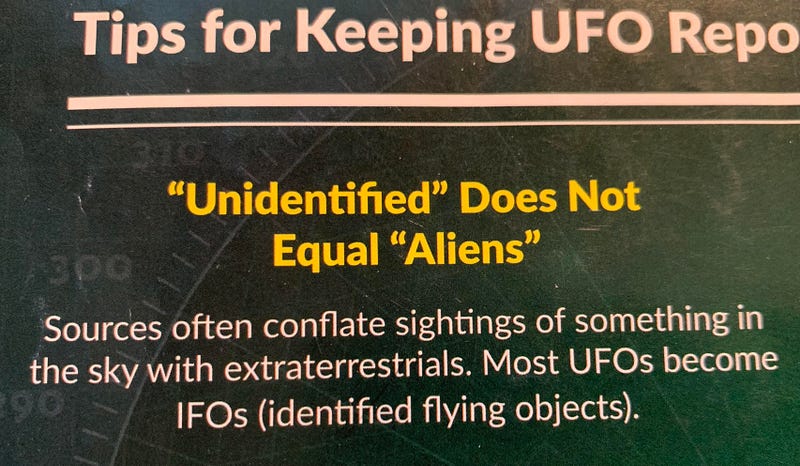
If we take Skeptical Inquirer at their word, the original sin of ufology is ignoring the “U” in UFO. “Unidentified Does Not Equal ‘Aliens’,” declares the statement by the Committee for Skeptical Inquiry, published inside the magazine and on the back cover. “Sources often conflate sightings of something in the sky with extraterrestrials,” the magazine states. “Most UFOs become IFOs (identified flying objects).”
This rejoinder has, in the skeptical community, an almost mantra-like status. It’s possible that one famous skeptic, the astrophysicist and science popularizer Neil deGrasse Tyson (a CSI “fellow”) has over the course of his career said this hundreds of times.
The problem: The skeptic who labels a person or group “pro-UFO” or declares that they “believe” in UFOs literally conflates UFOs with extraterrestrials.
“Pro-UFO” breaks CSI’s own rule. If a group were truly “pro-” (in support of) unidentified flying objects, wouldn’t that suggest they were in favor of them never being identified? That’s absurd. “Pro-UFO” in this context obviously translates to “Pro-aliens” or “pro-extraterrestrials.” It’s a case of, “Do as I say, not as I do.”
And Sheaffer does it all time. Elsewhere on his blog, at one point, he chastises UFO investigative efforts in Central America:
“[I]t appears that, in Chile and Uruguay at least, the government-sponsored UFO investigative organizations are trying to strongly promote UFO belief.”
If a UFO is an unidentified flying object and nothing more, since they do obviously exist, why is it any more problematic to “believe” in them than to “believe” that the sun will rise in the east? Nothing … unless one is conflating them with aliens.
Interestingly, a skeptic who responded to the Chicago O’Hare article fell into the same trap.
He simply stated:
Not knowing what something is does not mean you know what it is.
The skeptic’s insinuation was clear: I had no right to argue that aliens brought one of their craft down to hover over United Airlines Gate 217 one November afternoon in 2006. There was no proof of this, and I certainly hadn’t proved it in the article. Therefore, this skeptic felt moved to offer this gentle rejoinder. To which I replied, “I agree.”

Let’s be clear: Nowhere in our article did the words “alien” or “aliens,” “extraterrestrials” or “E.T.,” “visitors from outer space” or the tired cliche “little green men” appear. I have no idea what witnesses saw. We were reporting on a skeptic’s attempt to debunk the case with an ostensibly scientific explanation that simply didn’t withstand scrutiny. To imply otherwise is a textbook straw man argument.
The NARCAP report, meanwhile, reached the only scientifically-supported conclusion possible, given the available information, about the O’Hare UFO: It remains unidentified. That’s all they concluded. It also called for government inquiry into whether the sensing technologies employed then were enough to insure against similar incidents in the future. Because that, after all, is what NARCAP actually is bullish on: Not aliens, but aviation safety.
That said, the words “aliens” and “extraterrestrial” appear a few times, so lest Sheaffer trot those out in response as some sort of smoking gun, let’s be aware of the context in which they appear:
- A citation to a publication called UFOs/Aliens in a list of media coverage that’s included in the appendix.
- A witness statement: “I always thought people who believe in aliens were crazy but I don’t know what that thing was. We see lots of aircraft come in even the fancy stuff that stays in the air when the President lands, but this thing was like nothing none of us ever saw.”
- The observation (by investigators) that “at least a least a dozen fraudulent claims involving hoaxed photographs” had produced the “clearly unwanted result” of aviation facilities being bombarded by “media inquiries, self-proclaimed ‘researchers’ and ‘investigators’ with no aviation investigation experience, as well as alien/ET chasers.”
- A witness statement: “When I watched it from the parking lot, there was simply no doubt in me that I was seeing, under practically ideal circumstances, a craft that was under control … and that it was, in fact, extraterrestrial in origin.”
There is nothing in NARCAP’s report to suggest that investigators are lost in the woo or loitering anywhere near it, or that they even believed or affirmed the two statements by the witnesses cited above.
Indeed, in nearly 800 pages of domestic NARCAP studies and technical reports spanning two decades, “extraterrestrials” come up barely a dozen times — all in utterly benign and mostly parenthetical references like those above. In fourteen reports, the words don’t even appear. This, from a “pro-UFO/alien” organization!
It goes without saying that none of NARCAP’s reports claim to prove that a non-human intelligence is behind any case; those that reach any conclusion simply point out the obvious: The UFO remains unidentified, the case is still unsolved, here are the safety concerns raised, etc.
Sheaffer provides an interesting clue as to why this scenario (an inexplicable and apparently unsolvable case) is so objectionable to the skeptic.
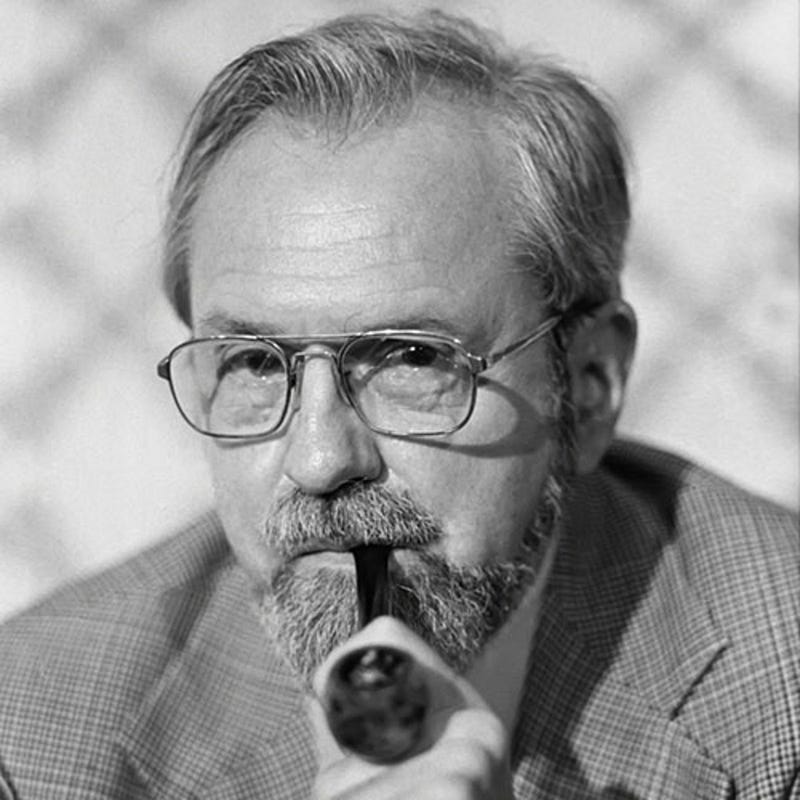
He cites the “bundle of sticks” analogy, which was used by UFO investigator (sorry … “pro-UFO” investigator) J. Allen Hynek, which reporter Leslie Kean (sorry … “pro-UFO” reporter) mentions in The New Yorker article in which she was profiled. Sheaffer writes:
“So even if the Rendle-sham (sic) case has a logical explanation, it is nonetheless a ‘top ten’ UFO case, a Golden Oldie, so that counts for something, I guess. And here she repeats Hynek’s ‘bundle of sticks’ analogy, which I heard him make many times: any one stick might be broken, but taken together they are too strong to break.’ To which the obvious reply is: If each case is a zero, the sum of any number of zeros is zero.”
For Sheaffer’s “bundle of sticks” that comprise the UFO phenomenon to break, all the sticks must be zero (debunked). The skeptic must prove that each stick is indisputably a zero. Any stick that refuses to snap (and every “fellow” at the Committee for Skeptical Inquiry knows there are thousands) presents a problem, one Hynek legitimately called a “challenge to science.”
A UFO that resists all “skeptical” efforts to be definitively identified requires the skeptic to resort to a different strategy: attack the messenger. Brand the investigator, scientist, journalist, etc. “pro-UFO” or “biased,” suggest that they’re lost in the weeds of irrational conspiracy theories, etc. This, in turn, allows skeptics to throw out any data or testimony they collect. It’s unlikely Sheaffer gave the NARCAP report more than a cursory glance. Why bother? They’re “pro-UFO.”
The skeptic’s reply to this invariably falls along the lines of, “When people say ‘UFOs,’ what they really mean is “aliens.’” That’s quite a presumption on their part and one steeped in hypocrisy, given that it’s clear enough that that’s what they mean — at least much of the time. Many ufologists obviously are convinced that aliens are behind UFOs, but for every one, it’s not too difficult to find another who has more nuanced thoughts on the topic. In any event, it is pretty safe to say that when virtually any skeptic starts off with: “When most people say ‘UFOs’ …” they basically mean all people who say “UFOs.”
UAPs (unidentified flying phenomena) put the skeptic in a bind. The “pro-UFO” label (and admonishments like the one posted at the end of our previous article) suggests that skeptics — by basically going along with what “people” queried on the subject “really mean” and themselves conflating UFOs with aliens — have argued themselves into an epistemological cul-de-sac that looks something like this: Yes, it’s statistically possible that aliens exist, but we can’t let UFOs remain unidentified because that might open the door to hypotheses about aliens, which .. um, don’t exist!
Guilt by Association
Skeptics will (and do) raise other objections — the personalities involved are somehow tainted by their associations, past work and influences. One gets the sense reading Skeptical Inquirer’s UFO coverage that the very act of simply being interested in the phenomenon (or other paranormal topics) is by itself enough to disqualify you — and not only that, but also to discredit and/or ignore anyone you talk to.
This is why NARCAP (and other groups) has essentially landed on a sort of skeptical blacklist. Take William Puckett, the retired atmospheric scientist who compiled the weather section of the O’Hare report. For some inexplicable reason, this individual who has spent his life literally studying the sky at some point became curious about the unusual phenomena people kept seeing there. Presumably, curiosity got the better of him and he decided to look into it, solicit UFO reports, interview witnesses, etc. Which means the skeptic can safely ignore him.
Guilt-by-association is also one reason Sheaffer apparently feels justified discounting virtually all the testimony by those who witnessed some aspect of the Kecksburg incident: they were interviewed by (drum roll) a pro-UFO investigator!
In fact, one is struck watching UFO investigator Stan Gordon’s 2004 documentary, Kecksburg: The Untold Story, at how infrequently he and those he interviewed even use the words “extraterrestrials,” “not of this earth,” etc.
That said, it’s worth noting that good UFO investigators are skeptical. It is Gordon, after all, who notes in his documentary one instance where some witnesses may have been confused: A couple of boys were reportedly playing with a camera flashbulb near the woods. NARCAP’s investigators themselves note the existence of hoax photographs and the difficulty this presents for the investigator. The New York Post’s Steven Greenstreet, who has hosted the UFO YouTube series The Basement Office since 2019, lately seems to lean toward the drones-sent-by-foreign-adversaries theory. But to listen to Sheaffer, “pro-UFO” people (Gordon, Kean, the Pennsylvania radio journalist who was on the scene in Kecksburg, etc.) are the most irrational, credulous human beings on the planet.
The list goes on. In another article ( Skeptical Inquirer gave Sheaffer two; in one, he actually quotes himself from the other article) Sheaffer informs us that UFO investigator Jacques Vallee (an astronomer and computer scientist) and J. Allen Hynek “found value in Rosicrucianism.”
Honestly, who cares? Dr. Anthony Fauci attended Jesuit schools and once identified as a Roman Catholic, but he somehow managed to muddle through all that mysticism and become the nation’s top virologist. Roger Bacon, who famously advanced the scientific method, was Catholic. Isaac Newton was a devout Christian. Alvin Radkowsky was an Orthodox Jew. Sheaffer surely knows that any list of successful, brilliant scientists and inventors who held deeply “irrational” and “mystical” views associated with one religion or another could fill a book.
But for skeptics, guilt-by-association is a legitimate strategy. Neil deGrasse Tyson frequently weaves ComicCon’s cosplay crowd into his snide jokes about UFO “nuts,” so one has to wonder what he’d make of a picture on Sheaffer’s Facebook page where he is shown at ComicCon happily posing with a Klingon.
Skeptical Self-preservation
There is a vast chasm between “proving” or even claiming that aliens are behind UFOs and being willing to entertain the hypothesis that — after exhaustive, scientific research eliminates every possible natural and man-made explanation — a non-human intelligence is possibly at work behind the phenomenon that we are not presently equipped to understand.
While simultaneously warning against the dangers of conflating UFOs with aliens, skeptics freely conflate the alien hypothesis with the (presumed) certainty of what is being hypothesized: In bestowing “pro-UFO” shame on their target, this leads them into another cul-de-sac:
Yes, aliens might exist, but you’re not allowed to hypothesize that aliens might be behind a phenomenon that cannot be explained any other way; if that is your hypothesis, you’re ‘pro-UFO,’ you’ve already made up your mind, etc.’ Or worse — a “nut,” “fabulist,” “mystical,” etc.
Neither of these arguments make a lick of sense.
Both also point to the understandable ulterior motive of self-preservation: The mere possibility that the hypothesis might eventually be shown in one case (and really, one is all that’s needed, which is why it’s largely irrelevant that most UFOs become IFOs) to be unquestionably true poses a threat of intellectual self-annihilation. Paradigm changes are hard.
The neuroscientist Sam Harris illustrates this point nicely.
In conversation with with other scientists (Tyson among them) and the comic Ricky Gervais, he said on his Making Sense podcast that he had been subject to some “private outreach” by someone in the know, and was advised to think of how he might prepare his audience for the reality of extraterrestrials on Earth. Harris did not name the person, but it was clearly someone in his intellectual orbit he respected.
His penchant for rationality notwithstanding, Harris sounded genuinely rattled by the prospect. But he was honest about how this scenario made him feel. In conversation with Gervais, he said:
“ … [W]hat is being promised here is a disclosure that is frankly, either the most alarming or the most interesting thing in the world, depending on how you take it, but it’s not a representation of the facts that will give scientific skeptics any comfort … we’re faced with the prospect of having to apologize to the people we’ve been laughing at for the last fifty years who have been alleging that they’ve been abducted or that cattle have been anally probed, pick your punch line.”
It’s a candid admission. If the E.T. hypothesis turns out to be correct, we’re going to have to admit we’ve been wrong the entire time; everything we thought we ‘knew’ was wrong.
Harris, to his credit, seems willing to acknowledge that this is at least within the realm of possibility. And in fact, one public intellectual and professional colleague of his, Eric Weinstein, has actually apologized for marginalizing the “pro-UFO” community.
The science press has over the last decade or so occasionally rolled out stories about the “crisis” in cosmology or the “crisis” in physics, which basically boils down to scientists’ inability to reconcile seemingly incompatible theories that, in isolation, stand on solid ground.
The UFO phenomenon has once again been acknowledged by the U.S. government to be real (and this is where skeptics pivot back to “the ‘U’ stands for unidentified!”) That forces a similar problem for the skeptical community, a reckoning of sorts. Some, like Harris and Weinstein, have at least grudgingly acknowledged they may have to cede some territory. Skeptical Inquirer will probably have a rougher time of it.
NEXT: The alleged “credulity” of The New Yorker magazine
Trail of the Saucers focuses on UFO/UAP news, culture, history, and analysis. Here are a few more articles from the vault:


