
Twilight of the Skeptics, Part II
The O’Hare Field UFO Remains a Great Case
When Skeptical Inquirer’s Robert Sheaffer tries to debunk a pesky UAP sighting with a ridiculous scientific theory of his own, it doesn’t go well.
This is the second article in an occasional series Trail of the Saucers is publishing this fall about Skeptical Inquirer magazine’s latest fusilade against anyone who dares entertain the hypothesis that non-human intelligence might be behind the UFO phenomenon. — The Editors
Skeptical Inquirer, the “magazine for science and reason,” put UFOs on the cover of the September/October issue under the banner of “UFOs (or UAPs) Hit the News.” Inside are nearly half a dozen articles taking on the “credulity” of mainstream media coverage of UFOs, which exploded this year in the run-up to the Pentagon’s report on UAPs, and extolling the virtues of “skepticism.”
Our first installment looked at how “veteran UFO skeptic” Robert Sheaffer’s take on the 1965 Kecksburg incident was, to put it mildly, problematic. On his blog a few days later, he posted a 3,000+ word response. We’re obliged to him for bringing to our attention a date error, which we regret and fixed promptly. Beyond that, he raised issues that simply revealed more contradictions and questions. I responded to him there.
Today, we examine another UFO incident that he bungles even more badly: The disc seen by multiple witnesses hovering over Chicago’s O’Hare International Airport for several minutes late afternoon on Nov. 7, 2006.
Last spring, The New Yorker published an article entitled How the Pentagon Started Taking U.F.O.s Seriously. Written by Gideon Lewis-Kraus, it stands as a brief introduction to ufology for a readership that one imagines isn’t normally interested in or familiar with such things. In describing journalist Leslie Kean’s growing interest in UFOs, Lewis-Kraus briefly cites several UFO reports (“really good cases,” in her words) that intrigued her. In Skeptical Inquirer, Sheaffer objects and sets out to drop each “really good case” into his “debunked” bin.
One of those is the O’Hare Field sighting, which — among other things — had the distinction of becoming the Chicago-Tribune’s most-read online news story when it was published several months later by one of the paper’s columnists.
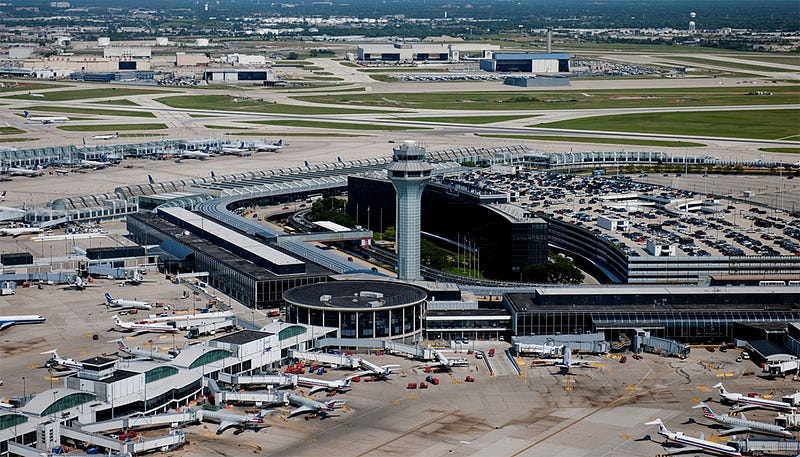
Basically, on an overcast afternoon, an actual “flying-saucer”-like object was spotted over United Airlines’ Gate C17 in Concourse C by pilots, ground crew, mechanics and other witnesses in various locations. It was described as between six and 24 feet in diameter hovering below the clouds. Some said it was spinning like a Frisbee; others said it wasn’t. It was reportedly dark grey and silent, had no lights, and was very distinct against the low cloud deck, which witnesses estimated to be several hundred feet above it. Despite the variations and contradictions to be found in the testimony, witnesses agreed on one point: It was a clearly an object that was quite distinct from and separate from the clouds. Witnesses said it eventually shot almost straight up, vanishing in the blink of an eye and punching a perfectly round hole through the clouds that remained for a few minutes before closing. The UAP did not appear on radar.
There’s much about the incident’s aftermath to make one skeptical about the official explanation (a rare weather phenomenon). But skeptics typically pay no attention to details that seem to imply that officials may be trying to hide something; that’s “conspiracy theory” territory — a subject discussed in another article in Skeptical Inquirer by Mick West, which we’ll address later in this series.
For example: A United Airlines tower employee declared unambiguously that someone snapped a picture of the UAP (and many others were reported to have been seen taking pictures with their cell phones) but no authenticated photographs have ever surfaced. United Airlines management at first professed no knowledge of the incident; the Federal Aviation Administration was also cagey about it but eventually released audio of the tower chatter, chalked the event up to weather and would say nothing more about it.
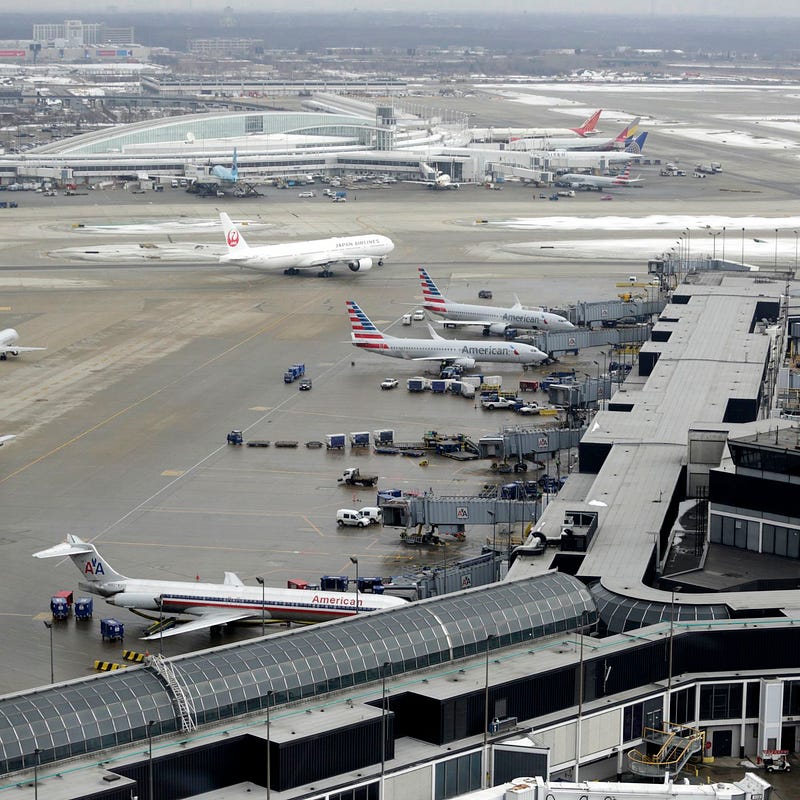
One might keep in mind: This was only a couple months after the 5-year anniversary of 9/11, a tragedy in which a United Airlines passenger jet was hijacked and flown into the south tower of the World Trade Center. But we’re supposed to believe that they and the FAA didn’t know about and/or weren’t interested in a strange object hovering unchallenged and unidentified over one of the nation’s busiest airports? One witness interviewed by the Chicago-Tribune, a United Airlines baggage handler, alluded to this contradiction:
“Some of us are getting angry with this being hushed up with all the terrorism and TSA idiots hanging around. If we see a funny looking bag all damn hell breaks loose but park a funny silver thing a few hundred feet above a busy airport and everyone tries to hush it up. It just don’t (sic) make sense.”
These aren’t the sorts of things that interest the skeptic, because they’re not “scientific,” I guess. The skeptic’s mission is to move quickly on the target to prove there’s no “there” there. Since eyewitness testimony can be unreliable, it is therefore always unreliable — or at least when you need it to be.
Sheaffer writes in Skeptical Inquirer:
Unfortunately, no photographs exist of this supposed “metallic-looking disc” hovering over one of the world’s busiest airports in daytime, and nothing showed up on radar.
Supposed. What exactly does Sheaffer suppose witnesses are “supposing”? That they saw something shaped like a disc? Or that the disc that they saw (assuming, of course, that they weren’t misidentifying a square or rhombus) was “metallic-looking”? Are the powers of human observation so pathetic and fallible in such cases that rational adults are somehow rendered incapable of discerning basic shapes and colors? That all will erroneously “suppose” the same thing? Sheaffer’s “skepticism” regarding witness testimony (in this and other UFO cases) knows no bounds.
The Investigation
The O’Hare case was investigated by the National Aviation Reporting Center on Anomalous Phenomena, which was founded in 1999 to focus on “the documentation and analysis of aviation safety-related encounters with Unidentified Aerial Phenomena.” Their inquiry into the O’Hare incident produced the organization’s single longest technical report (152 pages), which was released in March 2007 and concluded that the object remains unidentified.
One suspects that because this is a pretty good case, it’s all the more essential that the skeptic make it go away. The ways Sheaffer attempts to do that with O’Hare raises legitimate questions about the value and intellectual honesty of “skepticism” (not to mention his research skills) as it is brought to bear on the UFO phenomenon.
So let’s talk about the weather at O’Hare Field that day. There’s no shortage of both scientific and anecdotal information about it.
The Chicago-Tribune’s first report cited descriptions of the object shooting through “thick clouds,” which is echoed by Sheaffer himself (“dense clouds”). Citing National Weather Service data, the NARCAP report states: “There was a solid overcast layer” at an altitude of 1,900 feet “over the entire Chicago area.” A witness also reported “normal low ceiling overcast.” There is no dispute about this; data from a Doppler radar site southwest of O’Hare indicated that the cloud layer sat perched between 1,900 and 3,700 feet. According to the report, “conditions closely approximated those for the formation of a simple ‘textbook’ cloud deck, with no complicating factors such as temperature inversions, nearby freezing levels, winds, or convective activity.”
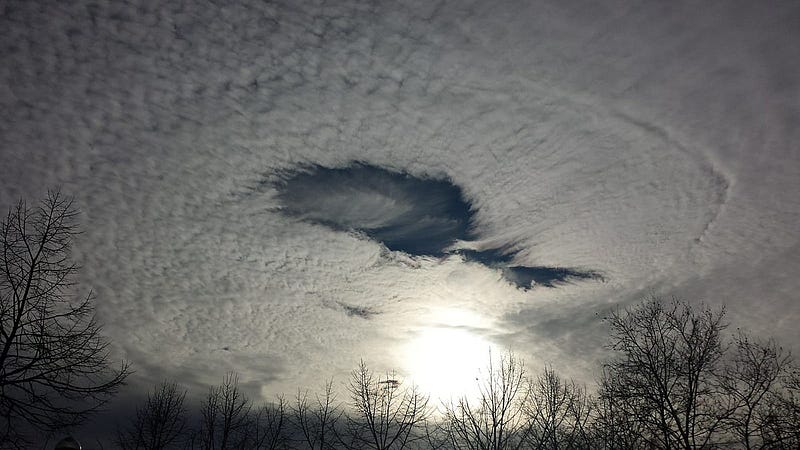
The official line on the O’Hare UAP was that witnesses probably observed an unusual weather phenomenon known as a “hole-punch” cloud (sometimes called a fallstreak cloud) which can occasionally appear in below-freezing temperatures. This was suggested by both the FAA and, incredibly, an astronomer from Adler Planetarium who was quoted by the Chicago-Tribune in a follow-up story years later and who clearly had no idea what he was talking about: the temperature at 1,900 feet that day was 53 degrees — much too warm for a hole-punch cloud.
Sheaffer concedes that this information is “probably correct,” and then ventures his own wildly improbable theory, which appears here verbatim:
“But the low ceiling could easily have been partially obscuring a much higher cloud layer, where a hole-punch cloud could exist because of much lower temperatures. Hole-punch clouds occur in cirrocumulous or altocumulous clouds, approximately 8,000 to 39,000 ft. elevation — not in low clouds at 1,900 feet! Thus, there is no reason to reject the FAA’s explanation.”
There are three sentences in this quote; the one in the middle is, to give the author the benefit of the doubt, probably correct. The other two claims are so demonstrably wrong as to be ridiculous.
First of all, Sheaffer here breezily discards the supposed fallibility of human observational power, bestowing upon eyewitnesses something akin to the Six Million Dollar Man’s bionic eyeball: They were able to spot a (rare) weather anomaly through nearly two thousand feet of “dense clouds” that covered the entire city of Chicago — a “completely overcast” sky!
We reached out to several meteorologists (not affiliated with NARCAP) who specialize in cloud physics. They told us that a hole-punch cloud separate from and above another cloud deck is well within the realm of possibility. But one pointed out the obvious conundrum: Unless you were looking out the window of an airplane (or enjoyed a satellite’s view) how would you see it?
You couldn’t. But a sky “completely overcast” with “dense clouds” poses no obstacle for Sheaffer’s imagined scenario: It “could easily” have happened.
The Cloud that Didn’t (and Couldn’t) Exist
Sheaffer then slides into his next “could”-have-happened: The rogue hole-punch cloud hiding “much higher” over O’Hare Field (one only “partially” obscured by “dense” clouds) where temperatures were presumably “much lower.” The O’Hare UFO incident, solved!
Here’s the problem with that bit of speculative revisionist history. Had Sheaffer carefully read the NARCAP report’s collection of weather data, he would have known that there was a second cloud layer above: It was between 8,000 and 9,000 feet — and the freezing level was 1,000 feet above that. Hole-punch clouds occur naturally only when ice crystals form.
“You can’t get new ice forming in a cloud that is above the freezing point,” one meteorologist told me. “Typically, clouds need to be substantially colder than freezing, about five to minus four degrees Fahrenheit on average before they begin to form any ice.”
But in the mind of a skeptic hell-bent on “debunking” a UFO “there is no reason” here to question the FAA’s absurd weather explanation, because dozens of people in this case “could” have miraculously peered through a dense cloud bank and spotted a rare weather anomaly (above another cloud deck, in this instance) where one literally could not have existed because the temperature wasn’t freezing and there were no clouds!
So much for “science and reason.” How did this sort of bunk make it past Skeptical Inquirer’s editors?
And what an anomaly Sheaffer’s imaginary hole-punch cloud must have been. In preparing this article, we looked at more than 150 images of hole-punch clouds. They are, to be sure, fascinating phenomena. In all but a few of the images turned up in a Google image search, the cloud’s opening is nowhere near a “crisp cookie-cutter-like hole,” which was Sheaffer’s (apparently accurate) description of what the O’Hare UFO left behind.
In many, the hole is oblong, oval, or just an opening with a meandering circumference. Most also have visible moisture (streaks or clumps of white) partially filling the center — as if a “piece” of cloud has been punched out but is breaking up inside the hole left behind. Wikipedia’s article on hole-punch clouds notes that because they are uncommon and unusual looking, they are sometimes mistaken for UFOs. That said, we found no image of a hole-punch cloud that any reasonable, sober person would have mistaken for anything other than an unusual cloud formation, certainly not if they had more than a minute to look at it. The witnesses at O’Hare had several.
An(other) Error and a Foul
Sheaffer’s failure to take into account the NARCAP report, and the instinct to present his own unsupported theory as “easily” within the realm of possibility is also on full, embarrassing display in another case cited in his Skeptical Inquirer article, which he dubs “The Fly.”

Briefly, a celebratory flyover by the Chilean Air Force over El Bosque Air Base in Santiago in November 2010 turned up video afterwards that some said appears to show one or more UAPs buzzing through the scene. There was a formal inquiry by the Chilean government. Kean and Ralph Blumenthal wrote about it for the Huffington Post. Sheaffer claimed on his Bad UFOs blog that the UFO was a fly buzzing in front of the lens. The ostensibly “credulous” Lewis-Kraus gives him credit for this and appears to actually take him at his word. Sheaffer’s retort is to lament that no URL was given so readers could check it for themselves.
In walking readers through this, Sheaffer points to the Huffington Post article by Kean and Blumenthal, first published in March 2012 and updated in 2017.
“I was not able to find the original article in the internet archive or anywhere else,” he declares, leading him to suspect that the article was “undoubtedly” updated “to make it less embarrassing.”
I found the original article easily. It was reprinted in NARCAP’s June 2012 report on the case. Sheaffer seems not to have taken time to do so much as a keyword search of it. As for the update that “undoubtedly” was intended “to make it less embarrassing”? Not quite.
In the 2017 version, the 24th paragraph from the original that gave nothing more than the date, location and circumstances of the incident (an Air Force flyover) was removed because it was repeating information that had already been stated in the sixth and 13th paragraphs. A minor embarrassment for a copy editor, perhaps, but hardly one that casts shame on the authors, or a fix intended to bury an “embarrassing” instance of credulity. Sheaffer here goes for snark, not facts.
The ‘Ah-HA!’ Moment
Sheaffer’s obliviousness to or apathy about NARCAP’s investigation into the O’Hare incident notwithstanding, he does have another prong of “skeptical” attack, which is casually rolled out in Skeptical Inquirer for “debunking” the Chicago case — one that is central to his skepticism of virtually anything Kean says or does.
This time-worn “skeptical” strategy serves debunkers well when confronted with difficult UFO cases. It’s a reveal of sorts, an “Ah-HA!” that can be hurled at NARCAP and UFO researchers in general that Sheaffer uses time and again to basically steer discussion of a UFO incident in the direction he wants to go:
NARCAP, Sheaffer informs readers, is a “pro-UFO investigative team.”
We’ll deal with this problematic, disingenuous charge in our next article.
Trail of the Saucers is edited by writer/producer Bryce Zabel and published by Stellar Productions. Zabel co-hosts the popular new podcast Need to Know with Coulthart and Zabel that can be found on all major platforms.


