
UAP Report
That Pesky “Catchall ‘Other’ Bin” for UFOs
The new Intelligence Assessment on UAP is more than we’ve gotten in the past but not so much as we may deserve in the present. Still, it’s not the end of the UFO story. It may be the end of the beginning.
The 180-day countdown is over. The surprise isn’t what’s in the UAP report. It’s that it was written at all and turned in on time. Even with expectations tempered mightily, it was still a rush felt by many to see a UAP report pop up on a website run by the Office of the Director of National Intelligence, then download the PDF, and read the damn thing. Not quite the same feeling as where you were for JFK, the Moon landing, or 9/11, but important in its own way.
The report was written by the intelligence community and the Pentagon, working with a specially created Unidentified Aerial Phenomena Task Force (UAPTF). They were ordered to do it by the U.S. Senate’s Select Committee on Intelligence in a bill that was signed by the President. Besides flat-out saying that many of these are physical objects, here are three other quick highlights:
“UAP clearly pose a safety of flight issue and may pose a challenge to U.S. national security.”
“Some UAP appeared to remain stationary in winds aloft, move against the wind, maneuver abruptly, or move at considerable speed without discernable means of propulsion.”
“The UAPTF has 11 reports of documented instances in which pilots reported near misses with a UAP.”
There will be plenty to argue over the days ahead but the thing that jumps out first is the way the report writers are trying to define the problem. They say, “Our analysis of the data supports the construct that if and when individual UAP incidents are resolved they will fall into one of five potential explanatory categories” —
- airborne clutter
- natural atmospheric phenomena
- USG or U.S. industry developmental programs
- foreign adversary systems
- a catchall “other” bin
Let’s be clear. No one interested in the truth about UFO/UAP reality thinks that all sightings are exotic technology from someplace that isn’t here being flown by someone who isn’t us. We know about these five categories. We know that most things seen in the sky are not exotic and fall into the first four categories.
We do, however, appreciate that we now have validation that there is a catchall “other” bin (a phrase that is going to endure in the historical literature). The government is right to lay it out and to focus some investigative firepower on finding out what kind of cases are rumbling around in there.
Get a download of the report here. Read a PDF of the report here.
Candidly, it’s hard to not be just a little bit disappointed by a nine-page report when we know, for sure, there are excellent cases that belong in that “other” bin going back at least 74 years. The report tries to address that by stating:
“The UAPTF focused on reports that involved UAP largely witnessed firsthand by military aviators and that were collected from systems we considered to be reliable. These reports describe incidents that occurred between 2004 and 2021, with the majority coming in the last two years…”
So, we can return to our flying saucer / UFO / UAP history lesson some other time. For now, this report states that they looked into 144 reports that originated from USG sources and that 80 of those reports involved observation with multiple sensors. For emphasis, let’s remember, “in the last two years.”
Something else the report drops is that most of these reports described UAP as objects (again, physically real) that interrupted pre-planned training or other military activity. So, yes, it admits that these devices are hassling our military, which seems to underscore why there is a report at all.
It clarifies a couple of points that are extremely important.
They’re Real
This is key because it’s been the policy of the government for many years to say “nothing to see here” and toss it all off to weather balloons, birds, atmospheric light shows, and, of course, even swamp gas. The report now clarifies:
“Most of the UAP reported probably do represent physical objects given that a majority of UAP were registered across multiple sensors, to include radar, infrared, electro-optical, weapon seekers, and visual observation.”
They’re Not Ours
While the report doesn’t come out and say this in so many words, people like Senator Marco Rubio, former DNI John Ratcliffe and even Presidents Obama and Clinton have been saying it. The report danced around that one a bit, but not too much.
“Some UAP observations could be attributable to developments and classified programs by U.S. entities. We were unable to confirm, however, that these systems accounted for any of the UAP reports we collected.”
Clearly, with all the money America spends on maintaining the biggest and scariest military on the planet, it’s likely that some of the objects we see will turn out to be ours. Still, this report says it could not confirm that this answer was responsible for any of the 144 cases they studied.
They Probably Aren’t from Russia or China Either
Ah, but here’s the rub. What with the stigma that goes with talking about UFOs or UAP, it’s been clear that many people in Washington thought the best way to dip their toe in the water of exotic tech is to call it a national security issue and to pointedly wonder if our adversaries have leapfrogged us somehow. Again, the report gives no aid or comfort to this view.
“We currently lack data to indicate any UAP are part of a foreign collection program or indicative of a major technological advancement by a potential adversary.”
Of course, to those of us who study these things, that seems more than reasonable. We’ve been seeing these unidentified objects and/or phenomena since World War II. It seems unlikely that China or Russia in the 1940s, 1950s, and 1960s had anything at all that could do what these objects were reportedly capable of doing back then and still doing today.
While there are advanced aircraft and drones from these countries now, and they will go in their own bin, China and Russia simply cannot account for everything we are seeing.
What‘s Next?
It’s probably no surprise that there is no finding about what these things are. Instead there is a lot of discussion about how we can do a better job of investigating these cases by standardizing incident reporting across U.S. military services and other governmental agencies, and that it will cost some money to do so. As their headline put it: “Explaining UAP will require analytic, collection and resource investment.”
You think? Still, that is solid news. Instead of telling everyone they’re crazy if they’ve seen a UFO, the conversation is shifting to trying to figure out what makes them tick. Here’s a sentence that should get you going:
“The initial focus will be to employ artificial intelligence/machine learning algorithms to cluster and recognize similarities and patterns in features of the data points.”
Translation: We’re going to call in A.I. to help us sort out this mess. This could be interesting, of course, since it’s not impossible that a lot of the cases inside Bin #5 may be A.I. driven vehicles from, well, not here exactly.
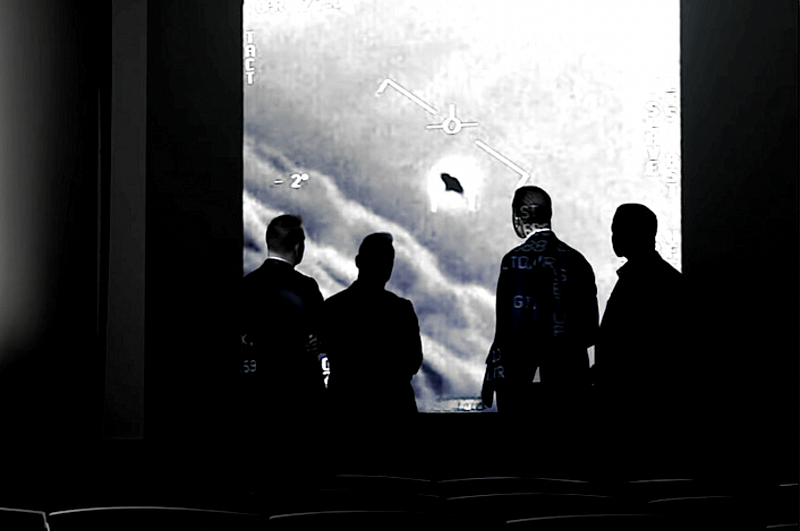
If a reader was hoping to see the words “alien” or “extraterrestrial” in this report then, of course, they might be disappointed. We’re not there yet. We’re creating the infrastructure to study it, and removing the stigma a little more every day. That is progress.
The history books will probably record that this was an important date, like the 2017 New York Times and Politico articles, and was part of the larger story still to be told.
The Bottom Line
The report is bureaucratic in tone and word choices. It offers no videos or photos. Even worse, it offers zero details of any of these 144 cases it looked into. We are left with this short, unsatisfying document that, if you take out the title page and the two appendix pages, is really just a thin six pages.
Yet it does offer the first glimmer we’re getting from officials that something is afoot, that the phenomenon as General Nathan Twining wrote in 1947 is “real and not something visionary or fictitious.” It’s also technological with objects that operate in ways we can’t explain, and it might be a flight danger or even a larger threat. And, finally, that none of the cases pointed to the U.S., China, or Russia, or any other nation.
Which, of course, takes us back to the fifth choice. In a mostly bland and soulless accounting, the authors have given us a memorable turn of the phrase that we can hang on to, as they put it, “the catchall ‘other’ bin.” Someday it may be as famous as the phrase “expletive deleted” from the Nixon Watergate tape transcriptions.
Here’s a parting thought. This was just the public version. The Senate and House Intelligence and Armed Services committees got a much longer, expanded report that is classified. Some or all of it may leak. If it does, it’s a safe bet that some of those secret briefings held in a SCIF (sensitive compartmented information facility) included hard-to-deny photos and videos. Had they been included in today’s report, just imagine how the world would be going wild right now. Those pictures and video clips are coming, sooner or later.
In the meantime, we’re left to wonder what exactly our government has inside that pesky catchall ‘other’ bin that couldn’t yet be shared with us. Personally, I just cannot wait until the bin gets ripped open and we get a peek. That’ll be the day.
Here is news coverage from The Washington Post, The Wall Street Journal, USA Today, CNN, The Debrief, Politico, The Los Angeles Times, NPR, Fox News, NBC News, ABC News, Huffington Post, The New York Times, Newsweek, The War Zone, Reuters, The Daily Express, The BBC.
Trail of the Saucers is edited by writer/producer Bryce Zabel and published by Stellar Productions. Zabel co-hosts the popular new podcast Need to Know with Coulthart and Zabel that can be found on all major platforms.


