
Dear School Staff: Stay In Your Lane
That goes for other professionals too. We need to remember we’re the experts in our respective fields, not on other family’s experiences.

I hear you and I see you
I know I write a lot of critical pieces about public education, and in each, I try very hard to acknowledge the extremely difficult position school staff are in. Schools are under-funded and under-resourced, staff are over-worked, under-paid, and under-supported.
There are some amazing school staff who go above and beyond to do the best they can for their students, with very limited resources. I want to make that clear.
I also tend to be involved when there are challenges between home and school, so I am exposed to more of the negative stories than the positive ones — however, there are many positive ones too!
Families tell me about wonderful educators and other professionals they have encountered who made a difference in the lives of their children. It’s important to acknowledge these relationships and the opportunities we have to have a positive impact.
So if these criticisms don’t apply to you, please do not take them personally.
Dear school staff: Please stay in your lane
I say this with all due respect.
There are some school staff who think it’s okay to judge the home life of families, despite knowing very little about what actually goes on in their homes. Let’s be clear, you cannot know how someone parents based solely on their child’s behaviour. The most amazing, skillful parent can still have children who are struggling with very challenging behaviours.
Children are born with disabilities, neurodevelopmental differences, and other physiological factors which impact their behaviour, which have nothing to do with parenting. Also children are children, so sometimes their behaviours are challenging for adults. That’s part of working with and raising kids.
A few years ago I was in an IEP meeting for my son and was inquiring as to why no enrichment or acceleration had been provided for him, given his demonstrated ability to work well beyond what the class was doing. The teacher had been well aware of this from the beginning of the school year, yet a month into classes and my son was bored out of his little mind.
The Educational Assistant (EA) in that meeting thought it was okay for her to say something along the lines of, “just let him be a kid.” I had never even met this person before. Excuse the fuck outta me, but who the hell are you to tell me how to parent my child, and assume I’m not “letting” him be a kid?
My son was coming home from school telling me how painfully boring it was, that he was being forced to do “baby” work (in his view). When I saw the activity booklets the class were doing, they were incredibly repetitive. They also required a lot of fine-motor (cut and pate) skill, which was something we’d made clear (as did the formal assessments their own clinicians had done) was difficult for him.
When I spoke of providing enrichment opportunities for my son, I wasn’t trying to push him to be some kind of little professor, I wasn’t pushing him at all.
I was simply asking for his needs to be met, needs that had been clearly outlined by the division’s own psychologist. I didn’t care about my six year old child becoming a rocket scientist, I just wanted my child to be happy, and he wasn’t — at school, he was miserable.
When did this become acceptable?
I’ve heard from many other parents that school staff have made judgemental comments to them about their parenting. Look: stay in your lane. You may think you know what you’re talking about, but you don’t.
Parents know their children better than anyone else. While school staff may have some great insights, and parents can and should work collaboratively with their children’s schools, collaboration is not the same as giving direction.
If you feel a parent is “coddling” their child, or being too lenient, that’s none of your business. Firstly, you’re probably wrong. You’re probably making a judgement based on a fraction of what you see or hear about the parent-child interactions. Secondly, it’s not your business. Did I say that already? You don’t get to tell parents how to raise their children.
This goes for professionals too, myself included.
We’re still not the experts
I don’t get to tell other parents how to raise their children, and I don’t fool myself into thinking I know better than they do. We may be the experts in our fields of practice, but we’re not the experts on other family’s home lives.
Absolutely, I coach and guide parents. I provide information, education, and support. I offer advice and suggestions when asked, but always based on that family’s values and goals. I take their lead.
I get to know them, build rapport. It seems a lot of clinicians have forgotten that the very first step to supporting anyone is developing a therapeutic relationship. Our “brilliant” advice, however well-intended, is not going to be well received if we are pushing our biased views without taking the time to build trust.
This can be difficult in certain roles where our working relationship with families are short-term, but that’s how we get good at doing those jobs: we learn how to build rapport quickly, how to follow the client’s lead, and how to provide support and guidance without pushing our own opinions.
If you know me, or if you’ve read any of my work, I’m sure you will see I am very opinionated. That’s why I write. I express my strong opinions where they’re available for those who wish to read them, but I have no interest in pushing my views on anyone who’s not interested.
I acknowledge it may not seem thus when I write with such strong conviction, but I am constantly challenging my own views and learning from other professionals and from my clients — especially the kids.
Kids humble us. They don’t care how many letters I have after my name, whether I’m wearing “fancy” clothes, or whether I have a fancy job title. They take me at face value. If they disagree, they’ll often tell me. When I’m wrong, they’ll show me with their reactions or behaviour.
Kids are my best — and favourite — teachers.
Judgements are useful— sharing them is not
Our human brains are wired to make snap judgements. Those reflexive evaluations are evolutionarily important: we need to determine quickly whether a person or situation is safe, so we can take immediate action if they’re not.
Jumping to subjective conclusions about people and situations is a natural, human response. However we can — and should — acknowledge to ourselves those assumptions can be wrong, and challenge ourselves to reserve judgement until we gather more information.
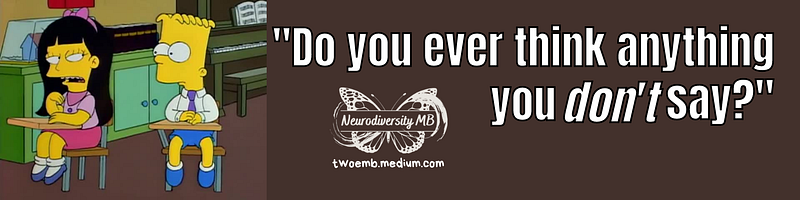
This will sound rich coming from me, but here it is: having an opinion does not mean we need to share it. We definitely don’t need to share it if it hasn’t been asked for and if it’s not our place.
And if you absolutely must get it out somewhere, might I humbly suggest a blog?
© Jillian Enright, Neurodiversity MB
When you join medium, as a member you’ll have access to unlimited reads for only $5 per month. If you use my referral link, I’ll earn a small commission, and you’ll earn my undying gratitude.
If you’d prefer give a one-time tip, you can support my writing on Ko-Fi — also, it’s free to follow me on Facebook and LinkedIn!