
Daily Writing Plans
The routine that helps me meet my writing goals

Recently, I wrote about how to create a revision plan for a whole book. Today, I want to talk about how that breaks down into the day to day work of writing.
A caveat before we start: consistent inconsistency is basically my trademark. I come up with a routine that works well for me… then I file it away and only use it when flailing stops working. This is unideal, I admit. I need to take my own advice more often because daily planning is a technique I know works for me. But we work with the brains we’re given… at least until science figures out how we can trade them in.
That said, even if all I do here is give you another weapon for your productivity arsenal, I’d say that’s good enough.
Daily Plans
Picture this: you have two hours set aside to write today. You sit down at your desk. The word processor of your choice is open. A blank page (or a draft hoping for revision) awaits you. The possibilities for today are endless.
Two and a half hours later, you look up from a fugue state, your phone in your hand, only to realize nothing has changed on the page in front of you. A lot of tweets have been liked, maybe, or TikTok videos played, or comments left on Medium articles, or parts of your house organized. But as for what you set out to do… wait. What did you set out to do?
Not making a plan for your day makes it a lot easier to fall into the trap of doing literally anything else. This is especially true for creative work like writing.
This is what I do instead (when I remember). At the beginning of my writing session, I pull up an unrelated document in a different program than writing happens in. Usually, this is analogue, in a notebook I have for the purpose, but occasionally I’ll work in Google Keep. Then I spend five to ten minutes free writing — not writing for the project of the day, but free writing about writing.
I’ve done this several ways over the years. Since this was a technique I tried out of desperation first, it started as me stopping revision to journal about why I was stuck. Journaling about what’s sticking you beats staring at the blank page wishing it would update itself.
However, this can be taken from diagnosing symptoms into preventative care. Starting your day with a plan can:
- save time
- help find problem areas before you get there
- help you set realistic expectations for what you can accomplish in your timeframe, based on the work you actually have
But how does that happen?
How to Create a Daily Plan
Start with a review
I often open my journaling session with where I left off the last time I wrote. Where I was in the story, which of my dozen Medium drafts are nagging at me, something to that effect. I then analyze outside factors. How is my mood? How much energy do I have? How much time do I have? How motivated am I to write?
If there’s something I’m stuck on, I write about how I’m stuck, and why. I vent my frustrations about articles that just aren’t making sense, or dialogue that sounds stilted no matter how much I tweak it. This is simply to get my feelings out and on the paper. The next step will be to combine them into something actionable.
Decide on a plan
When you know where you’re at (in writing, in your mental state, and in why you’re stuck, if you are), you can use these factors to make decisions about the rest of your writing session.
As perfectionism is usually a reason I procrastinate, I have to make myself a list of what I actually need to get done that day. This helps me break the idea of needing to turn a blank page into a perfect piece of art, or think that I only have one shot at revising something before it’s done. Just like on a macro revision scale, when I prepare a list of don’ts, I prepare a narrow list of what I need to do that day.
This looks different, of course, depending on what I’m working on and why I’m stuck. Over the years, I’ve used:
- ranges of word counts/chapters edited
- addressing specific problems
- journaling to figure out the answers to specific problems
- good/better/best
A word count goal might say: I need to write 1,000 words today. Once I do that, I’ve met my goal. For a chapter, it would be, I need to edit chapters 42 and 43 today. Both of them only have minor issues, although I am a little stuck with part of chapter 43, so that will take a bit more time.
Problems to address (either in text or via journaling) would look like this: today, I need to figure out Adam’s motivation in this scene and see how that will change his dialogue and action. Or, today, I need to think of a new opening to this chapter. Or, today, I need to finally make my timeline for this book make sense.
Good/better/best is a technique I started using with a friend of mine for accountability. It can apply to any of the versions above. For a Medium article example: Today, I’m working on a few different articles. Good = one article drafted and another article outlined. Better = both articles drafted. Best = both articles drafted, edited, and submitted for publication. This technique gives me the chance to understand that I have limits, while giving myself the opportunity to exceed my own expectations. Hitting best usually calls for a celebration.
This idea of good/better/best also ties in well with a recent Matt D’Avella YouTube video, where he interviewed Greg McKeown. Productivity often happens best with both a minimum and a maximum set for the day. Good/better/best gives me that framework.
Check in later
The final part of this process is coming back to the journal at the end of my writing session. I only take about three minutes for this. During that time, I reread my goals, then write down an update. It’s usually simple, a “Later” added to the bottom, where I address whether I accomplished my goals and how it felt, and, if relevant, what I think I need to do in my next session.
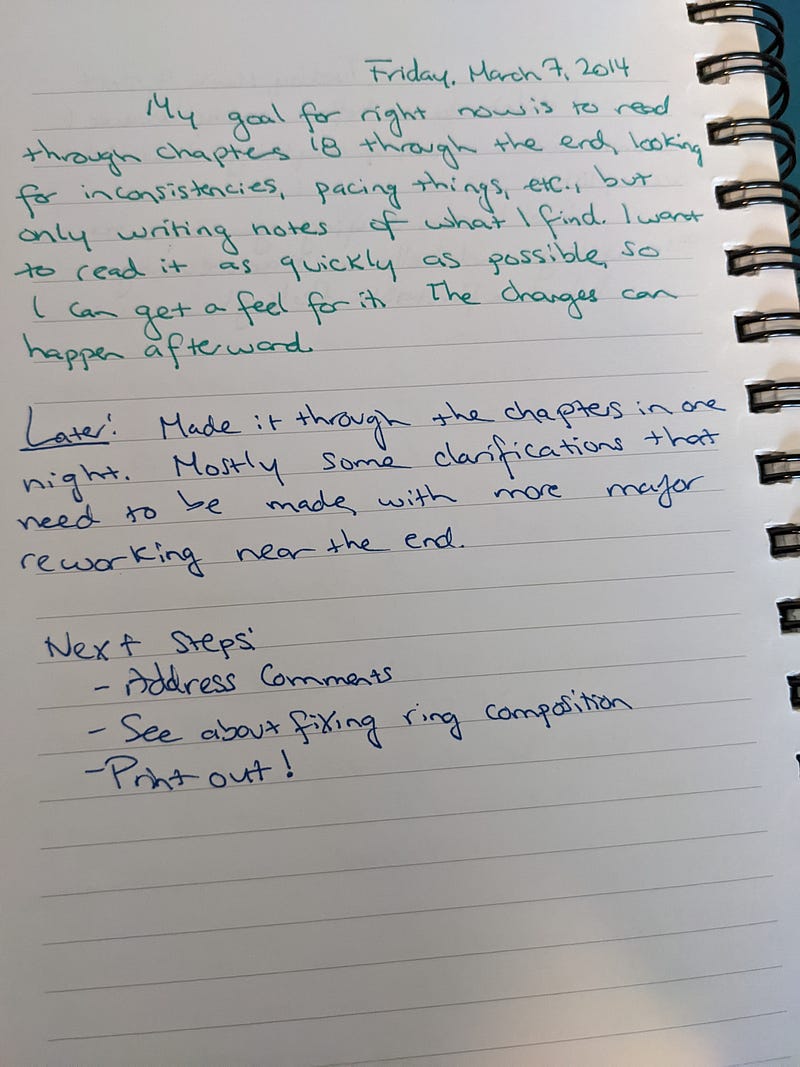
How My Plan Has Changed Over Time
The more I understand something, the more likely I am to move from more formal structures to more intuitive ones. That means I used this technique religiously in 2014–2016 (note the date in the image above) when I was teaching myself to revise, and significantly less often now. That isn’t to say I never do, and when I do, I still find it useful. But now much of my daily plan happens in Todoist.
Each of my Medium articles in Todoist has four sub-tasks: outline, draft, edit, submit. Each of these gets a due date. Each of my chapters for my Enchantress book is under a category called “Line-by-line edits,” and I assign them due dates a few chapters at a time. If I’m ever uncertain what to work on, I’ll text a friend. Often, that text is enough to unstick me. After all, I tend to text what things I could be working on, why I’m stuck, what mood I’m in, and how that’s affecting what I want to work on. Just because it’s less formal doesn’t mean it isn’t happening.
Do you make plans for your writing sessions before you start? How do you think it would affect your output, your procrastination, and your ability to reach your goals if you did?
If you like my work and would like to read more of it, consider joining Medium with my referral link to get full access to every article on Medium. Using my referral link doesn’t cost you anything extra, but half of the fee goes directly to supporting me each month.


