
Breaking the Barrier to Entry for Revision: Narrow Your Focus
Why the first part of any round of revision is, for me, a list of don’ts

I’ve written elsewhere about how moving between drafts can be overwhelming. You’ve broken the illusion of the perfect blank page, the perfect story, and, if you’re anything like me, all you can see are the flaws in your work.
It took months — perhaps years — to write a draft of your story and it looks like this?! What a perfect time to give up, right? Honestly, most people do give up sometime between “once upon a time” and “here, you can read this finished story.”
But I firmly believe stories are built in layers. Layers that need time to dry between applications. Layers that will, upon completion, provide a much fuller illusion of a complete universe than a story written all at once. This is why my first step when preparing for a new draft is a list of don’ts.
I know that my books take me between five and eight drafts before I’m anywhere near happy with them. Which means when I’m working on draft three, my goal isn’t to finish the book. It won’t be finished, not even if I try, and if I set out with that goal, the overwhelm will be too much and I’ll give up partway through.
The list looks a little different every time, but it always includes a definition of what a draft is and what a draft does not need to be.
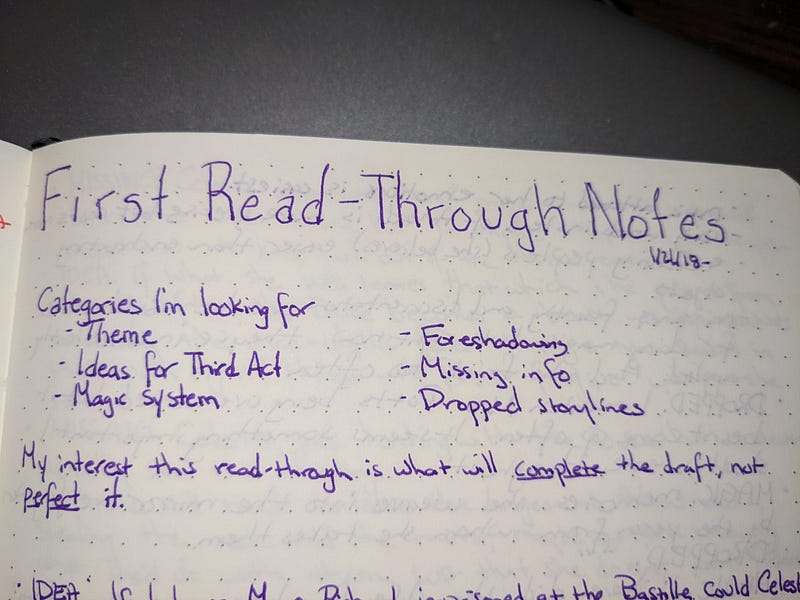
When I’d gotten stuck at about 50,000 words, I reread what I had so far, trying to figure out which plot threads were worth pursuing, what the third act would look like, and places I would need to come back to fill in more detail later. This resulted in an inordinate number of sticky notes that I placed on scene-level index cards to fix later.
By the end of it, I had something resembling a draft two… and a new list of don’ts for draft three.
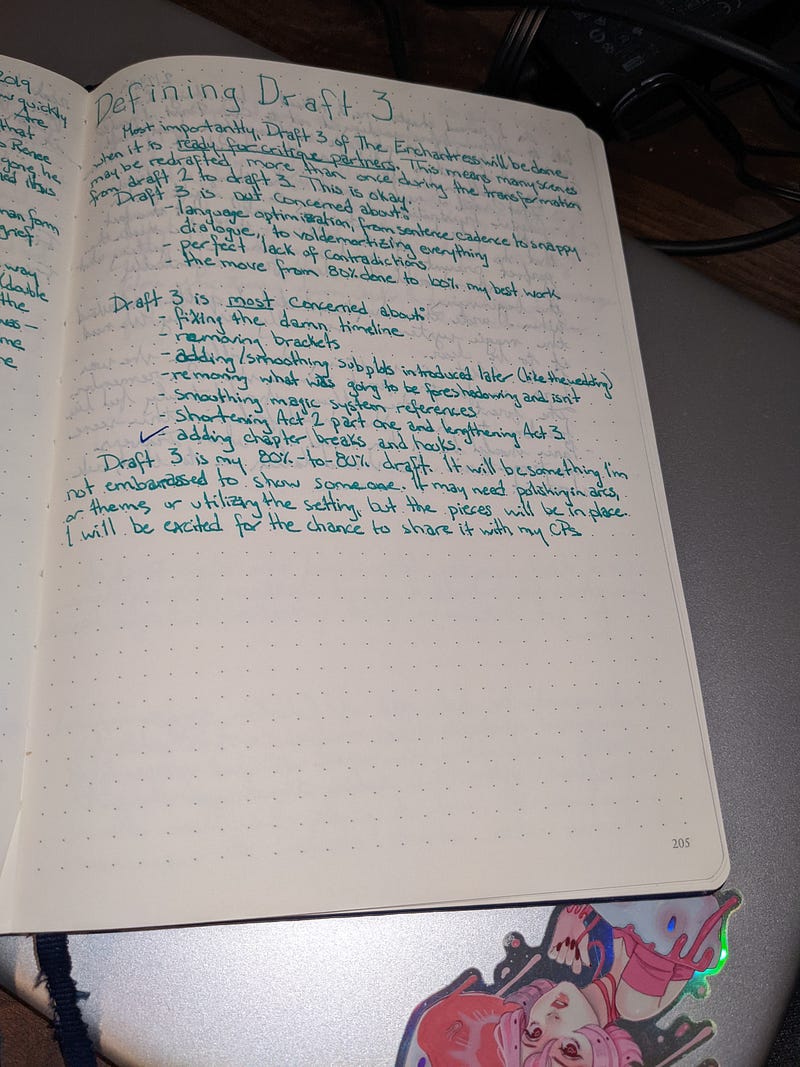
Now, as I prepare for a draft five, I once again have a list of concerns. It’s different, though. You can see my focus narrowing from “Does this even work?” to “How can I make this work?” and now, below, to “Is this the best I can do?”
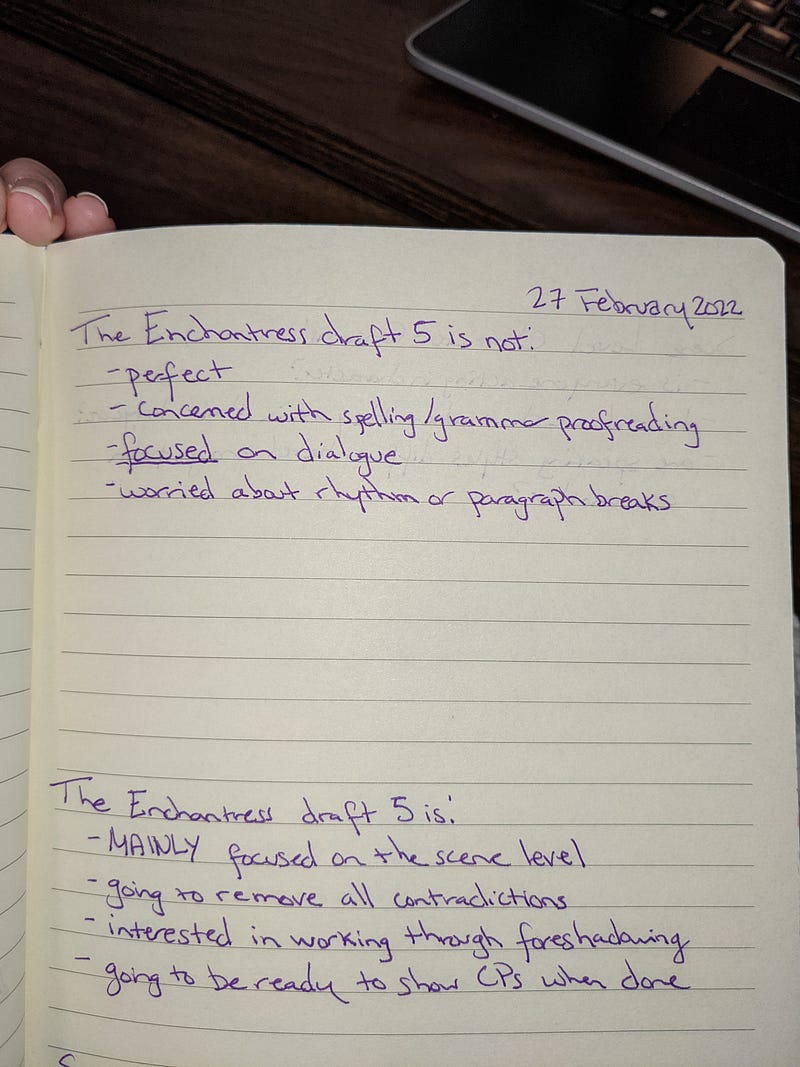
Working in layers like this is the reason I’m confident that when I reach draft six (which will be draft five plus proofreading), it will be the best I can do alone.
When you go to make a list of this sort for yourself, here’s what I would consider.
- What draft did you just finish? Your first? Your tenth? Do you still have to settle the main plot? How are the characterizations? The character arcs?
- How can you work biggest to smallest? (Susan Dennard has one example of this that I used for years, although it’s very left-brained and there are certainly other ways to do it.)
- What gets you stuck revising the same scene over and over again? Witty dialogue? Perfect language? Punctuation? Do these belong on your “don’ts” list for now?
If you like my work and would like to read more of it, consider joining Medium with my referral link to get full access to every article on Medium. Using my referral link doesn’t cost you anything extra, but half of the fee goes directly to supporting me each month.