
Creating a Revision Plan
How I break down “revise a novel” into manageable steps
I have always found that plans are useless, but planning is indispensable.
Dwight Eisenhower said that, and it’s been my mantra when it comes to revision for seven books now. As you’ll see below, I routinely fall prey to the same traps: oversimplifying things, and underestimating how much time something takes. I do this even though I know I’m going to do this, and try to plan accordingly. The science behind it says every human, whether they’re aware of this fallacy or not, falls into this trap.
However, that doesn’t make the planning any less important. I’ve written seven books, and I’ve revised to satisfaction seven books. That, unlike the planning fallacy, isn’t so universal of a process.
Why plan a revision, then? A few reasons:
- Revising a book can be overwhelming without breaking it down into smaller pieces to focus on. Choosing a focus helps you know where to start.
- For a lot of people, big tasks that will take months don’t feel real in the same way that smaller tasks that take hours feel real. Creating those small tasks makes it much more likely the work will get done.
- When you plan a revision, you’re more likely to focus on the most important work — often developmental in a first round — rather than tinkering with sentences, etc., before it’s time.
Not a lot of people plan to the extent that I do, and I definitely wouldn’t say it’s necessary to. However, if you’re feeling stuck when it comes to what exactly to do next after you finish your first draft, this might be a good jumping off point to finding what works for you.
The Snowflake Method
There is a method of writing called the snowflake method, in which you outline by turning a sentence into five sentences, and each of those five sentences into five more sentences, until you end up with either a complete book outline or a book, depending on how deeply you take the method.
With revision, I find it’s helpful to do something similar. But instead of looking at the plot of a story and making it iteratively more complicated, I look at the ultimate goal — a revised novel — and make it iteratively more achievable.
The first step in this process is a given: revise a novel.
For me, I tend to break that down into acts, as I find that’s an easy way to track my progress. So step two is: revise act 1, revise act 2a, revise act 2b, revise act 3.
These two are true for every book and every revision stage. At that point, I clarify my goals for this revision. What do I want to have on the other side? Then, how do I get there?
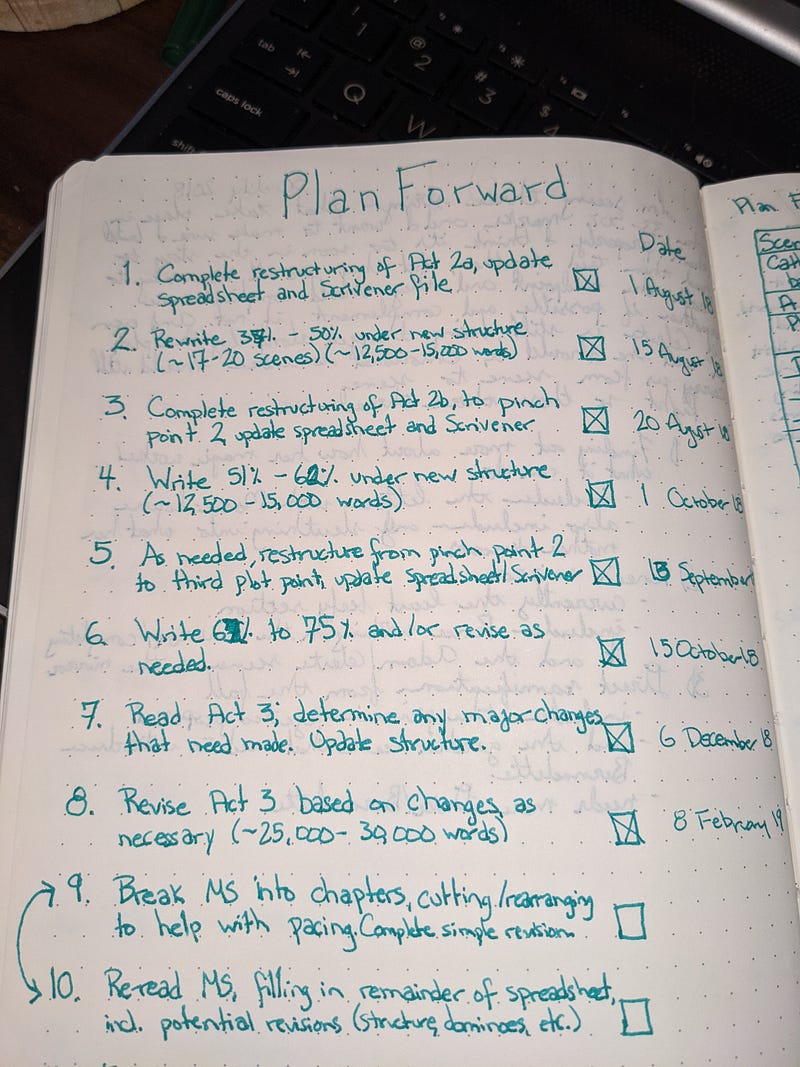
This was my aerial view plan for draft 2 of my enchantress book. But most of those numbers are huge undertakings. They aren’t SMART goals. They aren’t actionable, and they don’t help me plan my weeks. This was simply the big picture. From there, I broke down steps into much smaller pieces.
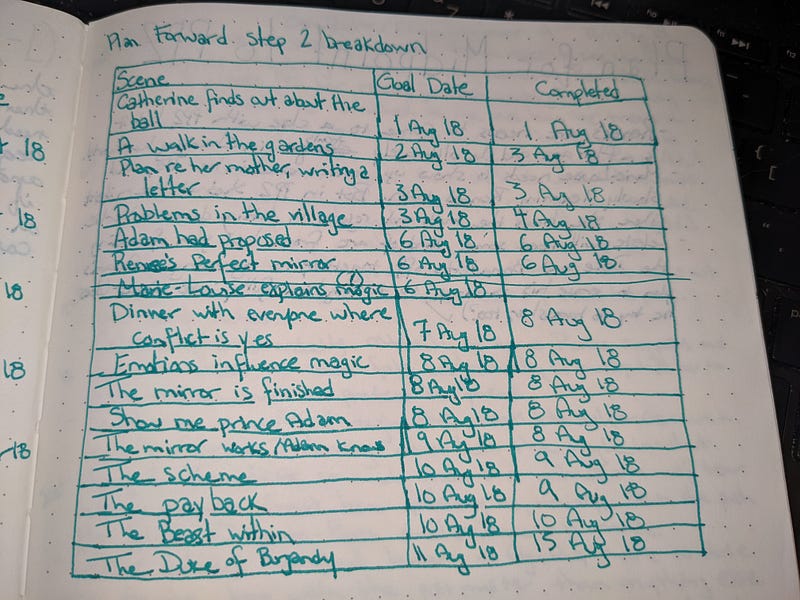
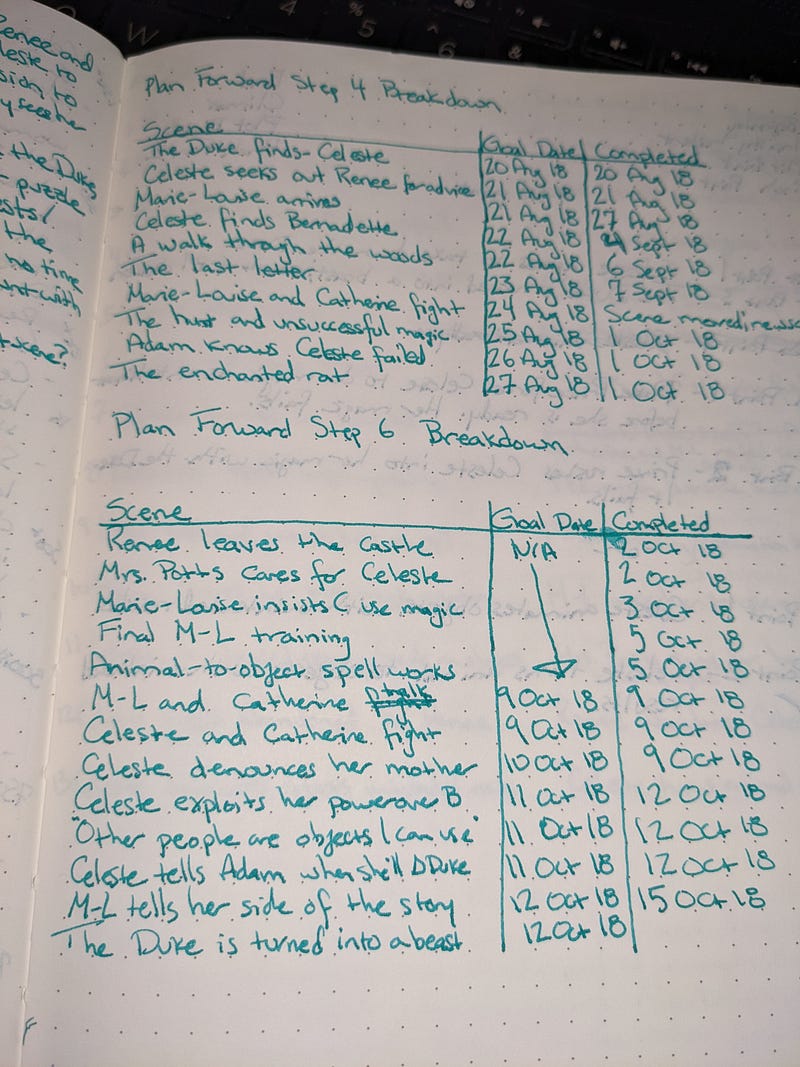
These lists went scene by scene through what needed changed, and assigned dates based on how much work I anticipated each of them taking. We will come back later to how I ended up more than a month off track from my goals for step 4, but for now, let’s look at what I included on this list:
- A scene description
- A planned date to finish the revision
- The date I actually completed it
But honestly, this isn’t a plan either. It’s a checklist. A more detailed one, so my lovely brain gets to see progress more easily, but it’s still a checklist. The planning work lives not here, but in secondary lists that I make.
Secondary Lists
My secondary lists are both far more comprehensive and far more messy than my schedules are. The actual planning happens in an amalgamation of brainstorming, lists, questions, answers, and banging my head against a wall. It’s the result of my first step of revision — reading the book — and the messy ideas that I come away with after reading it.
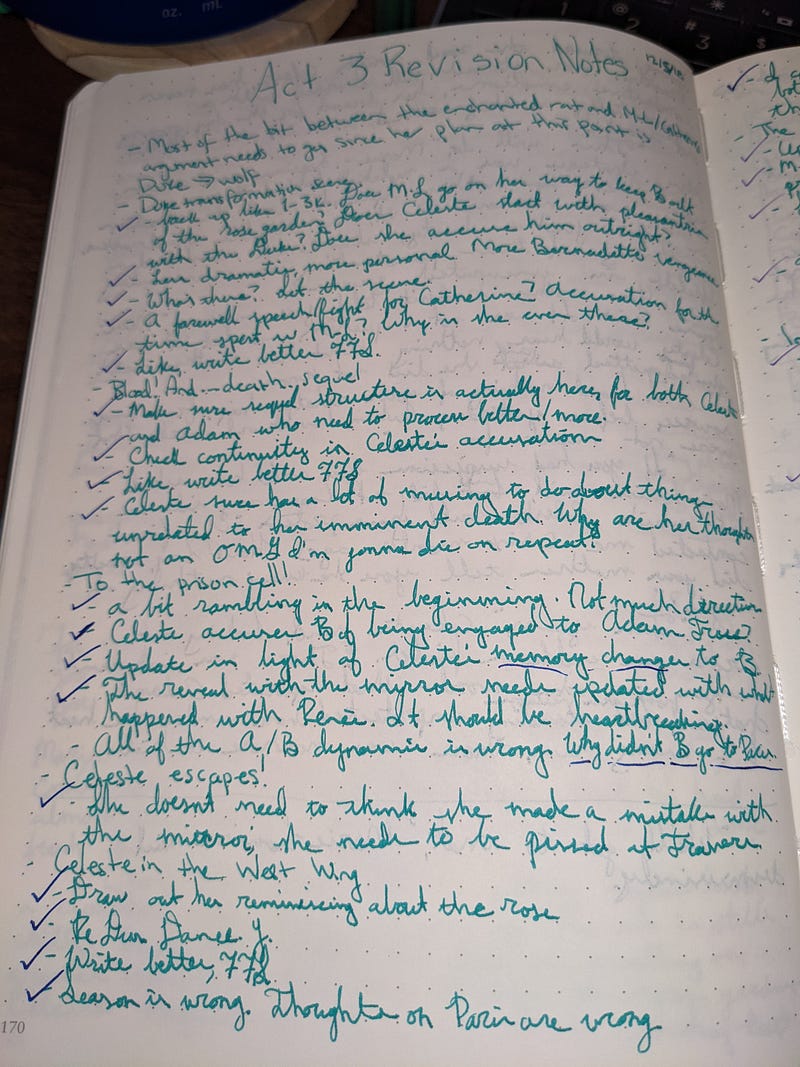
In the above image, I have scene descriptions written in printed handwriting, with things that needed to change in each scene written in cursive. When I finished, I checked them off in blue. (Because these are from my 2018 revision, not many of them are accurate anymore, but I know it took this iterative approach to get the book to what it is today.)
These and brainstorming sessions either with friends or in a journal got me the pieces I needed in order to complete each step of my schedule. We’ll talk next week about what this looks like on a daily basis, but for now, let’s discuss what happens when the plan fails.
What to Do When Everything Changes
First, if we’re listening to Eisenhower, I try my best to remember that the plan is supposed to fail. If I implement my plan properly, if I revise to the best of my ability with the information I have at any given time, there will come a point in which it won’t work anymore.
Think about the video games that give you a mostly blank map at first, and it’s only by exploring it that you find out what terrain lies ahead.
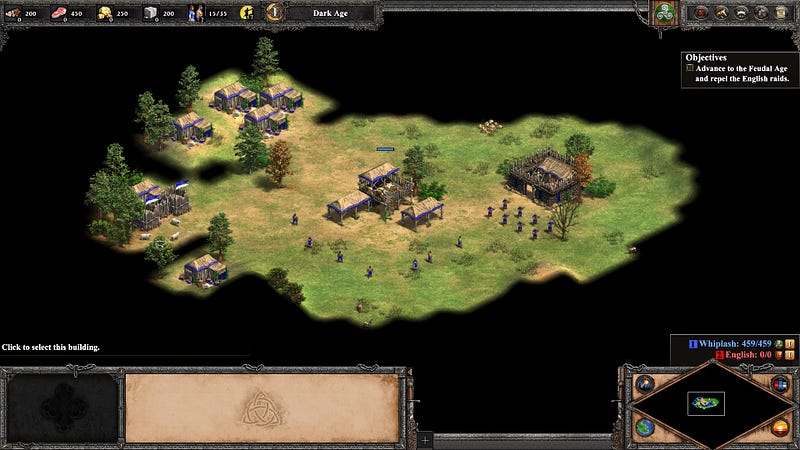
Say you know you need to get to the northwest corner of the map. You make a plan based on the information you have, but as you uncover more of the map, you might find mountains or competing tribes or whole oceans in the way of your original plan.
The plan gets you out of the door. Revising the revision plan gets you to the finish line.
As you may have noticed above, my step 4 breakdown ended up taking me a month longer than I’d hoped it would. But I didn’t make any further plans until that step was done. I knew it could — and likely would — change.
On the book I wrote before this one, I had made a similar revision plan, but I made it all at once instead of in chunks. About three months into revising, my plan stopped being useful at all because I was going to use such different scenes than the ones I’d thought at the beginning.
Now I admit that my approach is one of headlights on a dark night. I can only see so far ahead. Sure, I can guess this road will keep going straight for a while, but until it’s in my headlights, I don’t know that, so I can’t count on it.
My biggest tip for creating a revision plan is to not conflate following it with some kind of morality. It’s not inherently moral to stick to a plan, especially if it isn’t working. It doesn’t mean you planned better or are a better writer if the plan never changes. In fact, having adaptability, and realizing where you didn’t foresee problems, probably equates to a better sense of story and self than a rigid sticking to the plan was.
How I Plan to Change
You might have noticed with some frustration that all my images in this post are more than three years old. When I first wrote enchantress, it was my fourth novel. I’ve finished three since, and am revising it as essentially my eighth book now. This planning — entirely necessary earlier on in my writing — has, of course, changed.
Flexible Goal Dates
For one thing, I try not to adhere to specific dates anymore. Getting the story right matters more than finishing it in a certain timeframe. Of course, if writing were my full-time job, or I was on deadline for a publisher, I wouldn’t have this luxury. But it isn’t where I get my money, and my deadlines are relatively arbitrary. I have paid editing to schedule it around, family time that’s more important, and inevitable time spent sick, burnt out, or just plain stuck on the story that have made me have to slow down.
So right now, I plan a few chapters out, and no farther. Then when I get behind — which I have — I don’t have to rewrite my entire schedule.
Paper vs Digital
This isn’t a sponsored post, but it’s worth acknowledging that my move from paper to working digitally was pretty seamless when I downloaded Todoist.
I created a project for my enchantress book, categories for line edits, typing edits, working with CPs, proofreading, and marketing, and tasks for each chapter. Within each task, I can create subtasks akin to the secondary lists we talked about above, as well as leave comments with ideas and whatnot attached to each individual task. When I inevitably am late getting a chapter edited, I can immediately reschedule it — to tomorrow, to next week, or removing a due date altogether.
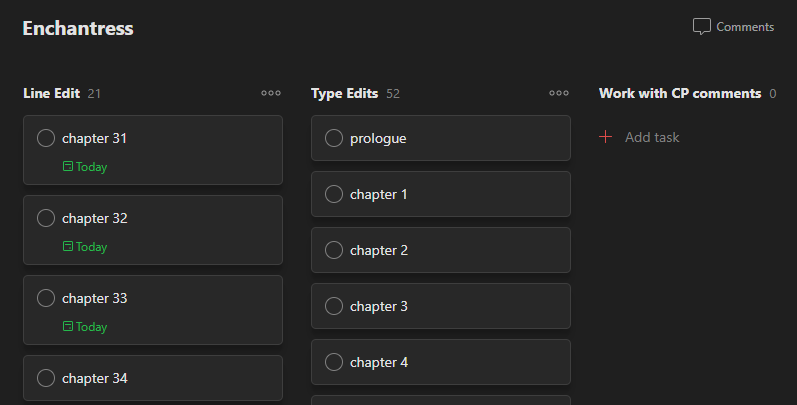
Is this going to work any better for me in the end? I don’t know. I told my husband recently that I need to have 15 weapons in my productivity arsenal at any given time because only 3 of them will work, and I never know which until I’m trying to use them. Having one more tool, while not forgetting the analogue methods I’ve used for years, will hopefully help in that respect.
And I’m certain I’ll see this revision through to completion because of the breakdown into tasks and subtasks and sub-subtasks that make each goal far more achievable.
If you like my work and would like to read more of it, consider joining Medium with my referral link to get full access to every article on Medium. Using my referral link doesn’t cost you anything extra, but half of the fee goes directly to supporting me each month.


