
Inconsistency Is the Reason I Consistently Keep a Bullet Journal
One of three rules I follow to keep me hitting my goals instead of hitting decision fatigue

If there’s one thing I’m consistently good at, it’s inconsistency. Buy a planner. Use it religiously for three entire days. Have a weird day where the planner doesn’t work or gets neglected. Never look at it again. Download a productivity app. Create a schedule that vibrates every time I’m supposed to start a new Pomodoro. Become an expert in ignoring those notifications.
As a freelance editor, a writer, a mother of two, and a neurodiverse human, I need some type of system to track things, or I’d forget them or at least be overwhelmed by a vague feeling that I am forgetting something. Yet planners bore me. Quickly. Or they gnaw at me with the guilt of a single day of excellent tracking in between thirty-five otherwise unused pages. The kind of guilt that’s dealt with by shoving the planner into a drawer and never looking at it again.
But for the last five and a half years, I’ve managed to keep a bullet journal to track (and reach!) my goals consistently. Why? Because I can be inconsistent in it. Miss a week because I went on vacation? No problem. Change up what habits I track on a monthly basis? Yes, please: that’s the only way I’ll track anything at all.
Over the years, I’ve watched my habits change, hit writing goals like I never could have imagined in early 2016, managed projects and life, and kept a record of it all so I can see how far I’ve come. The only reason I’ve managed to make it work? The following three rules.
1. No pencil, no ruler
The only times I’m allowed to draft in pencil and go back over it in the Staedtler markers I love is if I haven’t made a spread before, or if I’m creating trackers at the start of a new journal, things I’ll have to look at for a year and therefore don’t want mistakes in. But otherwise? I remember my template, count squares, draw dot to dot the best I can, and cross my fingers.
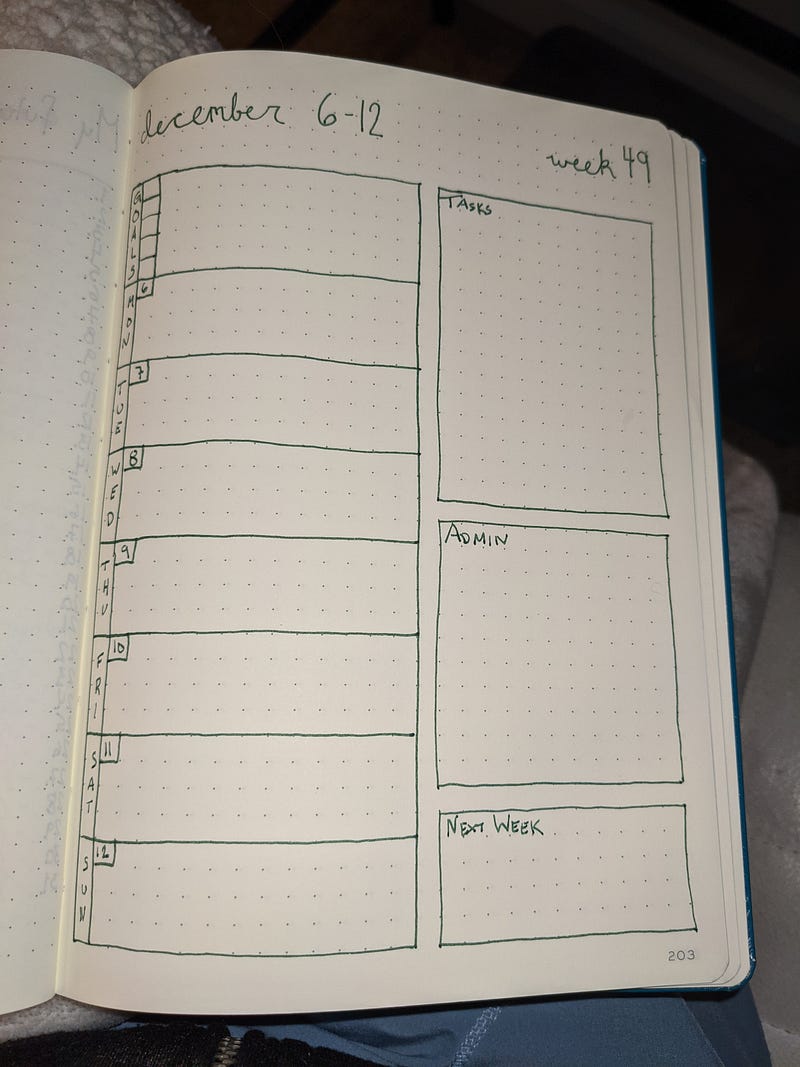
Similarly, I’m not allowed to mess with a ruler. I can math out what will center a spread, but the dot grid is my only guideline for drawing. If I can’t make it work with math and the grid, I don’t get to make it.
Why?
Removing these tools forces me to become comfortable with imperfection. On one hand, this is a vital part of the process for me, because I’m a recovering perfectionist and mediocre artist who could easily get caught up in the details of a Pinterest-worthy spread. I knew this about myself, so before I ever made my first bullet journal, I sat myself down for a stern talking-to and said this wasn’t going to happen. Bullet journals need to be a tool for me, not the final product. I need functional more than I need beautiful.
On the other hand, it’s a great metaphor to be reminded of as I use my bullet journal. The imperfect pages, with wobbly lines or a place I started to draw one space too far, are just as useable as the pretty ones. Imperfection, it turns out, isn’t so bad. My lines, like my words, aren’t precious. Plus, I can move on from making spreads to using spreads to help me achieve my goals in way less time.
2. Use the same layouts, in the same order
When I find something that works for me, I stick to it. I’ve used the same habit tracker layout since I started tracking habits in 2017. When a new month starts, I can copy over the spread without having to do much executive functioning. (I function so much better when I do not have to do much executive functioning.)
I track the same things at the start of each bullet journal: my writing hours, the books I want to read, the books I actually end up reading, etc. I also keep a page with a list of my long-term writing goals at the beginning of each journal so I remember what each day, week, month, and quarter is supposed to point toward.
When I start a new month, I know what’s going to be there: a calendar, a task list, a meal plan, a spread I call ‘My Future Self…’* and a habit tracker. Same spreads, same order, every single month.
Why does this work for me?
It removes decision fatigue. When I buy the same notebooks and use the same spreads, I don’t have to scroll through Pinterest for hours to find the cutest way to track something. In fact, I can stay off Pinterest altogether, and who knows how many more hours of writing time I’ve had because of it. I don’t have to decide what belongs in each month’s ‘front matter,’ so I can simply make what I know I need and go.
I collect long-term data. I might be inconsistent as a rule, but I also love data. When I track the same things in the same ways, I can quickly browse old bullet journals to see how many hours I spent writing that month, what projects I worked on, and more. Want to know exactly how many writing hours I’ve put in since I started tracking? I could tell you. (It’s just over 1,600).
3. Stop using layouts when they stop serving their purpose
In 2016, when I started bullet journaling, I had a page each month where the top half was dedicated to my goals (work projects, reading I wanted to accomplish, etc.) and the bottom half was for administrative tasks (buy Christmas presents, schedule appointments, pack for vacations, etc.). This worked okay, so I kept at it for a long time.
In April 2020, though, I looked at the month and laughed and laughed and laughed at the idea of making that spread. Goals? Tasks? With kids home indefinitely and nowhere to go? Right.
But I knew I needed something or quarantine would turn into ‘lounge around in my PJs and play Animal Crossing any moment I’m not helping the kids with school.’ So, instead of breaking my work into four main goals and a few admin tasks, I made a list of everything I had to do, should do, or wanted to do, and put at the top of it: ‘complete 50% of the following.’
This method of goal tracking stuck, even as I started having to schedule appointments again and interact with the world at large. I’ve tweaked it once more since, separating my tasks into one-on-one work, writing work, and admin tasks. But it’s remained just as granular and just as ‘you don’t need to do all of this’ as it was in April 2020.
Why did I make ‘change this if it isn’t working’ an explicit rule?
Allowing room for inconsistency keeps me consistent. Giving myself permission to adapt when something wasn’t working was pretty much the only thing that kept me using my bullet journal as the world kept radically shifting. I can decide to try something new that I think will help me, adopt it into my consistent layouts if it works, and ditch it if it doesn’t.
Inconsistency gives me room for growth. I’m not tracking the same habits I was in 2016 because some of them have become second nature. I have bigger goals now, things I couldn’t have imagined making habits then. I’ve grown since the beginning of my journaling habit. I don’t need the same tools in my bullet journal as I used to, just as I don’t need the same tools to write or revise that I used to. I can grow, and allow my process to grow with me.
Do you keep a bullet journal, a traditional planner, or something else to track your writing? What sort of rules do you follow, if any, that help you stay on track with planning and reaching your goals? What if you add a few rules that allow for inconsistency to your planning for 2022?