
TASK MANAGEMENT
Daily Done: Part 4 — The Daily Plan
How to make the best out of your workday
This is part 4 of a series of articles that started here: Daily Done: a sustainable paper-based productivity system. Up to now, we’ve seen why it’s a nice practice to create a new task list each day, how to review the previous day’s tasks, and how to prioritize today’s tasks by putting them in 3 categories.
Today, the rubber will meet the road, as we’ll schedule these tasks along the day. Let’s jump in!
Full disclosure: the technique we’ll use today is heavily influenced by Cal Newport’s Time-Block daily plans that I discovered in his Deep Work bestseller.
Why you need a daily plan
Picture yourself in a restaurant. Let’s say an Italian restaurant. You’ll probably salivate while reading the many options you have on the menu, such as the delicious Margherita Pizza, the divine Spaghetti Bolognese, and the exquisite Lasagne al Forno. Sadly, you can’t eat every plate. You know that if your eyes are bigger than your stomach, you’ll either waste food or have indigestion.
It’s the same with your task list. Your tasks for the day are the menu. And you need to check if they will fit into your workday (your stomach). This is the job of the daily plan. I would also mention that a daily plan is an example of an implementation plan, which is proven to increase the chances of doing your tasks.
Creating a daily plan
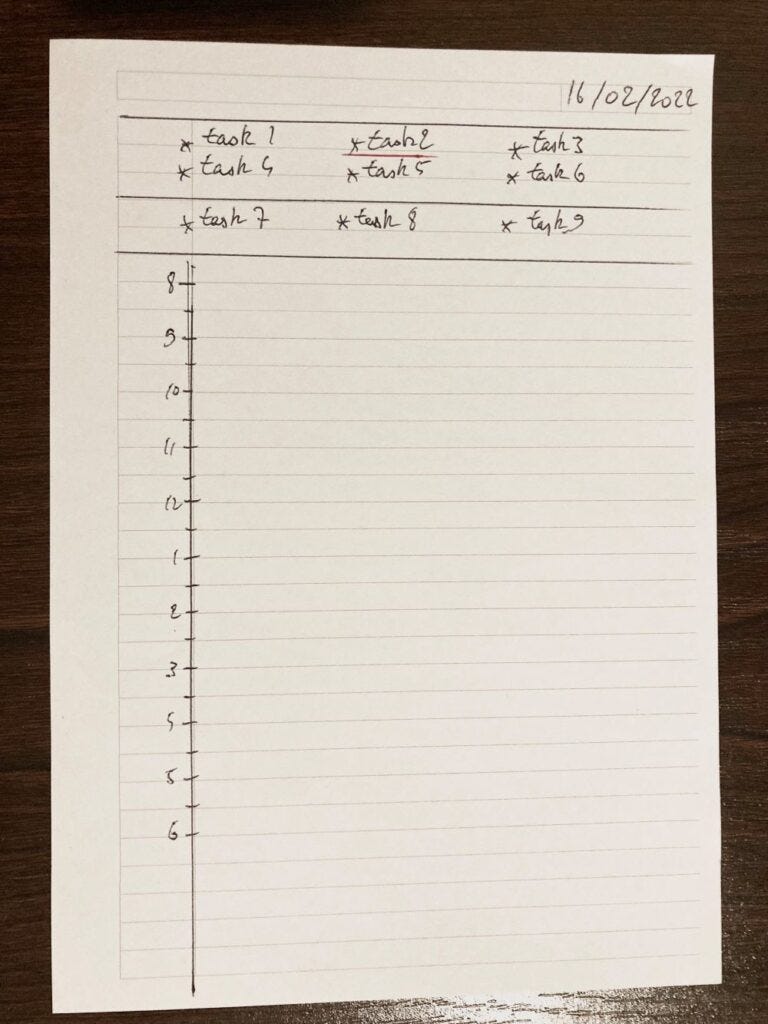
To create your daily plan, first draw a vertical line on the left of your paper sheet, and write each hour of your workday, like so:
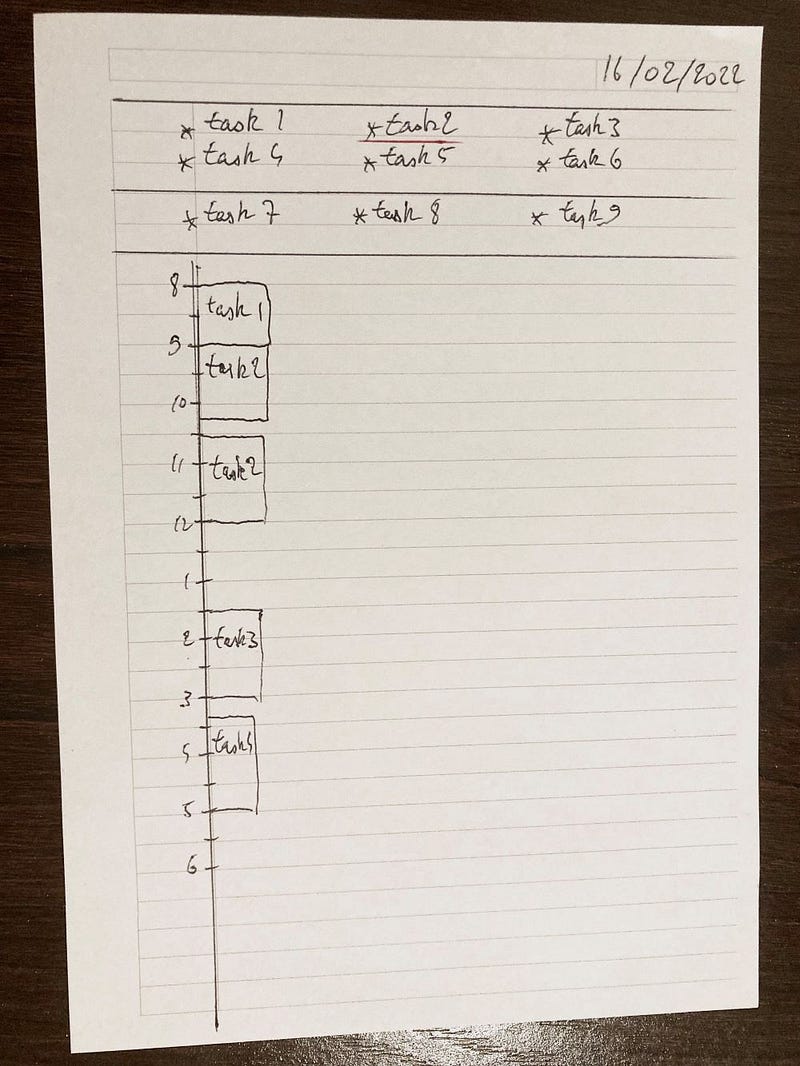
Now, create blocks of time for each of the tasks you have in your Today’s zone (the first block of tasks in the sheet):
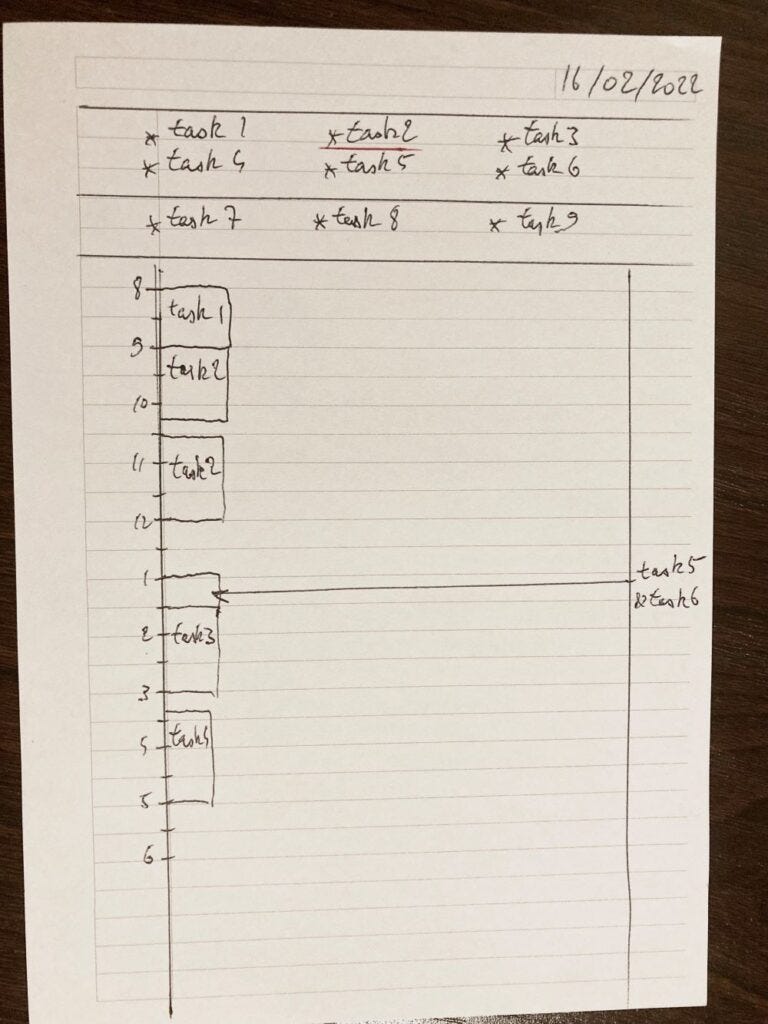
You can group tasks together in the same block if they are quick tasks. For example, let’s say that tasks 5 and 6 each take 15 minutes. Then you can group them in a 30-minute block. But how can you write the name of both tasks on this tiny little block? To solve this, we need a legend. We’ll create one on the right. Let’s draw a line in the right hand of the sheet. And let’s write in this area which tasks are contained in the block corresponding to tasks 5 and 6. Finally, we link that legend to its corresponding block using an arrow.
Here’s the result:
Also, don’t forget to include your pauses. Often, I like to draw them in a circle to differentiate them from other blocks. This is what I did for the lunch break in this photo:
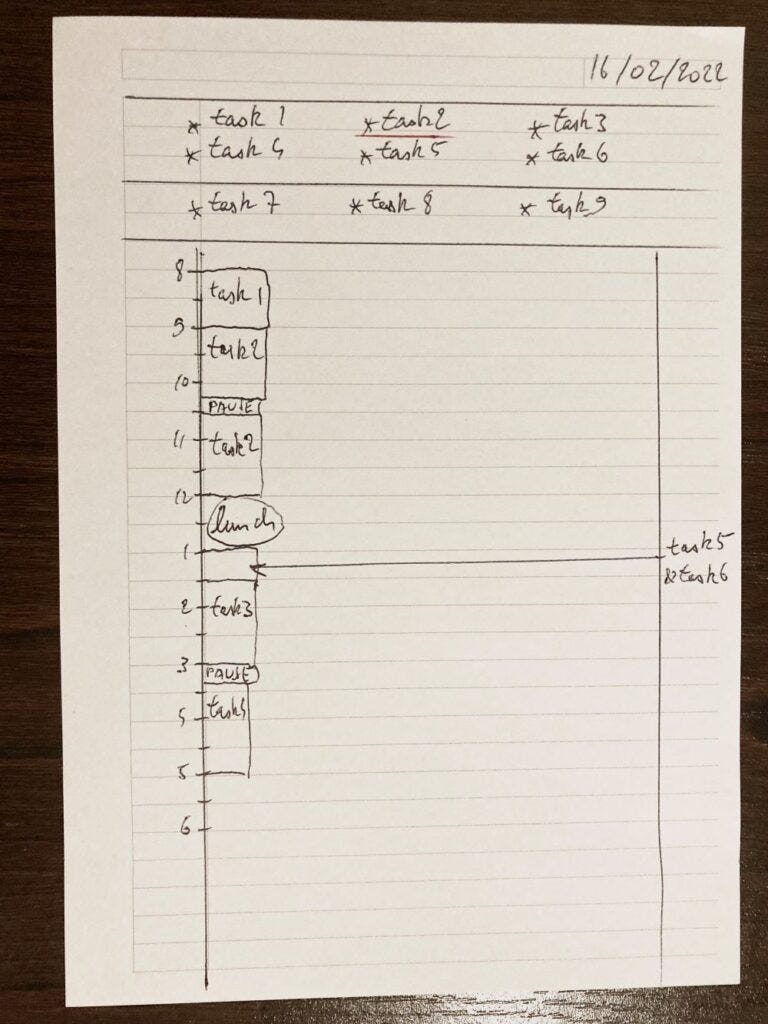
This daily plan will assign an activity to each moment of your day. It will be a nice guide to know what you are supposed to do when your mind feels a bit fuzzy. And this will also make it easier to estimate what work capacity you have in the first place.
But what if you are late while doing your tasks?
Revising your plan along the day
One of the key aspects of this daily plan is its flexibility. That’s the reason we drew very small blocks on the left. We want to leave plenty of space in the right because we’ll use this space to revise the plan during our day.
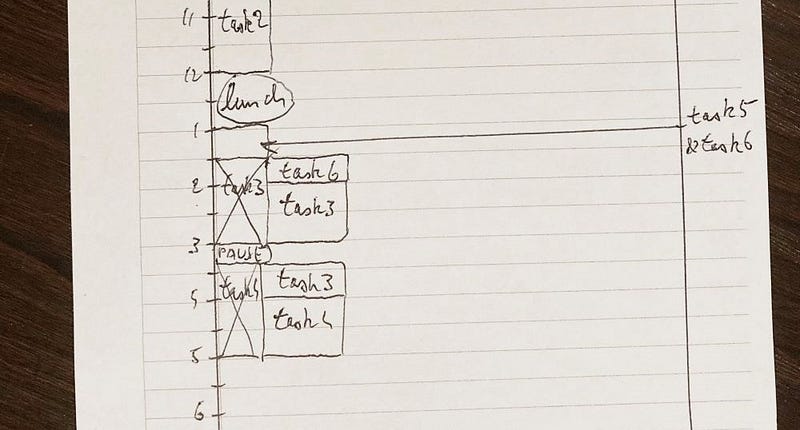
So let’s say you are late on task 6 by half an hour. Then you can redraw the rest of the blocks on the right to take into account that shift. Here’s how you do it:
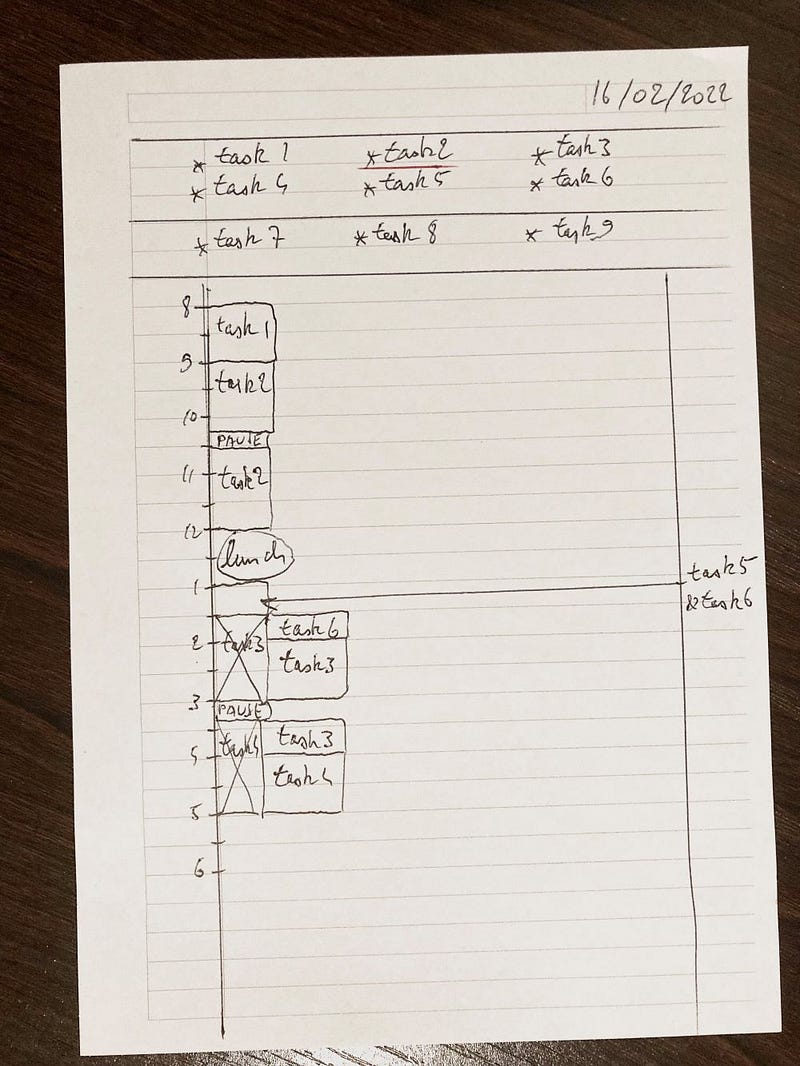
Apart from being late for one task, there can be plenty of other reasons why you have to change course. Maybe it makes more sense to do one of the tasks you have put in your “Upcoming zone” (the second block of tasks above your daily plan)? Let’s say task 7 or task 8. Or maybe there’s an urgent task coming from nowhere that gets the highest priority?
However, you want to reduce revising your plan all day long if you can. Here are 2 possible strategies:
- Exaggerate the estimate of your tasks, so if the task takes 1 hour, you would draw a 1 hour and a half block instead of 1 hour.
- Leave buffers, that is, blocks that are not affected by any task but are only there to absorb the delays.
In any case, don’t be hard with yourself if you need to revise 4 or 5 times your daily plan. This is perfectly normal. You can’t foresee everything. Sometimes it can be very difficult to make estimates if you are dealing with unfamiliar tasks. And sometimes, you even don’t know what tasks you will do.
Support work vs long term work
That’s what happens when you do “support work”. For some people, their job is to stay alert to urgent matters that come up all along the day. That’s what firefighters do, or hotline agents, to take a corporate example.
But most of the time, we switch between support work and long-term work, hopefully on different days of the week. Some days, you respond to urgencies. Other days, you can work on long-term tasks without interruption.
For me, as a software engineer, this is often what happens. Sometimes I can be very focused and dedicated to my daily plan. Other times, it’s not even possible to have a plan.
It really depends on the nature of how your work is organized.
—
I hope you enjoyed this technique. I’ve been using it since 2017 and it has become one of the keystones of my productivity. I even use it on the weekend sometimes, specifically when I have a busy Saturday.
Now I’ll do a little pause on this series to let you experiment. Drop me your feedback in the comments and I’ll answer your questions.
On February 1st, 2022, I’ve embarked on a 100 days writing challenge. This is post number 17.
Originally published at https://alexphili.com on February 17th, 2022.


