
What Western Writers Won’t Tell You about the Real Okinawan Diet
And why there isn’t anything really remarkable about it.

Okinawa is one of the so-called “blue zones.” Coined to refer to a collection of places on the Earth where people live long lives, its proponents also claim that following the diet eaten by the people living in the Blue Zones will also give you a shot at living to 100.
Unsurprisingly, the “traditional Okinawan diet” has become promoted to mythical proportions. According to the Blue Zoners,
“it’s whole plant foods, not fish, that make up 90 percent of the traditional Okinawan diet: Less than 1 percent of the diet was fish; less than 1 percent was meat; and less than 1 percent was dairy and eggs. Most of the diet was based on vegetables and beans, with the most calories coming from purple and orange sweet potatoes. It’s not only a highly anti-inflammatory diet but also a highly antioxidant one. - The Okinawa Diet: Eating and Living to 100 — Blue Zones
Unfortunately, one only needs to visit Okinawa to know that this account makes no sense. As Paul S. Marshall writes in his article Do We Need to Rethink Okinawa as a Blue Zone, pork is king, and trying to find vegetarian dishes to keep (his) familial hypercholesterolemia down has proven to be a little more difficult than (he) thought.”
https://readmedium.com/do-we-need-to-rethink-okinawa-as-a-blue-zone-95ecc2ee28d8
The casual observer might even make a logical leap and dismiss the Okinawan fondness for pork as a result of American influence. They would also be wrong. The reality is that the Okinawan love affair with pork has deep roots in history.
Okinawans Really Love Pork
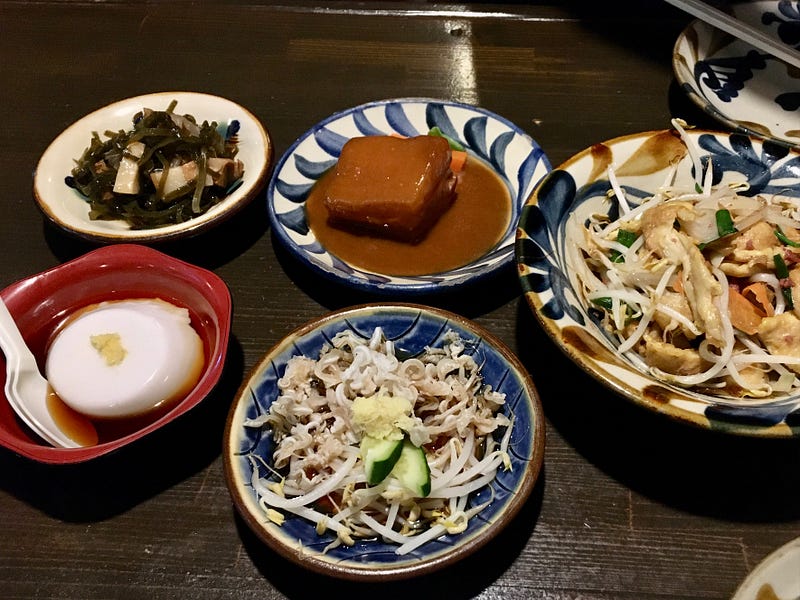
According to the Japanese Cabinet Office, it is told that pigs were introduced from Fujian, China to Okinawa in the 15th century. As diplomatic ties between the Ryukyuan court and the Ming court deepened, and the need to entertain pork-loving Chinese envoys increased, the consumption of pork became established as part of Okinawan culture.
(Incidentally, my grandparents were from Fujian, China. I grew up eating pork braised in dark soy sauce. I assume this is a traditional recipe they must have brought over, but I digress.)
To increase the supply of pork to match the demands of the pork-loving Chinese envoys, the Ryukyu government boosted the number of pig farmers. It also helped that the growing of sweet potatoes, which had also been brought over to Okinawa from China, turned out to be the perfect crop to feed pigs.
Ironically, it was precisely the sweet potatoes that the Bluezone promoters claim are at the core of the traditional Okinawan diet that made it possible for Okinawa to develop its unique pork culture. As sweet potatoes spread as a staple food for the common people, the other parts of the plant became feed for pigs. Pork and sweet potatoes became a part of the common people’s diet in tandem.
Even so, only wealthy people were able to eat pork on a daily basis. Pork was still considered a luxury good, and the average person could only eat it once or twice a year — during the New Year, and during the Obon Festival.
By the time Ryukyus had been annexed by the Meiji government and absorbed into Japan, Okinawa had the greatest number of pigs in the entire country. The pig livestock population reached 140,000 in 1938, but by 1946, after the Battle of Okinawa, the number had plummeted to less than 10% of that figure.
The pig farming industry had been decimated. The “traditional” Okinawan diet, which is big on sweet potatoes, is historically specific. It was not born out of tradition but in the context of postwar starvation and necessity.
After the war, pig farming was restarted under the leadership of the U.S. government. As is also well known, Spam was also distributed by the US military to combat the scarcity of the postwar situation. This is how luncheon meat became incorporated into Okinawan cuisine.
But pig farming would only become fully re-established with the help of Hawaiian Okinawans. Banding together to establish the “Hawaii United Okinawa Relief Association,” they raised sufficient funds to ship over 500 pigs to Okinawa in 1948.
When the pigs finally arrived after a 5000km journey across the Pacific Ocean, due to excessive demand from pig farmers, they were distributed by lottery. Four years later, the number of pigs recovered to around 100,000.
Pig farming was back in Okinawa.
Okinawa’s “Longevity Village” is (Moderately) Big on Meat
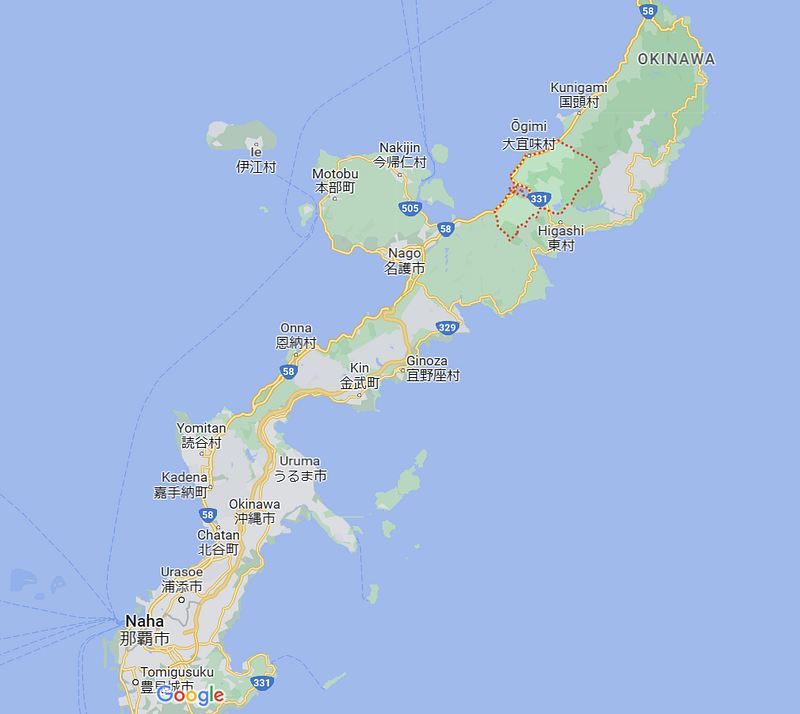
80(歳)はサラワラビ(童)90(歳)となって迎えに来たら、l00(歳)まで待てと追い返せ我らは老いてますます意気盛んなり、老いては子に甘えるな。
When you are 80 (years old), you are a sarawarabi (child), and when you are 90 (years old) and they come for you, turn them away and tell them to wait until they are 100 (years old). — Ogimi Village Saying
Ogimi Village has a nickname. It’s called the Longevity Village. In 2023, out of a population of 3032 people, 20 of them were centenarians. It’s a well-recorded fact. Even National Geographic knows this.
But National Geographic mistakenly claims that the locals do not eat a pork-heavy diet. Perhaps “pork heavy” is relative?
Genetics aside, diet more easily identifies how locals stand apart. If you go to a typical Okinawa-themed restaurant in Tokyo or a touristy one in Okinawa, the menu is pork heavy and the alcohol is as strong as it gets in Japan. Awamori, the fiery regional spirit, weighs in at an ABV of 40 percent. But that’s not representative of island habits.
Unfortunately, that is not the narrative the villagers themselves claim. In fact, according to the official Ogimi Village website:
Ogimi Village (1) consumes about 3 times more meat than rural Akita, (2) 3 times more green and yellow vegetables, (3) 1.5 times more beans, as typified by tofu, and (4) more fruits…
In Ogimi, even the elderly eat nearly 50 grams of meat every day, while in Akita, the amount is as low as 20 grams.
The Ogimi village website not only goes on to talk about the importance of community but also their historical consumption of animal protein as a source of their longevity. This is in stark in contrast to the Western narratives that we’ve seen from the Blue Zoners and National Geographic.
In the past, even in Okinawa, pork was a food for special occasions and was extremely precious and expensive for the common people, who cherished it curing and salting pork for the New Year. The daily diet of the common people was simple, consisting mainly of potatoes and vegetables, but a culture of sharing food with others took root in every village, and the villagers were blessed with opportunities to consume protein such as meat, fish, and tofu through weddings, funerals, and village events, which I believe was very fortunate for their health...
In addition to pork, everyone would gather around a goat (goat nabe) after building a new house or after communal labor in the village, and fish and shellfish from the nearby sea and rivers were also skillfully used to help secure the necessary protein source.
This kind of food culture is more distinctive than the mainland diet, where meat consumption has traditionally been restricted, and we are convinced that it was a major factor in the village’s longevity.
Very much like the Japanese word “ikigai,” the meaning of which has been misappropriated to sell books to the Western public, it’s clear that the traditional Okinawan diet promoted by the Blue Zoners isn’t at all what the Okinawans eat.
But Isn’t Life Expectancy in Okinawa Falling?
Paul S. Marshall is not wrong when he points out that average life expectancy for all age groups has decreased in Okinawa.
In 2020, Okinawa ranked 43 out of 47 prefectures in 2020. But if you drill deep into the data (source in Japanese), the decline is being led by younger people — especially younger men.
Okinawa’s average life expectancy for men ranked 10th in 1975. Ten years later, in 1985, life expectancy rose to 1st place. It began to reverse, and declined to 4th place in 1995, 25th in 2005, and 36th in 2015. In 2022, it dropped even lower, to 43rd out of 47 prefectures.
Women, on the other hand, ranked first in every survey for 30 years, from 1975 to 2005. However, in 2015, they dropped to 7th place, and in 2023 they were 16th.
But this kind of data can often be misleading. Life expectancy is still incredibly high for the elderly: 75-year-old men still rank second place, and 75-year old women still hold first place in Japan. (A refresher on demography 101: Life expectancy refers to the number of years a person has left to live.)
Conversely, for those aged 20 and 40, men rank 43rd, the same as the average life expectancy, while women rank 15th. Younger people are expected to live shorter lives than their elders. This decline in the life expectancy for younger folks is being driven by the burgeoning scourge of obesity.
In 2023, the Okinawa Prefectural Health and Nutrition Survey, conducted every 5 years, reported that the percentage of obese persons aged 20 and over is 41.6% for men and 24.8% for women, both higher than the national average. In particular, the proportion of people with a body mass index (BMI) of 25 or higher, is particularly high among men, and exceeds 50% among those in their 30s-50s age group.
Can We Still Learn Anything from the “Okinawan Diet?”
It’s hard to say for certain, but it doesn’t take a nutritionist to make some connections: The practice of moderate pork consumption (together with a combination of fresh vegetables, tofu, fish, and fruit) probably contributed to the longevity of the Ogimi villagers.
On the other hand, excessive meat intake (and likely in the form of highly processed Spam), as well as alcohol consumption among the 30s-50s cohort observed by Paul S. Marshall, is likely a key driver in obesity rates and ultimately decreased life expectancy.

Still, I am not a nutritionist, and it is not the intention of this article to dispense nutritional advice. Instead, what I have hoped to achieve is to discuss what the Okinawans — in particular, the Ogimi villagers — themselves claim is the basis of their longevity.
I’ve also tried to avoid mythical representations, and show that Okinawan people, particularly the younger folk, are also not immune to the scourge of obesity if they over-indulge in meat and alcohol to excess.
If the longevity of the Ogimi villagers is any indication, a very balanced diet, filled with complex carbohydrates, vegetables, seafood, legumes (in the form of soybeans and tofu), moderate animal protein, and fruit is likely one of the ways to achieve a healthy and long life. Staying active into old age, and participation in strong communities are also contributing factors.
Perhaps the key to a healthy life is moderation in everything, a principle ancient Greek philosopher also abided by. If so, then perhaps there is nothing special about the “Okinawan diet.” That many seem to think such a sensible diet remarkable in the first place, is to me, the more remarkable fact.
References:
- なぜ沖縄は「豚食文化」なのか?歴史から紐解く沖縄と豚の物語 | 沖縄復帰50周年記念~これまでの歩みと今~ | 沖縄復帰50周年 | 内閣府 (cao.go.jp) “Why is Okinawa a “Pork-eating Culture”? The Story of Okinawa and Pigs as Unraveled through History | The 50th Anniversary of Okinawa’s Return to Japan — Past and Present”
- 長寿の里/大宜味村 (vill.ogimi.okinawa.jp) “Longevity Village / Ogimi Village”
- 長寿県・沖縄に異変が起きている?その“食文化”と平均寿命の歴史 | CBC MAGAZINE(CBCマガジン) (hicbc.com) “Is something unusual happening in Okinawa, a prefecture of longevity? History of “Food Culture” and Average Life Expectancy”
Notes
- Japanese sources were translated with the help of DeepL and human-checked.
Interested in Japan, Japanese culture, or the Japanese language? Follow me! I write frequently about Japan-related topics on Japonica, where I am also an editor. Discover my most-read stories here.


