
The Truth About Ikigai: How We’ve Been Misled and What It Really Means
Separating Fact from Fiction

You’ve probably heard of ikigai (生き甲斐).
It’s a Japanese term that roughly translates to “the reason for being.”
It’s become a buzzword over recent years. You may have come across it in self-help books, TED Talks, or social media posts claiming that it holds the key to a fulfilling life.
But what if I told you that ikigai isn’t exactly what it’s been made out to be? That it has been misappropriated by motivational consultants worldwide?
Keep reading to uncover the truth behind ikigai.
Modern-day “ikigai”
If you googled ikigai right this instant, you would be inundated with several Venn diagrams.
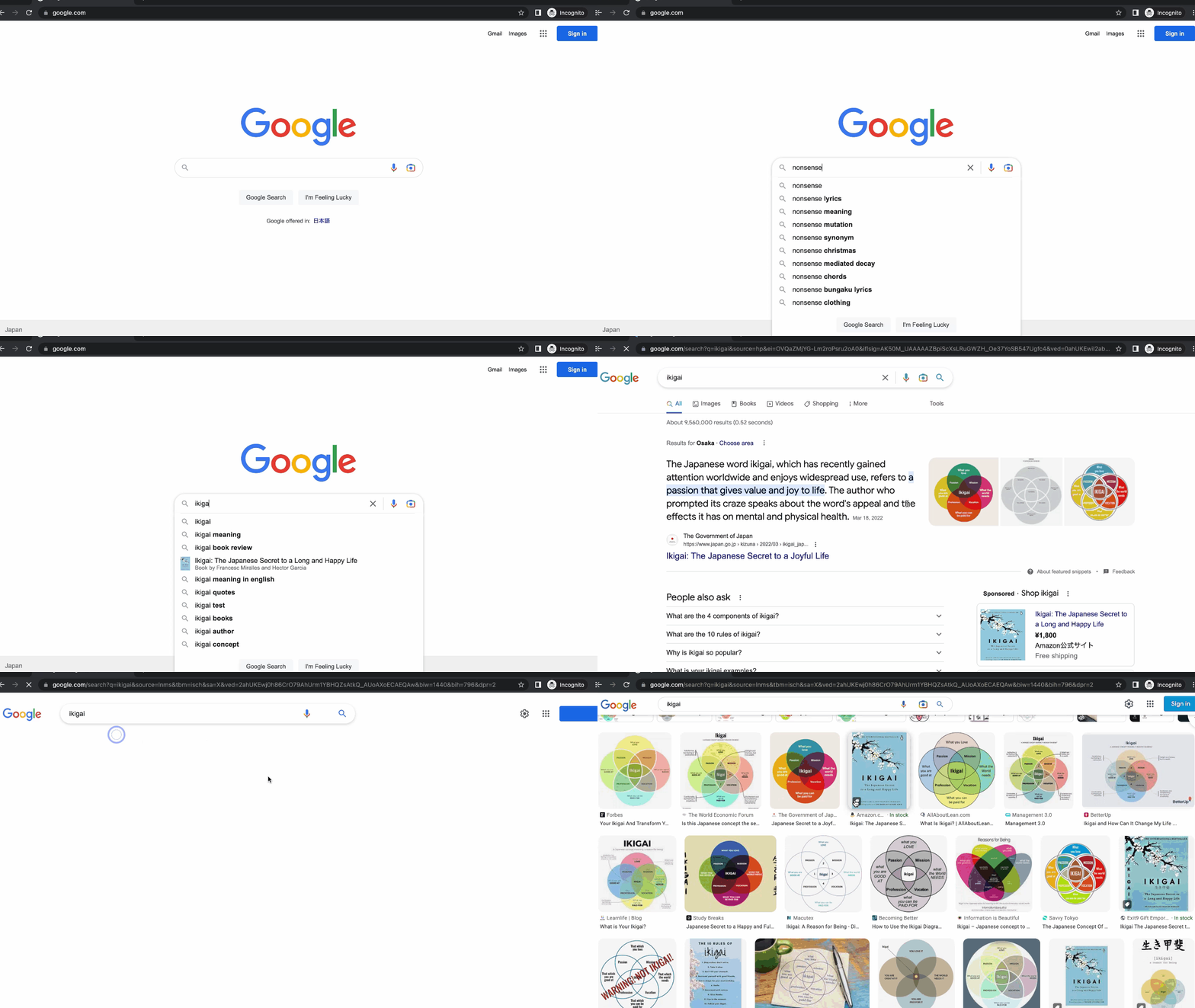
According to these Venn diagrams; at the intersection of what you love, what you are good at, what the world needs and what you can be paid for is “ikigai” (or so you have been led to believe).
Since then, ikigai has become something of a self-help cliché — lauded in front of universities, businesses and anything in-between.
Why is modern-day “ikigai” so popular?
The popularity of ikigai in recent years is not without reason.
The advancement of society has ironically created a feeling of emptiness and aimlessness. Ikigai appears to offer a solution.
In today’s world, we have access to conveniences that our ancestors could only dream of. We no longer have to hunt or gather for our basic survival needs, and we enjoy longer lifespans as well. This shift has opened up opportunities for us to travel the world, order goods with the click of a button and even access healthcare services online. While these developments are undoubtedly positive, we aren’t equipped to deal with the resulting sense of dissatisfaction. We become easy prey for motivational consultants looking to make a quick buck.
The reality is that most motivational speakers either (1) have no idea what ikigai is or (2) they sinisterly profit from the confusion and Japan’s ostensible mysticism (more on that below).
There exists a biased perception of Japan and other Asian cultures, often rooted in the idea that their long history and distinct culture have given them access to hidden truths about life or a higher sense of self through spirituality. This is sometimes referred to as “oriental mysticism.”
However, accepting this perception and the concept of ikigai would be to paint all Japanese people as purpose-driven, optimistic, and happy, which is far from the truth. Despite its many virtues, Japan, like any other country, faces its share of challenges, such as isolation, stress, and depression.
Modern-day “ikigai” is toxic
While at first glance the ikigai diagram might look helpful, it’s much more toxic than you think. The world of today is focused on scarcity: we don’t have the best job, the most money, the best body, the coolest gadgets, etc. Modern-day ikigai adds fuel to this fire.
For instance, let’s say you have a job that you’re good at and the world needs and that pays decently.
One day you stumble across the ikigai Venn diagram. All of a sudden, you’re thrown into a pit of existential dread — “but maybe I don’t LOVE this job?” you think to yourself.
Of course, if you really despise your job, by all means, find another. But to assume you will get your entire life’s fulfilment from one aspect of your life is naive. That’s the beauty of friendship, family, pets, hobbies and exercise — they exist separately from work. It’s impossible to be happy and content all the time. If you did, you wouldn’t be able to delineate between the happy and not-so-happy moments in life.
In the end, buying into ikigai will make you feel like what you have is never enough.
If you want to get yourself out of the ‘scarcity’ mindset, I’d recommend Brenne Brown’s book: Daring Greatly: How the Courage to Be Vulnerable Transforms the Way We Live, Love, Parent, and Lead.
So where did the Venn diagram come from?
Andrés Zuzunaga, a Spanish author and astrologer, published the Purpose Venn Diagram back in 2011. The centre of the diagram was an asterisk (*), not ikigai. Zuzunaga intended for the asterisk to represent a person’s purpose in life.
Some years later, Dan Beuttner completed a Ted Talk, “How to Live to be 100+”.
Dan Buettner and his team researched some of the world’s blue zones (regions in the world where people live longer than average): Sardinia (Italy), Okinawa (Japan) and Loma Linda (America).
In doing so, Buettner mentioned ikigai as one (but definitely not the sole) contributing factor the high life expectancy observed in Okinawa. There wasn’t a reference to need, love, expertise or money — he described ikigai as a person’s reason for waking up in the morning. Interviewees described their ikigai as
- Carrying forth the martial art of karate
- Catching fish for the family three times a week
- A great-great-great granddaughter
What is important to note is that ikigai definitely exists, just not in the way that you’ve been led to believe.
Enter Marc Winn
Marc Winn, a motivational consultant (shudders), saw Buettner’s Ted Talk and combined Zuzunaga’s Purpose Venn diagram with ikigai. He posted it to his blog on 14 May 2014. From there, it went viral.
I looked through Marc Winn’s LinkedIn profile. No work experience or education tied to Japan. A little suspicious to say the least.
In an interview, Zuzunaga admitted that he had no idea that his Purpose Venn diagram would have such an impact:
“I didn’t frankly know that it would have so much impact. It’s what you have said now, it’s because somebody merged it with ikigai, so in a way, I am thankful with this confusion because maybe without that, it wouldn’t be what it is today.” — Andrés Zuzunaga (Source)
What ikigai is to Japanese people
To explain ikigai as a non-Japanese person would be both inappropriate and hypocritical. I can only offer my view from an outsider’s perspective.
Here are a few quotes from the documentary, Jiro Dreams of Sushi (2011). The documentary follows world-renowned sushi chef, Jiro Ono.
Once you decide on your occupation… you must immerse yourself in your work. You have to fall in love with your work. Never complain about your job. You must dedicate your life to mastering your skill. That’s the secret of success… and is the key to being regarded honourably.
I do the same thing over and over, improving bit by bit. There is always a yearning to achieve more. I’ll continue to climb, trying to reach the top, but no one knows where the top is.
I’ve never once hated this job. I fell in love with my work and gave my life to it. Even though I’m eighty-five years old, I don’t feel like retiring. That’s how I feel.
Without defining the term, Jiro’s perspective highlights that ikigai is perhaps less selfish and grandiose compared to Marc Winn’s interpretation. It also seems to be missing elements of capitalism, which most motivational speakers prey on (“do what you love and you’ll never work a day in your life” “make money doing what you love”, etc.)
Final thoughts
Having lived in Japan for the better part of a year, I can honestly say that no Japanese person has ever mentioned ikigai. That in of itself supports the preposition that ikigai is largely a misappropriated Japanese word, retooled into a capitalist weapon for motivational consultants. In any case, be sure to look the other way when you see a non-Japanese person mention the word ikigai.
The author is a writer for Japonica, a Japan-focused publication. If you want to read more of Rahil’s stories, click the link below.


