
[CALL] The Attachance Approach to Creative Journey
The ECHO Way (v3.0) and Beyond
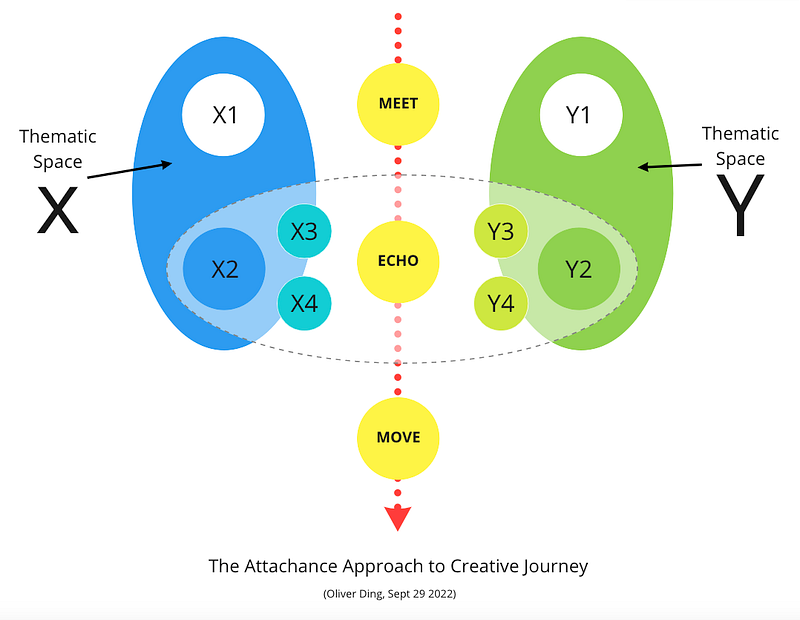
The above diagram is designed for the Attachance approach to Creative Journey. I consider it as the ECHO Way (v3.0) too.
On June 30, 2021, I shared the ECHO Way (v2.0): A practical framework for Knowledge Curation and Boundary Innovation.
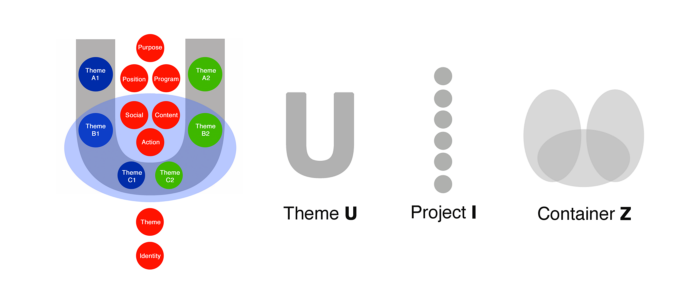
The core ideas of the ECHO Way (v2.0) are the following sub-frameworks:
- Theme U
- Project I
- Container Z
This year, I developed one new idea: Thematic Space. I also launched some new ideas about the concept of Attachance.
Last week, I reflected on my journey of “Activity — Opportunity” Thematic Dialogue and I found there are several “ECHOes” within the journey.
- Slow Cognition: The “Activity — Opportunity” Thematic Dialogue
- Slow Cognition: The Echoes of A Thematic Dialogue
Finally, I made a new framework: the Attachance approach to Creative Journey.
From Creative Actions to Creative Journey
CALL stands for Creative Action Learning Lab. The early topic of CALL is Action-based Creativity. On July 8, 2020, I published The NICE Way and Creative Actions and suggested a “Process as Product” approach to studying creativity.
The “Process as Product” approach emphasizes the creative life experience of people. In 2021, it led to the Path of Creative life. See the diagram below.
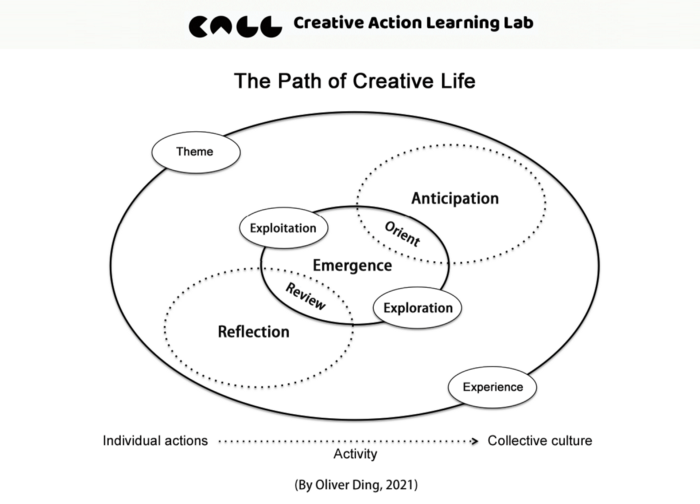
I pointed out that there are three timescales for the “Process as Product” approach in the article about the Path of Creative Life.
- Moment: creative action
- Project: creative work
- Life: creative life
Now I want to add a new unit of analysis called “Creative Journey” to the “Process as Product” approach.
What’s a Creative Journey?
A Creative Journey is a long-term activity including several creative projects.
In the 2000 book Where Mathematics Comes From, George Lakoff and Rafael E. Nunez use the Source-Path-Goal schema as an example of the cognitive science of the embodied mind. See the picture below:
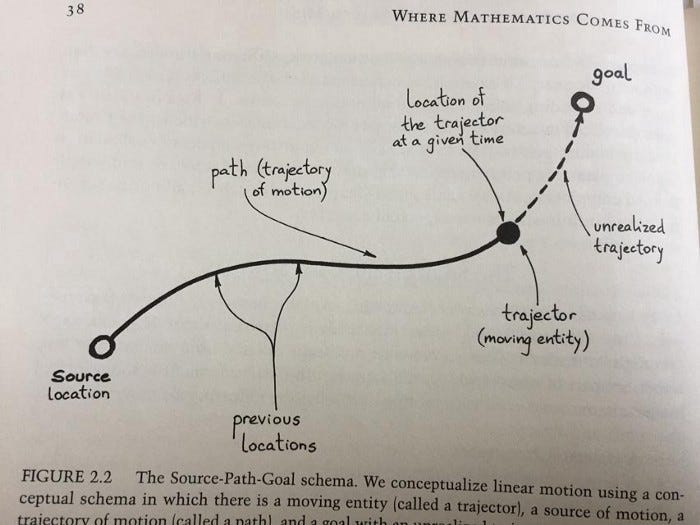
The Source-Path-Goal schema points out that there is an unrealized trajectory between the location of the trajector at a given time (present) and the goal (future). The diagram clearly shows the Temporal Difference between Present and Future is the Spatial Difference between the present location and future goal.
From the perspective of Cognitive Metaphor theory, the metaphor behind the journey is the Event-Structure metaphor. According to George Lakoff and Mark Johnson, Journeys are long-term activities:
A journey takes an extended period of time, covers a lot of ground, and usually involves stopping at a number of destinations along the way before one reaches a final destination, if there is one.
Given the rest of the Event — Structure metaphor, journeys correspond to long-term activities, usually with a number of intermediate purposes. The intermediate purposes are intermediate destinations, the ultimate purpose is the ultimate destination, the actions performed are movements, progress is movement toward a destination, the initial state is the initial location, and achieving the purpose is reaching the ultimate destination.
Every aspect of the source domain of the Event — Structure metaphor may occur in some kind of journey, and hence journeys are very useful for talking about long-term activities of many kinds. (Philosophy in the Flesh, 1999, pp.193–194)
If we put the Source-Path-Goal schema and the Event-Structure metaphor together, we can use them to understand the two levels of “Journey”.
- Journey: the Event-Structure metaphor, long-term activities, and a number of intermediate purposes.
- Project: the Source-Path-Goal schema, short-term projects, each project refers to an intermediate purpose of the Journey.
In this way, we can expand the Path of Creative Life from three units of analysis to four units of analysis:
- Moment: creative action
- Project: creative work
- Journey: creative projects
- Life: creative life
For example, my journey of “Engaging with Activity Theory” is a Creative Journey. On Sept 15, 2022, I reflected on the journey and selected four creative projects for a case study. See the diagram below:
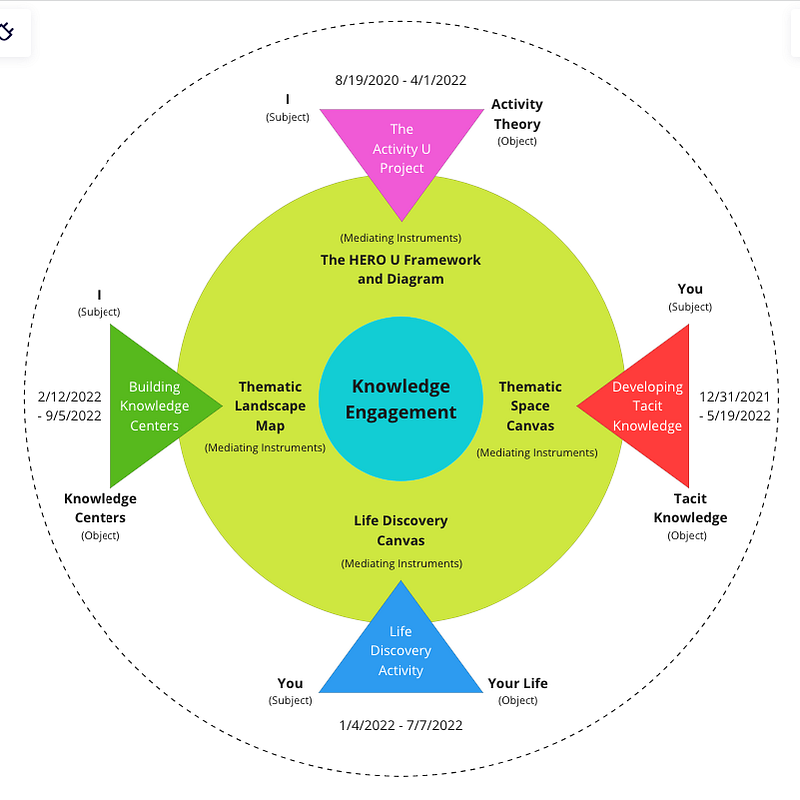
You can find more details in Slow Cognition: Mapping Thematic Journey (Engaging with Activity Theory, 2020–2022).
Thematic Dialogue
Moreover, I found a specific aspect of my creative journey:
I always worked on thematic dialogues and most my significant insights were born from thematic dialogues.
In the past several years, I worked on connecting THEORY and PRACTICE. Since I didn’t work on only one theory, there was a challenge for me. I had to maintain the boundary between one theory and the others. For example, Activity Theory and Ecological Psychology.
However, I found the zone of boundary is a great creative space for developing new ideas. Sometimes, I can find similarities between these two theories.
Eventually, I found a new way to develop a thematic dialogue between two different theories.
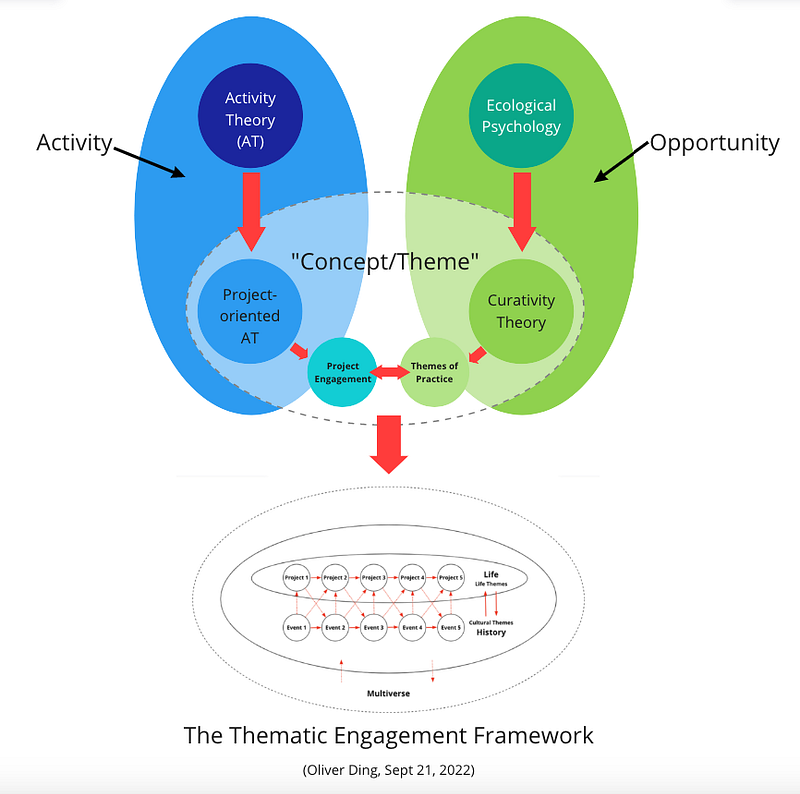
The above diagram represents the process of the journey of making the Thematic Engagement framework by running a thematic dialogue between Activity Theory and Ecological Psychology.
What’s my strategy behind the process?
- Move from “Theory” to “Thematic Space”
- Move from “User” to “Maker”
- Switch between Host and Guest
- Second-wave Development
- Close A Thematic Dialogue
You can find more details in Slow Cognition: The “Activity — Opportunity” Thematic Dialogue.
The ECHO Way (v3.0)
I also found there are six “ECHOes” within the journey of making the Thematic Engagement framework. "Themes of Practice” and “Project Engagement” are not the only two sources of the final outcome. See the diagram below.
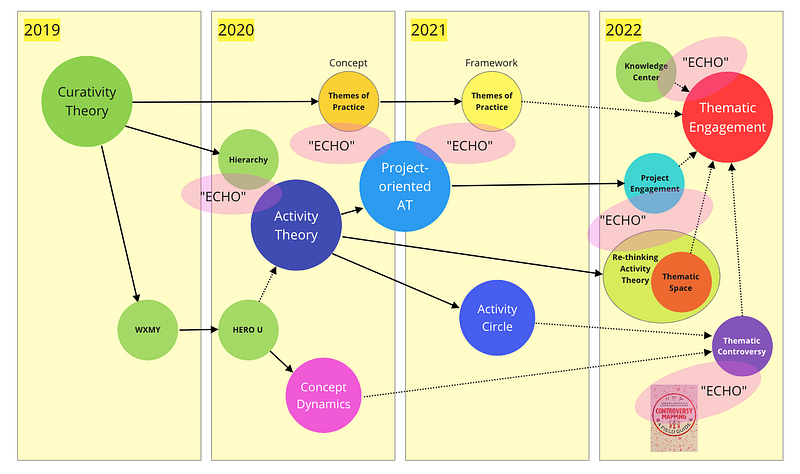
You can find the large-size diagram and more details in Slow Cognition: The Echoes of A Thematic Dialogue.
In order to visualize the details of the thematic dialogue and six ECHOes, I used the ECHO diagram to make many new diagrams. The by-product is the ECHO Way (v3.0).
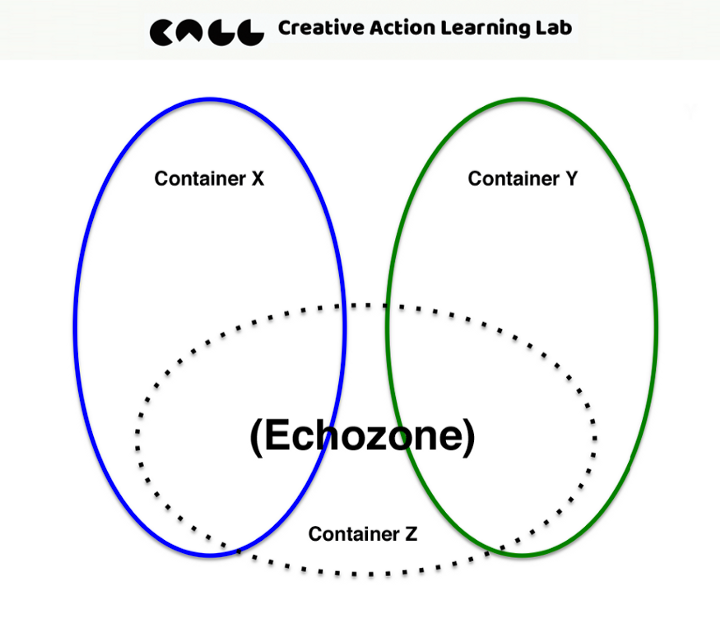
The concept of Container is the core of the Ecological Practice approach. By adjusting the quality and quantity of the Container, we can create advanced frameworks for discussing complex phenomena. The quality of the Container can be potential and actual, and the quantity of the Container can be one or two. If we develop a new framework with one potential container and two actual containers, the outcome is the above diagram.
I named the potential container (Container Z) as Echozone which refers to a creative space containing echoes between Container X and Container Y.
The term “Echo” of “Echozone” refers to a connection between two containers. The connection may lead to a significant insight. It may change Container X or Container Y. The “Echozone” may produce something new beyond X and Y.
While the ECHO Way (v2.0) focuses on Theme U, Project I, and Container Z, the ECHO Way (v3.0) is only about “ECHO”.
See the following examples:
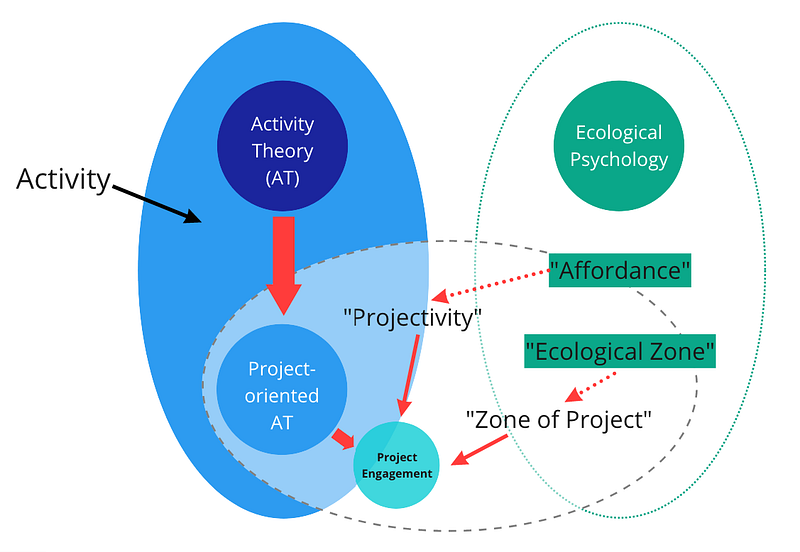
In the above diagram, the Host is the “Activity” thematic space while the Guest is the concept of “Affordance” and the concept of “Zone of Project” from the “Opportunity” thematic space.
In Jan 2021, I worked on developing the Project Engagement (v1.0) framework for Project-oriented Activity Theory. I used the concept of “Projectivity” which is inspired by Ecological Psychology to develop Andy Blunden’s approach to Activity Theory. I also used the concept of “Ecological Zone” to develop the concept of “Zone of Project” for the Project Engagement (v1.0) framework.
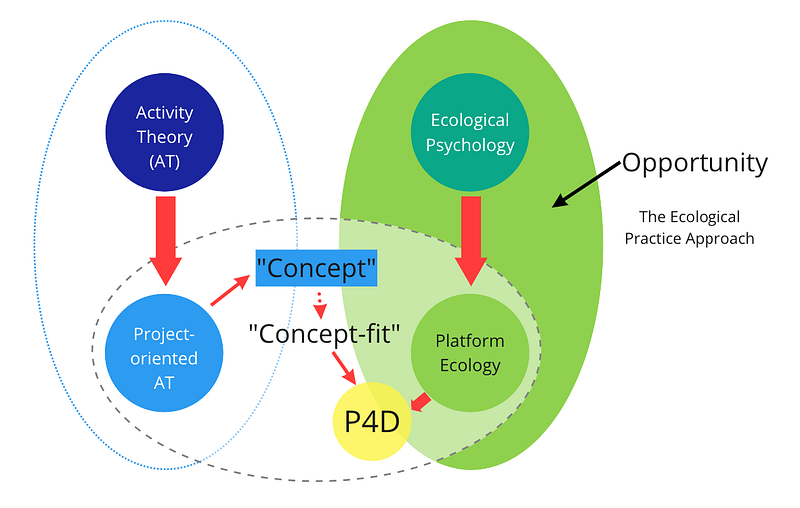
In the above diagram, the Host is the “Opportunity” thematic space while the Guest is the concept of “Concept” from the “Activity” thematic space.
In March 2021, I wrote a book titled Platform for Development: The Ecology of Adult Development in the 21st Century. On March 24, 2021, I introduced the Concept-fit framework for understanding Platform Innovation.
The term “Concept” is adopted from Project-oriented Activity Theory which considers an activity as a process of formation of a brand new concept. The “Concept-fit” framework is a sub-framework of the Platform-for-Development (P4D) framework.
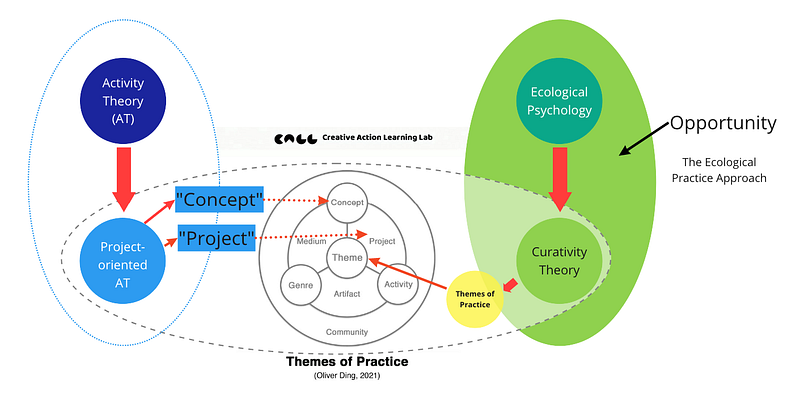
The above diagram represents an “ECHO” between the Project-oriented Activity Theory and the Themes of Practice framework.
In June 2022, I developed the Themes of Practice framework and used “Concept”, “Project” and “Activity” as Operational Concepts. I also used Concept Theory, Activity Theory, and Project-oriented Activity Theory as theoretical resources for the framework.
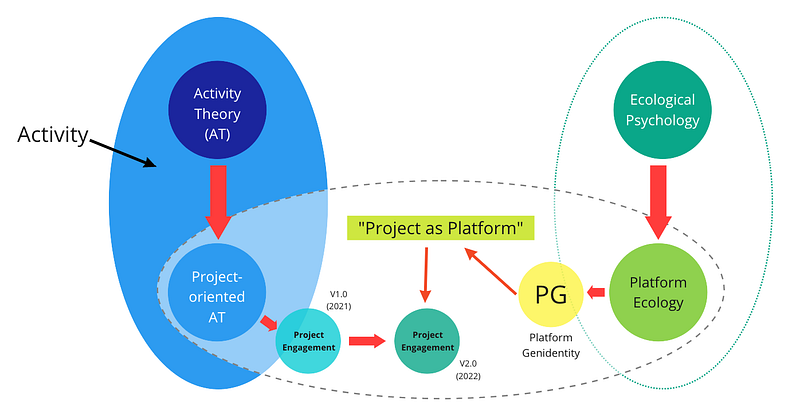
In the above diagram, the Host is the “Activity” thematic space while the Guest is the concept of “Platform Genidentity” from the “Opportunity” thematic space.
In July 2022, I wrote a 116-page file that introduces the Project Engagement approach (v2.1). I used the term “Genidentity” to refer to the transformation from a theme to a project, then a platform because I realized that I can detach the Platform Genidentity framework from the Platform Ecology project, and attach it to the Project Engagement approach.
I used the notion of “Platform(Project)” for the Platform-for-Development framework in 2021. It means a platform is an environment of projects.
The notion of “Project as Platform” refers to a new meaning: some projects will grow into large-scale platforms.
Originally, the Platform Genidentity framework is used for describing the path from project to platform. From the perspective of Project Engagement, I can consider the framework as a part of Project Engagement.
This is a new style of using the ECHO Way diagrams. I called it the ECHO Way (v3.0).
The Attachance Approach to Creative Journey
Yesterday, I reflected on the ECHO Way (v3.0) and my creative journey of engaging with Activity Theory and the “Activity — Opportunity” thematic dialogue.
I realized that there is a deep pattern behind these journeys. See the diagram below.
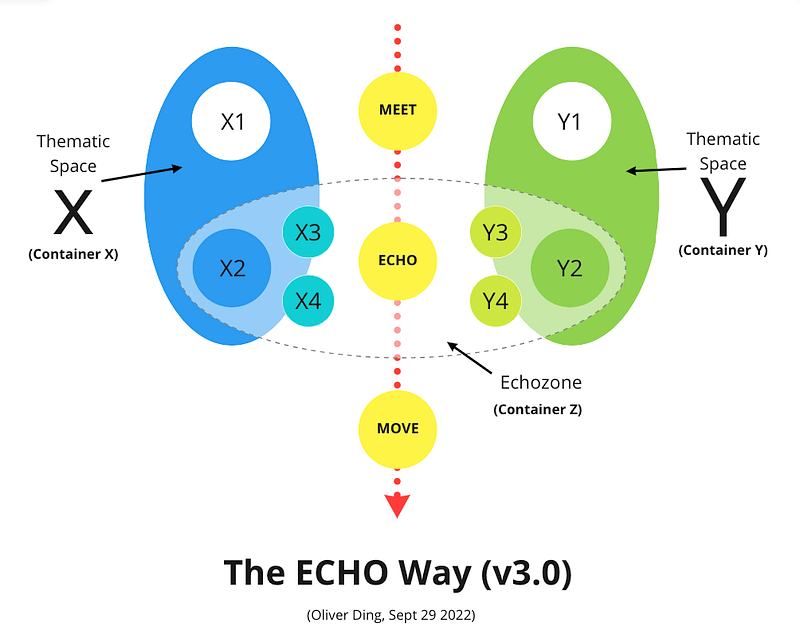
The basic unit of creative thematic dialogue is visualized with the “MEET — ECHO-MOVE” schema in the above diagram.
- MEET: When Container X meets Container Y!
- ECHO: There is an ECHO inside the Container Z.
- MOVE: The ECHO leads to a Significant Insight that guides a Move.
Container Z is the creative space where we face challenges and opportunities.
For the thematic dialogue, Container X means Thematic Space X. For example, my “Activity” thematic space. X1, X2, X3, and X4 refer to members of the thematic space X.
Container Y means Thematic Space Y. For example, my “Opportunity” thematic space. Y1, Y2, Y3, and Y4 refer to members of the thematic space X.
The key to the thematic dialogue is the differences and similarities between members inside one thematic space.
We also need to pay attention to the differences and similarities between members inside Container Z: the ECHOZONE.
A real ECHO is based on discovering differences and similarities between members.
Finally, we can return to the basic model of the Ecological Practice approach. See the diagram below.
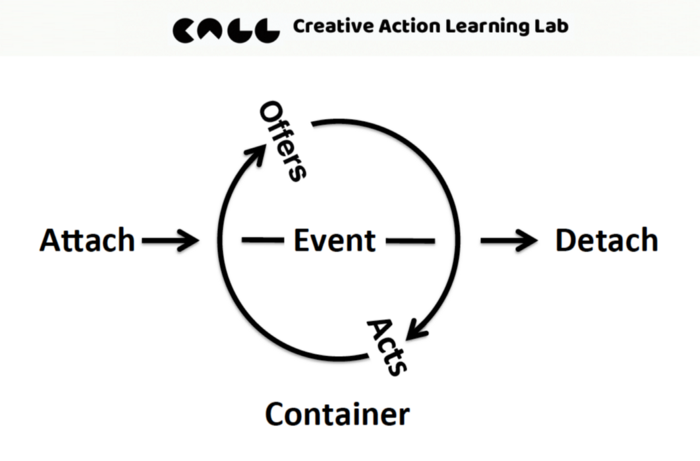
The above diagram combines three core concepts of the Ecological Practice approach together: Affordance, Attachance, and Containance. The term “Offers” is an affordance-inspired concept, it refers to opportunities afforded by the Container. The group of “Offer — Act” forms “Event” which changes the status of the Container. The new status of the Container affords new opportunities which guide the new acts and events. In a broad sense, the Ecological Practice approach has its philosophical roots in traditional Pragmatism.
In 2019, I started working on my own theoretical account of the Ecological Practice approach after finishing a book titled Curativity. The 2019 version of the approach is a curated toolkit version. The concept of Attachance is part of the toolkit. In May 2020, I wrote a book titled After Affordance: The Ecological Approach to Human Action in which I proposed several new theoretical ideas for expanding ecological psychology to the modern digital environment. The primary theme of After Affordance is the concept of Attachance.
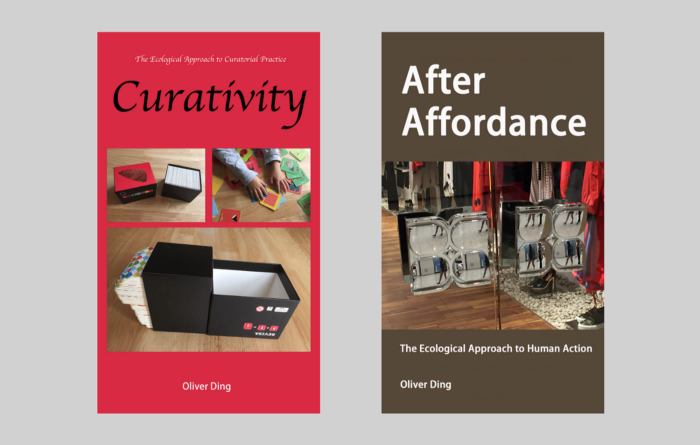
The concept of Attachance is planned to develop as 1) an ecological practice concept for practice studies such as interaction design and startup innovation, and 2) a philosophical concept for developing a social theory.
The book After Affordance only achieves the first goal and it focuses on the following acts:
- Attaching to an environment
- Detaching from an environment
- Attaching to an object
- Detaching from an object
For the Creative Journey, the Container Z is the Environment.
The “MEET-ECHO-MOVE” schema matches the basic model of Ecological Practice Practice.
- MEET: Attach
- ECHO: Event (Offers — Acts)
- MOVE: Detach
Since this is a basic model, we can scale it and curate the large-scale complex in many ways such as Chains, Networks, Circles, Hierarchies, etc.
In this way, we develop a new approach to Creative Journey and Creative Life in general.
Notes
I use the concept of Attachance in many ways.
The Attachance Perspective refers to its philosophical meaning. You can find more details in D as Diagramming: The Attachance Perspective.
The theoretical concept of “Attachance” for the Ecological Practice Approach. It refers to what I explored in the 2020 book After Affordance. For example, I used it and Affordance together for discussing creative actions. You can find more details in Creative Actions: Second-order Affordance and Attachance.
The word “Attachance” for normal discussions. I often discuss some stories or topics from the perspective of Attachance. You can find an example in Possible Practices: Attach, Detach, and Opportunities.
I also used “Attachance” to rename the Ecological Transformation Framework. See more details in The Attachance Framework (2018) and Thematic Engagement.


