
Creative and Surprising Ways to Use Jupyter Notebooks
Learn how a computational notebook can improve your life.
Wait... what? Isn’t it a popular tool for data scientists? Yes, it is.
However, Jupyter is so much more than just a data-analysis tool
Jupyter is a free, open-source, interactive web tool known as a computational notebook. This client-based interactive web application allows users to create and share codes, equations, visualizations, as well as text and images. Creative people figured out a long time ago that they can use all these features of Jupyter notebooks to their advantage. So when I say that a Jupyter notebook can improve your life, I really mean it.
If you’ve never seen a Jupyter book in action, check out these examples in your browser first:
Create presentations and slides
It probably won’t be as intuitive as building the same presentation in PowerPoint, but it does sound like a fun experiment. Here is an entire Medium article that explains how to build a decent presentation in Jupyter step-by-step:
Build a game
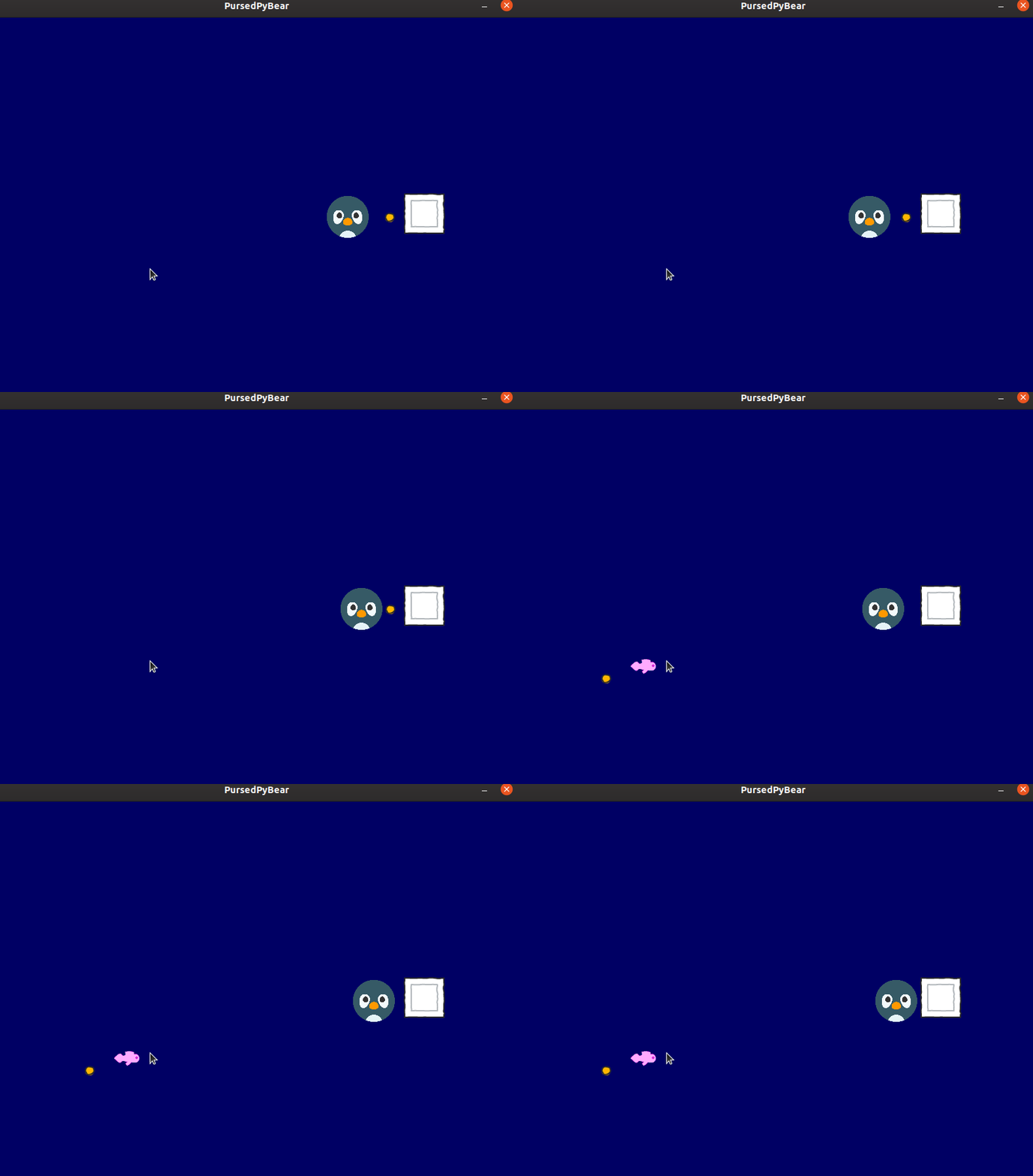
Python is known as a great beginner-friendly language. But where does one begin? Playing games and building games are the most popular ways to learn the basics of programming without getting bored too quickly.
While there are tons of amazing Python libraries out there, I would say ppb is one the easiest libraries for a beginner:
Edit images
I would never think of it, but some people use Jupyter to edit images or even create coloring books!
Improve your time management
Almost any online resource you use has a web application interface (API). So in theory, you can get, parse, and analyze your data from any app. You could use a Notion API or, say, your google calendar data to analyze your day-to-day life and maybe create a few fancy charts along the way. Here is a little something that might inspire you:
Practice your coding skills
This looks like a fun alternative to HackerRank:
Teach kids programming
Python has a lot of great visual libraries that kids are going to love. Turtle is only one of them. When I was working as a code instructor in San Francisco, I was always impressed by how easily kids get a hang of this Python library for drawing. I think the youngest student in my class was a 7-year-old girl who managed to draw her entire family using Turtle in replit.
Here is how you can set up Turtle on Jupyter:
Blogging
But… why? I don’t have an answer for you, but I sincerely enjoyed reading about it. I hope you will too:
- Blogging With IPython in Blogger, also available in blog post form by Fernando Perez. The fill repository can be found here.
- Blogging With IPython in Octopress, by Jake van der Plas. Also available as a blog post.
- Blogging With IPython in Nikola, also available in blog post form by Damián Avila.
Learn programming
A quick search on GitHub reveals thousands of learning resources built using Jupyter notebooks. As an example, here is an entire Python course for beginners:
Create tutorials
It makes sense to learn Python and data science using the Jupyter notebooks, but did you know you can create a tutorial on virtually any topic using the same tool? I found quite a few math, physics, chemistry, biology, and earth science tutorials created in Jupyter. My personal favorite? This interactive workshop on language analysis:
Take notes
Are you still with me? Good, because we still have a lot of cool things to cover.
You can find plenty of personal to-do lists, class notes, and entire lectures in Jupyter online. I even found one of the homework sets for Harvard’s CS 109 Data Science course called Desperately Seeking Silver.
Learn other languages besides Python
Python is great, but what if you are a JavaScript fan? No worries. There is something for you in here as well! Check out this interactive notebook that shows how to use a D3 library:
Practice your CSS skills
…and make your notebook pretty:
Draw
My quick online search revealed so many amazing examples of creative coding in Jupyter. Here is only one of them:
Or check out this example of 3D drawing using Matplotlib:
Become a data-driven journalist
Data-driven journalism is a new and exciting medium for people who love to write, research, and can put it all together nicely:
Write and publish a book
Here is an entire lecture on this topic in case you’re interested:
Win a game
Did you know that Python can be used to calculate the next state of the game board and possibly win the game?
Some of the great examples I could find include:
- Conway’s Game of Life. Interesting use of convolution operation to calculate the next move.
- pynguins. Using Jupyter notebook, Python, and NumPy to solve Board Game “Penguins on Ice”.
- SudokuCodeColf.
Create a personal weight notebook
A scientific approach to weight loss:
Access and program an IBM quantum computer via notebooks
This is definitely a topic for advanced Python users, but I’ll leave it here. To be honest, I secretly hope that it will inspire someone to do something awesome with these tools (because I will never be able to do it):
If you liked this article, here are some other articles you may enjoy:
More content at plainenglish.io


