
Consumer’s guide to making a solar panel system.
Part 4: Practical Issues to consider before taking the plunge.
Summary to previous sections
- In our solar journey, we began by examining the crucial elements of your roof in Part 1, understanding the factors that determine its readiness for a solar PV system, whether it’s on your house, garage, or any available space.
- Part 2 delved into the intricacies of calculating electrical demand, offering insights into consumption behavior.
- Bringing it all together in Part 3, we explored the components of a PV system, focusing on the critical choices surrounding solar panels and inverters.
This summary provides a high-level overview, but I strongly recommend to read the preceding three parts for a comprehensive understanding. By now, you should have a clear vision of your ideal system. In this fourth part, we shift our focus to the practical challenges of installing a PV system, putting the system to the test against real-world considerations. Let’s navigate the practicalities before you take the plunge into solar energy.
Accessibility, again
I touched this topic briefly in part 1, and here we look at it a bit closer. The term “accessibility” itself has several interpretations in a PV system.
We, of course, discussed in part 1 about accessibility to a roof. It should be free of obstructions and sufficiently safe to access and walk on. Let’s extend that discussion to a separate roof, like a garage or pool or garden shed. The advantage is that they are short, and have high scope for DIY. These are typically detached from the main house (which has the mains and meters). In an off-grid system, this is fine, since you don’t need to talk to the grid, but it may be a bit of a problem if you want to connect to the grid. The detached roof should be connected to the house, through some fuse box. If that is not already there, you need to make one, or you need to create a pathway (dig a trench, run a cable pipe, anything) from the garage to the mains. This path should have an AC cable.
The inverter must be placed closest to the panels. The inverter must be connected to the grid through the mains.
Then there’s the question of the roof itself. Remember mentioning “mounting structures” in previous parts? Here’s a sample image of mounting placed on a tilted roof.
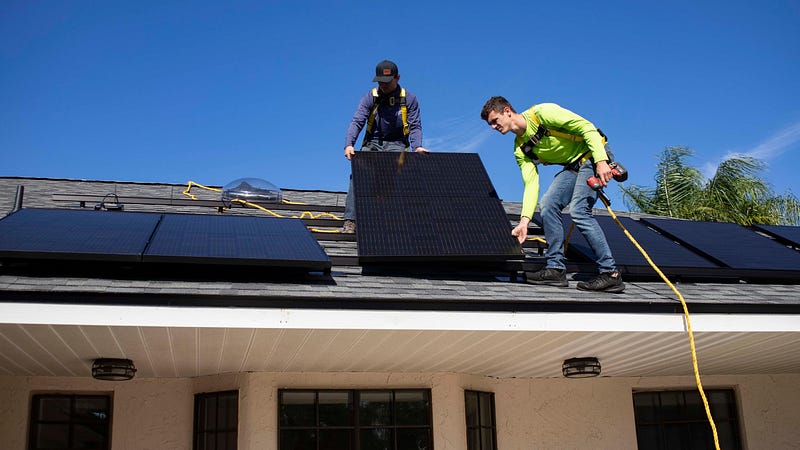
In a flat roof, they are laid on the ground (more about that in a bit) . In the tilted roof, they are drilled into the under-roof, or the structural support of the roof. You can simply lift and remove tiles to access this underroof, but if your roof has slates or sheet metal, you need equipment and effort to cut through. And placing panels on a glass roof is a strict no, it is just not worth the risk. If you have a roof with some kind of vegetation (like grass or moss), it could pose a fire hazard. The underbelly of a solar panel can be quite hot (above 65 degrees — Celsius, not Fahrenheit) and under prolonged exposure, it may affect the green negatively.
Cost and Returns

This is the biggest decision factor, ultimately. Every component has a cost, and PV systems are a pretty huge investment. A typical system with 8 panels, sufficient for a single house, can be anywhere upwards of 4000 euros EVEN if you are doing the installation by yourselves. The batteries can cost upwards of 2000 euros each, which brings the system cost even higher. The additional costs, like hiring an installer, or renting out specific equipment, or the mandatory fee to be paid for local permits, that is very region-specific.
The typical returns of a PV system is the money you save by not spending on the electricity bill, and maybe also by selling some power to the grid. From my observations, the payback period for a PV system is a healthy 6–7 years, and may stretch to 10–12 years if you produce in off-grid or low sunlight areas. Since PV panels are expected to function at high warranty for a minimum of 20 years, anything outside of the payback period is a profit. This could be a serious deterrent if you are in the market for a quick ROI.
Many countries are waking up to the issues of allowing unregulated injection into the grid (by that I mean selling solar power back), which affects the electrical infrastructure of the grid. They are bringing policies to limit, or tax, this quantity and money, so you are better off going for maximizing self-consumption (as in, getting that costly battery).
Technical know-how
Let’s be honest — If this were so easy, I would be out of a job.
Building your own PV system requires quite the learning, market survey, technical clarity of the products involved, how they can be integrated, what are the additional constraints and possibilities. It also needs awareness of the energy policies, grid policies and some good patience (you know, supply chain and personnel issues if you are not able to lift a panel yourselves). And then there’s municipality-level legislations, permits and things bureaucratic.
I intend this article series as a value addition in your research towards deciding whether or not you want a PV system, and provide some insights, but this is not the complete DIY toolkit for the process.
Gambling into uncertainty
Sure, you want to produce PV power. But, like we saw enough number of times in these articles, there are factors beyond your control that can influence your system. Let’s take a very simple example — Suppose your roof has a small tree in front of it. In a few years, it will grow up to block your panels. If that tree is “public”, what is the solution where you get power and everyone else gets the tree?
Then there’s the trend in electricity prices. It is a subject of interesting academic debate, but the general theory is that if the grid becomes greener (as in, move from oil to sun and wind), the cost of electricity will get cheaper. This may mean that your PV system has a longer payback period.
Final thoughts
Installing a PV system can be a very significant decision. It can also tie in with your other future decisions to embrace sustainability, like an EV, and is a solid first step. However, there are several variables influencing this choice, and the shape and size of your final system. My hope is that after reading this, you are able to ask the right questions both of yourselves, and of an engineer who is selling you a PV system, like me.
If you think this article added value, please do share with your friends, and maybe a bit of encouragement along my way!
P.S, a bit of self-publicity: I’d love for you to also check out my other posts, (mostly) non-technical articles as well, here: