avatarAswath

Free AI web copilot to create summaries, insights and extended knowledge, download it at here

5331

Abstract

below (<a href="https://support.smappee.com/hc/en-gb/articles/202343685-Do-I-have-a-Single-phase-three-phase-star-or-three-phase-delta-electrical-installation-">source</a>). This decides the phase of the inverter and also some other components.</p><figure id="6522"><img src="https://cdn-images-1.readmedium.com/v2/resize:fit:800/0*HMSfyo7xcRVADWwE.png"><figcaption></figcaption></figure><h2 id="bdd0">The current constraint</h2><p id="7392">The “main switch”, which can be found around this mains, also carries a rating called “Amperage”. This is the maximum current of the system.</p><p id="4303" type="7">The output (AC) current of the inverter has to be lesser than the main current.</p><p id="7153"><b>You can find the output current in the product specifications, AKA data sheet</b>. Just going with the most popular brands from a google search is quite adequate — Unless of course you have specific requirements, like optimization. Download the catalogue and datasheets of the most popular inverters, and read them very closely.</p><h2 id="0ba2">The capacity constraint</h2><p id="8790">Another data point you can find on the data sheet of the inverter is the capacity of the inverter. There is the kilowatt capacity (which is the rated power), like what you call a 2-kilowatt inverter has a rated power of, 2 kilowatt. There is another capacity called the VA (Volt-Ampere) capacity, and can be called as apparent power.</p><p id="c7f9">If you don’t find it, apparent power is around 1.11 times the kilowatt power. This number can be important in some local regulations.</p><h1 id="8883">Special inverters:</h1><p id="3704">The regular inverter I spoke above are technically called “string” or “serial” inverters, meaning they connect panels in the same line of connection. There are some specific cases which need different inverters.</p><h2 id="8c99">Hybrid inverters</h2><p id="3329">These are also serial/string inverters, but the difference is that they support batteries. Hybrids are becoming popular in grid-connected systems as well, but they are the staple in an off-grid system. Any company which sells a hybrid inverter usually also sells its own batteries. Generally, there is limited, or virtually no, cross-compatibility, so if you want a Brand A inverter, go for Brand A battery too.</p><h2 id="b678">Inverter with optimizers</h2><p id="58fb">These are inverters which have an additional component called optimizers, which is attached to each solar panel. The optimizers are useful in areas with a lot of shading objects, to make most use of the available sunlight. Of course, these are far more expensive.</p><h2 id="3204">Microinverters</h2><p id="b76f">As the name implies, these are “small” inverters. Microinverters are attached to each solar panel, just like the optimizers, but each one is an independent inverter. This is also a way to highly optimize power production, but these systems are expensive.</p><h1 id="1e12">Concluding remarks</h1><p id="d081">The choice of inverter depends on the type of system you need, and the electrical connection of your house. It also depends, as in case of many countries, on the local regulations. So, if you’re DIY-ing this, getting a basic overview of those regulations will help a lot. <b>Also good to know, some inverters behave differently when they are made off-grid. It is very important to know the distinction.</b></p><h1 id="9e22">Solar Panels</h1><p id="8c19">Now lets get to business — How to choose solar panels?</p><figure id="3d5e"><img src="https://cdn-images-1.readmedium.com/v2/resize:fit:800/0*rKHAODGN4tLzSQW1"><figcaption>Photo by <a href="https://unsplash.com/@bdchu614?utm_source=medium&amp;utm_medium=referral">Brendan Church</a> on <a href="https://unsplash.com?utm_source=medium&amp;utm_medium=referral">Unsplash</a></figcaption></figure><p id="4080">The solar panels also have their datasheet, and some of the most important specifications usually on almost all websites selling them. The following are the various decisions to be made when choosing the panels.</p><h2 id="4e57">1. Capacity of solar panel (Watts)</h2><p id="c7ce">Generally speaking, the higher the capacity of the panel, the higher its output. The market has anywhere between 270 watts to upwards of 500 watts.</p><h2 id="4afe">2. Type of cells (technology)</h2><p id="13cf">This is for those more interested in the technology of solar cells. As a thumb rule, you can go for the half-cut solar cells. Here’s a very good primer on the concept:</p><div id="c7b9" class="link-block"> <a href="https://www.solarreviews.com/blog/half-cut-solar-cell-technology-explained"> <div> <div> <h2>What is half-cut solar cell technology?</h2> <div><h3>Half-cut solar cells create a more efficient solar panel, producing more energy per square foot than traditional…</h3></div> <div><p>www.solarreviews.com</p></div> </div> <div> <div style="background-image: url(https://miro.readmedium.com/v2/resize:fit:320/0*rof8xkLmOxIVnXo1)"></div> </div> </div> </a> </div><h2 id="26ca">3. Number of panels</h2><p id="cd98">This is another somewhat easy aspect, but it also involves a little bit of research.</p><p id="fd

Options

63"><b><i>One of the easiest mistakes</i></b> we may end up doing is the following. If you are buying 400 watt panels for a demand of 3300 kWh, you need 3300/8 = 8.25–> 9 panels. <b>This is not necessarily how solar energy works.</b></p><p id="27af" type="7">Solar power produced depends on the capacity, the geography (location) and even the manner of orientation of the panels.</p><p id="8d44">If you don’t want to do too much calculation, or don’t want to use an open-source calculator like SAM, you can do the following. Use a site like <a href="https://globalsolaratlas.info/map">Global Solar Atlas</a> or <a href="https://re.jrc.ec.europa.eu/pvg_tools/en/">PVGIS</a>(specialized for EU) and use the default variables to get a <b>VERY</b> approximate output. Fine-tune this result to match your electrical demand, and search for panels that can have the required wattage and size.</p><p id="9bf6">Larger capacity means lesser number of panels, but they are also bigger in size, so the roof may not the right dimensions for them.</p><p id="f37b">Pro-tip: Most panels in the market fall around the dimension of 1.8m in length and 1.2m in width, so using that as a template would be a great starting point.</p><h2 id="8a7b">4. Minimum and maximum number of panels</h2><p id="ac8c">This can be slightly tricky. The number of minimum and maximum depend on both the specs of the panel, and the specs of the inverter. In a “string”, the voltage of the panel gets added up, while the total current is the same. So,</p><ul><li>The total voltage should be higher than the “startup voltage” of the inverter</li><li>The total voltage should be lesser than the “maximum voltage” of the inverter</li><li>The total capacity of the panels should be equal to, or greater than the capacity of the inverter.</li><li>The total current of the solar panels should be lesser than the input current of the inverter.</li></ul><p id="41bb">You can find these terms in the data sheets of the two products. I would be more than happy to explain any specific questions.</p><h1 id="980a">Concluding Remarks</h1><p id="a0ea">The choice and number of panels depends on several factors, including demand, space, inverter and ease of installation.</p><h1 id="36f8">Good to know</h1><p id="dec5">The system calculation as I discuss here is very superficial. There are several variables that go into these calculations, so if you want to be precise, I would really recommend further reading, or reaching out to the likes of me. Plus, this article assumes you are savvy enough to relate to terms like “data sheet” — they are one google search away, so it should be relatively easy to find. The rest, again, recommendations as above.</p><h1 id="726d">Other main components</h1><p id="6c34">The rest can be explained with much lesser detail:</p><ul><li><b>Batteries</b>: I already mentioned about choosing the same brand, so go for batteries based on your capacity. As a general rule, assume like this — If the capacity of your system exceeds the capacity of 1 battery, go for two. Batteries are generally expensive, so choosing one, or more, should be very carefully considered. Example — You decide to make a 6 kilo-watt system, and choose a 5-kWh battery, you need two of those batteries. This is a very general calculation.</li><li><b>Cables</b>: You need these to connect the system to the mains. Go for 4mm cables, or if you want better safety, 6mm cables. The length of cables depends on where your panels are and where your inverter is.</li><li><b>Switches</b>: Depending on your mains, they can also be one or 3-phase. The amperage of the switch should always be higher than the inverter.</li><li><b>Data loggers/additional meters:</b> This may be needed if you want to track your production and go for the data analytics. I would particularly recommend to spend money on this if you are going off-grid.</li><li><b>Other components: </b>This may be any additional components that are needed, based on the individual product and compatibility. When you choose your brand of panels and inverters, you would get an idea of what else you need for the system.</li></ul><h1 id="f69b">Concluding remarks, for real.</h1><p id="f66c">If you’ve stayed with me until here, first off, thanks. I know it’s a very long article. But at the end of this, you should have a fair idea of how to plan your PV system, and how to decide on the components of it. In the next part, I will conclude this series with a few thoughts on practical considerations about installation of the system.</p><p id="09a1">P.S, a bit of self-publicity: I’d love for you to also check out my other posts, <b><i>(mostly)</i></b> non-technical articles as well, here:</p><div id="a626" class="link-block"> <a href="https://aswaths.space"> <div> <div> <h2>Aswath Subramanian - Medium</h2> <div><h3>Read writing from Aswath Subramanian on Medium. I ask questions and do solar panel stuff. Every day, Aswath Subramanian…</h3></div> <div><p>aswaths.space</p></div> </div> <div> <div style="background-image: url(https://miro.readmedium.com/v2/resize:fit:320/0*Npjn2E8zetkhS038)"></div> </div> </div> </a> </div></article></body>

Consumer’s guide to making a solar panel system.

Part 3: Making the perfect list of components.
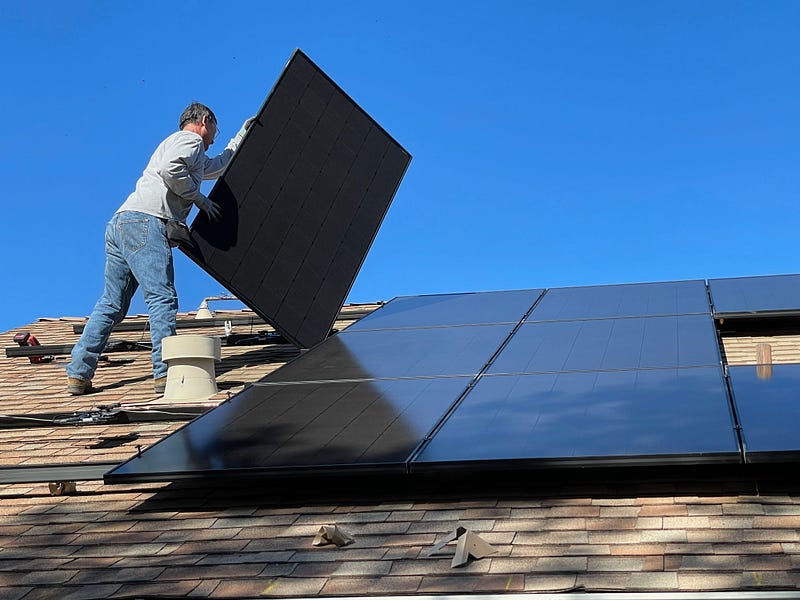
Photo by Bill Mead on Unsplash

Before jumping in..

Let’s have a short review of what we already know from the previous sections:

  1. The type, construction material and structures on the roof has a bearing on the feasibility and performance of a PV system.
  2. The available space on the roof determines the maximum number and layout of solar panels that can be placed.
  3. The electricity demand must be calculated across the year to have a good idea about consumption patterns and optimizations. It also determines the capacity of the PV system, subjected to the roof constraints in the above points.
  4. The choice of having a grid-connected or off-grid system can influence the system.

At this point, you know that your roof is good for panels, and you are aware of what your electricity demand is. In this section, we introduce the various parts of a PV system, how they are to be chosen based on a few calculations (I swear to keep it simple) and how the electrical system of your house plays a role. If you’d like to catch up:

Parts of the PV system.

Photo by Ryan Quintal on Unsplash

Let’s make a list of the hardware and electrical components of a solar PV system. Please note that this list does not include structural components, like mountings, and installation-specific activities, like drilling, lifting and others:

  • Solar panels
  • Inverter(s)
  • Switches (minimum of two)
  • Battery(-ies)
  • DC Cable/wires
  • Additional meters
  • Data loggers
  • Optimizers
  • Other specific components

The bold-marked items in this list are mandatory, while the other components are dependent on need and situation. Usually, when you contract any service provider/company for your system, chances are, they have a fixed catalogue of components, mainly panels and inverters. This saves both you, and the company, the effort of extremely large varieties to be planned, and also keep up with the market standard as best as they can.

However, for the scope of this article, we’ll assume you are doing the legwork. So let’s go over the components in terms of what to look for in each of them.

Inverter

If you want to go for the largest possible output, the limiting factor of a PV system is the inverter.

The choice of inverter is limited by BOTH the grid regulations and the electrical system (the so-called mains) of the house. It, in turn, limits the number of panels as well.

The phase constraint

What do I mean by the mains/meter?

You know, that thing where you can read the electricity?
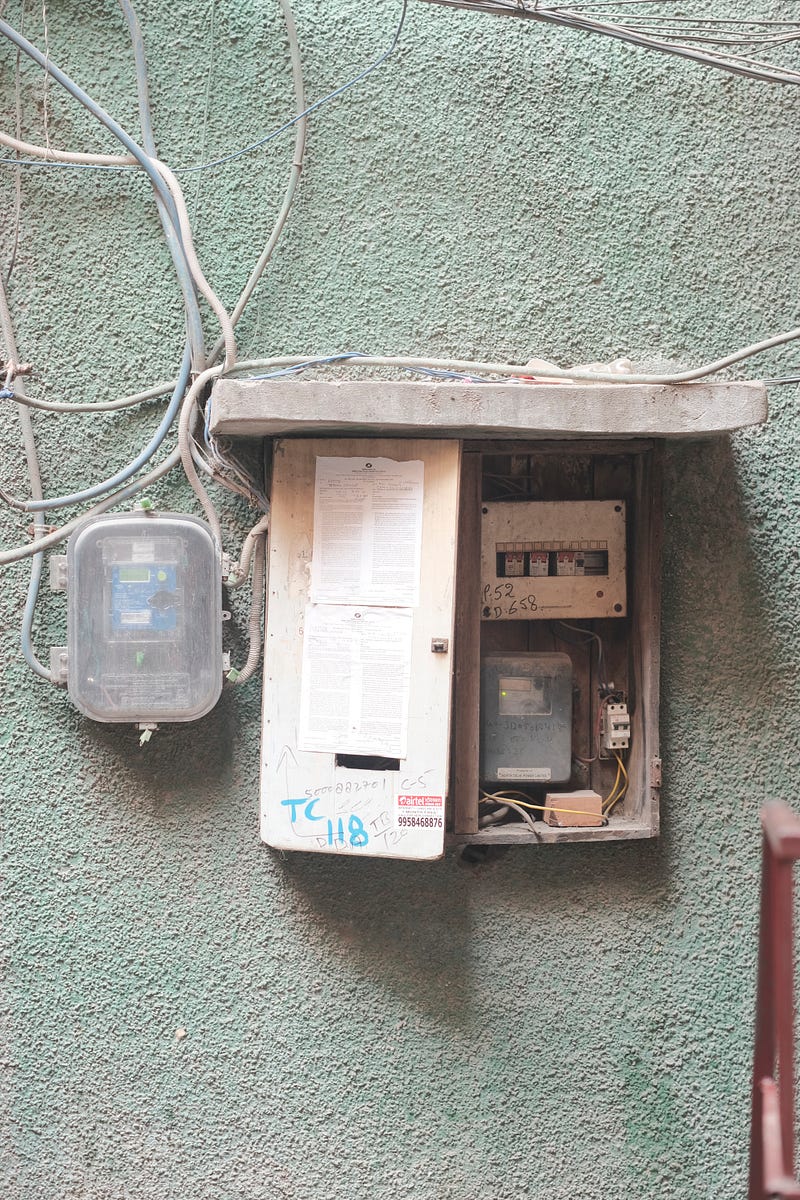
Photo by Sehajpal Singh on Unsplash

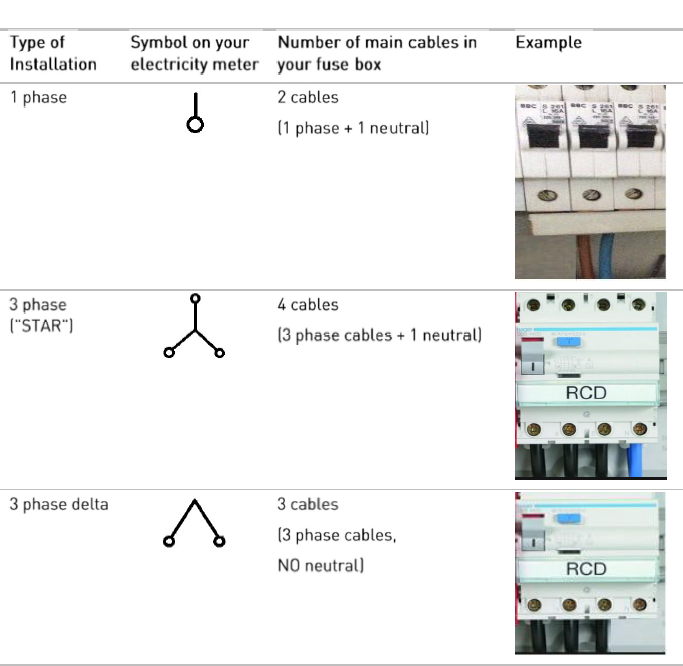
The mains can be one of the following three types: 1-phase, 3-phase star, 3-phase delta. How to check what is your connection is shown in image below (source). This decides the phase of the inverter and also some other components.
The current constraint

The “main switch”, which can be found around this mains, also carries a rating called “Amperage”. This is the maximum current of the system.

The output (AC) current of the inverter has to be lesser than the main current.

You can find the output current in the product specifications, AKA data sheet. Just going with the most popular brands from a google search is quite adequate — Unless of course you have specific requirements, like optimization. Download the catalogue and datasheets of the most popular inverters, and read them very closely.

The capacity constraint

Another data point you can find on the data sheet of the inverter is the capacity of the inverter. There is the kilowatt capacity (which is the rated power), like what you call a 2-kilowatt inverter has a rated power of, 2 kilowatt. There is another capacity called the VA (Volt-Ampere) capacity, and can be called as apparent power.

If you don’t find it, apparent power is around 1.11 times the kilowatt power. This number can be important in some local regulations.

Special inverters:

The regular inverter I spoke above are technically called “string” or “serial” inverters, meaning they connect panels in the same line of connection. There are some specific cases which need different inverters.

Hybrid inverters

These are also serial/string inverters, but the difference is that they support batteries. Hybrids are becoming popular in grid-connected systems as well, but they are the staple in an off-grid system. Any company which sells a hybrid inverter usually also sells its own batteries. Generally, there is limited, or virtually no, cross-compatibility, so if you want a Brand A inverter, go for Brand A battery too.

Inverter with optimizers

These are inverters which have an additional component called optimizers, which is attached to each solar panel. The optimizers are useful in areas with a lot of shading objects, to make most use of the available sunlight. Of course, these are far more expensive.

Microinverters

As the name implies, these are “small” inverters. Microinverters are attached to each solar panel, just like the optimizers, but each one is an independent inverter. This is also a way to highly optimize power production, but these systems are expensive.

Concluding remarks

The choice of inverter depends on the type of system you need, and the electrical connection of your house. It also depends, as in case of many countries, on the local regulations. So, if you’re DIY-ing this, getting a basic overview of those regulations will help a lot. Also good to know, some inverters behave differently when they are made off-grid. It is very important to know the distinction.

Solar Panels

Now lets get to business — How to choose solar panels?

Photo by Brendan Church on Unsplash

The solar panels also have their datasheet, and some of the most important specifications usually on almost all websites selling them. The following are the various decisions to be made when choosing the panels.

1. Capacity of solar panel (Watts)

Generally speaking, the higher the capacity of the panel, the higher its output. The market has anywhere between 270 watts to upwards of 500 watts.

2. Type of cells (technology)

This is for those more interested in the technology of solar cells. As a thumb rule, you can go for the half-cut solar cells. Here’s a very good primer on the concept:

3. Number of panels

This is another somewhat easy aspect, but it also involves a little bit of research.

One of the easiest mistakes we may end up doing is the following. If you are buying 400 watt panels for a demand of 3300 kWh, you need 3300/8 = 8.25–> 9 panels. This is not necessarily how solar energy works.

Solar power produced depends on the capacity, the geography (location) and even the manner of orientation of the panels.

If you don’t want to do too much calculation, or don’t want to use an open-source calculator like SAM, you can do the following. Use a site like Global Solar Atlas or PVGIS(specialized for EU) and use the default variables to get a VERY approximate output. Fine-tune this result to match your electrical demand, and search for panels that can have the required wattage and size.

Larger capacity means lesser number of panels, but they are also bigger in size, so the roof may not the right dimensions for them.

Pro-tip: Most panels in the market fall around the dimension of 1.8m in length and 1.2m in width, so using that as a template would be a great starting point.

4. Minimum and maximum number of panels

This can be slightly tricky. The number of minimum and maximum depend on both the specs of the panel, and the specs of the inverter. In a “string”, the voltage of the panel gets added up, while the total current is the same. So,

  • The total voltage should be higher than the “startup voltage” of the inverter
  • The total voltage should be lesser than the “maximum voltage” of the inverter
  • The total capacity of the panels should be equal to, or greater than the capacity of the inverter.
  • The total current of the solar panels should be lesser than the input current of the inverter.

You can find these terms in the data sheets of the two products. I would be more than happy to explain any specific questions.

Concluding Remarks

The choice and number of panels depends on several factors, including demand, space, inverter and ease of installation.

Good to know

The system calculation as I discuss here is very superficial. There are several variables that go into these calculations, so if you want to be precise, I would really recommend further reading, or reaching out to the likes of me. Plus, this article assumes you are savvy enough to relate to terms like “data sheet” — they are one google search away, so it should be relatively easy to find. The rest, again, recommendations as above.

Other main components

The rest can be explained with much lesser detail:

  • Batteries: I already mentioned about choosing the same brand, so go for batteries based on your capacity. As a general rule, assume like this — If the capacity of your system exceeds the capacity of 1 battery, go for two. Batteries are generally expensive, so choosing one, or more, should be very carefully considered. Example — You decide to make a 6 kilo-watt system, and choose a 5-kWh battery, you need two of those batteries. This is a very general calculation.
  • Cables: You need these to connect the system to the mains. Go for 4mm cables, or if you want better safety, 6mm cables. The length of cables depends on where your panels are and where your inverter is.
  • Switches: Depending on your mains, they can also be one or 3-phase. The amperage of the switch should always be higher than the inverter.
  • Data loggers/additional meters: This may be needed if you want to track your production and go for the data analytics. I would particularly recommend to spend money on this if you are going off-grid.
  • Other components: This may be any additional components that are needed, based on the individual product and compatibility. When you choose your brand of panels and inverters, you would get an idea of what else you need for the system.

Concluding remarks, for real.

If you’ve stayed with me until here, first off, thanks. I know it’s a very long article. But at the end of this, you should have a fair idea of how to plan your PV system, and how to decide on the components of it. In the next part, I will conclude this series with a few thoughts on practical considerations about installation of the system.

P.S, a bit of self-publicity: I’d love for you to also check out my other posts, (mostly) non-technical articles as well, here:

Solar Energy
On Grid Solar
Offgrid Solar
Subject Matter Experts
Finding The Joule
Recommended from ReadMedium