Climate Crisis Hypocrisy (and How to Avoid It)
It’s all too easy to demand drastic climate action. The real test is living a life congruent with such demands.
Take a good look at those colorful falling lines in the graph below. They almost make greenhouse gas emissions reductions look easy, don’t they?
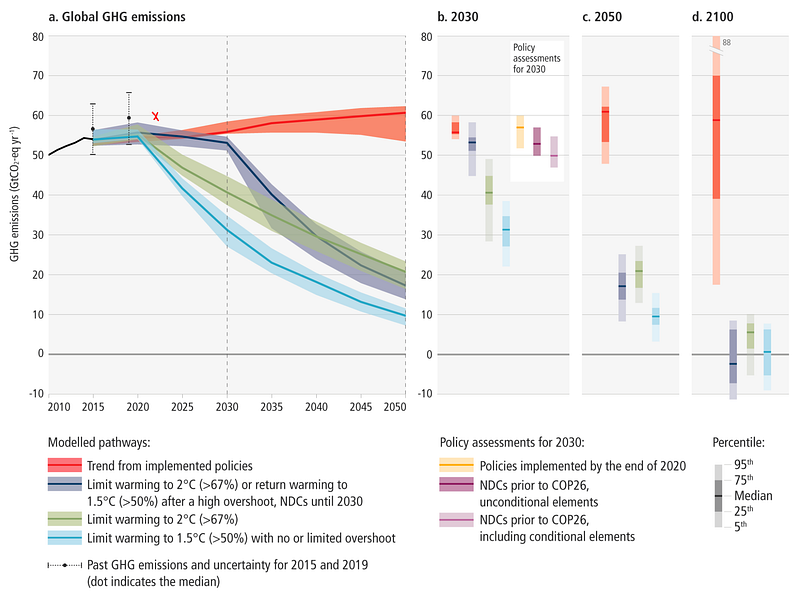
Sadly, following those lines is not easy at all. In fact, such a sudden near-term drop in global emissions is physically impossible without a major recession. But I’ve now been in this field for long enough to understand that arguments over the costs and benefits of drastic climate action only lead to even greater polarization of opinion. Hence, this article pursues a fresh angle.
The following sections outline five real-world tests climate activists must pass for their words to retain credibility. The tests are formulated to make the costs and complexities of extreme climate action very real to advocates, inherently securing a full understanding of what it is they are demanding.
Here is the condensed version:
- Accept the financial burden associated with the historical emissions that made your comfortable lifestyle possible. If you advocate for restricting global warming to 1.5 °C, this amounts to about $1 million per taxpayer. A more moderate target of 2.5 °C brings the debt down to $200000.
- Make sure your ecological footprint matches your stance on climate change. No one with unsustainable habits can reasonably advocate for drastic cuts in fossil fuel consumption at this time when over 6 billion world citizens remain below decent living standards.
- Study all sides of the argument with an open mind. Those who only consume information confirming their existing views are the fundamental reason why our progress on big and complex topics like climate change is hampered so severely by extreme polarization.
- Carefully consider the congruence between the degree of climate urgency you advocate for and the solutions you support. For example, demanding net-zero by 2050 while opposing any solution other than wind, solar, and electric cars is badly incongruent.
- Gain perspective by objectively contrasting climate change with other major global problems. Do you understand other major global problems (and their interactions with climate policy) well enough to state with confidence that drastic climate action will not make things worse?
You can find more details on each of these five steps in the following sections.
Step 1: Start Paying Your Carbon Debt
Hypocrisy: The world must spare no expense to prevent another 0.4 °C of warming, but let’s not mention the historical emissions behind the initial 1.1 °C that made my comfortable life possible.
Climate change is incredibly unfair. A minority (previous and current rich-world generations) enjoy most of the benefits from historical fossil fuel combustion, whereas the majority (current and future developing-world generations) get saddled with almost all the costs.
I’ve recently published an article dedicated to this important topic where I lay out the moral case for a rich-world carbon debt and attempt to quantify it. If you live in a comfortable, developed society built on the back of billions of tons of CO2 emissions, please check it out.
What is your carbon debt?
My calculations revealed that the average rich-world taxpayer stands for about 2300 tons of historical CO2. I’m confident in this number, but the monetary cost of each ton is a matter of far greater uncertainty. Thus, I created this graph giving a range of rich-world carbon debt valuations depending on how much damage you link to each ton of CO2.
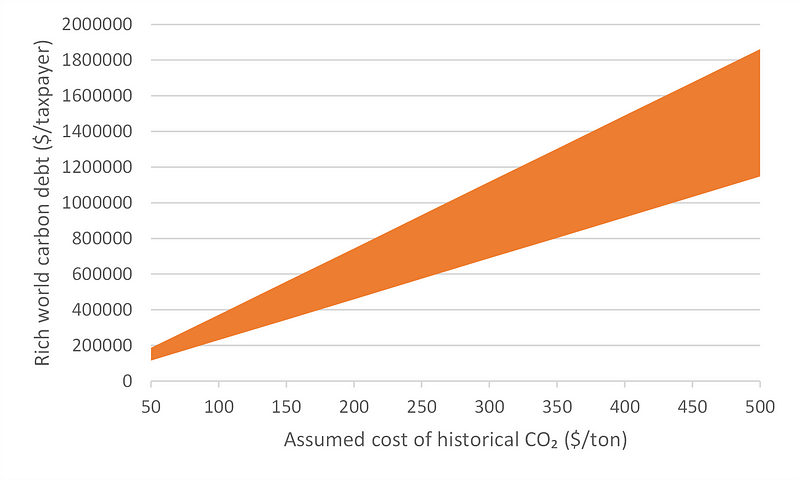
And this is where the hypocrisy test comes in. Those who advocate for drastic climate action (such as global net-zero by 2050) inherently assign a large cost to each ton of CO2 already in the atmosphere. Furthermore, the drastic overhaul of the global energy-industrial system (the very foundation of our modern civilization) aligned with such views will significantly impede the growth prospects of the developing world, adding to our debt.
Overall, I estimate that rich-world advocates for net-zero by 2050 inherently saddle themselves with a carbon debt in the order of $1 million, whereas those permitting a more realistic 2.5 °C of warming (with a 5x higher remaining carbon budget than 1.5 °C) would end up with about $200000.
How do I pay my carbon debt?
There are many worthy causes that could use your carbon debt repayments to improve the lives of the underprivileged communities feeling the effects of the historical emissions behind your comfortable lifestyle.
So, how much should you give? Well, $1 million in debt paid back over 30 years with a 3% interest rate (accounting for the continued accumulation and ongoing damages of your carbon debt over the payback period) amounts to 4300 $/month. Obviously, this will be beyond the reach of the vast majority of climate activists.
But we should adjust for the ability to pay by expressing it relative to individual earning power. For example, repaying a $1 million debt on the terms given above would take fully 37% of developed-world GDP. Thus, considering that the labor share of GDP is about 60% in developed societies, advocacy for 1.5 °C corresponds to monthly payments equal to 62% of your income and 2.5 °C to 12%.
Since 62% of income remains exceedingly high, a more realistic option for “net-zero by 2050” advocates would be to ramp down their degree of employment and dedicate the appropriate amount of time to humanitarian work.
Step 2: Minimize Your Personal Footprint
Hypocrisy: I like using the platform afforded by my 10 ton/year carbon footprint to tell the developing world to leave fossil fuels in the ground, so their average footprint does not exceed a sustainable 2 tons/year.
There are few things as hypocritical as spreading climate panic while continuing to leave an unnecessarily large ecological footprint in your wake. Everyone born into a developed society has the means to reduce their ecological footprint to sustainable levels (calculate yours here), thereby cutting environmental damages and, far more importantly, sending clear market signals demanding more sustainable products and services.
Reducing your footprint is easy. First, make a concerted effort to ditch consumerism and strongly increase your Life Efficiency. Not only will this shrink your footprint; it will also improve your health and happiness. Here is a handy calculator to determine your Life Efficiency and some dedicated guidelines for boosting this vital number.
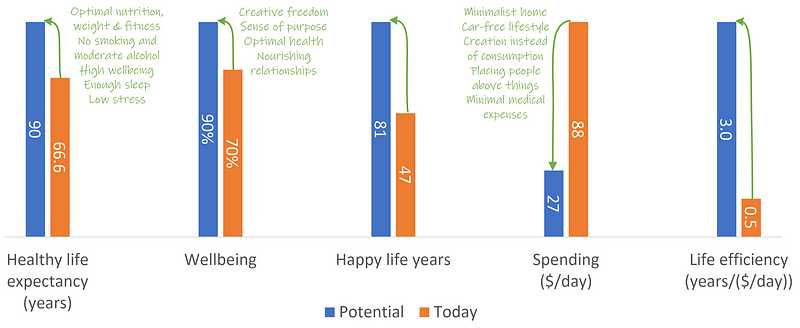
Next, take technological steps to cut your footprint further. Always choose the most efficient product on your shortlist, install solar panels and batteries at your home, and, if you must own a car, make sure it is electric and charged almost exclusively from the solar power you generate at home. If you have committed to greater Life Efficiency, your reduced expenditure will easily open up space in your budget for these additional expenses (which can be quite low thanks to various government incentives).
Living a genuinely healthy and happy life with a sustainable footprint is the best advertisement for sustainability you can make. It will also give you a much stronger platform for climate activism.
Step 3: Fully Understand Opposing Arguments
Hypocrisy: You need to do your homework on the climate crisis so you can accept my point of view, but don’t expect me to read any denialist nonsense about the high cost/benefit ratio of drastic climate action.
The sustainability movement is wrought with cognitive biases. Confirmation bias is the most damaging of these. It gets people to actively look for information that supports their existing views, making them increasingly entrenched in their beliefs. This is the phenomenon responsible for the deep polarization in any hotly debated topic, driving opposing camps to ever-more extreme viewpoints and rendering rational discourse impossible. The effect is an even stronger binary bias where people tend to see complex issues as black or white instead of the bland shades of gray where the truth normally resides.
Two other biases worth mentioning are the simplicity and desirability biases. These biases describe our tendency to favor standpoints that are simple to understand and in line with the way we desire the world to be.
The climate bias test
So, do these biases influence your stance on climate change? Answering a few simple questions can give you the answer. As preparation, please commit to resisting the tragicomic “I’m not biased” bias.
- How many pieces of comfortably affirming information do you consume for every piece of challenging information? A number larger than two puts you in the clutches of confirmation bias.
- Do you regularly use phrases like climate crisis or climate emergency? Would you label advocacy for targets beyond 2 °C as climate denial? If so, beware of the binary bias.
- Do you believe cost reductions in wind, solar, and batteries will soon put an end to fossil fuels? Would you say reaching net zero by 2050 is only a matter of political will? A “yes” to these questions indicates a strong simplicity and/or desirability bias.
Curing cognitive biases
The first step to curing your cognitive biases is to read “Think Again” by Adam Grant. It will change the way you think, guaranteed.

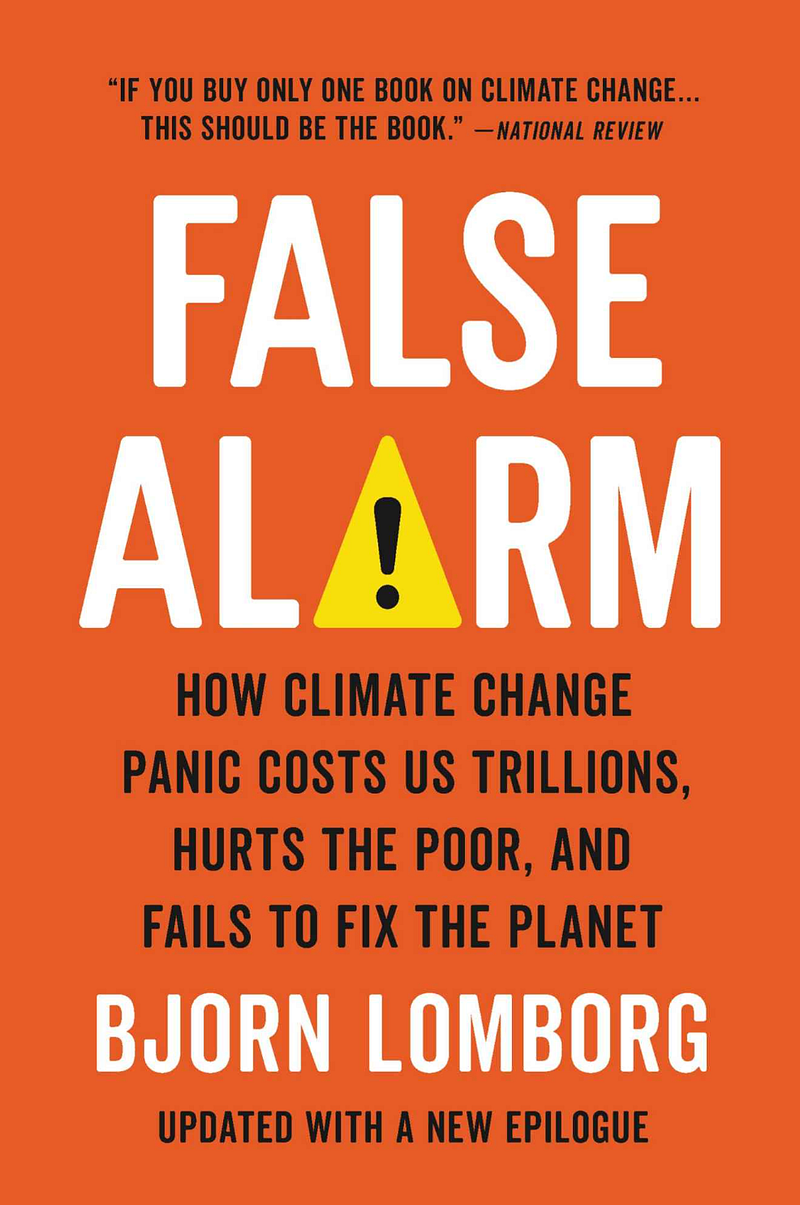
Next, read a book on the opposite side of the argument. It’s important to only do this after reading “Think Again” so that you are in a mindset where seeking out complex information that might change your mind about something big actually becomes desirable. For climate crisis advocates, Bjorn Lomborg’s “False Alarm” is my top pick. If you’re on the opposite extreme and question whether climate change is a problem at all, I recommend the new version of “Six Degrees” by Mark Lynas.
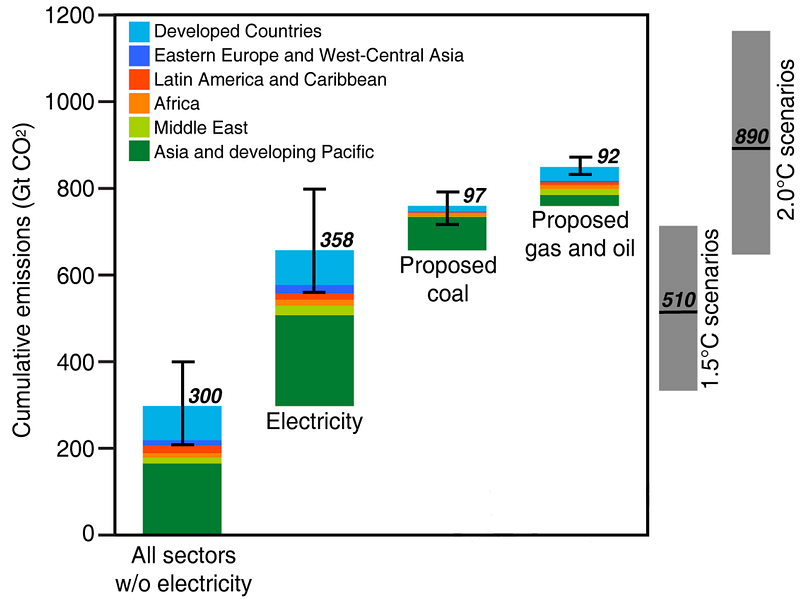
Finally, anyone spending a significant portion of their time talking or writing about climate change should read the latest IPCC reports. DO NOT rely on sensationalist interpretations of the content of these reports by news outlets or climate activists. Read the reports directly. Specifically, carefully read the summary for policymakers and make sure you fully understand every figure in the technical summary.
All this will take plenty of time and effort, but no responsible person would ever share their opinions on topics impacting billions of lives without the balanced view that all these materials provide. In fact, many millions of underinformed and heavily biased opinions flying around the web are a key driver behind our terribly inefficient response to climate change thus far.
Step 4: Be Technology-Neutral
Hypocrisy: The climate crisis will probably destroy the planet, but that still doesn’t justify any investment in any of those dirty and dangerous technologies designed exclusively to combat climate change.
One of the most ironic things about climate alarmism is that those who demand the most dramatic reductions in greenhouse gas emissions often oppose solutions designed exclusively for climate change: CO2 capture, adaptation, and (dare I say it) geoengineering. Wind, solar, batteries, and electrolyzers are often the only solutions climate activists support.
This is utterly nonsensical. The more urgent the climate threat becomes, the stronger the case for these climate-specialized solutions.
- CO2 capture and storage can be used to retrofit existing infrastructure (which will consume double the remaining 1.5 °C CO2 budget if not retired early at great cost), it can decarbonize hard-to-abate industries (about a third of global emissions), and it can achieve negative emissions (without which reaching net-zero this century is impossible). It’s a proven technology, already sequestering 40 Mton of CO2 per year.
- Adaptation is cheap, fast-acting, and plays to the natural strengths of human nature (direct experience of a problem drives us to solve it). In contrast, mitigation via green technologies is expensive, slow-acting, and completely against human nature (it imposes immediate local costs on the promise of long-term benefits, concentrated largely in other countries).
- Geoengineering could potentially reduce global temperatures for less than 1% of the cost of dramatic CO2 abatement pathways. It can also act far more rapidly than conventional abatement pathways. Yes, we must carefully assess harmful side effects, but this simply points to a clear R&D need, not a case for boycotting these technologies. It’s so cheap that it would be foolish not to develop this climate risk mitigation strategy.
Barriers to technology-neutrality
Our simplicity and desirability biases strongly support the green ideal of near-100% wind and solar. Renewable energy benefits (perpetual, cheap, and locally produced clean energy) are simple to understand and market, whereas their drawbacks (spatial and temporal variability, non-dispatchability, material and area intensity, lack of versatility) are much more complex. The same story holds for electric cars that are easily marketed as “zero-emission vehicles” while they hide many complex problems behind the scenes.
These complex issues are already hampering green technology expansion at tiny global market shares of around 2%. This experience, confirmed by the large rebound in fossil fuel demand after the pandemic, supports the Saudi energy minister’s claim that net-zero by 2050 is the sequel to La-La Land.
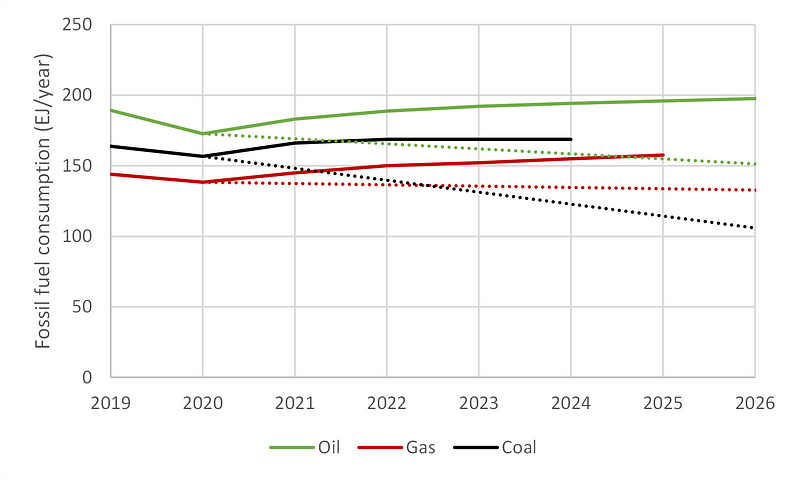
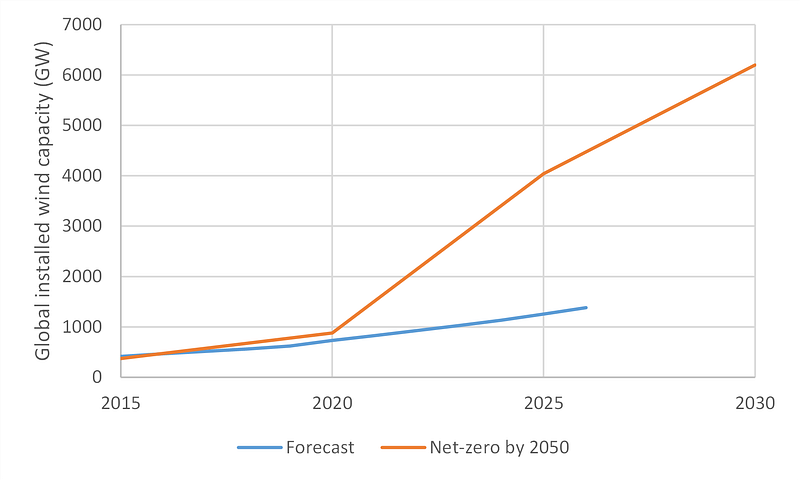
Meanwhile, CO2 capture, adaptation, geoengineering, nuclear energy, and even bioenergy face strong opposition from many climate activists. The total reliance on renewables implied by such views creates impossible green energy deployment pathways such as the one illustrated below.
In the end, we’ll need every tool on the table to address climate change. Every technology has its niche, and every region will require a unique blend of solutions based on its stage of development, population density, geography, renewable energy potential, mineral riches, political and geopolitical inclination, and several other factors. The current pure-green obsession is making the climate challenge far tougher than it needs to be.
Step 5: Get Perspective on Other Major Problems
Hypocrisy: We must do whatever it takes to save our grandkids from the climate crisis. The millions of preventable annual deaths and existential threats of other major problems can wait.
It’s common for climate advocates to see climate change as the world’s most pressing and important problem. However, the world has many other serious problems. In my present opinion, climate change ranks at number 13.
That does not mean it should be taken lightly. Indeed, climate change is a trillion-dollar problem deserving decisive action. But the world has several 10-trillion-dollars-and-millions-of-preventable-deaths type problems that must take priority, especially if they could be worsened by drastic climate action.
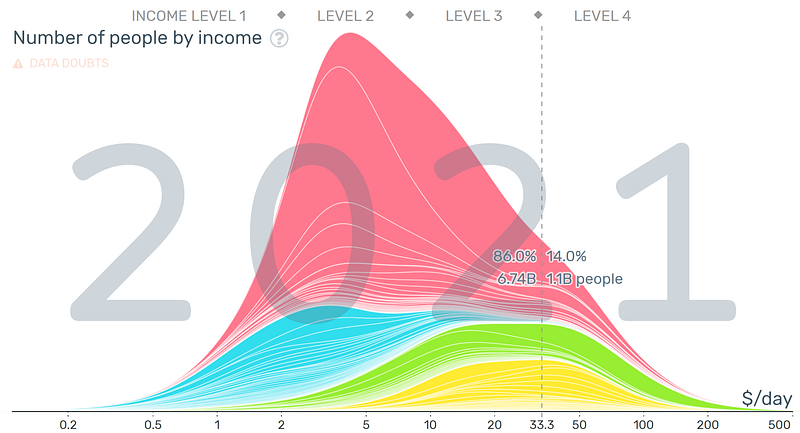
Fully understanding these problems is key to responsible climate activism. The world only has a limited amount of skilled labor, materials, land, and energy to spend in any given year. With these limited resources, we must keep 8 billion (and counting) humans happy and healthy and, in parallel, make massive investments toward uplifting 6.7 billion people to decent living standards and building a sustainable and equitable global society. We will need to prioritize very carefully to complete this gargantuan task.
The emotional pull of climate change
With climate change, such rational prioritization is difficult. It’s far too easy to weave the climate story into a deeply emotional, apocalyptic narrative, further inflamed by every report of extreme weather from somewhere around the world. In fact, this narrative has already convinced many young people that climate change will wipe out life on Earth.
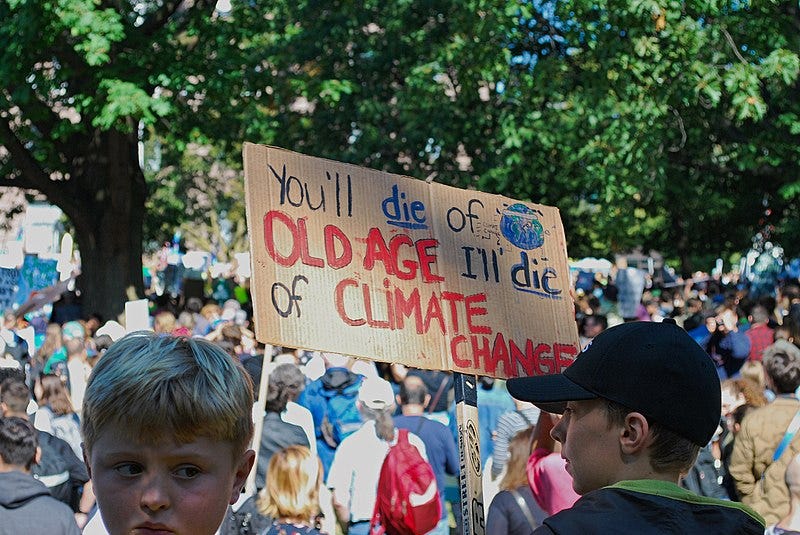
The human mind has evolved to react strongly to potential danger. That’s why bad news sells, whether it’s statistically representative of reality or not. Climate change raises the prospect of the worst news possible: Apocalypse. Rising seas will soon engulf cities, increasingly severe natural disasters will destroy everything in their path, global famines will kill hundreds of millions, changing climate is already driving the next mass extinction, and unstoppable positive feedback loops will soon make the Earth uninhabitable…
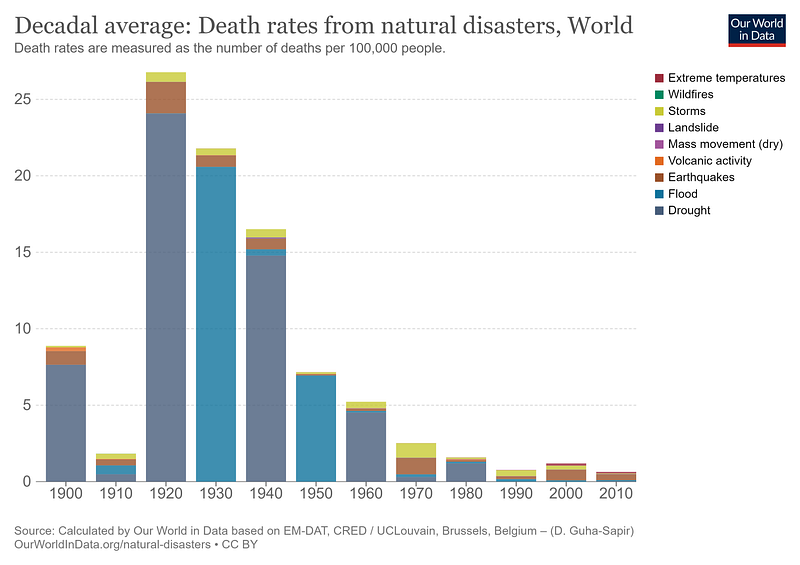
Contrast these alarmist statements with the facts: Sea levels will rise by only about 5 mm per year this century, extreme weather damages are staying constant at about 0.2% of world GDP, obesity kills more than 20 people for every person killed by malnutrition even though we waste a third of all food, climate change only ranks seventh on the list of biodiversity threats, and the IPCC states explicitly that the strongest feedback mechanism, permafrost thaw, will not cause runaway global warming. Unfortunately, these reliable sources make little impression on the juicy apocalyptic narrative.
Perspective
In my experience, studying other major global problems with the aim of identifying rational priorities is a highly effective antidote to such alarmist narratives. My prior article ranking the world’s greatest problems, together with a recent follow-up on the solutions, offers a good starting point.
Final Thoughts
To conclude, advocates for drastic climate action must do the following if they expect their opinions to be taken seriously:
- Give about half of their potential income to developing world causes.
- Do all they can to build a lifestyle with a sustainable ecological footprint.
- Regularly study opposing viewpoints with an open mind (Think Again).
- Support a broad range of climate mitigation and adaptation technologies.
- Build a solid understanding of global problems other than climate change.
Without adherence to these points, calls for a disruptive revamp of the very foundation of our society within a single generation are hypocritical and, I dare say, grossly irresponsible.
Thus, I conclude with two tangible recommendations:
- If you are a net-zero by 2050 supporter, please consider these points carefully and take action to rid your life of climate crisis hypocrisy.
- If you see someone advocating for extreme action without understanding its true implications, please challenge them with these five points.