
Life Efficiency: A Vital Paradigm Shift in the Sustainability Movement
Energy efficiency and clean energy won’t be enough
We, the citizens of the 21st century, have a critical mission: Give everyone a fair shot at building a decent life without destroying the ecological carrying capacity of our planet.
Many people think that completing this mission is as simple as deploying lots of clean energy (mainly wind and solar power), even though this strategy faces many serious challenges. Others at least acknowledge the critical role of energy efficiency and the fact that climate change (of which only two-thirds is linked to energy) is just one of many environmental concerns.
Luckily, there’s another sustainability lever that offers a holistic solution to our intimidating collection of environmental problems while simultaneously accelerating socio-economic progress. I like to call this lever “life efficiency,” and this article will explain it in greater detail.
Let’s start by taking stock of where we stand today.
A Global Status Update
History shows that uplifting a growing global population and protecting the environment are conflicting goals. It’s easy to understand why: Decent living standards require a certain level of material consumption, and all the materials we consume come from our environment.
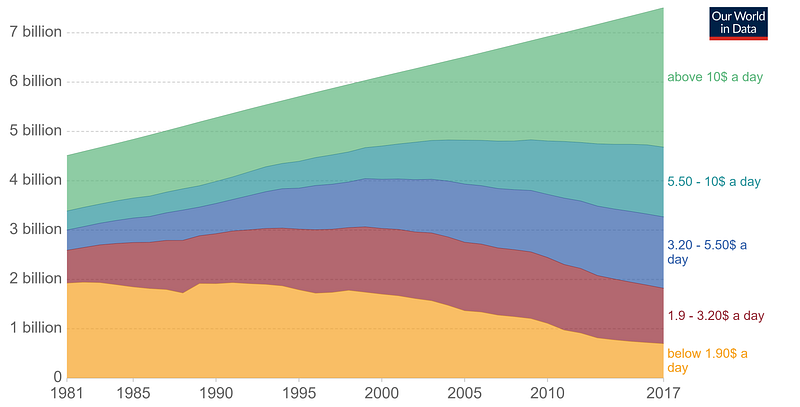
To illustrate, consider the graph below showing our steady progress in reducing extreme poverty.
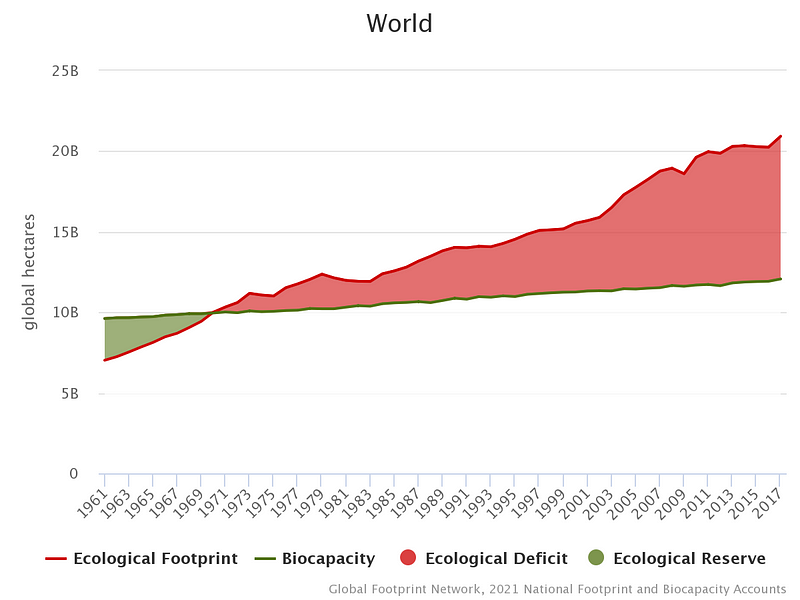
The next graph shows the cost of this progress: a large ecological overshoot. Even though technological and economic progress continues to gradually increase the global biocapacity at our disposal, we currently need 1.73 planets for a sustainable global economy.
And we still have a huge amount of socio-economic upliftment to do. Case in point: the first graph above shows that almost 5 billion people still live on less than $10/day ($3650/year).
Have you ever tried living on $10/day? I sure haven’t. In fact, the average rich-world citizen consumes over 5x this very modest amount (explore the global income data here).
This is the world’s greatest injustice: We get to consume 10x more than the median world citizen simply because we were lucky enough to be born into a wealthy society.

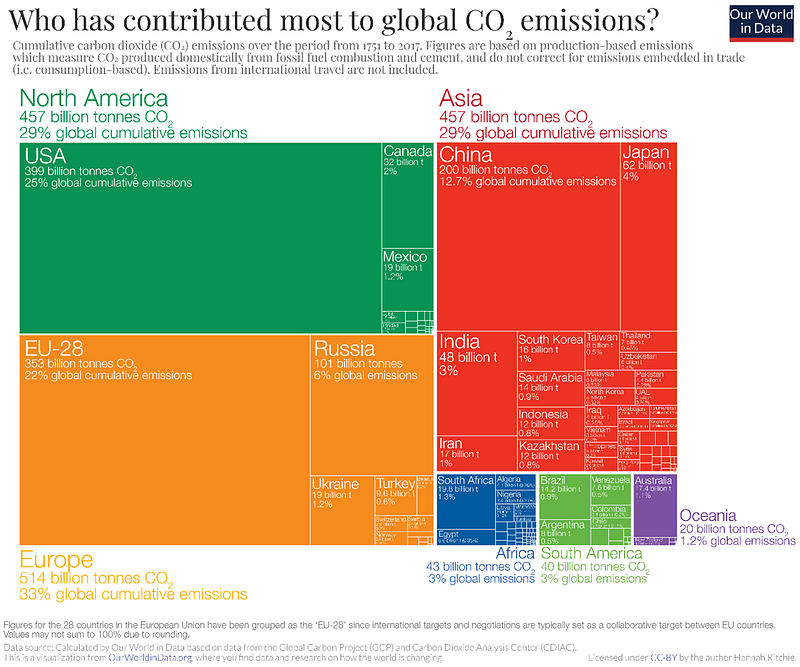
The bottom 80% have every right to consume the planetary resources they need to carve out a decent life for themselves and their loved ones. But if they were to live like the average American (whose world was built on 400 billion tons of CO2), we would need about five planets.
Clean energy and energy efficiency are not going to close this gargantuan gap on their own. And the more we expect them to do the impossible, the more ridiculous all those highly fashionable “net-zero by 2050” pathways being churned out by think tanks around the world will become.
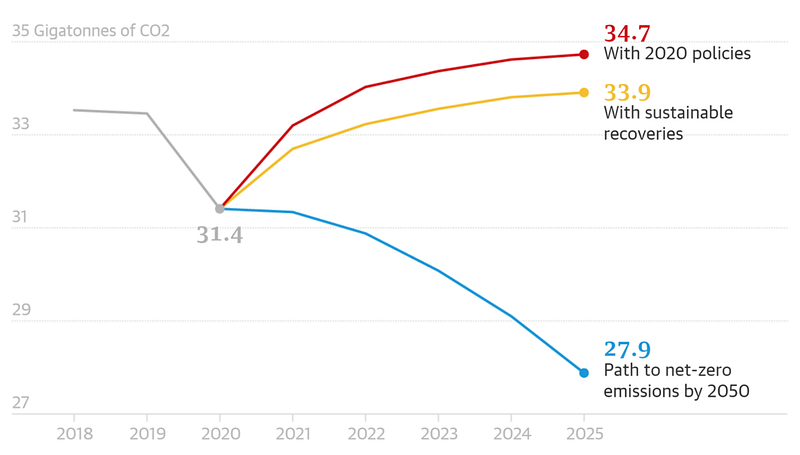
We desperately need some diversification in our approach to sustainability. And that’s where life efficiency comes in. Let’s explore with the help of an elegantly simple equation.
The Kaya Identity
In 1997, a Japanese energy economist proposed the following identity as a simple framework for describing the behavior of global emissions.

Naturally, our global emissions depend on how many people our planet needs to sustain. But the Kaya identity shows us three other ratios that influence emissions:
- GDP/Person: How much goods and services the average person produces and consumes.
- Energy/GDP: The energy required to produce those goods and services.
- Emissions/Energy: The emissions intensity of all that energy.
At the moment, ratio #1 is the central indicator of social progress. The more goods and services the average world citizen can consume, the better.
Hence, GDP/Person must always increase, while the global population also continues expanding. Thus, if we want to reduce our environmental impact, we need some serious reductions in the second and third ratios.
We can shrink ratio #2 by using energy more efficiently. More efficient cars, better home insulation, and a preference for buying services rather than material goods all help.
Reducing ratio #3 requires the development and deployment of cleaner energy sources such as renewable energy, nuclear, and CO2 capture from hydrocarbon fuels.
But this equation leaves out an essential additional lever we have at our disposal. It’s about time this lever gets the recognition it deserves.
Life Efficiency
Despite everything the advertising industry shouts at us 8000 times a day, we don’t really want more goods and services. What we want is all the happiness and longevity we’re told those goods and services can give us.
So, how can we measure our achievement of happiness and longevity? Arguably the best metric out there is “happy life years” — the product of a subjective wellbeing score and life expectancy.
Incorporating happy life years (HLY) into the Kaya identity looks like this:

This equation is almost the same as the original Kaya identity, aside from splitting the first ratio (GDP/Person) into two parts:
- HLY/Person: The number of happy life years enjoyed by the average person.
- GDP/HLY: The goods and services required for building a long and happy life.
This simple modification allows us to isolate the true ratio we must keep increasing at any cost: HLY/Person.
More importantly, it identifies an invaluable additional lever we can pull to reduce our environmental impact: GDP/HLY. To make it easier to conceptualize, we’ll work with the inverse of this ratio.
You guessed it: This precious ratio (HLY/GDP) is life efficiency — a direct measure of our ability to extract health and happiness from all our effort and environmental impact.
And the good news is that the untapped potential of life efficiency is truly enormous.
Global Implications of Higher Life Efficiency
As shown below, life efficiency can be improved by a massive 500% from the baseline of the United States. The figure also shows some simple measures for increasing life expectancy and wellbeing while decreasing consumption.
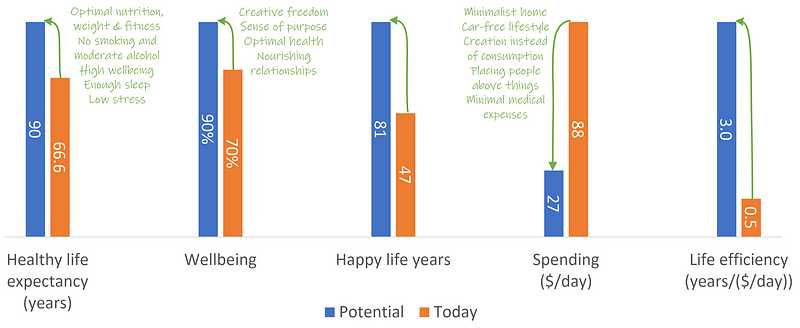
The optimal healthy life expectancy is estimated from studies such as those showing 12–14 extra years from healthy nutrition, exercise, smoking, and alcohol habits, 3 years from stress reduction, and similar mortality risk reduction of strong social support and high life purpose as not smoking 20 cigarettes per day (about 8 years of life expectancy).
Optimal wellbeing and spending estimates come from my own experience. Despite my cheap lifestyle, I’m about as happy as a man can be, which illustrates a critical point: Life efficiency is not some kind of twisted environmental martyrdom. Instead, it’s a lifestyle design philosophy that boosts health and happiness while simultaneously reducing consumption.
This philosophy shaped my entire adult life, starting way back in 2009. The results thus far include perfect health (I’ve not been sick for 12 years), financial freedom at age 34 (according to the 4% rule), the inspiration to happily work over 3000 hours per year with no hint of burnout, and a sustainable ecological footprint.
In addition to these tremendous personal benefits, life efficiency has two other features that make it particularly attractive for accelerating our transition to a sustainable society.
Rapid Deployment Potential
Increasing life efficiency requires nothing more than a mindset shift. In contrast, energy efficiency and clean energy require lots of new technology to be developed, scaled up, and deployed.
If life efficiency can go viral in our interconnected society, the benefits will be vast and immediate. Sure, the 6x gain shown above is not a reasonable global target. To give just one example, our legacy of car-centered city design means a car-free lifestyle remains impractical for many people. But even a lowly 2x improvement will still have a massive positive impact.
The remaining 3x gain will take more time as eco- and people-centered urban development grows, remote work becomes the new normal (I’m particularly excited about the potential of emerging VR innovations), and the health and wellness movement gathers further momentum.
Reduced Inequality
Let’s add another striking stat to those already presented at the top of this article: The average rich world citizen at the 95th percentile of the global income distribution consumes as much as 50 citizens born on the opposite side of the spectrum (5th percentile). Think about that for a second.
Improved life efficiency can dramatically reduce the wasteful consumption of those who were lucky enough to be born in the top 10% (and emit half the world’s CO2). This will address the terribly unfair climate impact on poorer nations and leave a much larger portion of our aggregate productive capacity for building a sustainable and equitable society.
But the size of this impact will depend on what high earners with high life efficiencies choose to do with their substantial excess income. Luckily, my experience shows that figuring out how to deploy your surpluses to do maximum good for the world is way more satisfying than any kind of consumer spending. This natural incentive can magnify the positive impact of life efficiency even further.
Final Thoughts
It’s worth restating that life efficiency is not self-deprivation for the sake of the planet. No, you don’t need to sacrifice your quality of life when building a more sustainable lifestyle. In fact, efficient living leads to large gains in health and happiness with reduced ecological impact.
Earning creative freedom, downsizing and simplifying intelligently, placing people above things, mastering the art of healthy cooking, building a car-free lifestyle, reconnecting with nature, rediscovering (screen-free) relaxation…
All these things can boost life efficiency. Combining them in a way that perfectly suits your unique situation is a fascinating challenge that will boost life efficiency in and of itself. And getting started needs nothing more than the right mindset.
This article is a reworked version of my earlier article on Energy Post.


