avatarSchalk Cloete

Free AI web copilot to create summaries, insights and extended knowledge, download it at here

16470

Abstract

0.1016/j.jclepro.2022.132347">3</a>). Usually, the model is run with optimistic long-term costs of green technologies up to 3x lower than today to explore scenarios around mid-century, but this example will use today’s costs.</p><figure id="b6b2"><img src="https://cdn-images-1.readmedium.com/v2/resize:fit:800/1*8kncCUs_jHNHjAshiPbHHg.png"><figcaption>The optimal share of variable renewables in the German electricity system as the CO2 price is increased</figcaption></figure><p id="bfd0">As illustrated above, the wind and solar shares enabled by Germany’s current technology-forcing policies would only be realized with a very high CO2 price of 200 €/ton. Yet, under the cost assumptions employed, the levelized cost of electricity (LCOE) for onshore wind (57 €/MWh) is already below that of natural gas power production at a capacity factor of 50% when there is no price on CO2 (59 €/MWh). So, why does the model only start installing high shares of wind and solar at a CO2 price of 200 €/ton that increases the LCOE of gas-fired power to 125 €/MWh?</p><p id="b624">Well, the first issue is that wind generally requires additional transmission capacity to get the power to population centers from regions with good wind resources and low public resistance. We usually assume an extra transmission cost of <a href="https://doi.org/10.1016/j.enpol.2019.110994">300 €/kW</a> that increases the LCOE of onshore wind to 70 €/MWh.</p><p id="a421">Second, and more importantly, there are times in the year when it will remain impossible to satisfy demand with wind and solar power, no matter how much capacity we install. The graph below illustrates that, even with a ridiculously high CO2 price of 500 €/ton, the system is forced to deploy plenty of gas-fired power production (NGCC) during times of little wind and sun, even though this electricity now costs about 250 €/MWh.</p><figure id="a8ef"><img src="https://cdn-images-1.readmedium.com/v2/resize:fit:800/1*xOwlOoEh7sB4SZPzp4iONg.png"><figcaption>Optimal hourly generation profile for Germany over one full year with a CO2 price of 500 €/ton</figcaption></figure><p id="325d">Batteries cannot economically store electricity for these extended periods, so hydrogen is the only viable option. Unfortunately, such power-to-gas-to-power electricity storage is so inefficient that it will remain very expensive even in the long-term future.</p><p id="75d2">A popular mitigating solution for this problem, especially among modelers like myself, is to build an elaborate interconnected system where a lot of demand is electrified and fully flexible to ramp up and down with the wind and the sun. Unfortunately, this strategy comes with a <a href="https://www.sciencedirect.com/science/article/pii/S0360319920336673?via%3Dihub">considerable cost</a> as large parts of the system must be used at a low capacity factor. Many potential sources of flexible demand also face significant limits regarding ramps and cold starts that are generally ignored in energy system models.</p><p id="ca1e">More importantly, though, the degree of complexity and interdependence of such a system will be immense. Energy system models, like the one used in this example, are allowed to build a perfectly optimized system from scratch with perfect foresight regarding demand and wind/solar availability, perfectly rational and coordinated behavior from all actors, and constant prices. This is not how the real world works. Thinking through all the practical and political challenges (and the resulting inefficiencies) that lie ahead in building such a system in the real world makes my head spin.</p><p id="f38e">But as we will see next, this strategy will remain expensive even if it could somehow be executed perfectly.</p><h2 id="1ae2">The cost of electrification and green hydrogen</h2><p id="9859">Wind turbines and solar panels produce electricity, a wonderfully versatile energy vector. When competing with fossil fuels that need costly additional capital to be converted into electricity at a large efficiency loss, such direct production of electricity is a major benefit.</p><p id="343d">Electricity has its limitations, however, which is why only <a href="https://yearbook.enerdata.net/electricity/share-electricity-final-consumption.html">20% of our final energy demand</a> comes from electricity today. Relative to chemical energy in fuels, electrical energy is far more difficult and costly to store, transport over long distances, and use in industrial processes requiring high-grade heat and chemical reagents.</p><p id="f18c">To overcome these drawbacks, wind and solar power can be converted to fuels via electrolysis producing green hydrogen. Unfortunately, this dynamic exactly reverses the big advantage outlined two paragraphs earlier. Now, it is wind and solar that require costly additional infrastructure to convert one form of energy to another at a substantial efficiency loss.</p><p id="a711">We recently published two peer-reviewed papers quantifying this effect by comparing ammonia and methanol energy carriers from wind and solar to the alternative production route from natural gas with CO2 capture. As shown below, the cost disparity is large, even using optimistic mid-century green technology costs.</p><figure id="2c54"><img src="https://cdn-images-1.readmedium.com/v2/resize:fit:800/1*r6byt0tnhTbZJUzpqH3gaQ.png"><figcaption>The levelized cost of ammonia (LCOA) from various sources using cost assumptions applicable to the year 2050. “Green” refers to primary energy input from wind and solar, whereas “blue” refers to natural gas with CO2 capture and storage. “LAC” and “GSR” are present and future natural gas reforming technologies. | <a href="https://doi.org/10.1016/j.enconman.2022.115312">Arnaiz and Cloete (2022)</a></figcaption></figure><p id="9141">Overall, the green pathways require CO2 prices of <a href="https://doi.org/10.1016/j.enconman.2022.115785">around 300 €/ton</a> to compete with methanol from natural gas. Competing with natural gas (and oil) directly will require even higher CO2 prices.</p><p id="4a4f">The other great green electrification hope is electric vehicles. Unfortunately, this pathway also faces a broad range of challenges I reviewed earlier (<a href="https://readmedium.com/the-10-biggest-problems-with-electric-cars-1db4a80b2631">1</a>, <a href="https://readmedium.com/five-reasons-why-electric-cars-will-only-worsen-our-oil-problems-e1308da06b5f">2</a>). Even if we ignore all the non-economic challenges, electric cars remain an expensive way to avoid the 10% of global CO2 emissions linked to road passenger transport.</p><figure id="e94a"><img src="https://cdn-images-1.readmedium.com/v2/resize:fit:800/1*LE3e7sllAJpd9r-uta1fsA.png"><figcaption><a href="https://readmedium.com/the-10-biggest-problems-with-electric-cars-1db4a80b2631">My estimate</a> of the CO2 avoidance costs of electric cars (BEVs) relative to gasoline hybrids in the short and long-term future</figcaption></figure><p id="e9e2">Real-world data from the world leader in electric car market share (Norway) shows that the CO2 avoidance cost estimated above is far too low, even when all cars can be charged with cheap and clean hydropower. The eye-watering list of tax breaks and other incentives behind the impressive 75% electric car market share in Norway avoids CO2 for <a href="https://readmedium.com/norway-shows-the-world-how-to-achieve-electric-car-dominance-dbe89869a50a">over 2000 €/ton</a>.</p><p id="4211">When electric vehicles need to be charged with intermittent wind and solar power and are required to enter more difficult niches like long-haul trucking, these four-digit CO2 avoidance costs will only escalate further.</p><h2 id="47d0">Feeding the green machine we created</h2><p id="be5d">Finally, I want to highlight a powerful force behind the perseverance of technology-forcing policies: the lobbying power gained by beneficiaries. For example, the 30-year-old <a href="https://en.wikipedia.org/wiki/United_States_wind_energy_policy">wind production tax credit</a> in the USA was always supposed to be a temporary measure to help the wind industry reach self-sufficiency. It has expired many times over the years, but each time, the increasingly powerful wind lobby got it extended, citing all the job losses that will result when subsidy cuts reduce demand for new wind farms.</p><p id="36a9">Yes, the expiration of wind subsidies will shrink the industry, but it will not destroy it. The US has exceptional wind resources in its interior regions where wind can compete subsidy-free. These are the regions where wind energy makes sense and should be deployed. However, the continued subsidization of mature industries only serves to force technologies into uneconomical markets and generate louder calls for continued subsidization.</p><figure id="8682"><img src="https://cdn-images-1.readmedium.com/v2/resize:fit:800/1*0ti6YxCVenui_lxbJFVggA.png"><figcaption>The US interior, sometimes called “the Saudi Arabia of wind” can facilitate subsidy-free wind power | <a href="https://windexchange.energy.gov/maps-data/319">NREL</a></figcaption></figure><p id="a0e9">It’s a worrying sign when subsidy-dependent industries become powerful enough to influence the political system to maintain their handouts indefinitely. Sadly, this is a growing trend around the world, with battery electric vehicles being the latest addition to the club.</p><h2 id="9579">Wrapping up green technology-forcing</h2><p id="a211">As always, I must emphasize that wind, solar, and electric vehicles have a large role to play in future energy systems. When deployed in the niches where they make sense, they can practically and economically cut CO2 emissions and fossil fuel dependence. The best niches are 1) wind and solar displacing fossil electricity up to reasonable market shares given local resource quality and space availability and 2) <a href="https://readmedium.com/evs-in-our-cities-the-good-the-bad-and-the-ugly-e3c4e83879d9">smaller electric vehicles in urban centers</a>.</p><p id="a036">I should also highlight that direct support for green technologies was not always problematic. In fact, wind and solar subsidies were commendable up to around 2015 when global value chains and economies of scale were properly established and China got in on the act. Similarly, electric car subsidies were a good idea up to about 2019 for the same reasons.</p><p id="bc3c">Today, however, all these technologies have long since reached a level of maturity where further targeted support hurts more than it helps. In most cases, it saps vast amounts of resources by forcing green technologies into uneconomical niches where they avoid CO2 at tremendous costs, but it perseveres thanks to lobbying from increasingly powerful green industries and ideological pure-green activist groups. This practice harms global economic development and diverts resources away from a broad range of alternative solutions we will need for a sustainable world.</p><p id="0252">Sadly, the inefficiency of our approach to decarbonization does not end there. Let’s now talk about the well-intentioned but deeply misguided global movement to defund the fossil fuel industry.</p><h1 id="595b">Fossil Fuel Divestment</h1><p id="02bf">This section will be concise as I already covered the topic of fossil fuel divestment in detail in <a href="https://readmedium.com/fossil-fuel-divestment-our-painfully-ironic-gift-to-the-fossil-fuel-industry-28ea60f57277">a previous article</a>.</p><p id="a53e">While it’s obvious that forcibly restricting fossil fuel supply by limiting access to investment capital can achieve CO2 emission reductions, doing so is incredibly damaging to the global economy. The inevitable fossil fuel price spikes resulting from this strategy cause a massive global wealth transfer from billions of poor people in energy-importing developing nations to obscenely wealthy oil oligarchs who waste most of it on white elephants (or war).</p><figure id="4bf9"><img src="https://cdn-images-1.readmedium.com/v2/resize:fit:800/1*FqWjR2U_4HX-9tn-fb5qaw.png"><figcaption>High fossil fuel prices fueled by divestment currently force India to pay more than half their normal economic growth rate in excess payments to wealthy energy exporters. See the penultimate section of the <a href="https://readmedium.com/fossil-fuel-divestment-our-painfully-ironic-gift-to-the-fossil-fuel-industry-28ea60f57277">previous article</a> for more detail. | Graph compiled from <a href="https://www.bp.com/en/global/corporate/energy-economics/statistical-review-of-world-energy.html">BP</a> and <a href="https://data.worldbank.org/indicator/NY.GDP.MKTP.CD?locations=IN">World Bank</a> data</figcaption></figure><p id="526b">In essence, fossil fuel divestment is like implementing a large and very poorly structured global carbon tax and paying all the proceeds to the fossil fuel industry — utterly nonsensical.</p><figure id="9768"><img src="https://cdn-images-1.readmedium.com/v2/resize:fit:800/1*GJubTNco69TLksF5kxAwWA.png"><figcaption>Despite strong green technology-forcing policies, oil profits remain in a totally different ballpark to green energy | Graph compiled by assuming an oil price of 100 /barrel, oil production costs of <a href="https://www.rystadenergy.com/newsevents/news/press-releases/as-falling-costs-make-new-oil-cheaper-to-produce-climate-policies-may-fail-unless-they-target-demand/">23 /barrel</a>, and applying profit margins for the three largest wind (3.5%) and solar (9.7%) companies over the last three years and Tesla’s recent 10% profit margin for EVs to total <a href="https://www.iea.org/reports/world-energy-investment-2021">clean energy investment data from the IEA</a></figcaption></figure><h2 id="23f8">The cost of forcibly limiting fossil fuel supply</h2><p id="64fd">Fears of another global recession are mounting, and supply constraints related to insufficient investment in fossil fuels and other materials are among the primary causes. Green advocates will quickly lay all the blame on Putin, but the fact is that prices were rising well before the invasion of Ukraine and the subsequent sanctions on Russian energy.</p><p id="0b24">For example, the European gas crisis began well before Russian troops crossed the Ukrainian border. The EU simply did not make the necessary investment in gas supply to compensate for the phase-out of coal and German nuclear, exasperated (rather ironically) by an unusually cold 2020/2021 winter and a wind drought toward the end of 2021.</p><figure id="b918"><img src="https://cdn-images-1.readmedium.com/v2/resize:fit:800/1*NhXLoiikBEbMQZbjsHRgTA.png"><figcaption>Recent European natural gas price developments with a red “x” marking the invasion of Ukraine | <a href="https://tradingeconomics.com/commodity/eu-natural-gas">TradingEconomics</a></figcaption></figure><p id="5737">The story is similar for oil. Even though Russia’s invasion has introduced plenty of volatility, prices simply stayed on the upward trend following the end of the pandemic. Without lingering Covid restrictions depressing oil demand (especially in China) the situation would have been far worse.</p><figure id="e3c7"><img src="https://cdn-images-1.readmedium.com/v2/resize:fit:800/1*vo_CJeHPoAg0r619-544OA.png"><figcaption>Recent oil price developments with a red “x” marking the invasion of Ukraine | <a href="https://tradingeconomics.com/commodity/crude-oil">TradingEconomics</a></figcaption></figure><p id="8c56">As a result of these excessive energy prices and the resulting global inflation problem, growth forecasts for 2022 and 2023 have been dropping precipitously. If we conservatively assign a 1% drop in global economic output for a 1 Gton (2.5%) drop in greenhouse gas emissions, the cost amounts to approximately 1000 $/ton of CO2 avoided.</p><p id="0d3e">Most likely, the cost is far higher. In addition to a slowdown in overall economic development, the fossil fuel divestment movement also causes the previously mentioned perverse wealth transfer from poor to rich that does serious damage to the upliftment of billions of developing world citizens.</p><h2 id="2daa">The limited effect on emissions</h2><p id="445d">To make matters worse, the global gas supply crunch and general economic pain have caused a resurgence in coal. This was the reason why, despite oil demand remaining depressed due to lingering pandemic effects and insufficient investment

Options

, global CO2 emissions reached <a href="https://www.iea.org/news/global-co2-emissions-rebounded-to-their-highest-level-in-history-in-2021">new highs in 2021</a>. Unless the fears of a global recession come true, 2022 will likely see another record.</p><p id="5d7c">That brings me to an inconvenient truth: Most people only support costly climate policies when the economy is healthy. When they are struggling to pay the bills, priorities quickly shift to growth in whatever way possible. A small fraction of the resulting stimulus money may find its way into clean energy, but a large amount ends up in fossil-intensive infrastructure projects.</p><h2 id="deec">Wrapping up fossil fuel divestment</h2><p id="111f">In summary, fossil fuel divestment places a tremendous burden on the global economy and, in particular, the economic upliftment of billions of developing world citizens. To make matters worse, its efficacy in reducing greenhouse gas emissions is questionable at best.</p><p id="cd43">As I conclude in my <a href="https://readmedium.com/fossil-fuel-divestment-our-painfully-ironic-gift-to-the-fossil-fuel-industry-28ea60f57277">previous detailed article</a> on the topic, fossil fuel dependence must be cut from the demand side via carbon and import taxes, not from the supply side via divestment. Demand-side cuts will bring prices down, shifting wealth from people with large carbon footprints to people with small carbon footprints, whereas supply-side cuts move wealth in precisely the opposite direction. It’s glaringly obvious which solution is best.</p><h1 id="095b">Getting Our Priorities Straight</h1><p id="f215">The global response to climate change is reminiscent of a typical underperforming student during exam time. We procrastinate for too long before embarking on a panicked cramming session with impossible goals. For the student, the result is often a failed exam and virtually zero retention of the subject matter. For the world economy, the result could be structurally depressed economic development with persistently high emissions, i.e., <a href="https://en.wikipedia.org/wiki/Shared_Socioeconomic_Pathways">Shared Socioeconomic Pathway</a> (SSP) 3 or 4 in the graph below.</p><figure id="0c5d"><img src="https://cdn-images-1.readmedium.com/v2/resize:fit:800/1*2uRsM5eQToMzTt3DiFMt3g.png"><figcaption>The widely different futures that may unfold depending on our choices today | <a href="https://doi.org/10.1016/j.gloenvcha.2015.06.004">Dellink et al.</a></figcaption></figure><p id="4d2c">As the SSP studies show (please read the brief descriptions of each pathway <a href="https://en.wikipedia.org/wiki/Shared_Socioeconomic_Pathways">here</a>), greenhouse gas cuts have little to do with the future trajectory of the global economy. Instead, it’s all about massive, globally inclusive investments in human and social capital, fostering innovation, optimizing health, and naturally limiting population growth.</p><figure id="d507"><img src="https://cdn-images-1.readmedium.com/v2/resize:fit:800/0*zAtPoxEJDM97mFeV.png"><figcaption>The five shared socioeconomic pathways | <a href="https://en.wikipedia.org/wiki/Shared_Socioeconomic_Pathways#/media/File:Shared_Socioeconomic_Pathways.svg">Wikipedia</a></figcaption></figure><p id="27dc">In light of current trends, I’m concerned that the obsession with “net-zero by 2050” combined with misguided green technology-forcing policies and fossil fuel divestments will divert us from the path of broad economic upliftment.</p><figure id="7ed2"><img src="https://cdn-images-1.readmedium.com/v2/resize:fit:800/1*UvCDxP6xeIWIiUtDnNVdyw.png"><figcaption>This graph of between-country <a href="https://en.wikipedia.org/wiki/Gini_coefficient">Gini-coefficients</a> in the different SSPs shows that globally inclusive growth is a major factor in the vast prosperity growth in SSP1 and SSP5 | <a href="https://doi.org/10.1016/j.gloenvcha.2015.06.004">Dellink et al.</a></figcaption></figure><p id="8b73">Green energy technology is highly capital intensive and requires a broad array of similarly capital-intensive supporting infrastructure to overcome challenges with spatial and temporal variability and applicability beyond the power sector (recall the requirement for 4–8x more developing world investment). These enormous capital demands will compete directly with the vast array of non-energy investments we require to get ourselves onto SSP1 or SSP5. To make matters worse, the material intensity of green technologies could worsen regional rivalries because multiple key minerals are considerably more geographically concentrated than oil and gas.</p><figure id="c9ac"><img src="https://cdn-images-1.readmedium.com/v2/resize:fit:800/1*4oxQT-XjdhKfWhKdqTAJ9A.png"><figcaption>Market shares of the top three states in oil and gas compared to several critical minerals | <a href="https://www.iea.org/reports/the-role-of-critical-minerals-in-clean-energy-transitions/executive-summary">IEA</a></figcaption></figure><p id="1b58">We seriously need to take a step back, stop panicking about the world ending if we do not reach net zero by 2050, and get our priorities straight. Let’s see what this might look like.</p><h1 id="b40f">Level-Headed Climate Policy</h1><p id="de1d">Broad global prosperity is the single best climate policy at our disposal. By that, I do not mean more oversized rich-world suburban homes with multiple luxury SUVs in the driveway. I mean reliable modern energy and utilities, sturdy housing equipped with all necessary labor-saving, food preservation, and climate control devices, modern health and educational facilities, and well-diversified trade connections for the 6 billion world citizens currently living below 1000 $/month.</p><p id="0723">With these developments, billions of people can effectively protect themselves against all kinds of extreme weather, local crop failures, and diseases that may be exacerbated by climate change. Simultaneously, we will gain hundreds of millions of additional educated and resourceful minds to work on key global challenges, including climate change, while the natural drop in fertility rates limits the ecological pressures associated with further population growth.</p><p id="34e9">Prioritizing decarbonization over economic upliftment is a tragic mistake multiple powerful groups seem determined to make. We must resist it.</p><h2 id="0960">A ruthless focus on efficiency</h2><p id="7d0e">Climate action that costs hundreds or even thousands of dollars per ton of CO2 avoided must stop. As reviewed earlier, it does little for climate change mitigation and a lot to hamper economic upliftment.</p><p id="4ad8">When considering all the opportunities for more cost-effective decarbonization at our disposal, such expensive climate change mitigation measures become all the more indefensible. The IPCC gave a handy figure in their latest report as guidance.</p><figure id="5f98"><img src="https://cdn-images-1.readmedium.com/v2/resize:fit:800/1*ZZ8uxvE5jfuljMdoN7q8Tg.png"><figcaption>A broad range of near-term climate actions and their estimated costs. Note that different potentials are not necessarily additive and wind/solar estimates exclude integration costs | <a href="https://www.ipcc.ch/report/sixth-assessment-report-working-group-3/">IPCC WGIII</a></figcaption></figure><p id="a718">One thing we must not do is impose a confusing mess of technology-forcing policies to individually promote various solutions in the IPCC figure above. Instead, we must scrap all technology-forcing policies and implement a CO2 tax instead. Such a policy will automatically promote every possible CO2 abatement technology and correctly prioritize their deployment.</p><h2 id="0dcd">The dual purpose of a CO2 tax</h2><p id="c97a">Even though all economists agree it would be by far the most efficient route to decarbonization, implementing a CO2 tax has proven politically challenging. However, rather than seeing this as a drawback, it should be viewed as an objective indicator of where our priorities truly lie.</p><p id="8934">A carbon tax puts a very explicit cost on climate change mitigation, thereby directly exposing our willingness to pay. Green technology-forcing incentives, on the other hand, impose costs in a far more obtuse manner, making it hard for consumers to know how much these policies actually cost them.</p><p id="1420">In other words, a carbon tax is honest and open about costs whereas technology-forcing can easily obscure true costs, permitting the very high CO2 avoidance costs calculated earlier. Under a technology-neutral carbon tax, such inefficient decarbonization solutions would never be deployed.</p><p id="ce14">And that’s why a carbon tax is doubly important. It openly asks the electorate whether it really wants to prioritize climate change mitigation over all our other developmental priorities. If the answer is “no,” it needs to be taken seriously. Not doing so can be viewed as willfully misleading the people.</p><p id="884e">As people become increasingly cognizant of climate change, CO2 tax schemes will emerge. The EU already has <a href="https://ember-climate.org/data/data-tools/carbon-price-viewer/">a high tax</a> and several others are being put in place around the world. Unfortunately, the EU still maintains a broad range of technology-forcing policies in parallel, thus doubly incentivizing green technologies, but the tax system is definitely a step in the right direction.</p><figure id="e63a"><img src="https://cdn-images-1.readmedium.com/v2/resize:fit:800/1*K5IoFyAG1JhCYTz78mLb1g.png"><figcaption>An illustration of the good progress made with CO2 pricing over the last decade. Purple indicates a carbon tax, green an emissions trading system, and yellow shows these measures are under consideration. | <a href="https://carbonpricingdashboard.worldbank.org/map_data">World Bank</a></figcaption></figure><p id="dd92">The EU is also working on a <a href="https://taxation-customs.ec.europa.eu/green-taxation-0/carbon-border-adjustment-mechanism_en">border adjustment mechanism</a> that will incentivize other countries to decarbonize the products they export to Europe. In this manner, the growing number of countries with implemented carbon pricing can rapidly expand their global impact. If everyone concerned about the climate would call for acceleration in these developments instead of promoting their green ideologies, we would make much faster progress.</p><p id="9d2e">That being said, there are many novel solutions that deserve targeted support. Let’s round out this article with a look at those.</p><h2 id="72bf">When targeted technology support is beneficial</h2><p id="ae45">As mentioned earlier, targeted support for wind, solar, and electric cars was beneficial up to the point when global value chains and economies of scale were well established and the majority of cost reductions were achieved.</p><p id="0e9e">There are many other technologies that require similar support. However, we must learn from the wind and solar experience and decisively withdraw all support when this point is reached. If the technology is worthwhile, it would have captured a profitable niche at that point (as wind and solar have successfully done), allowing it to grow naturally and independently of support, aided by gradually rising CO2 prices.</p><p id="a803">We can promote many alternative low-carbon technologies with all the money currently being poured into direct and indirect support mechanisms for mature green technologies. In addition, we can ramp up research, development, and demonstration (RD&D) efforts into novel low-carbon technologies of all kinds that can secure our long-term energy future.</p><figure id="c67e"><img src="https://cdn-images-1.readmedium.com/v2/resize:fit:800/1*CZGKi8jHXXgxzV6Rl64l6A.png"><figcaption>Distribution of global RD&D energy spending between technology classes | Graph from open <a href="https://www.iea.org/reports/energy-technology-rdd-budgets-overview/trends-across-technologies">IEA data</a></figcaption></figure><p id="a6a0">Currently, <a href="https://www.iea.org/reports/energy-technology-rdd-budgets-overview/low-carbon-rdd#abstract">RD&D into all forms of clean energy</a> attracts a mere 15% of the funds being poured into the direct subsidization of mature wind and solar technologies shown below (excluding all the indirect support in the form of deployment mandates, low-cost financing, fixed-price contracts to protect against value declines, free grid expansions, etc.).</p><figure id="ab72"><img src="https://cdn-images-1.readmedium.com/v2/resize:fit:800/1*Q5f8Vcfbbm-Nbj21HpY05A.png"><figcaption>Global direct subsidies for wind and solar | Graph from data in the <a href="https://www.iea.org/reports/world-energy-outlook-2018">IEA World Energy Outlook 2018</a></figcaption></figure><p id="b56f">We can get orders of magnitude more value for our money by developing multiple technologies with the potential to secure our long-term energy future. Nuclear fusion is the holy grail, but breeder reactors can also generate a practically limitless supply of clean energy. If we can figure out how to drill deep enough holes, geothermal offers the same promise. While these technologies supply heat and power, genetically enhanced ocean biomass farms could supply all our fuel needs without any land-use constraints.</p><p id="4cb4">These and many other solutions promise a boundless energy future that is not dependent on the weather, limited critical mineral resources, or vast land areas coveted by local residents. With such boundless, reliable energy, we can pull as much CO2 out of the atmosphere as necessary, eventually using greenhouse gases as a global thermostat to perpetually maintain the ideal climate. It’s a crying shame we spend so little money pursuing such a future.</p><h1 id="00b1">Final Thoughts</h1><p id="c0a5">Our current approach to climate change mitigation might even have been funny if it did not damage so many millions of lives. The most basic human biases are on full display complete with “end of the world” prophesies, cult-like beliefs in various ideological solutions, near-complete disregard for the interests of the silent majority, and a shocking degree of linear thinking and impatience behind our major decisions.</p><p id="fc39">We need to take a step back and acknowledge some basic truths:</p><ul><li>1.5 °C is impossible and 2 °C would unreasonably constrain developing world upliftment unless the rich world agrees to pay trillions per year in historical climate damages and we embrace technology-neutral climate policies. Since that is unlikely to happen any time soon, 2.5 °C is a rational target.</li><li>Luckily, the world will not end at 2 °C, and, unless we make a complete hash of global economic development, our civilization will be far more prosperous and equitable by the time that threshold is crossed after mid-century.</li><li>A prosperous and equitable society is more resilient to a more hostile climate, more willing and able to spend money on climate action, and more capable of developing novel solutions for major world problems.</li><li>By blundering ahead with deeply inefficient green technology-forcing and fossil fuel divestment, we significantly increase the likelihood of seriously impeding global economic development while failing to achieve a permanent decline in global greenhouse gas emissions.</li><li>We will need a set of solutions extending far beyond wind, solar, and electric cars to build a sustainable society. Technology-neutral policies like a carbon tax clearly offer the best framework for managing this transition and deserve all the support currently given to green technology-forcing.</li><li>The potential of limitless, reliable, and concentrated clean energy offered by multiple promising pathways deserves way more than the 0.02% of world GDP we currently spend on the relevant RD&D. It’s a much better target for all the money we throw at mature green technologies today.</li></ul><p id="5c41">In summary, keep the priority squarely on the economic upliftment of 6 billion (and counting) developing world citizens, demand no climate change mitigation action other than the establishment of gradually rising CO2 pricing around the world, and shift all targeted technology support to RD&D of new solutions and the subsequent establishment of global value chains and scale.</p></article></body>

Climate Action: When the Cure Becomes Worse Than the Disease

Tallying up the burgeoning costs of green technology-forcing and fossil fuel divestment
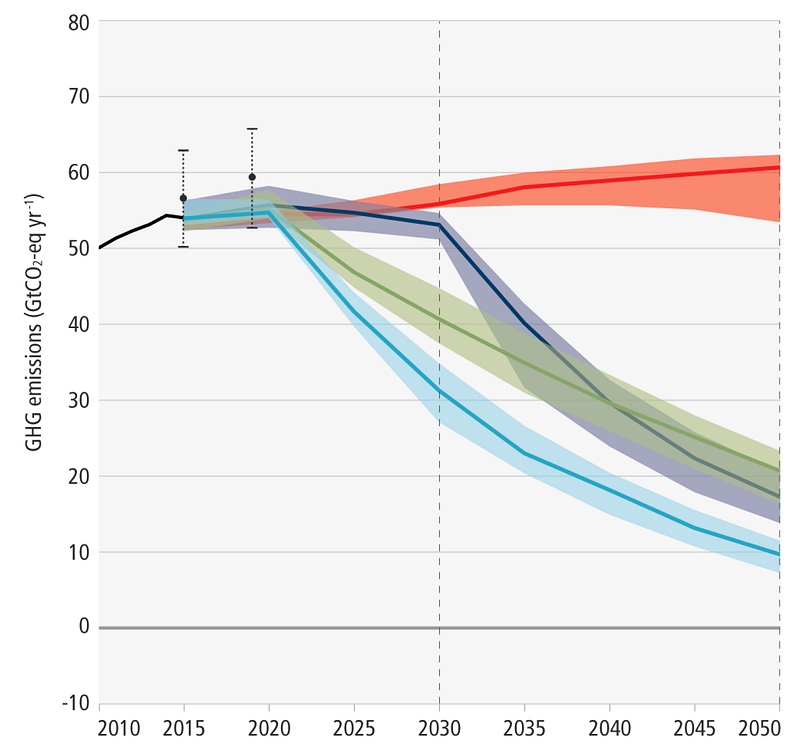
Decarbonization pathways from the recent IPCC report

The global decarbonization effort seems to become further divorced from reality with each passing year. Greenhouse gas emissions remain stubbornly high with no prospects for a sustained decline any time soon, and yet, we repeatedly double down on what has not been working thus far.

This article takes aim at the two philosophies driving climate action today: green technology-forcing and fossil fuel divestment. In many cases, these measures have become so costly and impractical that even business as usual would have been a better bet.

Obviously, we must take serious action on climate change. But we need to do it in a way that delivers net benefits to society. The final section of this article will outline what such climate action might look like.

But first, let’s take a much-needed “net-zero by 2050” reality check.

The Net-Zero-Likelihood Scenario

Net-zero by 2050 has become highly fashionable with every consultancy firm seemingly determined to generate its own unrealistic graphs of how we will get there. The objective energy observer might have dismissed this trend as a passing fad, but then, in mid-2021, the world’s premier energy advisory, the International Energy Agency (IEA), made big waves by getting on the “net-zero by 2050” bandwagon with its own dedicated report.

This IEA scenario was one of the craziest things I’ve seen in all my years of researching the global energy system. It literally had a zero likelihood of occurring because it required fossil fuel demand to keep falling after the big Covid-induced drop in 2020 (see the dotted lines below). Even the most novice observer could foresee the big fossil fuel rebound after the world reopened, driving global emissions to new highs in 2021 despite lingering Covid effects.
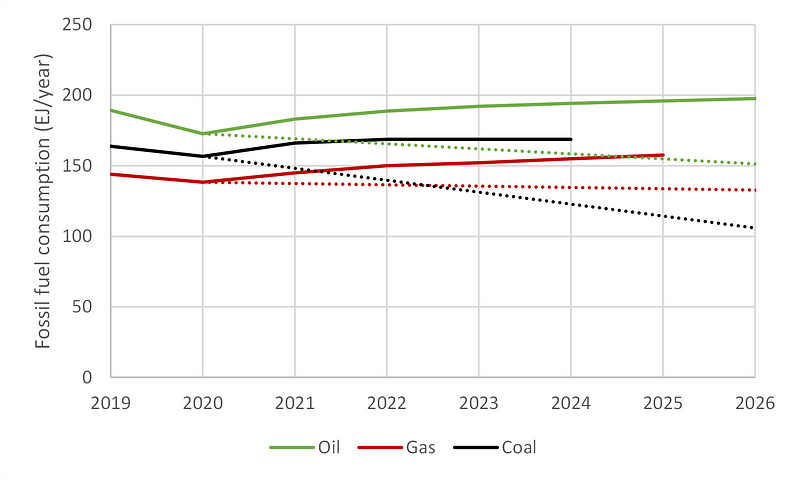
The rapid divergence between short-term forecasts for oil, gas, and coal demand (solid lines) and requirements in the net-zero by 2050 scenario (dotted lines) is inevitable | Graph compiled from open IEA data

Unfortunately, churning out zero-likelihood emissions pathways seems to be gaining in popularity. The recently released IPCC report presents a whole host of these, several of which are showcased below.
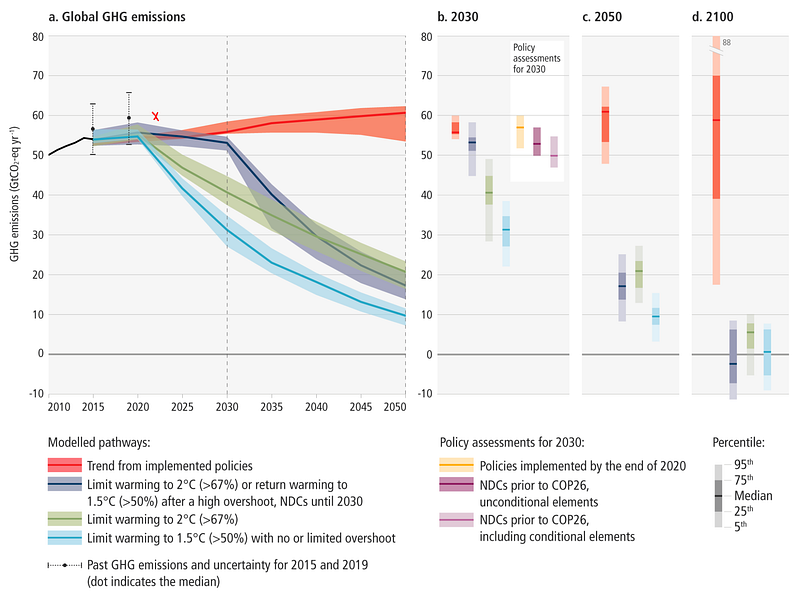
The primary summary figure from the IPCC WGIII report with a little red “x” added as an estimate of today’s emission levels

First, the modeled scenarios are already about 5 Gton below real-world emissions (indicated by the little red “x” added to panel a). For perspective, this is equivalent to the direct CO2 emissions of the entire USA.

Second, all rapid decarbonization scenarios feature a completely unrealistic CO2 emissions cliff. Such a sudden drop in emissions can only occur when global economic activity rapidly contracts (as happened in the pandemic). Without a massive global recession, such a scenario is physically impossible.

The next figure illustrates these impossible near-term expectations. As shown, the developing world is supposed to spend 4–8 times as much on mitigation during the 2020s as it is doing now. Note that these are not expectations for 2030, but averages that must be maintained each year over this decade (a quarter of which is already over).
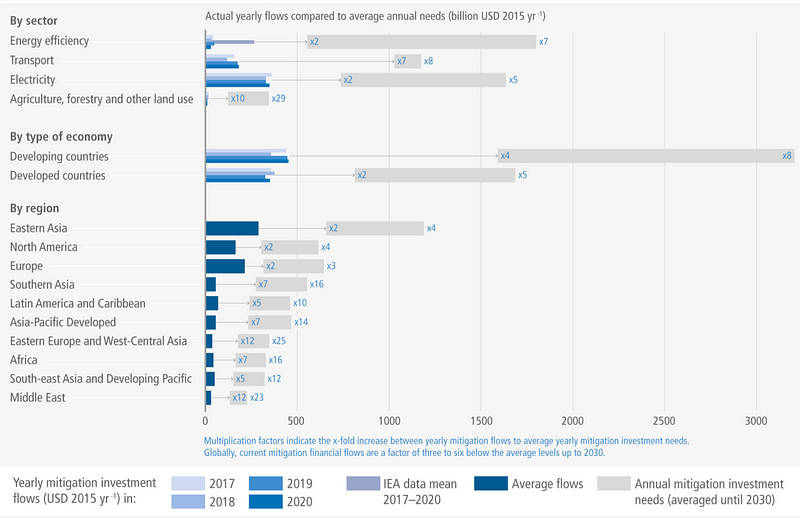
A summary of the massive mitigation investment increases required for 2 °C scenarios | IPCC AR6 WGIII

The increase in required mitigation spending equals 12–28% of the developing world’s gross fixed capital formation (all forms of investment). Thus, we are expecting underdeveloped nations to shift a quarter of their investment activity away from everything they need to uplift their people (decent housing, roads, factories, commercial districts, schools, hospitals, etc.) toward climate change mitigation.

Such an expectation is not only unreasonable, it’s impossible. Clean energy involves complex supply chains that need to be built up over many years. For this reason, we cannot install 100 GW of solar PV one year and 400 GW the next, no matter how much money we throw at the problem. The current global supply chain bottlenecks offer a timely illustration of this limitation.
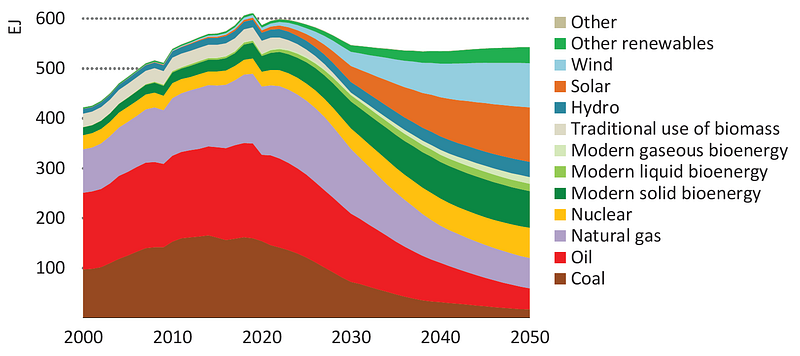
Total energy supply in the IEA net-zero by 2050 scenario

Third, the only way to get anywhere close to the sharp near-term drop in emissions required by these scenarios is a drop in energy demand (see the IEA figure above). Not only is the likelihood of such a sustained drop in energy demand zero without a prolonged global economic depression, but portraying it in such a high-profile publication is morally reprehensible because it does not permit developing nations to expand energy consumption to rapidly improve their living conditions.
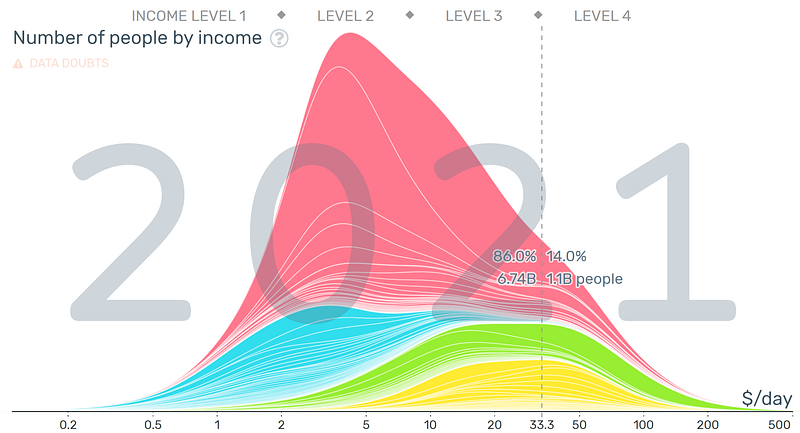
The global income distribution with a vertical line at 1000 $/month | Gapminder

As shown above, six out of every seven world citizens still live on less than $1000 a month, and one out of every four on less than $100 a month (please take a moment to imagine what that must be like). Not permitting the growth in energy consumption required to uplift these billions of world citizens to decent living standards comes with incalculable human costs.
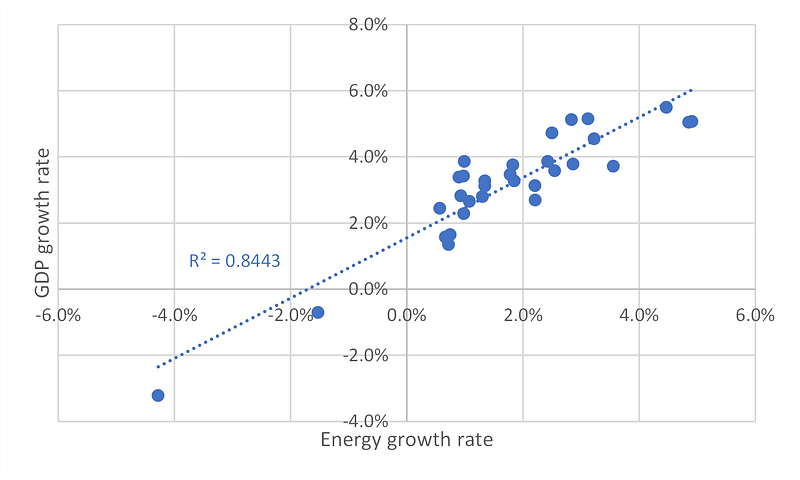
Economic growth is inextricably bound to energy growth | Data from BP and the World Bank for the last three decades

Obviously, the developing world will continue to grow its energy demand in defiance of all the hypocritical Western commentators shouting from their comfortable lifestyles built on the back of hundreds of billions of tons of historical CO2. In pursuit of decent living standards, they will build new coal power plants, buy oil and gas from Russia, and expand heavy industry, cementing the zero-likelihood status of the IEA net-zero scenario.

Sadly, their socioeconomic progress will be hampered by the flawed decarbonization philosophies the world currently follows. Let’s start with the all-too-popular policy of green technology-forcing.

Green Technology-Forcing

The most popular net-zero plan being pushed today is simple: Rapidly expand wind and solar power, electrify nearly everything, and produce green hydrogen for the few sectors that cannot be electrified. Technological learning will secure rapid and perpetual cost declines, ensuring that these green technologies will soon become economically superior so we can ditch fossil fuels and live happily ever after.

It’s a highly desirable story that has inspired a plethora of expensive green technology-forcing policies around the world (and a supporting legion of green echo chamber websites). Sadly, as we will discuss next, it’s fantasy.

Technological learning meets physical limits

The cost reductions experienced by wind, solar, and battery technology have certainly been very impressive. It’s a testament to the large benefits of mass-manufacturing modular technology and, far less popularly admitted, the efficiency of the Chinese economy (which utterly dominates global solar and battery manufacturing and installed as much wind in 2021 as the rest of the world combined).

However, learning rates naturally slow down as technologies mature. When technologies are growing from a small base, doubling the installed capacity is easy and costs plummet spectacularly. Today, however, wind, solar, and battery technologies are mature with large installed bases, making it increasingly difficult to achieve the next doubling.
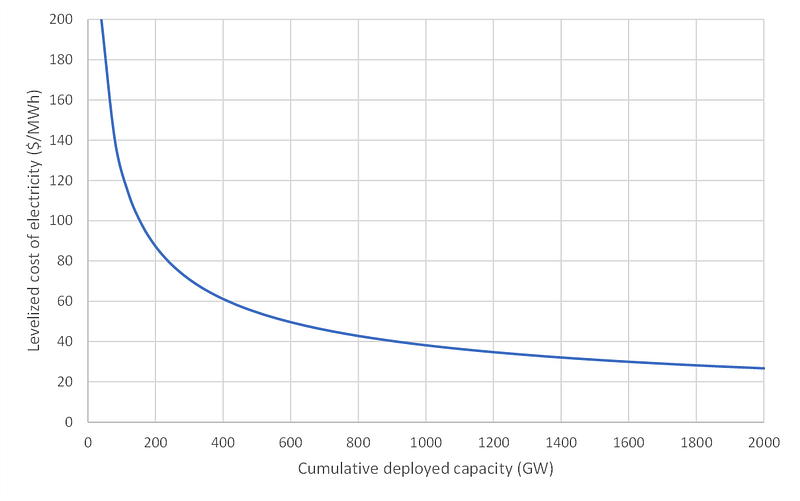
An illustration of learning in a technology that achieves a 30% cost decline with each doubling of capacity.

In parallel to these slowing cost declines, various headwinds are becoming increasingly likely to escalate costs and erode value. The fundamental problem is that wind and solar energy is inherently diffuse and variable (in space and time). These characteristics impose important physical limits on the socio-techno-economic potential of these renewable generators.

Fundamental problems with diffuse generators

The fundamentally diffuse nature of wind and solar requires vast blade and panel surface areas to collect meaningful amounts of energy. Two direct effects follow: 1) a need to cover large land areas with wind turbines and solar panels and 2) a high material intensity.

Even though there is no doubt that the world has more than enough surface area to supply our energy needs with wind and solar many times over, the problem is that no one wants to see these machines in their neighborhood. This is particularly problematic for the densely populated regions of the world that will dominate future energy consumption.
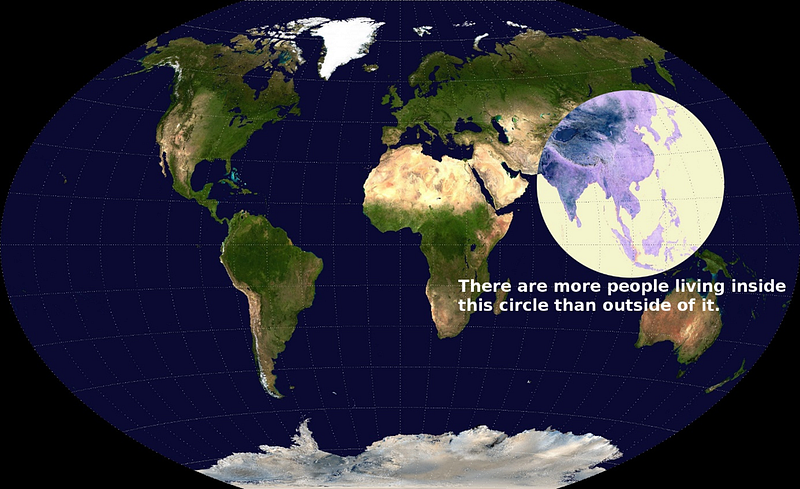
The extreme population density of developing Asia makes a society running on inherently diffuse wind and solar power unworkable (Africa will be in a similar situation in the second half of the century) | Wikipedia

The second issue, material intensity, raises a more direct constraint. Can we physically dig enough materials out of the ground to supply the world’s energy needs? The answer to this question is still unclear, but there can be no doubt that wind and solar are far more material intensive than traditional generators. Furthermore, the vast network expansions and storage systems required by a system with high shares of wind and solar will greatly augment this already high demand for raw materials.
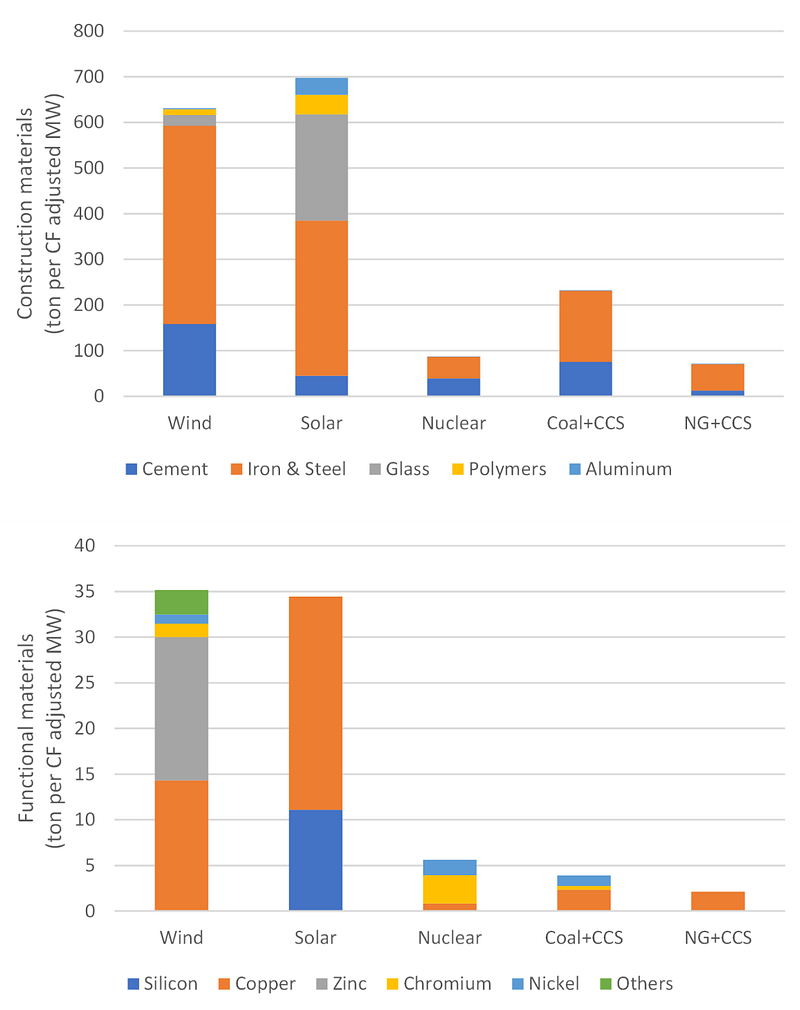
Material demands of different electricity generation technologies. The numbers are adjusted for capacity factor assuming 35% for wind, 18% for solar, 90% for nuclear, 70% for coal, and 50% for gas. | Data from Carrara et al. and Deetman et al.

Even though wind and solar provide a mere 2% of final energy consumption today (10% of electricity which represents 20% of final energy demand), these issues are already creating problems. News of local opposition to wind farms (and the long transmission lines they require) abound across the world, with the near-stagnation of wind in renewable-friendly Germany over the past five years being the most publicized example.

Simultaneously, the material intensity of these technologies makes them highly susceptible to cost escalations in a supply crunch. The IEA analysis shown below found that rising commodity prices will increase the cost of wind and solar by $100 billion — a number generated before Russia’s invasion of Ukraine put even more upward pressure on commodity prices.
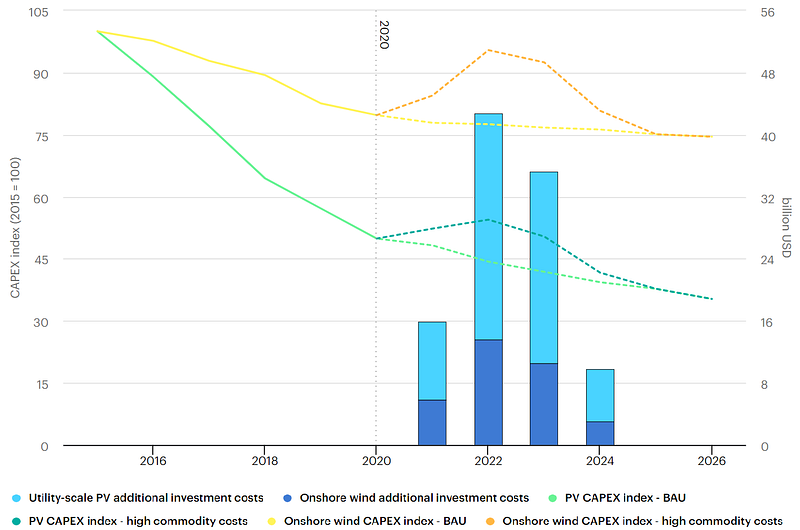
High commodity prices will add about $100 billion to the price tag of wind and solar deployment in coming years | IEA analysis

And I must reiterate: these effects are taking place at a time when wind and solar cover only 2% of global final energy. Thus, even though I expect costs to fall further once the current commodity price shock passes, it may not be long before these factors permanently overpower technological learning and put an end to the decades-long cost declines enjoyed by wind and solar. Signs are already emerging in Europe.
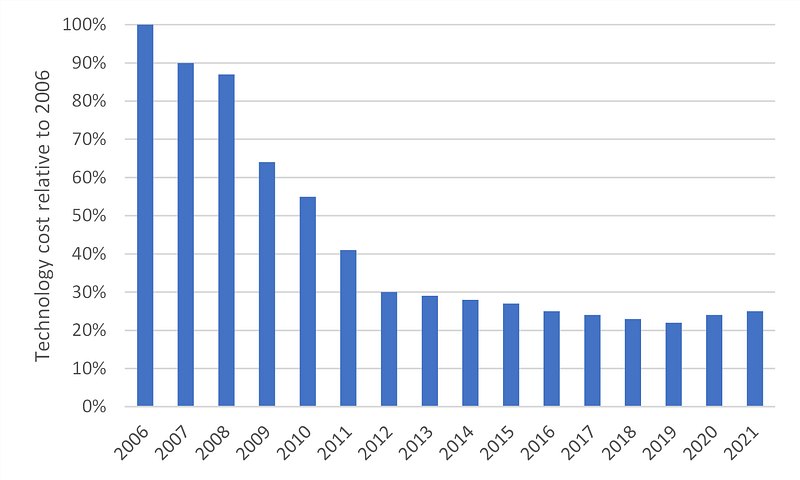
Cost development of large rooftop solar PV systems in Germany, one of the world’s most mature solar markets | Graph based on data from the Fraunhofer photovoltaics report

Such a slowdown or complete stagnation in cost declines is a major problem when considering the inevitable value declines stemming from variability to be discussed next.

Fundamental problems with weather-dependent generators

The intermittency problem with wind and solar is well-known, but its implications on system costs and complexity remain underappreciated.

I will illustrate using our energy systems model featured in several peer-reviewed publications (1, 2, 3). Usually, the model is run with optimistic long-term costs of green technologies up to 3x lower than today to explore scenarios around mid-century, but this example will use today’s costs.
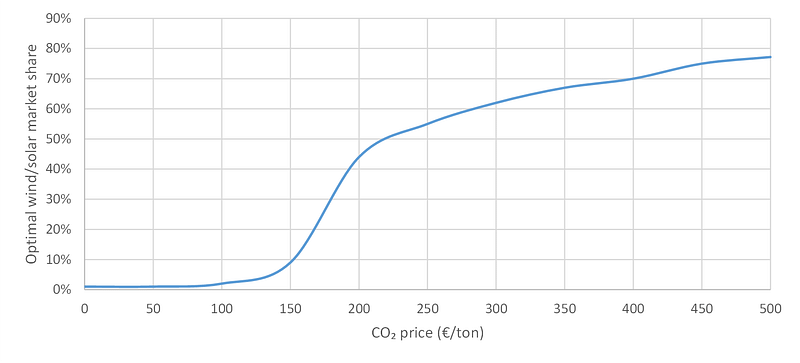
The optimal share of variable renewables in the German electricity system as the CO2 price is increased

As illustrated above, the wind and solar shares enabled by Germany’s current technology-forcing policies would only be realized with a very high CO2 price of 200 €/ton. Yet, under the cost assumptions employed, the levelized cost of electricity (LCOE) for onshore wind (57 €/MWh) is already below that of natural gas power production at a capacity factor of 50% when there is no price on CO2 (59 €/MWh). So, why does the model only start installing high shares of wind and solar at a CO2 price of 200 €/ton that increases the LCOE of gas-fired power to 125 €/MWh?

Well, the first issue is that wind generally requires additional transmission capacity to get the power to population centers from regions with good wind resources and low public resistance. We usually assume an extra transmission cost of 300 €/kW that increases the LCOE of onshore wind to 70 €/MWh.

Second, and more importantly, there are times in the year when it will remain impossible to satisfy demand with wind and solar power, no matter how much capacity we install. The graph below illustrates that, even with a ridiculously high CO2 price of 500 €/ton, the system is forced to deploy plenty of gas-fired power production (NGCC) during times of little wind and sun, even though this electricity now costs about 250 €/MWh.
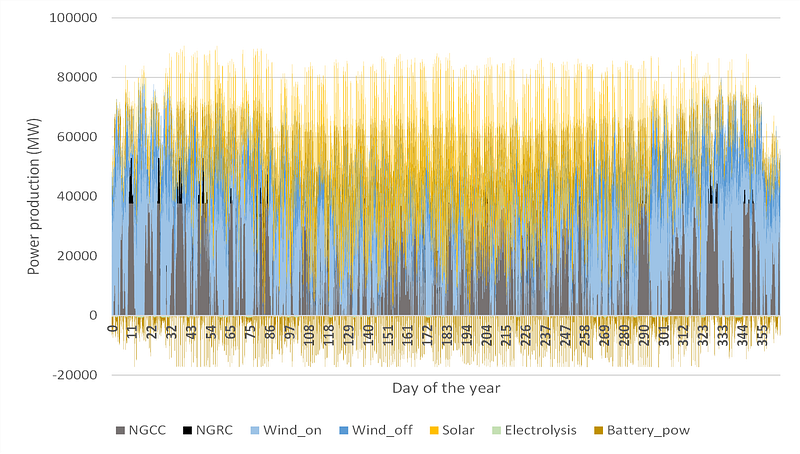
Optimal hourly generation profile for Germany over one full year with a CO2 price of 500 €/ton

Batteries cannot economically store electricity for these extended periods, so hydrogen is the only viable option. Unfortunately, such power-to-gas-to-power electricity storage is so inefficient that it will remain very expensive even in the long-term future.

A popular mitigating solution for this problem, especially among modelers like myself, is to build an elaborate interconnected system where a lot of demand is electrified and fully flexible to ramp up and down with the wind and the sun. Unfortunately, this strategy comes with a considerable cost as large parts of the system must be used at a low capacity factor. Many potential sources of flexible demand also face significant limits regarding ramps and cold starts that are generally ignored in energy system models.

More importantly, though, the degree of complexity and interdependence of such a system will be immense. Energy system models, like the one used in this example, are allowed to build a perfectly optimized system from scratch with perfect foresight regarding demand and wind/solar availability, perfectly rational and coordinated behavior from all actors, and constant prices. This is not how the real world works. Thinking through all the practical and political challenges (and the resulting inefficiencies) that lie ahead in building such a system in the real world makes my head spin.

But as we will see next, this strategy will remain expensive even if it could somehow be executed perfectly.

The cost of electrification and green hydrogen

Wind turbines and solar panels produce electricity, a wonderfully versatile energy vector. When competing with fossil fuels that need costly additional capital to be converted into electricity at a large efficiency loss, such direct production of electricity is a major benefit.

Electricity has its limitations, however, which is why only 20% of our final energy demand comes from electricity today. Relative to chemical energy in fuels, electrical energy is far more difficult and costly to store, transport over long distances, and use in industrial processes requiring high-grade heat and chemical reagents.

To overcome these drawbacks, wind and solar power can be converted to fuels via electrolysis producing green hydrogen. Unfortunately, this dynamic exactly reverses the big advantage outlined two paragraphs earlier. Now, it is wind and solar that require costly additional infrastructure to convert one form of energy to another at a substantial efficiency loss.

We recently published two peer-reviewed papers quantifying this effect by comparing ammonia and methanol energy carriers from wind and solar to the alternative production route from natural gas with CO2 capture. As shown below, the cost disparity is large, even using optimistic mid-century green technology costs.
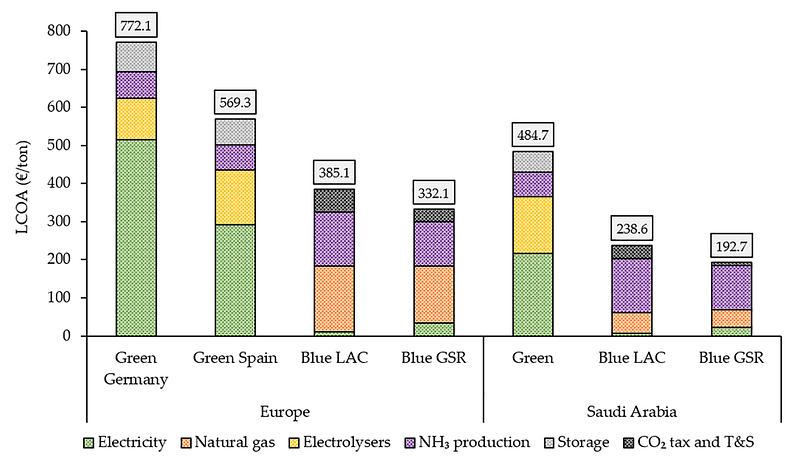
The levelized cost of ammonia (LCOA) from various sources using cost assumptions applicable to the year 2050. “Green” refers to primary energy input from wind and solar, whereas “blue” refers to natural gas with CO2 capture and storage. “LAC” and “GSR” are present and future natural gas reforming technologies. | Arnaiz and Cloete (2022)

Overall, the green pathways require CO2 prices of around 300 €/ton to compete with methanol from natural gas. Competing with natural gas (and oil) directly will require even higher CO2 prices.

The other great green electrification hope is electric vehicles. Unfortunately, this pathway also faces a broad range of challenges I reviewed earlier (1, 2). Even if we ignore all the non-economic challenges, electric cars remain an expensive way to avoid the 10% of global CO2 emissions linked to road passenger transport.
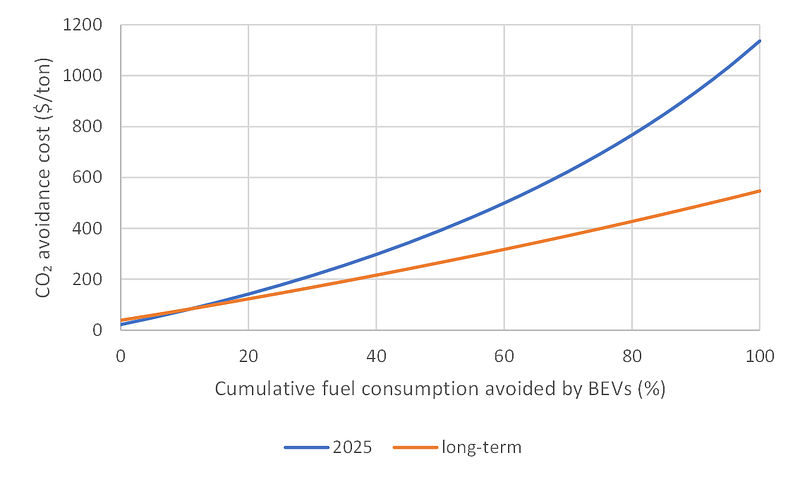
My estimate of the CO2 avoidance costs of electric cars (BEVs) relative to gasoline hybrids in the short and long-term future

Real-world data from the world leader in electric car market share (Norway) shows that the CO2 avoidance cost estimated above is far too low, even when all cars can be charged with cheap and clean hydropower. The eye-watering list of tax breaks and other incentives behind the impressive 75% electric car market share in Norway avoids CO2 for over 2000 €/ton.

When electric vehicles need to be charged with intermittent wind and solar power and are required to enter more difficult niches like long-haul trucking, these four-digit CO2 avoidance costs will only escalate further.

Feeding the green machine we created

Finally, I want to highlight a powerful force behind the perseverance of technology-forcing policies: the lobbying power gained by beneficiaries. For example, the 30-year-old wind production tax credit in the USA was always supposed to be a temporary measure to help the wind industry reach self-sufficiency. It has expired many times over the years, but each time, the increasingly powerful wind lobby got it extended, citing all the job losses that will result when subsidy cuts reduce demand for new wind farms.

Yes, the expiration of wind subsidies will shrink the industry, but it will not destroy it. The US has exceptional wind resources in its interior regions where wind can compete subsidy-free. These are the regions where wind energy makes sense and should be deployed. However, the continued subsidization of mature industries only serves to force technologies into uneconomical markets and generate louder calls for continued subsidization.
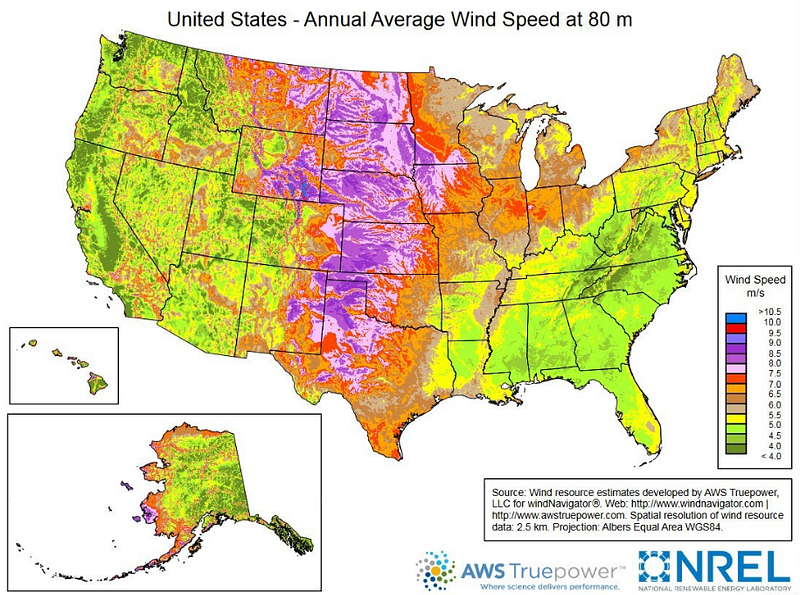
The US interior, sometimes called “the Saudi Arabia of wind” can facilitate subsidy-free wind power | NREL

It’s a worrying sign when subsidy-dependent industries become powerful enough to influence the political system to maintain their handouts indefinitely. Sadly, this is a growing trend around the world, with battery electric vehicles being the latest addition to the club.

Wrapping up green technology-forcing

As always, I must emphasize that wind, solar, and electric vehicles have a large role to play in future energy systems. When deployed in the niches where they make sense, they can practically and economically cut CO2 emissions and fossil fuel dependence. The best niches are 1) wind and solar displacing fossil electricity up to reasonable market shares given local resource quality and space availability and 2) smaller electric vehicles in urban centers.

I should also highlight that direct support for green technologies was not always problematic. In fact, wind and solar subsidies were commendable up to around 2015 when global value chains and economies of scale were properly established and China got in on the act. Similarly, electric car subsidies were a good idea up to about 2019 for the same reasons.

Today, however, all these technologies have long since reached a level of maturity where further targeted support hurts more than it helps. In most cases, it saps vast amounts of resources by forcing green technologies into uneconomical niches where they avoid CO2 at tremendous costs, but it perseveres thanks to lobbying from increasingly powerful green industries and ideological pure-green activist groups. This practice harms global economic development and diverts resources away from a broad range of alternative solutions we will need for a sustainable world.

Sadly, the inefficiency of our approach to decarbonization does not end there. Let’s now talk about the well-intentioned but deeply misguided global movement to defund the fossil fuel industry.

Fossil Fuel Divestment

This section will be concise as I already covered the topic of fossil fuel divestment in detail in a previous article.

While it’s obvious that forcibly restricting fossil fuel supply by limiting access to investment capital can achieve CO2 emission reductions, doing so is incredibly damaging to the global economy. The inevitable fossil fuel price spikes resulting from this strategy cause a massive global wealth transfer from billions of poor people in energy-importing developing nations to obscenely wealthy oil oligarchs who waste most of it on white elephants (or war).
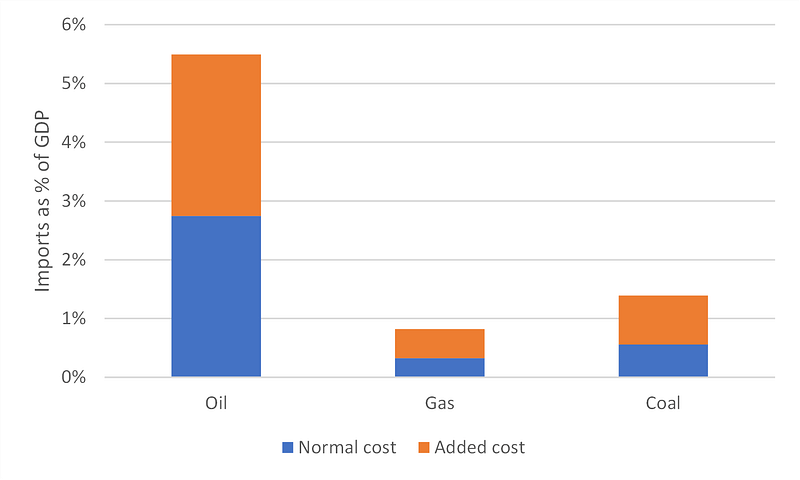
High fossil fuel prices fueled by divestment currently force India to pay more than half their normal economic growth rate in excess payments to wealthy energy exporters. See the penultimate section of the previous article for more detail. | Graph compiled from BP and World Bank data

In essence, fossil fuel divestment is like implementing a large and very poorly structured global carbon tax and paying all the proceeds to the fossil fuel industry — utterly nonsensical.
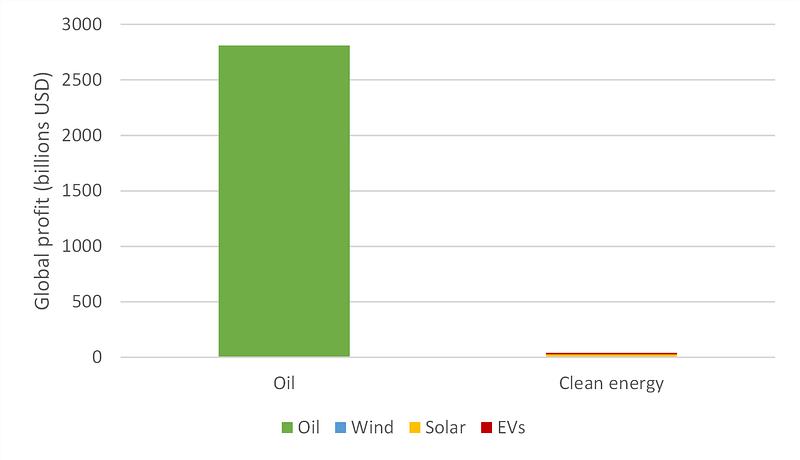
Despite strong green technology-forcing policies, oil profits remain in a totally different ballpark to green energy | Graph compiled by assuming an oil price of 100 $/barrel, oil production costs of 23 $/barrel, and applying profit margins for the three largest wind (3.5%) and solar (9.7%) companies over the last three years and Tesla’s recent 10% profit margin for EVs to total clean energy investment data from the IEA

The cost of forcibly limiting fossil fuel supply

Fears of another global recession are mounting, and supply constraints related to insufficient investment in fossil fuels and other materials are among the primary causes. Green advocates will quickly lay all the blame on Putin, but the fact is that prices were rising well before the invasion of Ukraine and the subsequent sanctions on Russian energy.

For example, the European gas crisis began well before Russian troops crossed the Ukrainian border. The EU simply did not make the necessary investment in gas supply to compensate for the phase-out of coal and German nuclear, exasperated (rather ironically) by an unusually cold 2020/2021 winter and a wind drought toward the end of 2021.
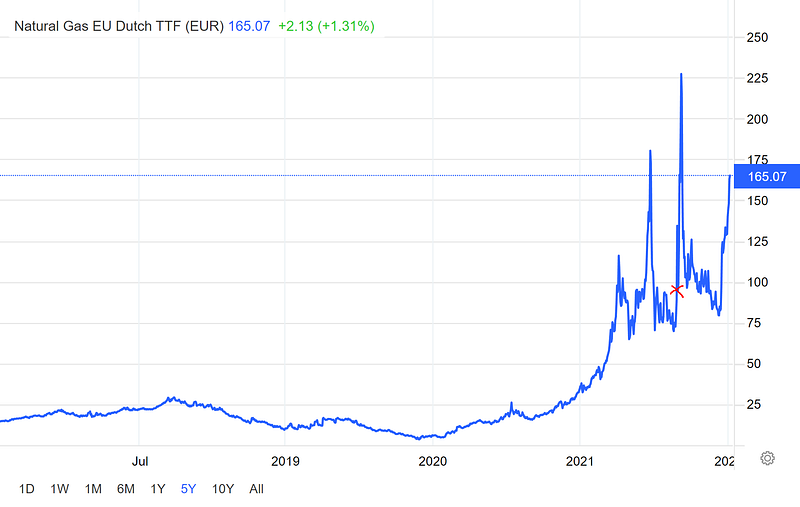
Recent European natural gas price developments with a red “x” marking the invasion of Ukraine | TradingEconomics

The story is similar for oil. Even though Russia’s invasion has introduced plenty of volatility, prices simply stayed on the upward trend following the end of the pandemic. Without lingering Covid restrictions depressing oil demand (especially in China) the situation would have been far worse.
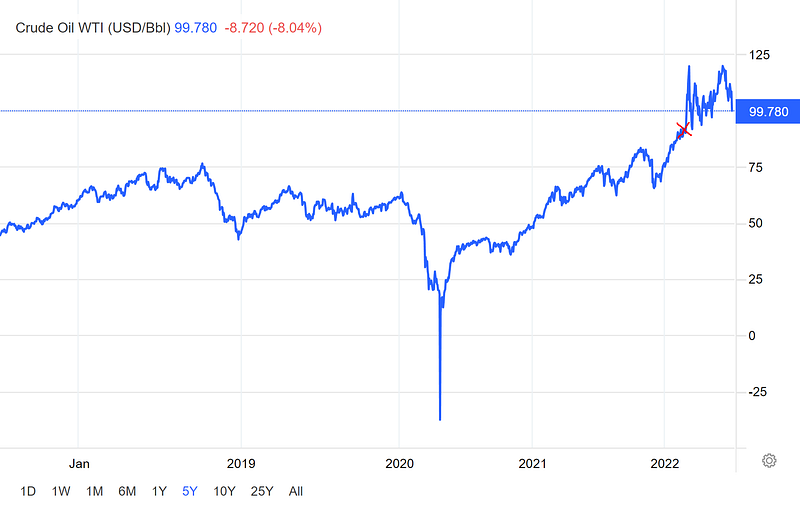
Recent oil price developments with a red “x” marking the invasion of Ukraine | TradingEconomics

As a result of these excessive energy prices and the resulting global inflation problem, growth forecasts for 2022 and 2023 have been dropping precipitously. If we conservatively assign a 1% drop in global economic output for a 1 Gton (2.5%) drop in greenhouse gas emissions, the cost amounts to approximately 1000 $/ton of CO2 avoided.

Most likely, the cost is far higher. In addition to a slowdown in overall economic development, the fossil fuel divestment movement also causes the previously mentioned perverse wealth transfer from poor to rich that does serious damage to the upliftment of billions of developing world citizens.

The limited effect on emissions

To make matters worse, the global gas supply crunch and general economic pain have caused a resurgence in coal. This was the reason why, despite oil demand remaining depressed due to lingering pandemic effects and insufficient investment, global CO2 emissions reached new highs in 2021. Unless the fears of a global recession come true, 2022 will likely see another record.

That brings me to an inconvenient truth: Most people only support costly climate policies when the economy is healthy. When they are struggling to pay the bills, priorities quickly shift to growth in whatever way possible. A small fraction of the resulting stimulus money may find its way into clean energy, but a large amount ends up in fossil-intensive infrastructure projects.

Wrapping up fossil fuel divestment

In summary, fossil fuel divestment places a tremendous burden on the global economy and, in particular, the economic upliftment of billions of developing world citizens. To make matters worse, its efficacy in reducing greenhouse gas emissions is questionable at best.

As I conclude in my previous detailed article on the topic, fossil fuel dependence must be cut from the demand side via carbon and import taxes, not from the supply side via divestment. Demand-side cuts will bring prices down, shifting wealth from people with large carbon footprints to people with small carbon footprints, whereas supply-side cuts move wealth in precisely the opposite direction. It’s glaringly obvious which solution is best.

Getting Our Priorities Straight

The global response to climate change is reminiscent of a typical underperforming student during exam time. We procrastinate for too long before embarking on a panicked cramming session with impossible goals. For the student, the result is often a failed exam and virtually zero retention of the subject matter. For the world economy, the result could be structurally depressed economic development with persistently high emissions, i.e., Shared Socioeconomic Pathway (SSP) 3 or 4 in the graph below.
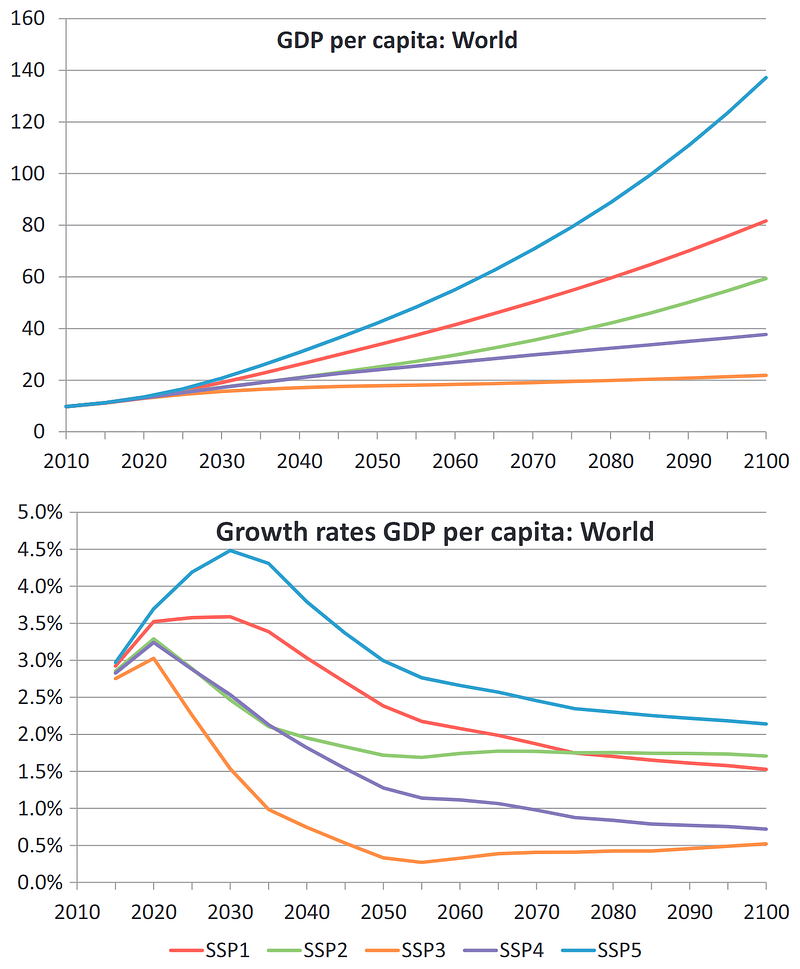
The widely different futures that may unfold depending on our choices today | Dellink et al.

As the SSP studies show (please read the brief descriptions of each pathway here), greenhouse gas cuts have little to do with the future trajectory of the global economy. Instead, it’s all about massive, globally inclusive investments in human and social capital, fostering innovation, optimizing health, and naturally limiting population growth.
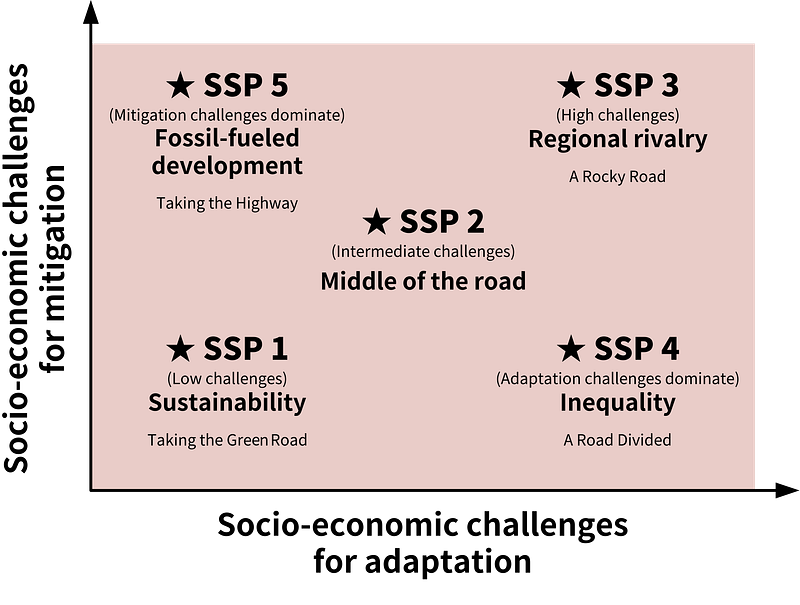
The five shared socioeconomic pathways | Wikipedia

In light of current trends, I’m concerned that the obsession with “net-zero by 2050” combined with misguided green technology-forcing policies and fossil fuel divestments will divert us from the path of broad economic upliftment.
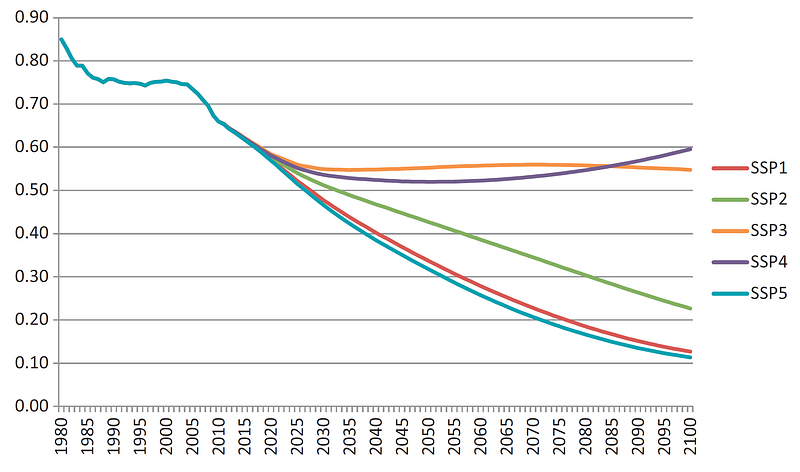
This graph of between-country Gini-coefficients in the different SSPs shows that globally inclusive growth is a major factor in the vast prosperity growth in SSP1 and SSP5 | Dellink et al.

Green energy technology is highly capital intensive and requires a broad array of similarly capital-intensive supporting infrastructure to overcome challenges with spatial and temporal variability and applicability beyond the power sector (recall the requirement for 4–8x more developing world investment). These enormous capital demands will compete directly with the vast array of non-energy investments we require to get ourselves onto SSP1 or SSP5. To make matters worse, the material intensity of green technologies could worsen regional rivalries because multiple key minerals are considerably more geographically concentrated than oil and gas.
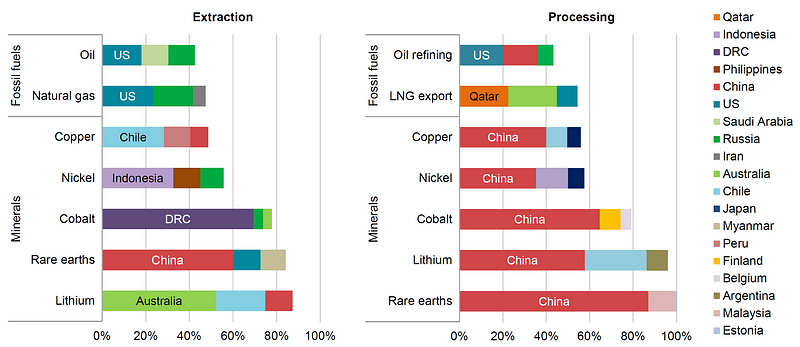
Market shares of the top three states in oil and gas compared to several critical minerals | IEA

We seriously need to take a step back, stop panicking about the world ending if we do not reach net zero by 2050, and get our priorities straight. Let’s see what this might look like.

Level-Headed Climate Policy

Broad global prosperity is the single best climate policy at our disposal. By that, I do not mean more oversized rich-world suburban homes with multiple luxury SUVs in the driveway. I mean reliable modern energy and utilities, sturdy housing equipped with all necessary labor-saving, food preservation, and climate control devices, modern health and educational facilities, and well-diversified trade connections for the 6 billion world citizens currently living below 1000 $/month.

With these developments, billions of people can effectively protect themselves against all kinds of extreme weather, local crop failures, and diseases that may be exacerbated by climate change. Simultaneously, we will gain hundreds of millions of additional educated and resourceful minds to work on key global challenges, including climate change, while the natural drop in fertility rates limits the ecological pressures associated with further population growth.

Prioritizing decarbonization over economic upliftment is a tragic mistake multiple powerful groups seem determined to make. We must resist it.

A ruthless focus on efficiency

Climate action that costs hundreds or even thousands of dollars per ton of CO2 avoided must stop. As reviewed earlier, it does little for climate change mitigation and a lot to hamper economic upliftment.

When considering all the opportunities for more cost-effective decarbonization at our disposal, such expensive climate change mitigation measures become all the more indefensible. The IPCC gave a handy figure in their latest report as guidance.
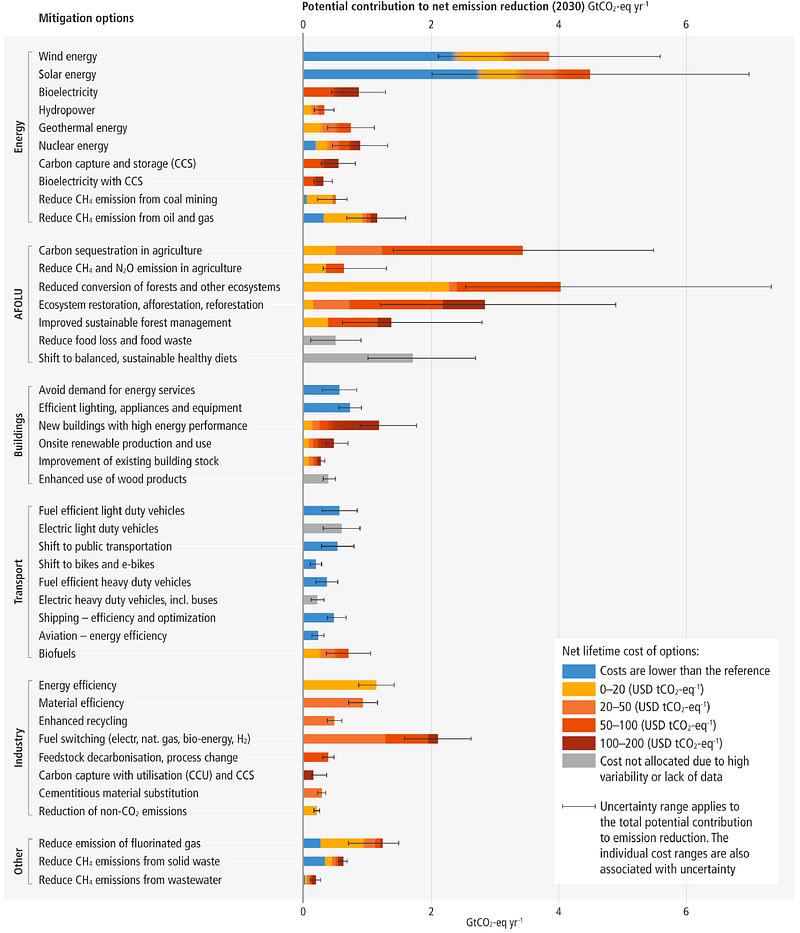
A broad range of near-term climate actions and their estimated costs. Note that different potentials are not necessarily additive and wind/solar estimates exclude integration costs | IPCC WGIII

One thing we must not do is impose a confusing mess of technology-forcing policies to individually promote various solutions in the IPCC figure above. Instead, we must scrap all technology-forcing policies and implement a CO2 tax instead. Such a policy will automatically promote every possible CO2 abatement technology and correctly prioritize their deployment.

The dual purpose of a CO2 tax

Even though all economists agree it would be by far the most efficient route to decarbonization, implementing a CO2 tax has proven politically challenging. However, rather than seeing this as a drawback, it should be viewed as an objective indicator of where our priorities truly lie.

A carbon tax puts a very explicit cost on climate change mitigation, thereby directly exposing our willingness to pay. Green technology-forcing incentives, on the other hand, impose costs in a far more obtuse manner, making it hard for consumers to know how much these policies actually cost them.

In other words, a carbon tax is honest and open about costs whereas technology-forcing can easily obscure true costs, permitting the very high CO2 avoidance costs calculated earlier. Under a technology-neutral carbon tax, such inefficient decarbonization solutions would never be deployed.

And that’s why a carbon tax is doubly important. It openly asks the electorate whether it really wants to prioritize climate change mitigation over all our other developmental priorities. If the answer is “no,” it needs to be taken seriously. Not doing so can be viewed as willfully misleading the people.

As people become increasingly cognizant of climate change, CO2 tax schemes will emerge. The EU already has a high tax and several others are being put in place around the world. Unfortunately, the EU still maintains a broad range of technology-forcing policies in parallel, thus doubly incentivizing green technologies, but the tax system is definitely a step in the right direction.
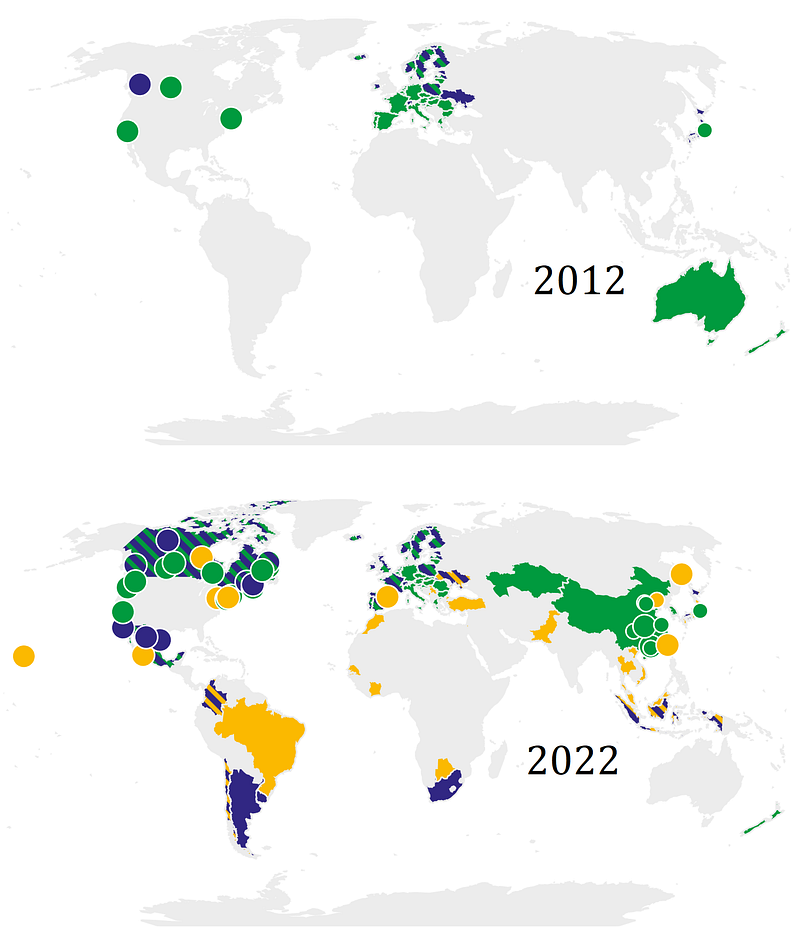
An illustration of the good progress made with CO2 pricing over the last decade. Purple indicates a carbon tax, green an emissions trading system, and yellow shows these measures are under consideration. | World Bank

The EU is also working on a border adjustment mechanism that will incentivize other countries to decarbonize the products they export to Europe. In this manner, the growing number of countries with implemented carbon pricing can rapidly expand their global impact. If everyone concerned about the climate would call for acceleration in these developments instead of promoting their green ideologies, we would make much faster progress.

That being said, there are many novel solutions that deserve targeted support. Let’s round out this article with a look at those.

When targeted technology support is beneficial

As mentioned earlier, targeted support for wind, solar, and electric cars was beneficial up to the point when global value chains and economies of scale were well established and the majority of cost reductions were achieved.

There are many other technologies that require similar support. However, we must learn from the wind and solar experience and decisively withdraw all support when this point is reached. If the technology is worthwhile, it would have captured a profitable niche at that point (as wind and solar have successfully done), allowing it to grow naturally and independently of support, aided by gradually rising CO2 prices.

We can promote many alternative low-carbon technologies with all the money currently being poured into direct and indirect support mechanisms for mature green technologies. In addition, we can ramp up research, development, and demonstration (RD&D) efforts into novel low-carbon technologies of all kinds that can secure our long-term energy future.
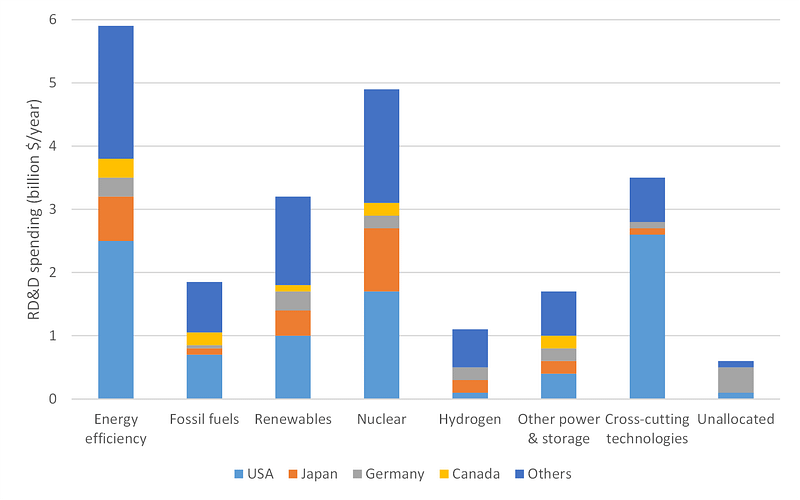
Distribution of global RD&D energy spending between technology classes | Graph from open IEA data

Currently, RD&D into all forms of clean energy attracts a mere 15% of the funds being poured into the direct subsidization of mature wind and solar technologies shown below (excluding all the indirect support in the form of deployment mandates, low-cost financing, fixed-price contracts to protect against value declines, free grid expansions, etc.).
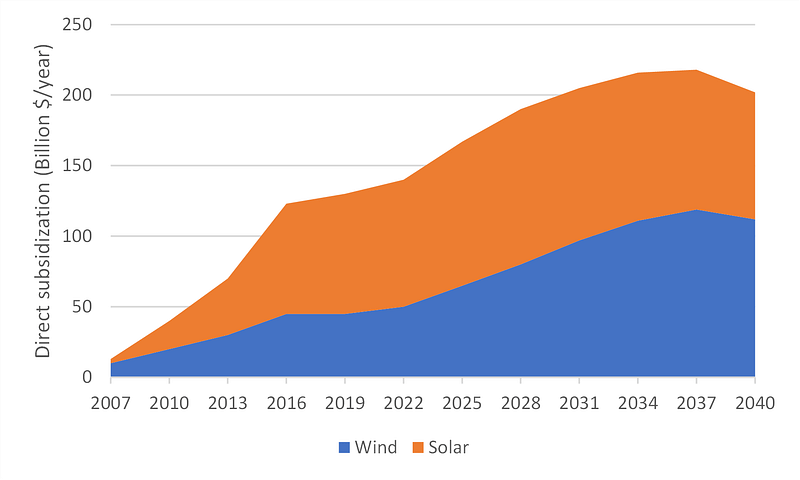
Global direct subsidies for wind and solar | Graph from data in the IEA World Energy Outlook 2018

We can get orders of magnitude more value for our money by developing multiple technologies with the potential to secure our long-term energy future. Nuclear fusion is the holy grail, but breeder reactors can also generate a practically limitless supply of clean energy. If we can figure out how to drill deep enough holes, geothermal offers the same promise. While these technologies supply heat and power, genetically enhanced ocean biomass farms could supply all our fuel needs without any land-use constraints.

These and many other solutions promise a boundless energy future that is not dependent on the weather, limited critical mineral resources, or vast land areas coveted by local residents. With such boundless, reliable energy, we can pull as much CO2 out of the atmosphere as necessary, eventually using greenhouse gases as a global thermostat to perpetually maintain the ideal climate. It’s a crying shame we spend so little money pursuing such a future.

Final Thoughts

Our current approach to climate change mitigation might even have been funny if it did not damage so many millions of lives. The most basic human biases are on full display complete with “end of the world” prophesies, cult-like beliefs in various ideological solutions, near-complete disregard for the interests of the silent majority, and a shocking degree of linear thinking and impatience behind our major decisions.

We need to take a step back and acknowledge some basic truths:

  • 1.5 °C is impossible and 2 °C would unreasonably constrain developing world upliftment unless the rich world agrees to pay trillions per year in historical climate damages and we embrace technology-neutral climate policies. Since that is unlikely to happen any time soon, 2.5 °C is a rational target.
  • Luckily, the world will not end at 2 °C, and, unless we make a complete hash of global economic development, our civilization will be far more prosperous and equitable by the time that threshold is crossed after mid-century.
  • A prosperous and equitable society is more resilient to a more hostile climate, more willing and able to spend money on climate action, and more capable of developing novel solutions for major world problems.
  • By blundering ahead with deeply inefficient green technology-forcing and fossil fuel divestment, we significantly increase the likelihood of seriously impeding global economic development while failing to achieve a permanent decline in global greenhouse gas emissions.
  • We will need a set of solutions extending far beyond wind, solar, and electric cars to build a sustainable society. Technology-neutral policies like a carbon tax clearly offer the best framework for managing this transition and deserve all the support currently given to green technology-forcing.
  • The potential of limitless, reliable, and concentrated clean energy offered by multiple promising pathways deserves way more than the 0.02% of world GDP we currently spend on the relevant RD&D. It’s a much better target for all the money we throw at mature green technologies today.

In summary, keep the priority squarely on the economic upliftment of 6 billion (and counting) developing world citizens, demand no climate change mitigation action other than the establishment of gradually rising CO2 pricing around the world, and shift all targeted technology support to RD&D of new solutions and the subsequent establishment of global value chains and scale.

Climate Change
Energy
Policy
Economics
Technology
Recommended from ReadMedium