
A Journey to the End of the Earth
Experiencing the majesty of Chile’s crown jewel — Torres Del Paine National Park
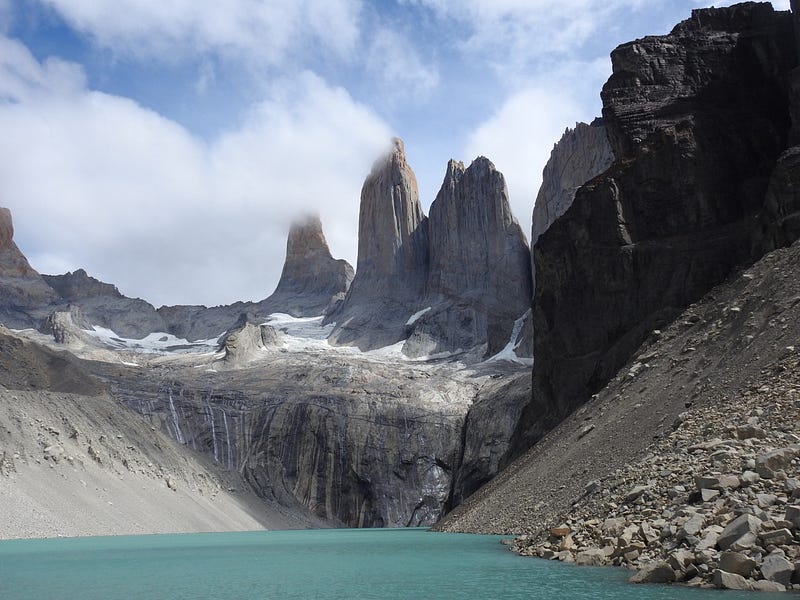
Arid yellow-brownish fields; glacial mountain peaks; a scattered pacific archipelago fusing into a multitude of intersecting rivers; crystalline turquoise lakes; galloping guanacos and pumas hiding somewhere in the bush. This is what was visible to our eyes in the final minutes prior to landing in Puerto Natales. The landing was punctuated by an aggressive Boeing belly-flop and full brake thrust due to the shortness of the deserted landing strip. We had landed at the end of the earth. The furthest south Maria or I had ever been. Fifty-one degrees south, seventy-two degrees west. Puerto Natales (non-international) Airport. Magallanes y Antártica Chilena. Yes, Antarctica begins here. Torres del Paine National Park was finally within striking distance. Our entire journey had been gradually crescendoing to this.
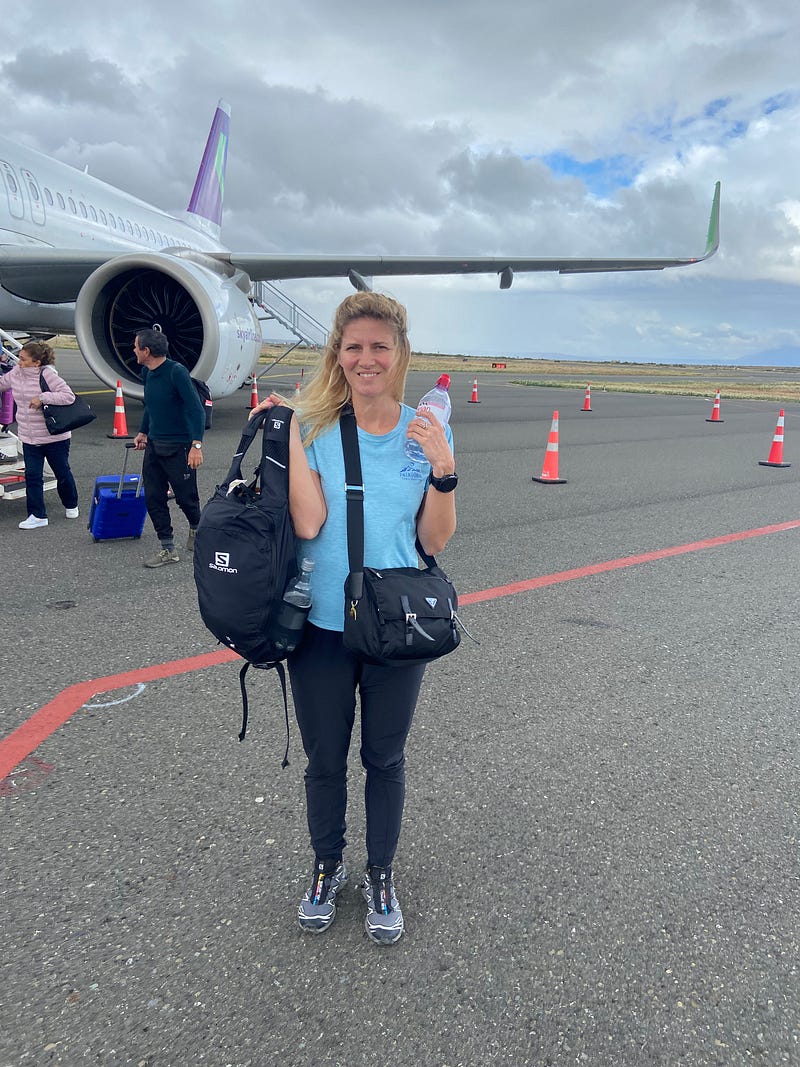
We took some pictures on the runway as if we were Magellan himself discovering this unexplored frontier. Maria picked up our luggage while I negotiated with a local cabbie for a transfer to our hotel. I managed to get told off in the meantime — by the one rent-a-cop of the lego airport — for allegedly crossing in and out of the baggage claim to do so. Controversy is never far off when traveling with our family contingent. (I wonder if Magellan also encountered a similar reception.) We loaded our luggage and settled in for a sixty-five-kilometer drive that would take ninety minutes.
After fifteen minutes, the flat, newly paved road leading out of the airport turned to gravel. From there, the consistency of the road alternated every ten minutes between concrete strips and dirt until it was just sand and rocks. (Top tip: make sure to do plenty of core exercises in the months leading up to a Patagonian trip.) However, we were so mesmerized by what we were seeing out the window, that we barely noticed as our discs slowly herniated and our lungs filled up with the dust that seeped through the cracks in the widows. We passed Lago del Toro with the iconic Torres del Paine in the background as we made our way through a labyrinth of seemingly random rock walls, surrounding narrow bends on the passes, overlooking rivers fusing into one another. This was truly nature at its finest taking a bow in front of us, saying “You are welcome.” We felt honored to be there, not caring that the cell phone reception was nonexistent.
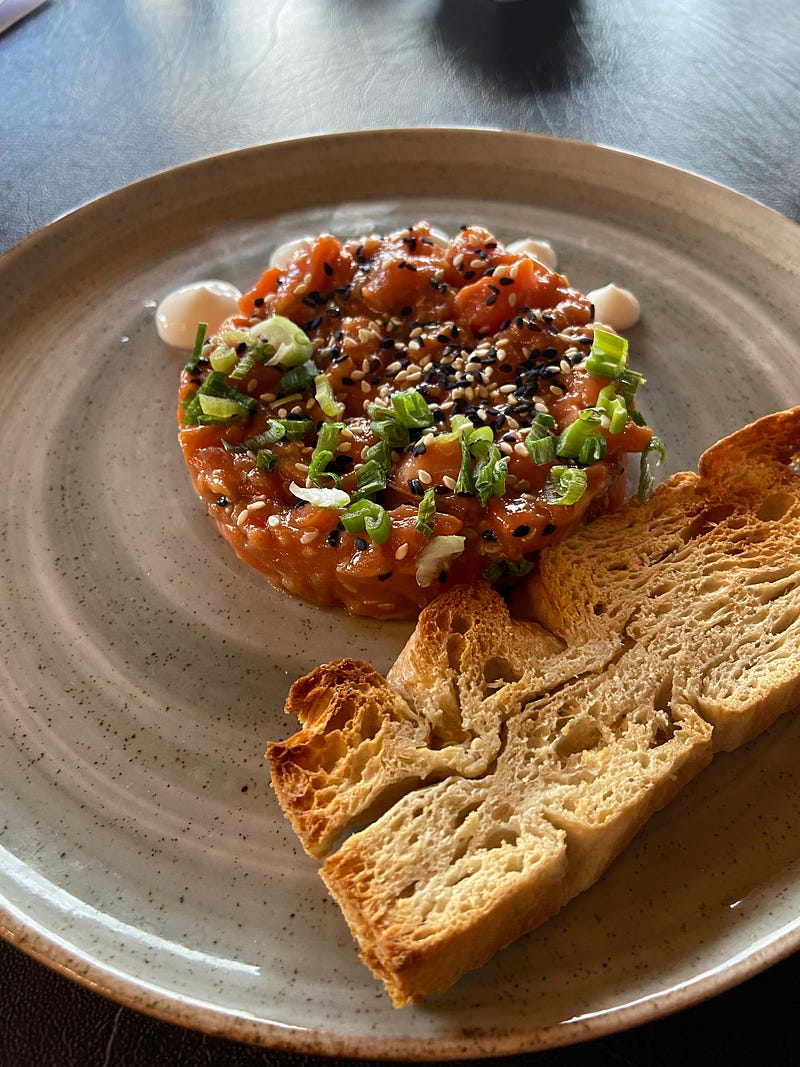
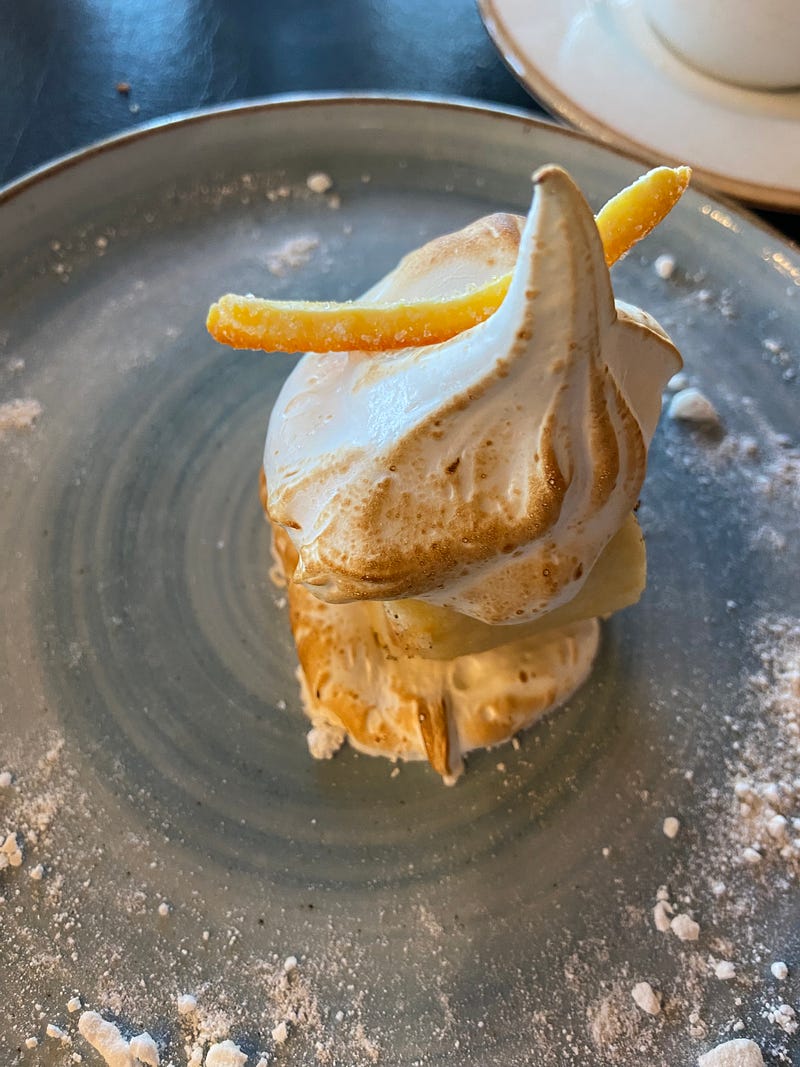
We arrived at Rio Serrano and headed straight to dinner where we had our best meal of the trip thus far: tuna tartare for Maria and guanaco with pureed sweet potato quinoa for me. We topped it off with a shared tres leches cake. After only a couple of days in Chile, I had made up my mind. Chileans make better food than the Argentines — by far — and can give the Peruvians a run for their money in the Americas food sweepstakes. The cuisine is diverse and refined. The beef in Argentina is in a class of its own but everything lives and dies by that. The Chileans, on the other hand, experiment and steal with pride (see shrimp causa). Andean staples such as quinoa and forty varieties of potato make noteworthy appearances but are complimented by some of the finest seafood the world over. Admittedly, the view of the Cerro Grande on the horizon as we approached the late summer sunset provided a backdrop to the dinner that would even make a Big Mac with soggy lettuce seem gourmet.
Maria asked me if I could see myself living here and I struggled to find a reason not to try.
We took our first morning at leisure before embarking on an alternative activity that Maria talked me into, horseback riding. Maria loves animals — stopping to pet anything she sees, even a squirrel in the middle of the street — and used to ride as a kid, so it was only fair that she would jump at the opportunity to emulate the great Patagonian gauchos. I, on the other hand, love my dog and enjoy observing wild animals within the confines of a zoo but bouncing around on a saddle for two hours is not exactly my cup of tea.
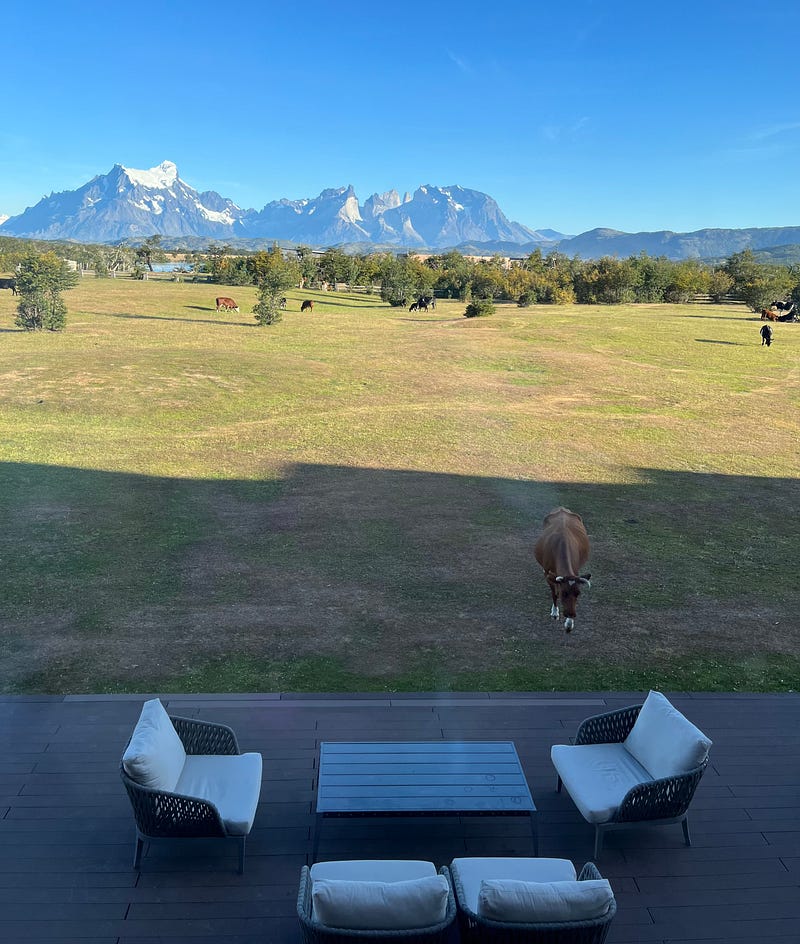
I had been horseback riding once before, about a decade ago on a ranch in Mexico. On that occasion, we mounted semi-sedated horses and were pulled around by the guides for a fifteen-minute tourist trap. (Oddly enough, a couple of months later, tourists were held at gunpoint at the same ranch and one of them, while reviewing the experience on TripAdvisor, alleged that the rancheros themselves had been in on it.) Safe to say, I was not thrilled by the prospect of giving up half a day of hiking to risk getting thrown off a mare and landing face-first into a pile of manure.
As usual, though, my wife was right. It turned out to be a very pleasant experience and a great way to explore the surroundings at Rio Serrano. I was given Estrella, the spicy eighteen-year-old lead mare, and so was up front next to Juan, our guide, for the entirety of the ride. Anytime one of the other horses would want to join upfront, Estrella would promptly put them in their place and solidify the pecking order.
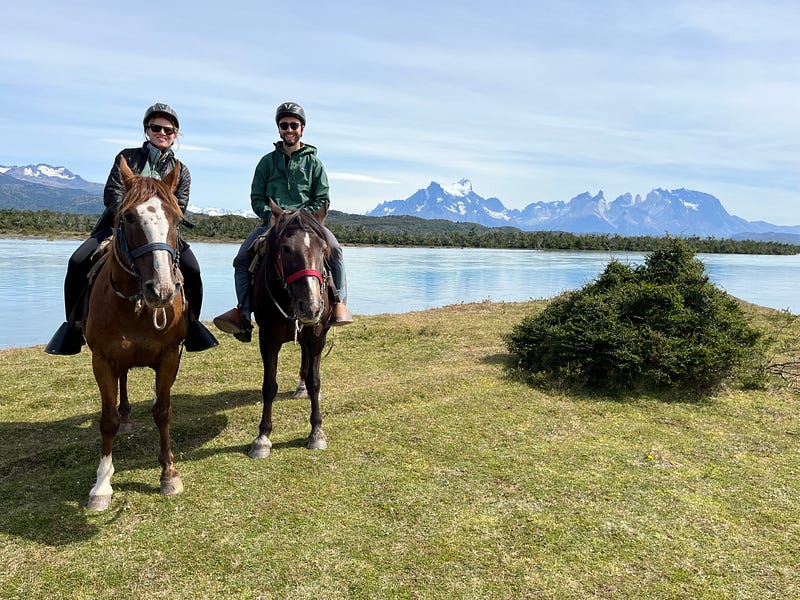
Juan gave me the lay of the land explaining that the hotels in the area are open from October until May at which stage they close for winter, which in this corridor of Patagonia hits hard. Joining Juan as a closing guide was Elise from the Netherlands. She had been traveling throughout South America for a year and was stopping from time to time at different ranches to work with horses. (As we later found out, this is quite a popular arrangement for adventure-seekers in their twenties.) When I asked her when she would be finished with her South American travels, she smiled, petted her horse, and said “not any time soon.” Looking around at the raw beauty surrounding us, I found it impossible to make a counterargument. Maybe horseback riding was not so bad, I thought — especially in such a setting. Little did I know that it would not be the last time I would be riding this holiday.
Every trip has its crown jewel. The one sight that you expect will make the entire journey worthwhile. Far too often these expected highlights are hyped and fail to deliver. In very rare instances though, they end up exceeding even the highest of your expectations. Welcome to Torres del Paine National Park.
On our second morning, we loaded up on breakfast, packed our bags Merry Poppins style with an infinite amount of different technical layers, and went down to the lobby to meet our group promptly at seven-twenty. Our team of six would be led by our guide Fabian through a grueling twenty-four kilometer, nine-hour hike up to Base de Torres — the emblematic rock towers overlooking a blue lagoon at the far end of the park. None of the participants backed out, even after the fear-mongering-laden dinner-time debriefing the prior evening. It would not be Everest but it would also be a far cry from sipping piña coladas on the beach in the Caribbean (something we would find ourselves doing just two weeks later).
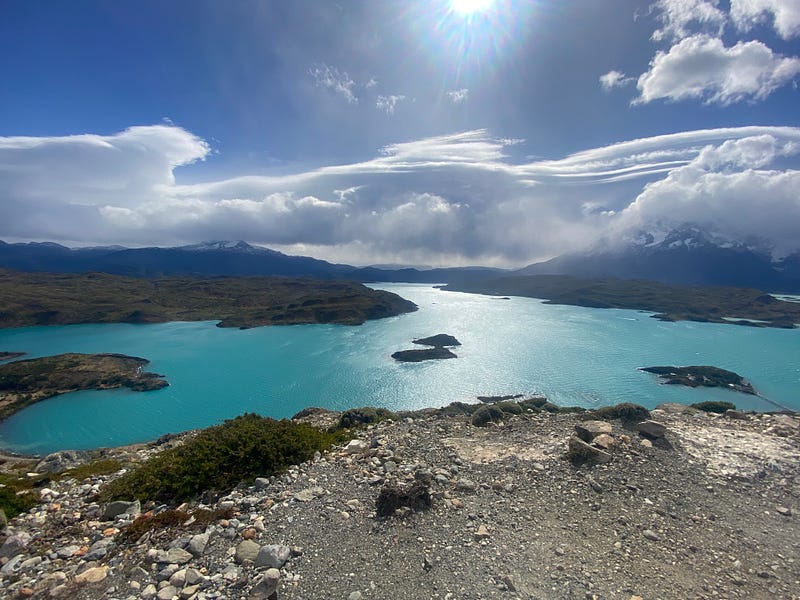
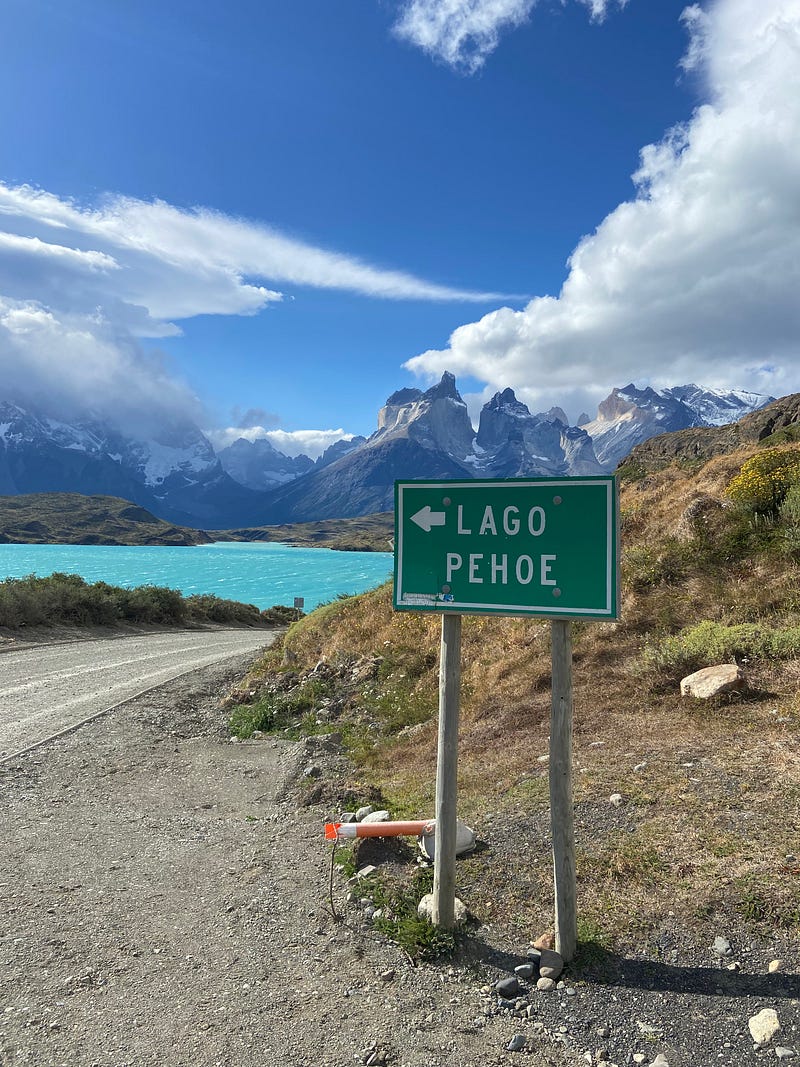
The excursion commenced with a ninety-minute drive from Rio serrano to the central camping base. The drive itself would have been enough to call the entire trip a success without breaking a sweat. Fabian explained the meaning and origins of the native Mapuche word Paine while Maria frantically searched for camouflaged pumas exfoliating themselves amongst the ‘mother-in-law’ bushes — named as such because of their welcoming appearance which tricks many hikers into touching their rash-inducing, prickly leaves. I, on the other hand, was entranced by the Paine blue hue of Lago Pehoe, undisturbed by any pollution other than our van’s exhaust pipe. No boats, no jet skis, not even a pedalo. After all, this was Torres del Paine National park, a protected territory.
On arrival at the campsite, we lathered ourselves in fifty SPF and proceeded through the initial part of the course. To our amazement, we were passed by a few hardcore heading in the opposite direction who had braved the cold and already been to the top to witness, what I could only imagine was, a majestic velvety sunrise over the three towers. Within half an hour our group split due to a foot injury sustained by one of our team members. Fabian stayed back to support like a true sherpa while the rest of us continued together until Maria and I upped the ante. We were joined by our pseudo-guide, Jacob, on the breakaway.
Jacob had been working with the horses at the ranch and was tagging along on his day off. He only arrived in Chile from California — where he had been a kayak guide on the Channel Islands — three weeks before. Safe to say he was not a certified mountain guide. What he lacked in qualifications, however, he made up for with banter and athleticism. He told us how on his journey to Chile he had forgotten his bag in the Atlanta airport with his hiking boots in it — not an insignificant detail when planning to live in Patagonia. He had also already lost his Chilean entrance receipt, meaning he could not journey to Argentina or anywhere outside of Chile for that matter. Now, to top things off, he found himself third-wheeling two psychotic honeymooners who chose to test their fresh marriage on a mountain.
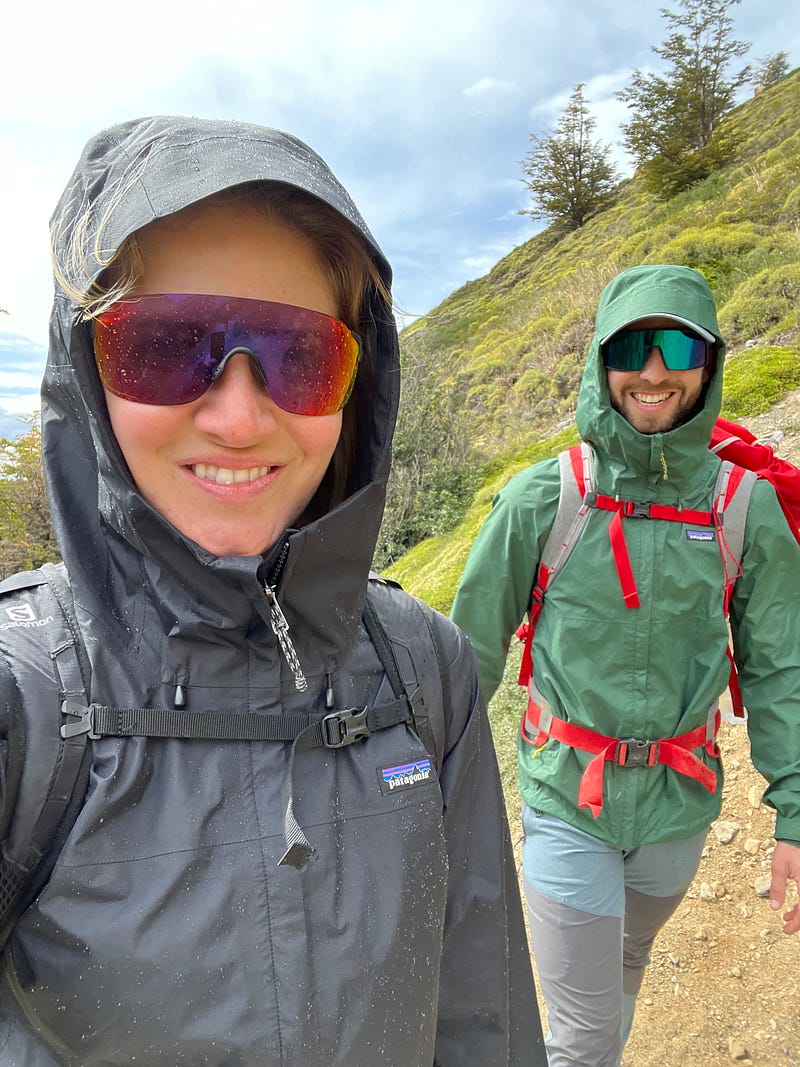
“You can experience all four seasons in one day in Chilean Patagonia” goes the adage. On these mountains, the time interval of seasonal variance felt more like one hour. In mere minutes we would go from overheating in short sleeves to piling on vests, wind shells, and gloves. The W circuit — as hikers refer to the trek — turned out to have its own microclimate that kept us guessing throughout the day.
The first part of the course was not too physically demanding. We were able to enjoy the constant shift in landscapes from the arid, brown hills — surprisingly dry this year — to the evergreen forests bisected by deafening waterfalls and rapids. We stopped briefly to regroup at the Refugio Chileno where we munched on an apple, fed the core to the horses, and proceeded to the top in order to have enough time to enjoy the view.
The final three kilometers is where the terrain got the trickiest and where we started to see tourists with inadequate footwear (Converses are for the city, not for hiking) collapsing to the side of the path. The track became one steep, winding climb with scattered boulders that we needed to latch on to at various points for stability as well as to generate upwards momentum. On the final kilometer of the stretch, the bipolar microclimate struck again. This time it chucked down supersized raindrops and lowered the temperature significantly. The cloud cover increased and more and more early birds made their way down with disappointed looks. The microclimate had probably gotten in the way of their picture-perfect Instagram moment. Undiscouraged, we trudged on.
Rounding the final bend, we caught sight of the turquoise lake in a bowl formed by the surrounding rock faces. At that stage, I felt the same sense of surrealism as when I had first laid eyes on Machu Picchu — the opposite of the disillusionment from a visit to the Mona Lisa. There was nature at its most pristine staring us head-on, granting us the fuzzy sense of fulfillment for having earned the view.
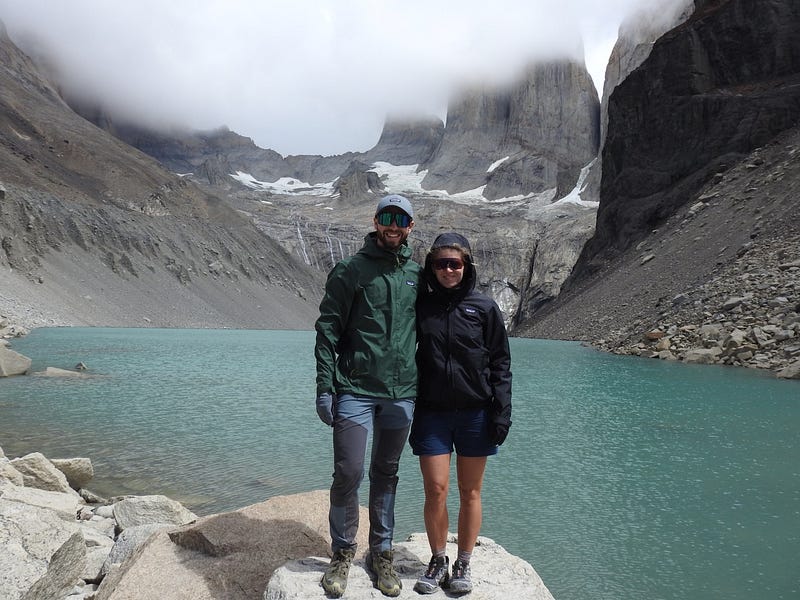
Jacob had forgotten to pack his lunch, so we shared a bite with him since he also had to make it back down to the campsite. In effect, we were only halfway through the day at that stage. After the frustrated masses had left prematurely and as we munched on our sandwiches and cashew nuts, all of a sudden the sun poked its head out and the three towers came into full view. At this stage, Jacob moonlighted as our contracted honeymoon photographer and the rest of the group (minus one) summited in time for a group shot including our official sherpa, Fabian. We got what we came for and more. The memory remains even better than the photos.
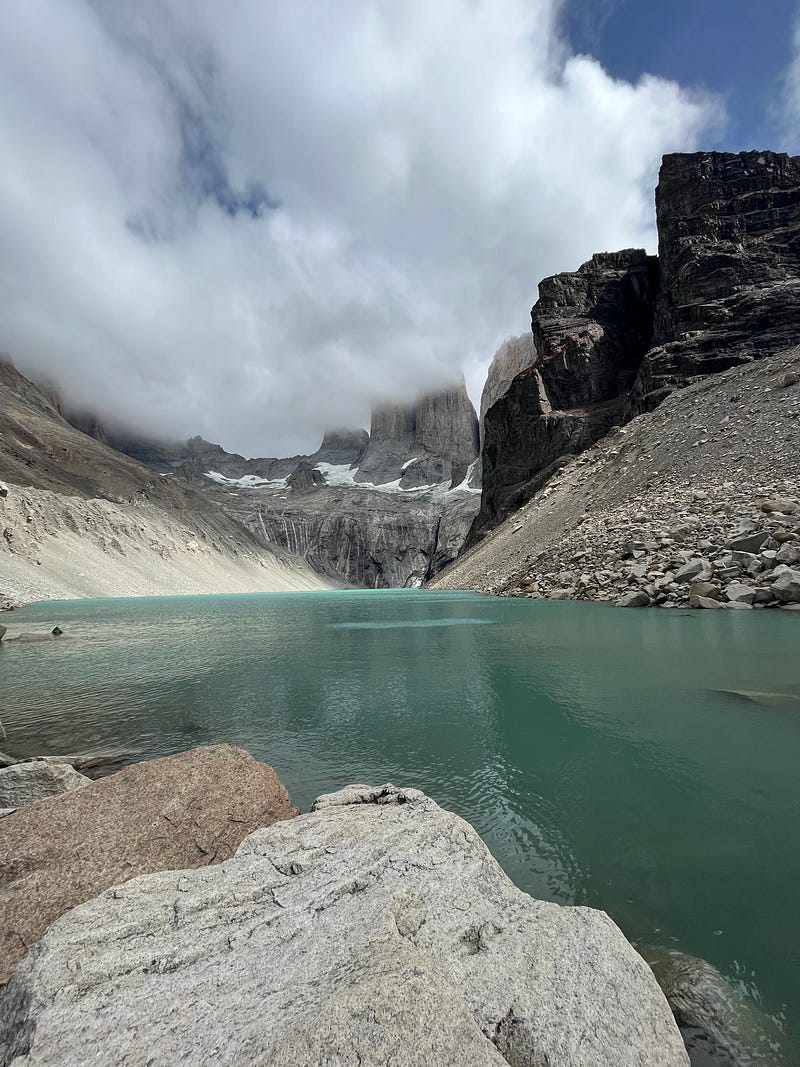
The march down required double the focus on half the energy and as such was done mostly in silence. The sun escorted us and allowed us to bask in its glory back at the Refugio where we re-hydrated while awaiting the rest of the group.
Before moving on, I went to the fountain to refill our water bottles. While awaiting my turn, I inadvertently made eye contact with the fellow queuing behind me. “Hola.”
“Hola.” He squinted his eyes. “Chileno?”
I could not believe my ears. It had happened again. This time I had been mistaken for a Chilean in Chile. The third time is the charm.
“No. Italiano. Tu?” I replied, struggling to hold back my laughter.
“Ah. Si, soy Chileno, pero soy Italiano también. Mi apellido es Camillo.” Ah. Yes, I am Chilean, but I am also Italian. My surname is Camillo.
Of course, the Chilean who mistook me as Chilean had Italian ancestry, A twist of fate typical of this southern cone of South America. I wished him luck on the rest of his W trip and we parted ways as a wannabe Chilean and a wannabe Italian.
Down we went through the Paso de los Vientos until we were on the front side again with a full view of the lakes and rivers glimmering in the late afternoon rays. We got back to the hotel, nearly fourteen hours after having left that morning, exhausted but in agreement that there was a new number one on top of the honeymoon power rankings. The crown jewel had overdelivered.
We took it easy the following morning in the spa and gym. After lunch, I packed my bag again to join Fabian and Esteban up the Paso del Condor. The hike would consist of a leisurely stroll up to a viewpoint overlooking Lago Pehoe and the backside of the towers.
Nonetheless, the guides obligated us to bring our poles. And thank God that they did. The Patagonian wind is like nothing else. Forget Copenhagen, Chicago, or Lanzarote. The gusts on Paso del Condor that day ranged from fifty to seventy kilometers per hour and can get up to triple digits “when the wind is really blowing.” To put this brute force into perspective, on multiple occasions my seventy-five-kilogram mass was blown to the side of the track. At the viewpoint, upon taking off my backpack to snap a few shots, I was no longer able to get it back on without assistance from both guides. If it could blow me over, you can only begin to imagine the kite-like effect it had on my red rucksack flailing in the gusts.
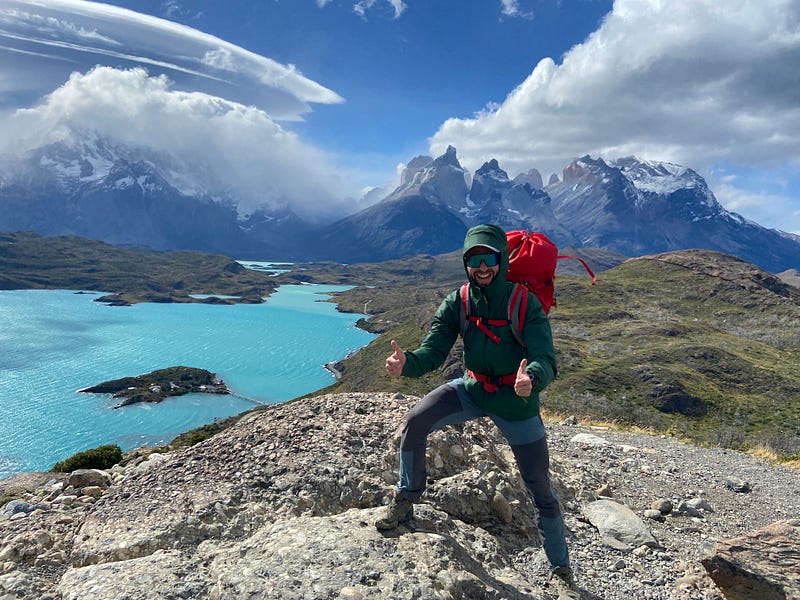
On the slide back down to the base, I got to know Esteban a bit better. Like Fabian, he came from Santiago. It was only his third month on the job but his ambitions went much further. He began studying eco-tourism and wanted to see all of Chile before venturing out to Europe so he could collect learnings to bring home. He spoke passionately about the need to grow Chilean tourism while at the same time avoiding the type of mass tourism that would damage the ecosystem underpinning Chile’s beauty. The very type of tourism that could eventually scare the pumas away. As we were discussing this, we caught a glimpse of the most exclusive hotel within the confines of the park, where President Obama had stayed on one of his visits. Esteban’s guide friends told him that Obama was so obsessed with the puma that, when he finally saw one, he cried. Although we did not manage to see any pumas, I was getting emotional myself at the thought of leaving Chile so soon. At least now we had an excuse to come back.
My travel storytelling centers on long-form first-hand accounts with a focus on vivid depictions of the local culture through the people I meet along the way. Stay tuned! In the meantime you can find some of my other pieces below: