
European Nights: From Milano to North London with Love
A roundtrip journey revolving around football and family
Nothing tests the temperature of a marriage quite like a sporting rivalry. Last November, my boyhood club, AC Milan, qualified for the knockout stages of the Champions League for the first time in nine years. As fate would have it, Milan drew Tottenham Hotspur — the very team my father-in-law and his daughter, my wife, grew up supporting. For three weeks between February and March, our house would be divided. There was no way around it. I exchanged pleasantries with my father-in-law about what a good, even matchup it would be. But who were we kidding? We both wanted to win and it could only happen at the expense of the other.
I managed to secure a ticket — thanks to my ongoing membership, which I continue to renew as a token of diaspora support — for the home leg in San Siro on Valentine’s day. My wife would not be joining me in the home stand. It was only later that I realized what a lose-lose situation I had created by attending a football match against my wife’s team on Valentine’s day. In the lead-up to the first match, we bought three tickets to the second leg in London as an early birthday gift for my father-in-law. I would be attending both matches. Home and away. From Milan to North London. Two potentially classic European nights from which only one-half of our marriage could come away satisfied.
Milano — February 14 (Valentine’s Day)
Milano may be Italy’s second-largest city, but it is its footballing capital. AC Milan and their bitter rivals, FC Internazionale, share one of the largest stadiums in Europe and have amassed a combined total of nearly one-hundred domestic and international titles. AC Milan was the first of the two clubs, originally founded as Milan Football and Cricket Club by Englishman Herbert Kilpin. Then, a dispute over international player quotas led to Inter breaking away — hence their official name Internazionale which, translates to International. Over the years, AC Milan became the most successful Italian club in international competitions. Historically, they are the team that has won the second most Champions League trophies with seven, second only to Real Madrid. In recent times, the decline of the Italian economy and consequently the star-appeal of its domestic football league combined with poor ownership runs and chronic managerial issues have led to Milan missing out on their favored competition for seven years, until they made a lackluster return last season. This year, they managed to reach the knockout stage and with that, Italy’s footballing capital would once again witness the magic and jeopardy of European nights.
Due in part to their scarcity, the cross-cultural nature of the encounters and the elimination aspect, the Champions League carries a much bigger weight for European fans than the usual Sunday match. There was a lingering sense of anticipation in the city that morning. Every newsstand featured the Gazzetta dello Sport previewing the match, baristas exchanged predictions with patrons and there was a steady buildup of away supporters and police cordons gearing up for the match.
Early in the afternoon, I went for a run through Parco Sempione and cut through the meeting point of the Spurs fans in front of l’Arco della Pace. There they were, a couple of thousand fans — mostly men aged between twenty-five and forty — basking in the February sun with a minimum of two cold ones per hand while singing ever more slurred renditions of “Oh when the Spurs… go marching in…” and “Glory, glory Tot’nam Hotspur…glory, glory” on loop. Behind them were various supporters club flags from each of the home counties to the north and east of London, where there is a stronghold of support for the Hotspur. There is nothing quite like a European away day to excuse displays of public drunkenness.
Coming into San Siro, you may as well have just gotten out of a time-traveling DeLorean and been catapulted back to the early nineties. La Scala del Calcio is as iconic as it is decadent, as hipster as it is brutalist.
After my run, I hopped in the metro to go meet my uncle and cousin next to the stadium and was immediately catapulted into another fan section. This time, it was a group of young Milan fans having made the trip north from Sicily that chanted in between swigs of beer. The closer we got to the stop where we would have to switch and the more they banged on the roof of the cab purportedly to mark the intended rhythm the song should be chanted at. As usual in these situations, I found myself at a loss for whether to join into the atmosphere or not as disgruntled Milanese commuters in the latest designer fashion watched on disapprovingly. Next to the Sicilian ultras was a group of middle-aged, heavy-set Tottenham fans with scarves and beanies that had made the trip out from Essex. They tried to respond with a few chants about John Terry but these did not land. Then they got to chatting to one of the Sicillians — the only one in the group who could speak English and thus relayed everything back and forth — about Spurs’ Italian manager Antonio Conte. Both parties agreed they did not like him. Later, when the other Sicilians started a chant about the small village that their designated interpreter came from, the other lads from Essex claimed one of theirs came from an even smaller place and they got to comparing sizes and the relative proportions of cousins to the general population. As we got out at the middle station, they exchanged predictions, with both parties — in keeping with classic football fan tradition — superstitiously, and in bad faith, saying the other would win.
At the changing station, we officially left behind the sophisticated, cosmopolitan, highbrow metropolis and were joined by thousands of other fans on their way to the stadium. This meant immense queues to get onto the coaches. The interlude between each departure was filled with more singing as the energy built up. After trying to get on five different times, I gave up and hailed a cab instead. Following an argument with the taxi driver about not accepting card payments and having to stop at an ATM to withdraw cash, I finally met up with my uncle and cousin.
My uncle is the reason I am a Milan supporter. Legend has it that on the day I was born, he visited me in the maternity ward and, along with a stuffed porcupine, brought a red and black scarf to drape over me. This was done to get to me before my father — a Fiorentina supporter — did. As a kid, supporting Milan also provided a strong connection to my home country since I lived abroad for the majority of my adolescence. My cousin, on the other hand, had previously been corrupted by a great-uncle to support our cross-town rivals Inter, but he wisened up with age and we forgave him his sins. We stuffed down a quick aperitivo in my uncle’s apartment that overlooks the stadium and headed down to catch the last bit of the warmups.
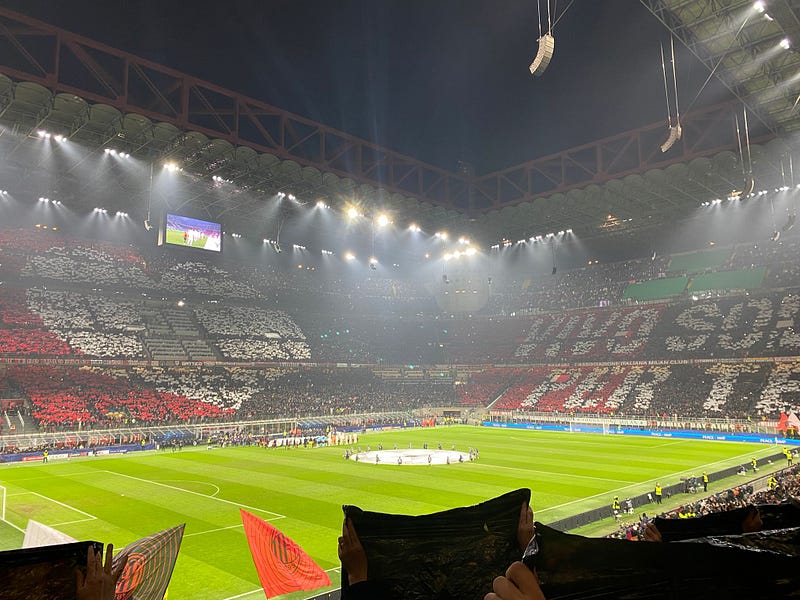
Coming into San Siro, you may as well have just gotten out of a time-traveling DeLorean and been catapulted back to the early nineties. La Scala del Calcio is as iconic as it is decadent, as hipster as it is brutalist. I have been coming to San Siro for over twenty years now and can say very little has changed. From the outside, when the lights are off, it is eerily reminiscent of an overground concrete car park with a semblance of a raggedy roof on top. The four cylindrical towers on each corner of the stadium barely hold up the third tier — built for the World Cup in 1990 — any longer. There are no VIP boxes, the gentlemen’s toilets are still mostly a hole in the ground and in what is probably the biggest affront to Italian culture, the food on the premises is atrocious. (One has to eat sandwiches from the concessions outside the stadium before entering.) It remains, however, one of the best places to watch a European night of football. The atmosphere when this stadium is full to the brink is electric. Phone reception cuts out, the coordinated fan-led choreography is unmatched, the acoustics are deafening and there is not an obstructed view in the house — although even the best of hawks could struggle to make out which player is which from the top of the towering third ring. These were the conditions that the Rossoneri had been missing for some years now, the very conditions that can push a mediocre team to play like possessed lions for one night.
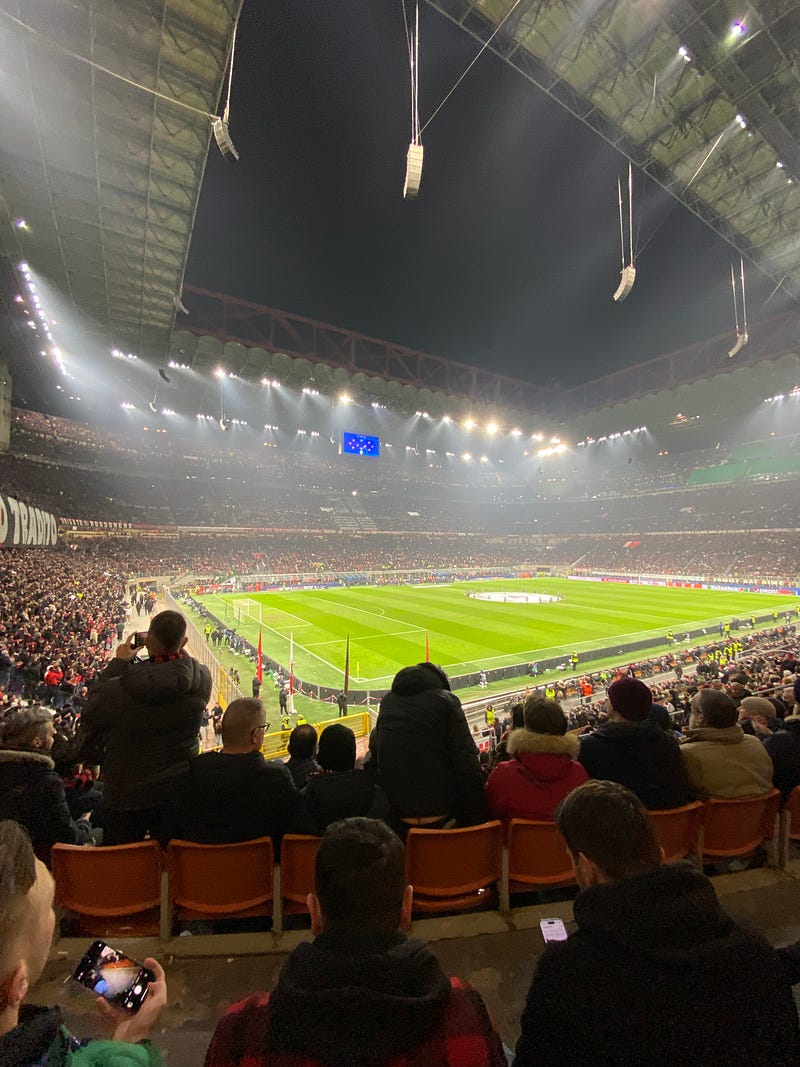
To add to the significance for the Milan fans, it was the first knockout match of any importance hosted at San Siro since a lackluster performance against Atletico Madrid in 2014. For a fanbase, which habitually claims this to be their competition, this night was long overdue. Finally, Milan had a team that, having surprisingly won last year’s Serie A title, could once again lay claim to playing with the big boys in Europe. Add to the mix the fact that no Milan fan had forgotten the last time these two sides played in the same round of the competition in 2011 — with the underdog Spurs going through 1–0 on aggregate thanks to a Peter Crouch away goal — and revenge was also in the air.
The curva sud was full and hopping already from the warmups. The coordinated choreography before the match invoked a combined sense of fear for the opponents and trust in the team. There was even a bit of Valentine’s love sprinkled in with a massive heart on the east stand. The shout of “Champions!” at the end of the Champions League anthem was goose-bump inducing. None of this would have been possible without the micromanaging of the new cap’ultra who seemed to be quite the control freak. We felt reprimanded like schoolchildren when he told us, over his loudspeaker, to not dare pick up our plastic bags until he said so for the opening choreography — and we were sitting in the tier below him, so one can only imagine the tight ship he ran in the curva itself. At one point, during a particularly tense moment in the second half, he yelled, “Hands up everyone!” and upon seeing that most of us were too spellbound by the action on the pitch, he called again “Hey! You! I said hands up!” It was intense, to say the least, but also somewhat fascinating to see someone take their duty so seriously.
On the pitch, the encounter was tense. The red and black devils struck first and last with Brahim Diaz — a poor man’s Lionel Messi — in what would go down as a surprise 1–0 victory for the hosts. Milan maintained relative control of a match which Spurs never truly entered and that was just enough for them to take a lead with them to North London. However, they also missed two chances to put the tie to bed in the second half and as such would still have to play it out in the second leg.
Everything would be decided in North London three weeks later. Milan would bring a lead with them, but a Tottenham side with home support could quickly turn things around. I, on the other hand, would have to try to strike a balance of supporting my club while endearing myself to my wife and father-in-law.
North London — March 8
I met my father-in-law at the airport in Copenhagen and we got so caught up in discussing the weekend’s results and reminiscing about his past life as a player, that all of a sudden we were in a rush to board our flight. My wife had already left for a work trip to London the day before and we would be meeting her there for the second leg. My father-in-law had played in the Danish first division for Odense Boldklub in the days before Danish football was fully professionalized and then quit to continue his education. To this day, he continues to play for his local old-boys team and has kept exceptionally fit. But why does he support Tottenham Hotspur? In Denmark, the cultural and geographic proximity to the English combined with the low level of competition in the local leagues has resulted in most Danish football followers electing to support an English side in addition to — or for some, in lieu of — their local team. For my father-in-law, Spurs was the first side he saw play on Danish television in the early sixties and so he has suffered by their side ever since. He passed on that passion to his only daughter and we now all found ourselves in a zero-sum game.
The weather in London was bad even by London standards. The temperature dipped in and around zero degrees. The rain was incessant and sometimes even turned into sleet interspersed with snow flurries. Conditions could not be worse for the second week of March. One of the main unanswered questions from football folklore is about how great teams or players from warmer climates would fare if they had to play week-in-week-out in more testing weather conditions. “Messi is a great player in sunny, dry Barcelona but how would he do on a cold, wet night in Stoke?” goes the most common rendition. A version of this was undoubtedly on the minds of all invested supporters in the lead-up to the match. Would the underdogs, Milan, be able to hold onto their lead on a soggy pitch in North London?
London is Europe’s only truly sprawling metropolis. People can live in the city for years and only experience one part of it. Tourists flock from all over the world and usually contain themselves within West London, where all the main attractions lie. (To be fair, just cutting across the center from Holland Park to the Tower of London already takes nearly forty minutes on the underground.) There is much more to London, however than the Royal Boroughs of Chelsea and Kensington or Covent Garden. Nearly an hour of public transport to the far north from the historic center of London lies Tottenham, a neighborhood which has been shaped largely by being a melting pot for immigration from all over the world, the rise of state housing blocks as the city expanded and, most famously, by its football club — one of the oldest in London, founded in 1882. Spurs has garnered a cult following throughout London, the greater UK and also internationally as a spirited club that, although not rich in trophies, has a loyal fanbase that stands opposed to the powers that be at Arsenal, Chelsea, Liverpool and Manchester United. Their supporters embrace the underdog status but that does not mean they like to lose. In recent years, Tottenham has solidified its position amongst the big English clubs. They even came close to winning a league title for the first time in nearly sixty years (their last having been in 1961 when my father-in-law was just a kid) and had their hearts broken by Liverpool in their maiden Champions League final appearance in 2019. Ambitions have also increased and with that came a new, modern, state-of-the-art stadium at White Hart Lane.
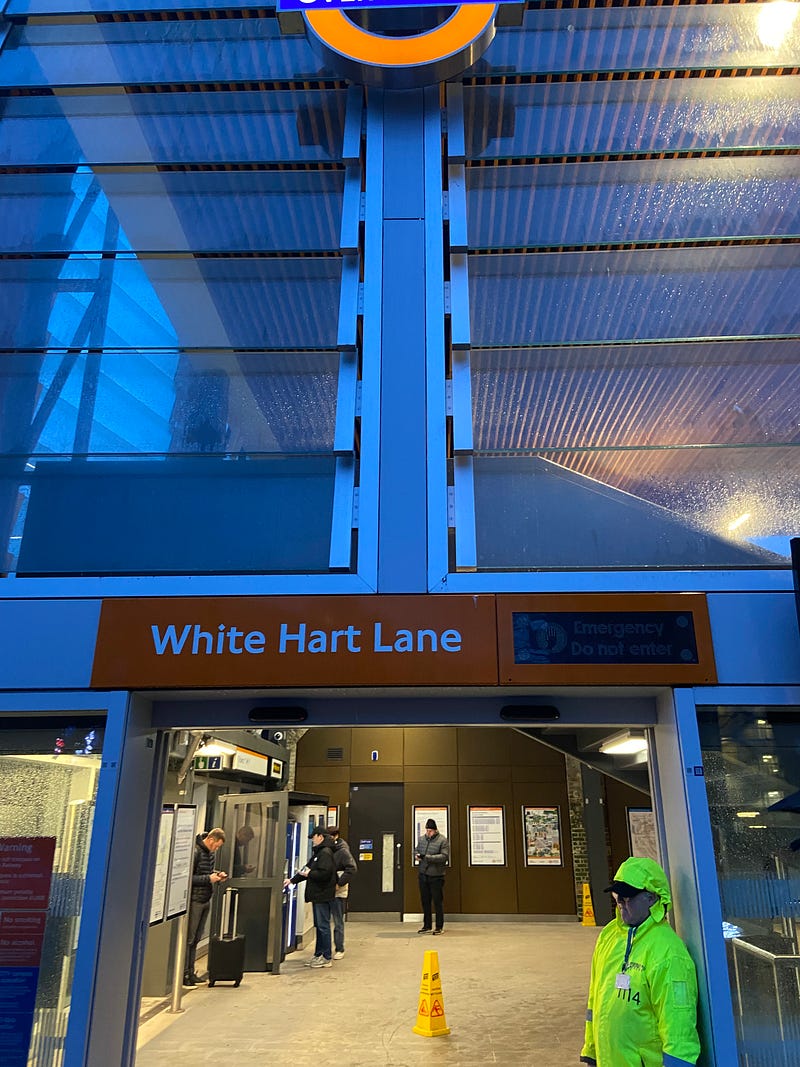
Rising like a spaceship in the middle of tower blocks and brick townhouses is the newly-built Tottenham Hotspur Stadium. The see-through glass lit up in the colors of the club and the sprawling, tidy concourse provide the antithesis to San Siro. Where San Siro is a relic of the past, THS is the future. In fact, the new Milan stadium being projected is said to be modeled on the work commissioned in North London. Inside are various restaurants, a wide array of concessions and a gift shop just as big as the pitch where one can find anything with a Hostpur emblazoned on it, from coffee mugs to baby clothes to bottle openers. I opted for a match-day scarf with both clubs’ colors and the dates of the two matches as an excuse to be able to don something red amongst the home supporters. Due to a past littered with violent incidents amongst hooligans, the rules in Europe for away supporters are quite strict. Since I would be sitting in the homestand, I could not be caught wearing Milan’s colors or cheering too obviously in their favor. I would have to grit my teeth and suffer through in silence while sandwiched between my wife and father-in-law who were both wearing their full Tottenham kit.
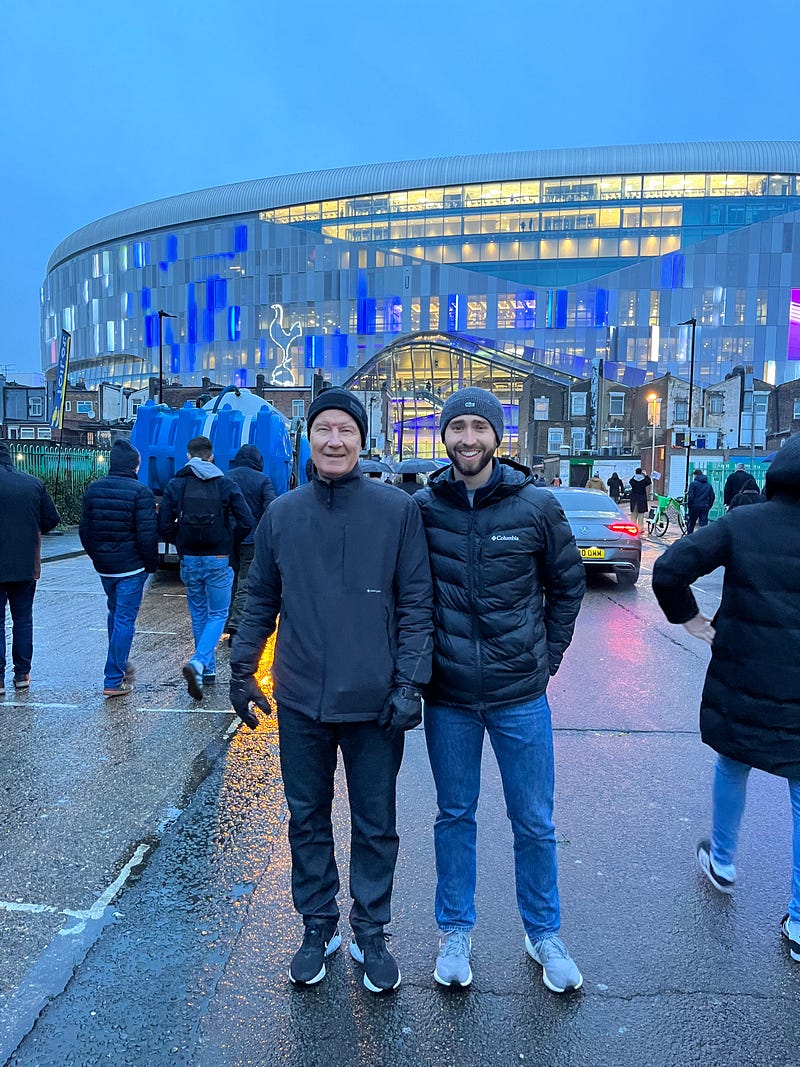
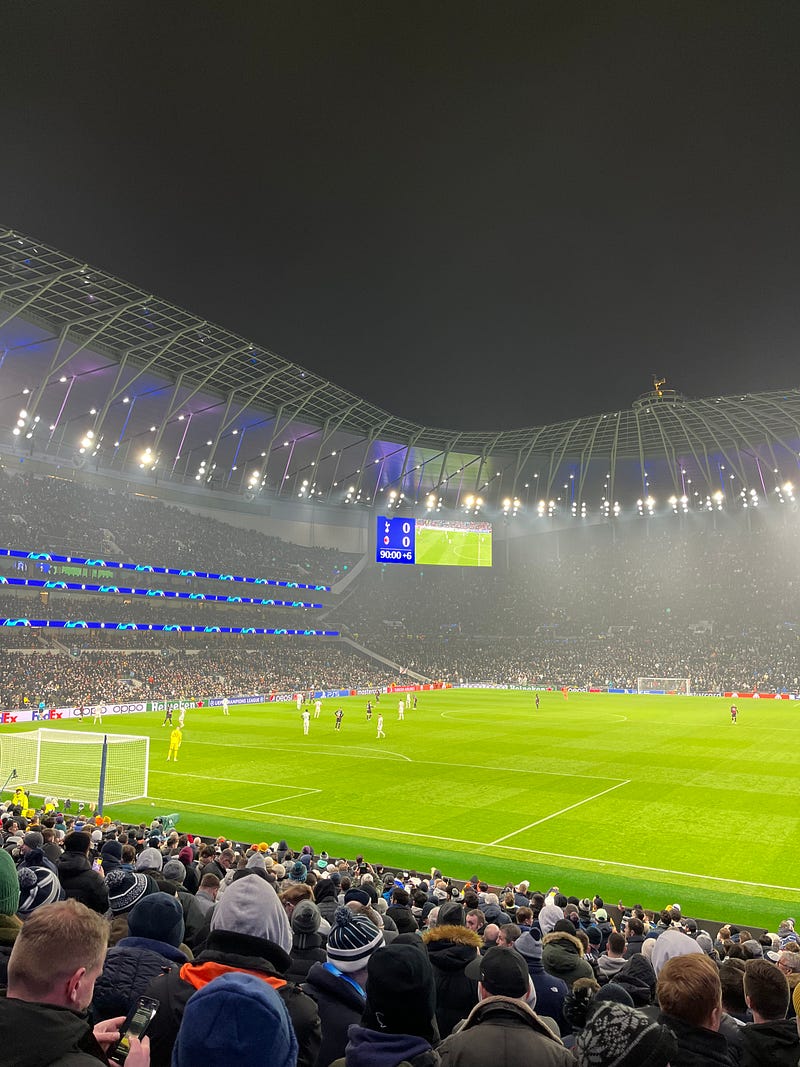
We took our seats in the north stand, just one section removed from the three-thousand Milan supporters clad in black hoodies that made the trip out from all over Italy. A massive delegation of Korean fans surrounded us, smiling as they waved their flags, hoping to get the camera pointed at them as they cheered on their hero and Spurs Talisman Son Heung-min. It was bone-chillingly cold and despite standing up for the entirety of the match, I felt my toes getting progressively colder until they went completely numb. Fortunately, all the seats are covered by the glass enclosing the stands with a gold Spur perched on top of the south stand and so, unlike the players, we kept dry. The view from behind the goal was superb. The stadium is built as a multi-use venue that can host concerts, NFL games and much more. As such, the seats are shiftable depending on the occasion and the result is a — rare for a football stadium — spacious experience.
“How can you enjoy a sport that is so low scoring?” This is a question many football aficionados have to grapple with when explaining their sport to uninitiated spectators. The key is context. An elimination match like this, with only a slight aggregate lead separating the two sides means any little thing, whether a kick or whiff, could disproportionately influence the outcome. Every touch over the ninety minutes of gameplay becomes potentially outcome-altering. There is nothing quite as enthralling as that. Milan came to London just needing to defend their narrow 1–0 lead from the home leg in order to go through to their first quarterfinal since 2012. Technically, they had two out of three results in their favor. Tottenham, on the other hand, would need to score two goals to advance but could prolong the match to extra time and eventually penalties by scoring just one. They had home-field advantage and presumably a slight upper hand over their rivals due to the weather conditions. Milan would have to defend well but just waiting for their opponents could result in a wallop and so would also need to try to secure their win with a second goal. Spurs, meanwhile, had no choice but to attack, however, going up with too many men could see them get stung by a counterattack. Finding the right tactical balance in such situations is purportedly what the big-name managers are paid for.
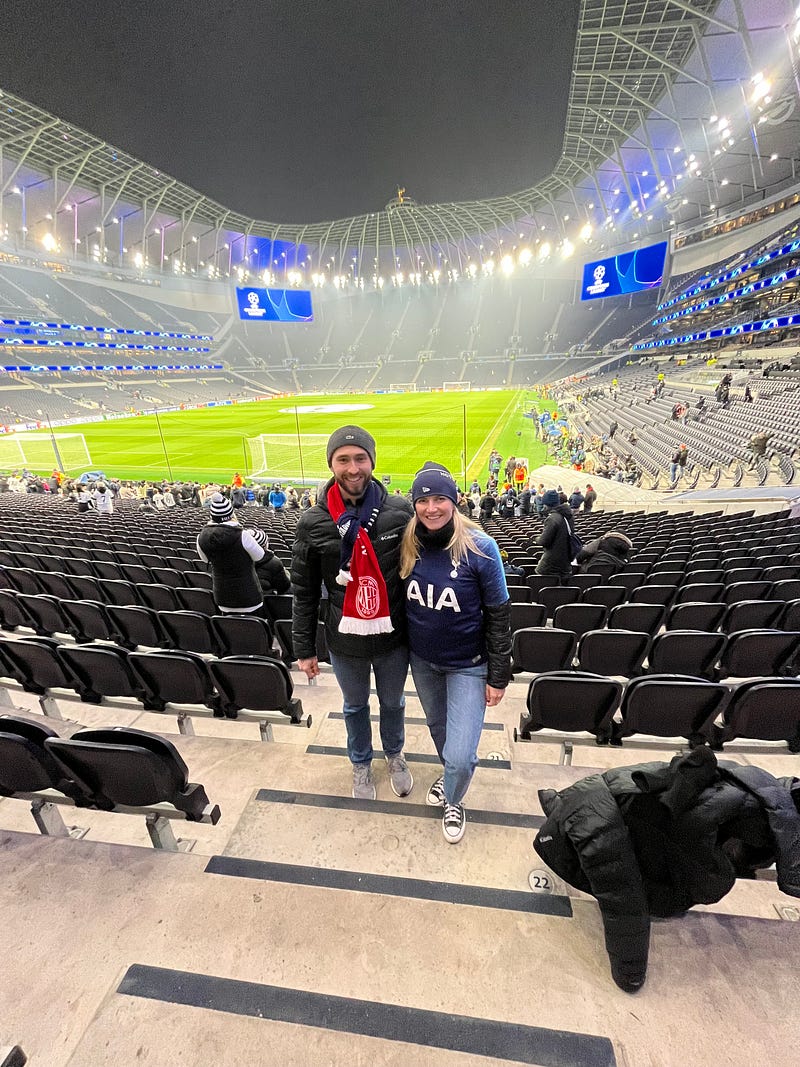
That very tactical battle and sense of impending jeopardy is what kept all sixty-five thousand viewers that night with their eyes glued to the pitch. It was 0–0 at half-time as neither side could break the deadlock. As time wore on in the second half, Milan began to hunker down as Spurs frantically searched for that final stroke to keep them alive. They sent more and more players up and risked a Milan counter each time. Fifteen minutes from the final whistle a Milan counter down the wing had to be broken by a tough foul which resulted in a Spurs player being sent off. The final minutes thus saw unbalanced end-to-end action which could have seen both sides score. The final result however was 0–0, which saw Milan going through to the next round and Spurs staying in North London. As the disappointed Spurs fans criticized their team and made for the exits, I inadvertently let out a little fist-pump and took in a final view of the wet night in North London. Two magical European nights over three weeks and I had managed to not be disowned. What more can one wish for?
My travel storytelling centers on long form first-hand accounts with a focus on vivid depictions of the local culture through the people I meet along the way. Stay tuned! In the meantime you can find some of my other pieces below: