
ChatGPT Article vs. Bard-Generated Article — What Performs Better
I analyzed the impact of AI-written content on SEO.
If you’ve been following me for a while, you might know I run a personal website, which I’ve grown to 6k monthly visitors all by myself in 2 years.
Since I am an SEO specialist and a content creator, I combine all my knowledge and skills to grow and monetize my website using various strategies.
Besides, I run multiple experiments on my website to discover proven-to-work strategies that help my website grow.
Our world is obsessed with AI technologies nowadays, but we have no clue how they will impact business in the upcoming future. That’s why I decided to run a few experiments related to AI and SEO.
In particular, I’ve published AI-written and optimized articles using ChatGPT, Bard, and Frase.io to analyze how they would perform in organic search results and whether AI content has the potential to rank on Google.
You can learn more about my experiments and conclusions here and here.
In this article, I want to compare the performance of articles written by ChatGPT and Bard, published on a healthy website with high EEAT (expertise-experience-authority-trust).
How ChatGPT content performs in organic search results
If you are a site owner using ChatGPT, these experiments will show you what might happen to your website if you heavily rely on AI.
If you are an agency owner hiring content writers, ensure they don’t feed you with AI-generated content. Otherwise, your investments won’t yield returns.
I must say a few more words about my website as an environment for experimentation.
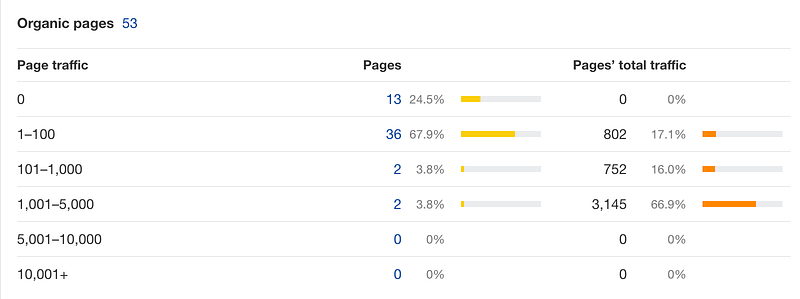
My domain name has a 2-year history, with a website authority of 28 out of 100, according to Ahrefs. That’s neither good nor bad. However, over 70% of my website pages generate organic traffic thanks to a smart keyword research process. I don’t buy backlinks and pay for guest posts. My website’s link profile grows slowly but consistently.
You can learn more about my keyword research and SEO writing process in this ebook.
Therefore, I can conclude that my website is healthy and can serve as a suitable environment for an experiment.
ChatGPT-generated article
I sincerely believe that AI-generated content is inferior to human-written content since it lacks depth and personality (if we talk about expert content).
However, AI content can perform well if targeting keywords with low competition.
Why? Because Google picks any content that satisfies user intent if there are no alternatives.
“SEO for contractors” has a 2/100 keyword difficulty, according to Ahrefs. It’s not a very exciting keyword despite having a transactional intent.
So, I dedicated several hours to using ChatGPT for content writing and optimization. You can read about all the details of this experiment here.
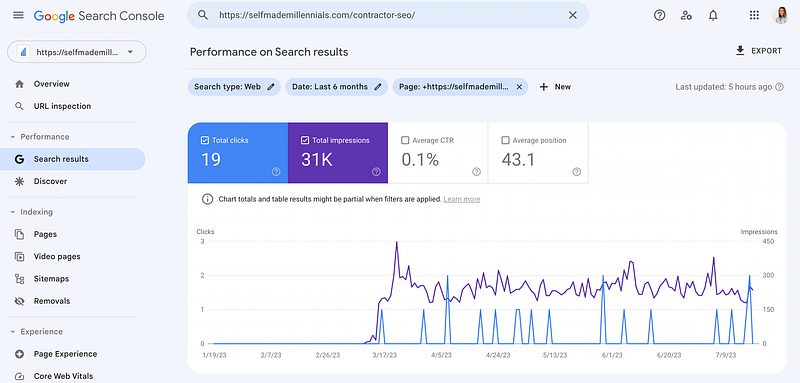
The article has been live since March 9, 2023, with no further changes to the content. Here is how the article’s performance changes over time, or better say, doesn’t change:
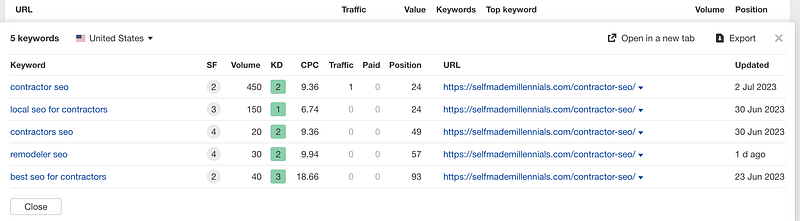
This article ranks for a few target keywords in the 24th position and lower.
When ChatGPT and human writing come together
If you add your opinion and experience to the AI content, you’ll be far more successful than most lazy content creators.
AI+human writing is how I see the future of content creation and marketing.
As an SEO expert and content writer, I am testing various prompts to make the most out of ChatGPT and tools.
I assume that AI content won’t harm user experience, and Google won’t punish my web page if I write helpful content backed by my personal experience.
This assumption has proven to work so far.
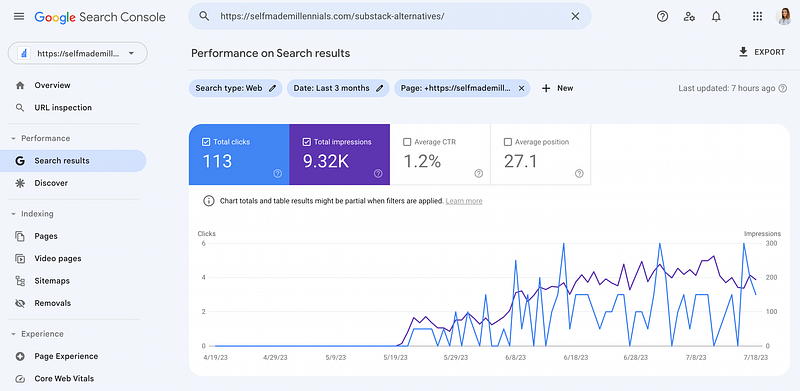
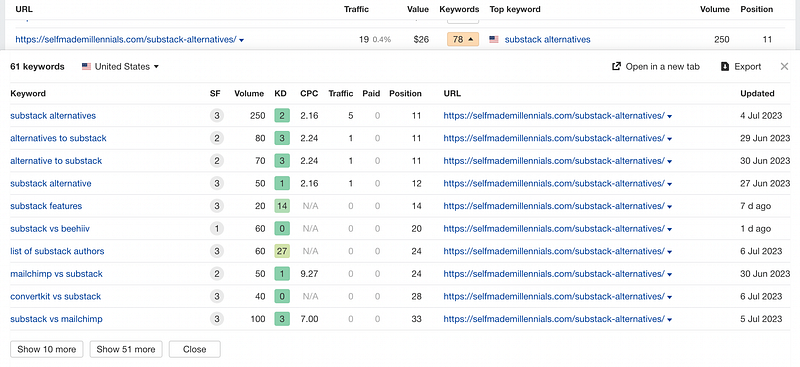
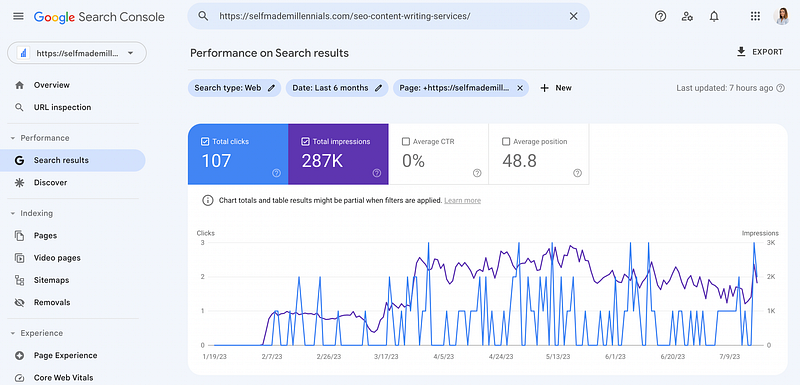
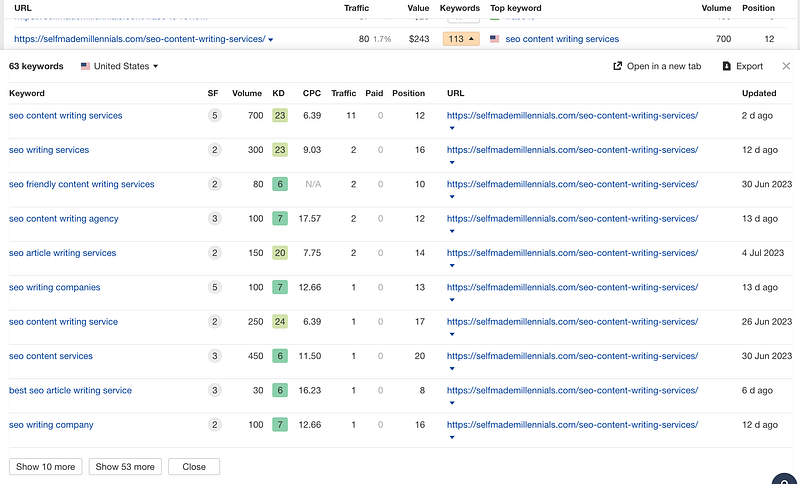
I’ve already published several articles on my website co-authored with ChatGPT. In particular, I used ChatGPT for:
- Definition writing
- FAQ section generation and writing
- Tool comparisons
I am sharing insights about two articles below. I have not noticed any negative performance trends yet.
Bard-generated article
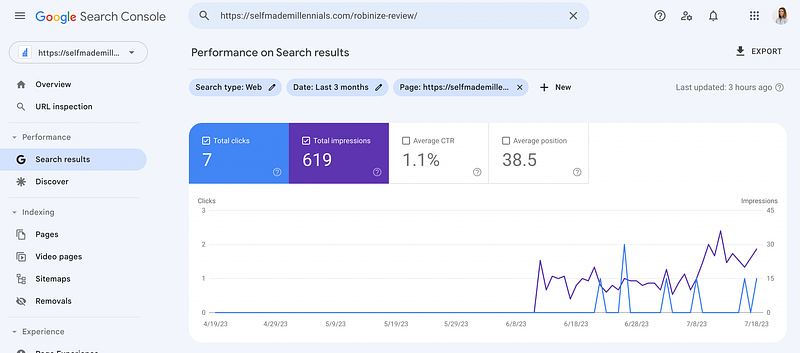
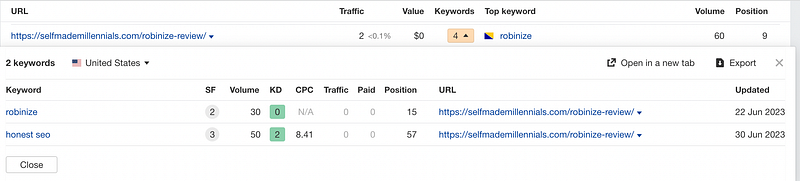
I used Google’s AI Chatbot Bard to generate an article about Robinize, an SEO tool for on-page optimization. The keyword difficulty was 0/100 at the moment of writing.
It took me 2 hours to generate, optimize and publish an article on my website on June 8, 2023.
Even though the article is fresh, its impressions are slowly growing.
The article reached the first and the second Google search result pages in one month and a half.
Even though I am against AI writing, it works to some extent. In this particular case, it worked well because:
- The keyword difficulty is low 0/100, according to Ahrefs
- SERP is not competitive yet
Once more expert content is published, the article will most likely drop. I’ve already seen it happening to other product review articles. That’s why this scenario is unavoidable for purely AI-generated content in the long term.
In conclusion
What content does have the highest potential and the best performance?
AI+human written content.
Such content resembles human writing. So, you won’t even feel it when you’ll read AI-generated content polished by an editor.
It’s faster and relatively cheaper to produce this content. That’s why it has a future. Honestly, it’s our new reality nowadays.
Noone checks articles from reputable websites on AI detectors. However, I am sure those websites use AI too.
I’ll likely continue facilitating my work using AI tools since I am a slow writer. However, my principles won’t change: be honest and add value.
📖 Grab my guide to learn how I create blog posts that hit the Google front page.
📈 Want to learn more about SEO? Join my free email course.


