
Challenging Pelosi: An Interview With Shahid Buttar
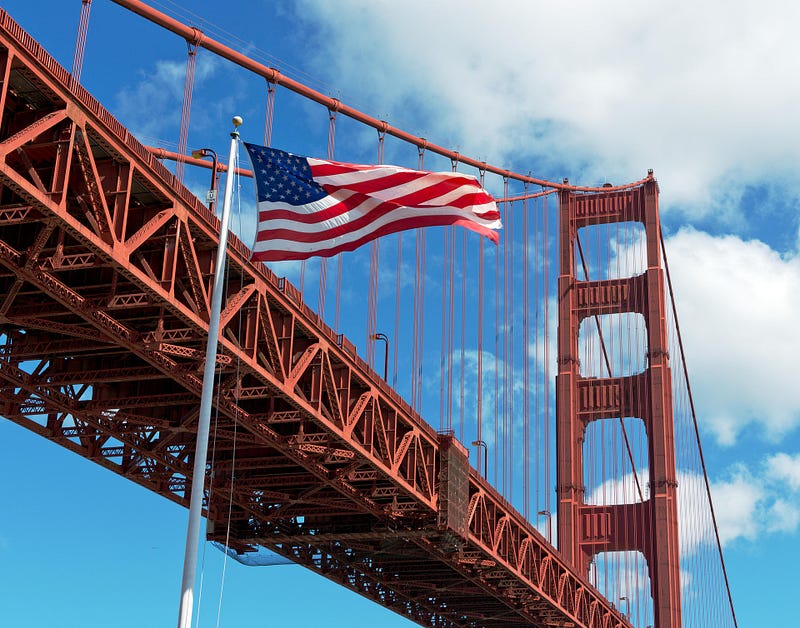
Cannabis and corporations: Is there such a thing as a libertarian progressive?
Speaker of the House Nancy Pelosi faces a political challenger in her own district. Today, hyper-liberal San Francisco would never elect a Republican, but self-described Democratic-Socialist Shahid Buttar comes at Pelosi from the left, casting her as a corporatist sell-out.
Where is the median voter in the City by the Bay? Do San Franciscans want to unseat Pelosi in favor of a younger firebrand? Or stick with an excessively experienced political operator who has served the interests of the left for decades?
After the Top Two Candidates Open Primary Act, took effect in 2011, the top two vote-getters move on to the general election. Pelosi faces an aggressive progressive instead of a doomed Republican. San Francisco can choose between two starkly different candidates and styles while still staying well to the left of most of the rest of the country.
For an in-depth discussion of his history and views, one can go to his interview with the Michelle Meow Show. The interview plus his articles in the Huffington Post, or occasionally in lesser know outlets like the Globe Post or Common Dreams reveals an unsurprising string of progressive positions:
- Single-payer healthcare
- Cutting military spending
- De-criminalizing illegal entry to the US
- Aggressive action on climate change
The list goes on; he is open and unapologetic about the progressive agenda. None of this is hidden on his campaign website. But what else is there besides the Bernie Sanders-style talking points?
Mr. Buttar shared some of his perspectives. He abhors corporatism but recognizes a surprising alignment with the libertarian streak within the GOP, particularly around freedom of speech. He invokes Reagan and the vision of the country as the “shining city on the hill.” And he wants to make pot legal.
Evolution of a liberal
Buttar’s time at law school spanned the pre and post-9/11 eras. He watched America went through a transformation, and looks at that time as an inflection point. As a Muslim of Pakistani heritage living in the US, he was in a unique position to see and feel the repercussions of America's wounds.
This personal experience of “being looked at funny in an airport” or of going to anti-war demonstrations and hearing people yell “go back home” accentuated the time period.
You know there’s there’s that degree of experience just inflects one’s perspective to see how much is at stake. If I weren’t an immigrant and if I weren’t Muslim would I have the same set of concerns about civil liberties? I would hope so. But identity has certainly given me a chance to experience a few things that I see from the standpoint of an impacted community.
As he commonly does, Buttar turns the question towards fundamental values of freedom and liberty:
It’s ironic to have this conversation with you right now I’m walking down the street with a massive tent city…and I just watched America go from a land of opportunity and liberty to a state of paramilitary police mass surveillance and mass stratification.
…in terms of the Muslim immigrant piece, it inclines me mostly towards, that I gotta take very seriously, the rhetoric about our nation’s promise and what we aspire towards. And that’s what I brought to law school, to see the 9/11 aftermath question the very citizenship of…migrant laborers or a South Asian physician or you know insert this greater minority here…
His love of America, and his home town
To listen to far-right pundits, liberals hate America. They want to fundamentally remake America. They don’t value freedom.
When Mr. Buttar speaks, though, he seems proud of the same things that people in ‘fly-over country’ are proud of. He was a Boy Scout and has a brother who was commissioned as an officer in the Army. He speaks of the great moments of American history and of American exceptionalism in the way you might expect of anyone from rural Missouri.
Literally the entire world is represented here. America is humanity in so far as all of humanity is represented here I almost think of America as like…a congress of the people of the earth. For all intents and porposes it has been, for all of the people have come here.
It’s also… just a beautiful country…our culture, our art, our science that we’ve made massive contributions…species wide-advances of NASA…to the worth of our legacy of the Second World War establishing an international state system committed to human rights.
That’s America to me. I see America as…the embodiment of the liberation of Europe. It’s a place for American exceptionalism that a lot of right wingers hype, this idea that we are the City of the Beacon on the Hill…that is actually the vision of America that I’m committed to make real…I love the America that liberated Europe. I love the America ended slavery. I love the America that ushered women suffrage into the modern world…that defeated and overcame Jim Crow.
… you might have heard me describe the way I feel about this inscription on the base of the Statue of Liberty. That to me also embodies America as it gets to that first point I was making about America as a polyglot civilization. This country is the huddled tired poor masses of the earth that came here to breathe free.
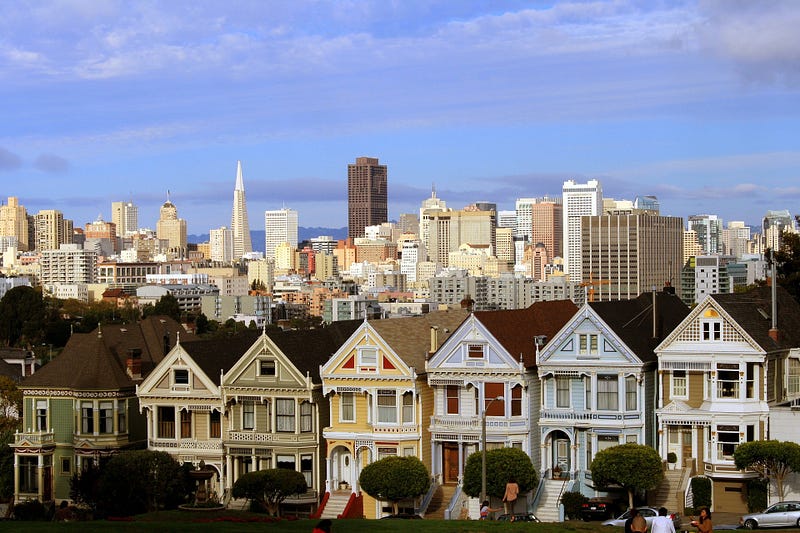
His views on progress and the diversity of the American ideal also inform his outlook on his adopted home of San Francisco. The average red-state resident finds the idea of living on the left coast inconceivable. Foreign migration to California remains strong, but outmigration to other states surges while inmigration stagnates. A small number of aspiring actors or tech entrepreneurs might move from Texas to California, but more Californians move to Texas in search of economic freedom, innovative high-quality schools, and a less intrusive and regulatory government.
So what would possess a patriot raised in Missouri to move to the epicenter of progressivism?
I feel that way about San Francisco as a microcosm of it [America]…San Francisco is a city of people who, you know, not literally but at least metaphorically left different parts of the country over the last hundred fifty years to establish this countercultural capital of the country…both San Francisco and the United States I see as beacons for iconoclasts…the United States in particular…this is the fruit of God’s invitation to people around the world…for ten generations we got together and made this place called America.
Freedom and weed
Nancy Pelosi, as Speaker of the House, wields enormous national power. A freshman representative taking her seat would have far less influence in Washington.
Typically, new congressmen choose one issue to focus on, to make their mark, rather than trying to specialize in everything at once. So what would drive Mr. Buttar in his first term? What would he focus on first?
Those are kind of different questions.The thing that would drive me is stopping authoritarianism. And I see that implicated in surveillance, detention, paramilitary policing, the prison -industrial complex, all that…My principal mission is defending democracy and the Constitution of the United States.
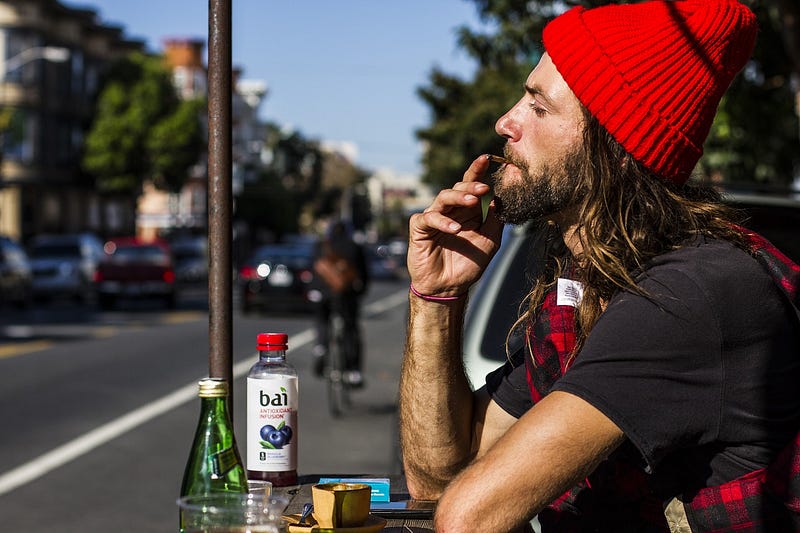
…a discrete thing that I think I could move…not easily, but I think I can win in the first term is ending the federal criminalization of cannabis. And I think that’s going to be huge because it’s going to knock a pillar out of the stool of the prison industrial complex. It’s going to create massive job stimulus. They’re going to be green jobs. It’s going to be a huge boon for California and the western and southern states. Frankly every state because there are going to be grow houses…This is all just going to be a massive stimulus program, economic stimulus for a country that frankly needs it.
The economics might be overstated a bit; cannabis is relatively easy to grow and gets consumed in small quantities. Certainly, there will be some weed millionaires created when legalization arrives, but probably not a new golden age of agriculture. In any case, though, it fits in nicely with his view on freedom. He even suggests it could be an area of cooperation with conservatism, and circles back to fighting authoritarianism.
And I think it’s the kind of particular vision that can bring together the left and the right and populist of various stripes in concert against our establishment common enemies… And you might even locate that within the broader rubric of fighting authoritarianism because prohibition is authoritarian in the first place…I would say ending the criminalization of cannabis as a discrete thing but we can do the service of ending story.
On shared values
Along these lines of fighting authoritarianism, Mr. Buttar points to certain common values among the left and the right. In particular, he points to security and liberty principles as shared between the parties.
Security is a value that’s traditionally claimed by conservatives and it’s one that is routinely undermined by everything from our national security agencies to police departments…Security I would claim is a value, privacy I think is a value, liberty I equate as a value, and I’m grateful to conservatives for holding those values in the context of a political debate that frankly runs roughshod over everyone, and that’s the irony, that nobody’s values are actually served.
At this point, Buttar sets up a conflict between capital and everyone else. Many would certainly read this as the classically described struggle between workers and capital. As Marxism. However, though he recognizes the same conflict, there’s no indication in his speeches or writings that he desires to collectivize or nationalize the means of production or seek a socialist revolution.
Rather, his vision seems to be an informed democracy of our current construct that provides tighter regulation of business, perhaps akin to Teddy Roosevelt’s “Rule of Reason” in the post-Gilded Age era.
That’s the tremendous irony and tragedy of corporate rule because it offends everyone’s values because it degrades people generally in the service of capital. And I see that being sort of a place where conservatives and progressives sort of diverge…that conservatives are typically unwilling to challenge capital as a locus of domination and coercion.
But when we see capital constraining our democracy, we see capital preventing people being able to get the doctors and the medicine that they need, I see capital then as a threat to human life and people. And I think…conservatives sometimes don’t internalize that threat. They cut capital too much slack. But I’m very grateful at least for the concern for taking on state control and how it threatens liberty.
I frankly wish that more liberals remembered their own ideological roots because liberals are supposed to be committed to liberty, and I see the contemporary guardians of those principles really as progressives and libertarians…There’s nothing liberal about mass surveillance.
Speaking of liberty and freedom, one wonders how Mr. Buttar views the current cancel culture, the narrowing of freedom of speech. Speech is now a partisan issue. An era where the ACLU would defend the speech rights of avowed racists seems long past. Gen Z has a very different take on what should be allowable.
Buttar again identifies corporate America as the most serious threat, particularly with digital speech, but corporate censorship also seems inextricably linked with government policy. He paints a remarkable picture of how fighting an evil most agree on, like sex trafficking, leads to more repression.
Absolutely and I agree that it [freedom of speech] was once an object of trans-partisan consensus…where I see it most sharply limited it is in the context of corporate censorship of user content…
The first wave of the attack by the establishment here was on sexual behavior and expression…laws that have passed abrogating parts of Section 230 of the Communications Decency Act…with respect to any communication that could be read as relating to not just sex trafficking which was the point of those laws but also for people who do engage in voluntary sex work…they’re all now censored and placed at greater physical risk because in order than to, for lack of a better word, ply their trade, they’re put at physical risk by having to get people on the street and sell online.
And so we see the limits of speech being curtailed quite concretely in this community. It’s not an abstract fear of government authoritarianism and fear and speech being denied, it has been denied and taken offline.
The corporate/government censorship death-star has even impacted Mr. Buttar personally. He related a story about how the YouTube algorithm took down one of his interviews because the word “Covid” came up. Ironically, the interview was about the Senate reauthorizing the Patriot Act.
…the layers of irony here were demonstrated vividly in this instance of corporate content moderation, and having experienced that myself I understand what people are worried about…
I’d say that’s even a bigger deal than individual speech because they’re recently asking for protections is not just us as equals, it’s for us as a country, so we can hear each other. If we lose it, it’s our democracy that suffers and that that used to be an object of liberal and conservative consensus…I fear particularly in this context content moderation and the chilling effect on speech…
Is there a political space?
Conservatives caricature liberals as America-hating communists that want to destroy the American way of life. The left uses the same types of arguments, painting conservative as racist, misogynist, authoritarians that want to turn America into a fascist dictatorship.
In reality, we abide by a shared social contract. Neither conservatives nor liberals wish to live in either lawless anarchy or an environment where the sovereign controls every aspect of life. Within these boundaries, we are really fighting over matters of degree. How much should we regulate corporations? How much should we regulate speech?
Fortunately, there are men and women of good conscience on both sides of the political divide that see nuance and value freedom. One of Mr. Buttar’s most interesting and consistent points is those shared values.
The threats to our liberties are thoroughly bipartisan. I think a lot of conservatives also get that there is no partisan allegiance by any of the major parties so we the people of the United States.
I see progressivism and libertarianism a sort of both sides of the same coin a [depending on] how close your neighbors are.
If you live on top of the neighbors your neighbors and have neighbors beneath you , you know that your collective liberation is bound up together…If your closest neighbors are a mile down the road, youmight think that liberation is something you can do alone, and that’s the difference between libertarians and progressives.
You might also like:
Brian E. Wish works as a quality engineer in the aerospace industry. He has spent 29 years active and reserve in the US Air Force, where he holds the rank of Colonel. He has a bachelor’s from the US Air Force Academy, a master’s from Bowie State, and a Ph.D. in Public and Urban Administration from UT Arlington. The opinions expressed here are his own. Learn more at brianewish.com.


