
Sleepless in San Francisco: What Keeps Nancy Pelosi Awake at Night
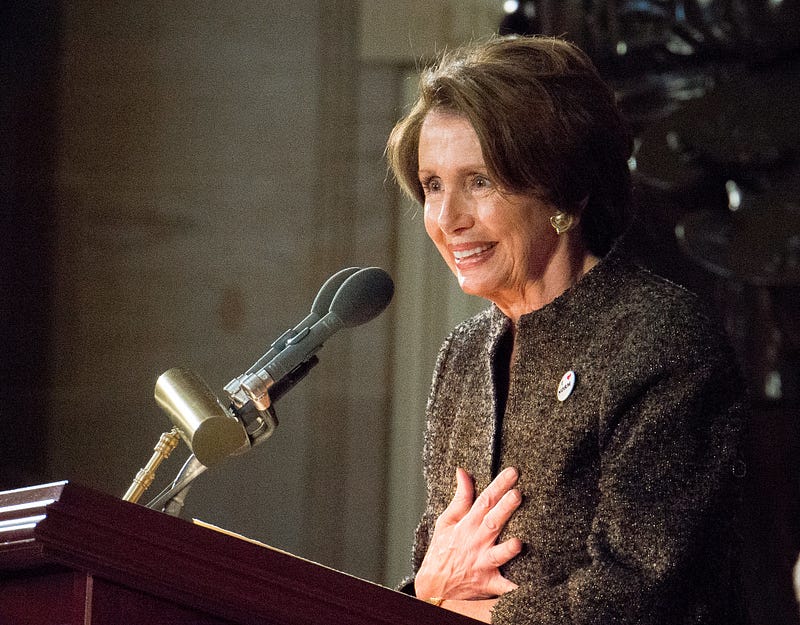
Hint: It’s not the pursuit of racial justice
The Democrats have a problem. The establishment wing of the party, embodied by Nancy Pelosi, Chuck Schumer, and Joe Biden increased the marginalization of American minorities. With the best of intentions, national Democrats pushed tough on crime policies in the 1990s that increased repression in Democrat-controlled the big cities. Desperate to deflect attention and pump minority turnout, they focus on meaningless political theater.
Sometimes it is those whose case is weak who make the most clamour.
~ Piers Anthony
Hilliary Clinton lost the 2016 election, at least in part, when minority turnout declined in places like Milwaukee. President Trump will point to his attempts to reach black voters and can point to the First Step Act and improved economic conditions before coronavirus. Despite sustained attempts to cast Trump and all Republicans as racists, no one knows how things will play out in November. Speaker Pelosi also has personal skin in the game; she faces a challenge from the left.
The ghosts of legislation past
In 1988, Republicans eviscerated Michael Dukakis on crime. He said he wouldn’t support the death penalty even if his wife were raped and murdered; Republicans stoked the fire with the infamous Willie Horton ad.
By the early 1990s, crime in America was even higher, reaching peaks around 1990 to 1991. In 1990, the murder rate in New York City reached 30.7 per 100K population; in 2018 the rate bottomed at 3.5, just over a tenth of its peak. Other cities suffered even more. The Washington D.C. rate peaked at 80.6.
Bill Clinton decided that he would not cede the high ground on crime, calling out President Bush’s performance. He would continue the tough on crime mantra in 1996 when Hillary made her infamous “super predator” remarks. Wide, Democrat-led but bipartisan support existed to get tough on crime, and that’s what the country did.
In 1994, Congress passed the Violent Crime Control and Law Enforcement Act of 1994, which Joe Biden claims credit for writing. Chuck Schumer, now Senate Minority Leader, cosponsored the bill in the House. Nancy Pelosi voted for the bill.
Opinions differ whether the bill directly enlarged the carceral state, but it likely did lead to longer sentences. It also put tens of thousands of new police officers on the street and signaled a cultural change in the approach to crime. Community policing sounded nice, portrayed as more interaction with the public to prevent crime before it happened. What occurred in practice was zero-tolerance policies pioneered by New York City.
The liberal city elected Republican Rudy Guiliani because he would be tough on crime, not despite his toughness. The actual execution of community policing and interaction with the public came to mean stopping young men, especially minority men, because they might be considering a crime.
Other cities facing their crime problems instituted similar policies, especially as the New York City criminal justice establishment brayed about their success. Crime did drop, and perhaps the ‘stop and frisk’ policies helped somewhat, but few serious scholars would point to that as the cause. No one knows why crime shot up from the sixties to the nineties, then dropped again even faster.
New century, old policy
Perhaps the country should excuse the local and national Democrats from the 1990s as products of their time. Millennials and Gen Z don’t understand the anti-crime hysteria that permeated the tough on crime era. But what about the failure to act since?
Even when crime fell, large cities controlled by Democrats for generations doubled-down on aggressive tactics. Stop and frisk in New York City would not peak until 2011 with nearly 700K actions under sometimes Republican mayor Michael Bloomberg. We do not know the extent of stop and frisk in other Democratic bastions like Chicago and Baltimore; they just didn’t keep that kind of data.
The fact that America socialized an entire generation of black youth to fear the police has been apparent for years. Bill De Blasio, upon becoming mayor of New York City in 2012, began to dismantle the stop and frisk empire. Crime didn’t explode. Why didn’t Democratic leaders in other cities follow suit? Why haven’t we had widespread police reform?
Nancy Pelosi first became Speaker of the House in January 2007, and Democrats controlled the White House from 2008 to 2016. President Obama, to his credit, took small steps around sentencing and prison reform but didn’t spend much political capital. Eric Holder’s Department of Justice (DOJ) worked for change through lawsuits and consent decrees, but never gained national traction. The efforts were typically after the fact and portrayed by Republicans as political attacks on the police. President Trump quickly ended the DOJ’s efforts.
If the establishment Democrats in Congress had been banging the drum for widespread police reform from 2000 to 2016, perhaps they could blame Republican obstructionism, but police reform never truly became a priority. Healthcare was a priority. The Iran deal was a priority. Even immigration was a priority. Criminal justice reform? Not so much. Democrats, including President Obama, remained under constant assault for being anti-police. Perhaps they made a political decision to concentrate on other things rather than give Republicans another wedge.
The first major federal justice reform, the First Step Act, waited until President Trump’s election.
Only now when the country reached a boiling point after a string of publicized tragedies are establishment Democrats responding to stimuli (one of the key tests if something is alive). In a crisis, the political class wants to appear engaged. Suddenly there are easy calls for justice and shows of solidarity.
Signaling virtue
In May 1861, a seventeen-year-old boy named Charles Crisp joined the army of the Confederacy. Born in England, brought to America as a baby and raised in Georgia by his theater parents, he didn’t own slaves or farm a plantation. A product of the times, he probably looked down on black humans as inferior. He also likely enlisted out of loyalty to Georgia at a time when many viewed patriotism as owed to their state rather than the republic as a whole.
After service through the civil war and spending the last year in a northern prison camp, he returned to Georgia to practice law, eventually becoming a judge, running for Congress, and becoming Speaker of the House in 1891. Now, more than a hundred and twenty years after his death, Pelosi says Crisp embodies “the violent bigotry and grotesque racism of the Confederacy.″ Pelosi removed his portrait as a former speaker, along with three other Confederates. The three other former speakers had long public lives and chose to rebel after serving in Congress. They should have valued the Union more. But the seventeen-year-old kid?
Suddenly, though, racial justice has become fashionable for the Democrats, and Pelosi has become a zealot. Senator Robert Byrd founded a local chapter of the Ku Klux Klan in the 1940s. As America became more racially conscious in the 1950s and 1960s, Byrd grew with the country. He regretted his KKK time and supported civil rights throughout his career in Congress. Pelosi praised his life and work at his funeral in 2010, but by the Crisp standard, his portrait should be removed from the Senate Leadership Portrait Collection.
While we are at it, we should remove the presidential portrait of Lyndon B. Johnson, who despite being a hero of civil rights remained an unrepentant racist until the day he died. What about Woodrow Wilson, responsible for the conscious and intentional segregation of the federal workforce long after reconstruction had ended? And Roosevelt, with his internment of Japanese citizens?
Quick, crush their statues! Burn their paintings! Attacking dead Confederates incurs no risk. Attacking liberal icons or championing change requires conviction.
Practicing synchronized genuflection for the 2024 Olympics
Political theater jumped the shark with Nancy Pelosi, Chuck Schumer, and the rest of the crew dressing in Kente cloth and taking a knee in the Capitol building.
Charlamagne Tha God had perhaps the best takedown of this spectacle on The Breakfast Club:
…This is what happens when people focus on symbolism and not substance…If nobody on the hill is going to tell them the truth, I will…all you white Democrats looked stupid yesterday…we need policy over pandering…you know what we need you saying yes to? Police reform bills…
Despite capturing the black vote for decades, federal and local Democrats have mostly made things worse. Squeezed in the same vise for a generation, they face the same choice. They can fight for justice, alienate the police, and be seen as soft on crime, or they can try to do some posturing to appease their most loyal base.
Minorities don’t need to vote for Trump for Democrats to lose. As with Clinton, they can decline to show up. Given Trump’s attempts at outreach and pre-COVID economics, will the black vote return to 2008 levels? Or drop even further below 2016 levels? Will America blame George Floyd on Trump and the Republicans?
Trouble in paradise
Speaker Pelosi now faces a challenge from the left. Long-shot Shahid Buttar seeks to unseat Pelosi, now in her seventeenth term. While unlikely, the structure of the race and the uncertainty of today’s politics give Buttar a better chance than any other of her previous opponents.
Under the California primary system, implemented in 2011 under the state’s Top Two Candidates Open Primary Act, the top two vote-getters move on to the general election. This year, instead of Pelosi and a nominal Republican, Pelosi faces a candidate arguably more progressive than she. In previous years, the people of San Francisco had the choice between a Democrat and a Republican; the Democrat would always win. Now, the people of San Francisco can hold a referendum on which flavor of progressive they like.
Buttar, a 2003 graduate of Stanford Law School, is described by his website as “a legal advocate, a non-profit leader, a grassroots organizer, and a poet & musician.” He’s also a Pakistani-American Muslim. In contrast, Nancy Pelosi recently turned eighty and her favorability rating is underwater. Nationally unpopular politicians are often popular at home, but Buttar hits her on a variety of policy choices over the last few years where she has drifted towards the right, or at least compromised with Republicans.
Towards the top of Buttar’s concerns list, hits Pelosi on opposition to universal healthcare and lack of aggressiveness on drug price regulation. He also points to Pelosi’s lack of enthusiasm for the Green New Deal and support for Trump’s new NAFTA. He blames the federal government for San Francisco’s housing affordability problems. Putting aside whether or not the role the federal government should be to transfer wealth to one of the richest cities in America to build affordable housing, the issue is near and dear to San Franciscan’s hearts.
Can Buttar beat Pelosi? Maybe. Upsets happen. George Nethercutt beat Tom Foley, a sitting speaker, in 1994. His district drifted conservative over the years, and his challenger used term limits as a wedge issue to excite the base. More recently, unknown Alexandria Ocasio-Cortez defeated the number two Democrat in the House in the 2018 primary, going on to win the general election.
The Buttar-Pelosi matchup contains elements of both those races. Harking back to the Nethercutt-Foley fight, San Francisco is vastly more progressive since Pelosi was first elected in 1987. She aged and became more aligned with corporate interests. In the Ocasio-Cortez versus Crowley primary, the young, photogenic progressive beat the establishment Democrat in a low-turnout election. While November 2020 is a presidential election year, the outcome in California is not in doubt. Will enough moderates and corporatists with a love of Pelosi show up at the polls? Or can Buttar muster an energized constituency to put him over the top?
Regardless of whether Buttar really has a chance or just wants to set himself up for 2022 after Pelosi plans to retire, she suddenly has to take her district seriously. Combined with national politics, she’s in a pressure cooker. Will taking down portraits and kneeling in Kente cloth be enough to get her through? Time will tell.
You may also like:
Brian E. Wish works as a quality engineer in the aerospace industry. He has spent 29 years active and reserve in the US Air Force, where he holds the rank of Colonel. He has a bachelor’s from the US Air Force Academy, a master’s from Bowie State, and a Ph.D. in Public and Urban Administration from UT Arlington. The opinions expressed here are his own. Learn more at brianewish.com.


