
Celebrating the Life and Times of Gloria Jean Watkins aka bell hooks
How an author/feminist signed her name in lowercase and why
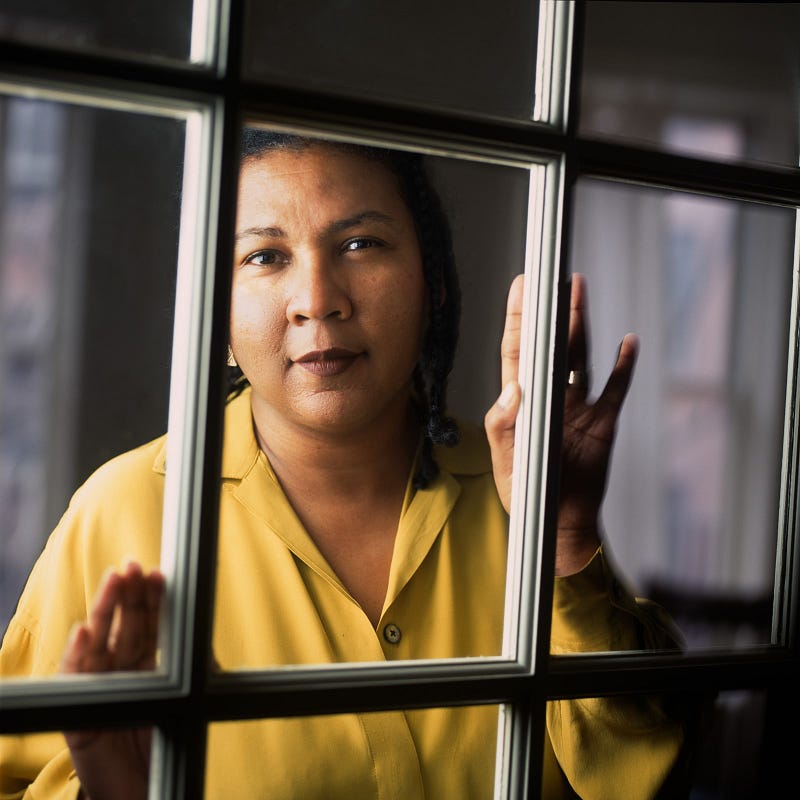
This extraordinary lady, Bell Hooks, a name honoring her great-grandmother, Bell Blair Hooks, whose biological name was Jean Watkins was a scholar, feminist, nurturing author, teacher, speaker, and leader that touched minds in a special way and like none other. Her voice and words turned on many hearts and minds, awakening each to a new day and a new way.
Bell Hooks, 1952–2021, crafted a life’s map for equality for others tying their hearts to their mind, finding their true voice, and lead the way for others to follow.
Her books “Ain’t I a Woman” and “All About Love” gave her the duly deserved notoriety befitting one who lived the walk, and talk the talk. Also, in 1993, she participated in a panel discussion at the Massachusetts Institute of Technology titled, “The Responsibility of Intellectuals in the Age of Crack,” organized by a Harvard theologian, Rev. Eugene Rivers.
Hooks not only championed scholarship but reiterated the strength and tenacity of Black women as thinkers in the Black communities in the face of little to no recognition of their efforts building bridges to connect communities.
She highlighted how often the words were spoken by the non-Black masses that there exists a lack of intellectual leadership in Black communities where the reality was that these non-Black masses refused to acknowledge many Black women’s work who were forerunner raising themselves to the status of leaders.
Hooks wore the label of being confrontational, direct, and challenging conventional ways of thinking as she made a concerted effort to illuminate women’s work and contributions to society as forethinkers.
Her voice could be heard forever in her bestselling works as a writer, feminist, poet, and cultural critic who popularized that intersectionality went far deeper than any single intellectual concept in her 30 books, published in 15 languages, as she explored the nature of love and the convergence of race, class, and gender. Her name can be viewed on the Bell Hooks Institute housed in Berea College, in Berea, Kentucky that now houses much of her legacy for others to experience.
Her published writing journey started with her first book, “And There We Wept,” in 1978, signed in lower case, “bell hooks”, to note the worth of the book’s content, not the author. This name was taken because family members told her that she was a lot like her great grandmother, quick thinking and outspoken.
The writing gate was opened, as she went on to become a celebrated feminist writer of an array of literature, including “Ain’t I a Woman,” “All About Love: New Visions,” “Salvation: Black People and Love,” “Bone Black,” “Feminist Theory,” “Love Redeems,” “ “All About Love: New Visions,” “Black Looks: Race and Representation,” “Talking Back: Thinking Feminist, Thinking Black.” and “Communion: The Female Search for Love.”
Hooks had a great appreciation for the written words from all types of genres along the psychological, spiritual, and self-help realm as she exuded love in all her work with transforming power in Black Americans’ lives.
Her thirst for reading and writing began in early childhood. She was the fourth child of seven, born in Hopkinsville, Kentucky, and spent much of her time reading and checking out books from the public library, such as Shakespeare, and other classics.
She attended segregated schools in Kentucky’s Christian County, and in 1973 attended Standford University, this platform became the launching pad where she crafted her first draft of “Ain’t I a Woman,” this tile was taken from Sojourner Truth’s now-famous speech.
At this time she found her voice among working-class Black women who wanted to hear her voice and cared less about notoriety, names, or credentials. They provided support and affirmation for her project and wanted someone to be candid about the events in life and how to make changes for betterment and understanding.
After receiving a master’s degree in English from the University of Wisconsin and a Ph.D. in literature from UC Santa Cruz, “Ain’t I a Woman’ was published in 1981 as it has become a classic work of feminist scholarship on the nature of Black womanhood.
Hooks was prevalent on the college and university circuit across the country inclusive of USC, UC Riverside, Occidental College, San Francisco State University, UC Santa Cruz, Yale University, and Ohio State University as she also served at Berea College as a distinguished professor in residence in Appalachian studies. She founded the bell hooks Institute for the celebration, and contribution of her life’s work.
Thereafter, in 2017, Berea College became the benefactor of her papers so that generations to come would be privy to her work and impact on race, gender, place, class, and sexuality. The following year she was inducted into the Kentucky Writers Hall of Fame.
Her legacy has been comprised in film and TV documentaries such as IFC’s “BaadAsssss Cinema” (2002), about Blaxploitation in the 1970s, and HBO’s “Happy to Be Nappy and Other Stories of Me”, a 2004 adaptation of some of her children’s books that she wrote and appeared as herself.
In conclusion, such an encyclopedia of work left behind is to inspire all readers to find their true voice and let it flow to change the landscape of America but do it best with “love” and it will be more impactful. Her loving shoulders to stand on will help others find their space in the universe. R.I.P. warrior!
For additional reads:


