
Business Architecture Modelling Basics
Start with the purpose, then model the structure

You don’t need special software to get started with business architecture modelling. Any tool that allows to create simple diagrams will do. This article provides an overview of a few go-to models that can help get started with a business architecture engagement or pre-project analysis.
These models are for business architects, business analysts, project and program managers — for any professional concerned with implementing successful changes. With the right approach, they will serve to clarify the context and scope of change, help identify risks and missing requirements.
Business Capability Model (BCM)
Business capability is a particular ability or capacity that a business may possess to achieve a specific purpose or outcome (BIZBOK).
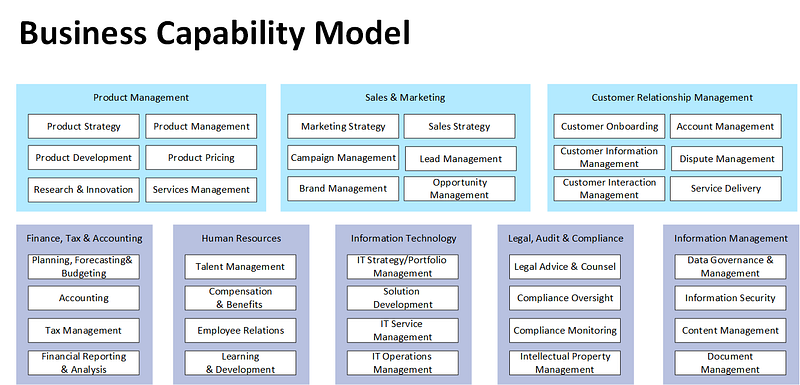
A business capability model captures business capabilities that an enterprise needs to exist, function, and sell its products and services.
In a BCM, capabilities are traditionally depicted as rectangles (regular or with rounded corners). We can identify around 10–20 core business capabilities, also called “Level 1 capabilities”, with each Level 1 in turn broken down into Level 2 capabilities. At Level 1, we distinguish core capabilities, specific to the type of business and industry, and supporting capabilities — those that every enterprise will need, such as Accounting, IT or Human Resources.
Each Level 2 capability can also be looked at as a process group, with multiple business processes enabling them. For example, the Talent Management capability may include recruitment, internal talent development and leadership development processes.
Below is a simple BCM example that illustrates the concept and the idea. You can find more complete examples (reference models) for various industries here.
Context Model
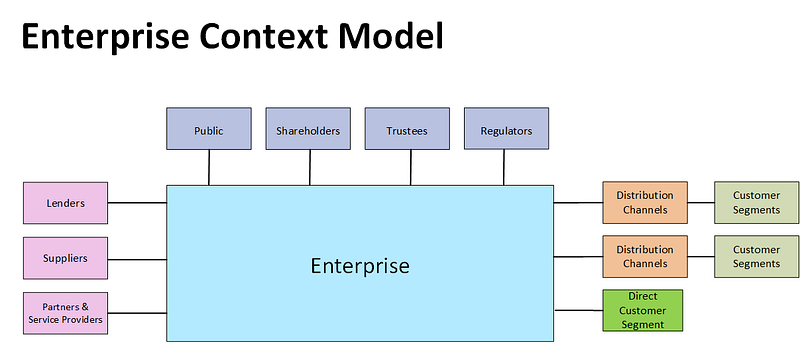
Context models capture the context in which a business, process of system exists, and the main entities that it interacts with.
Context models are concerned with relationships of the main entity with its context. The relationship can represent the flow of data, physical objects, or funds. For an enterprise context model, it is useful to group the types of external entities as follows:
- Governing bodies — entities that the business is governed by or reports to
- Partners and suppliers — entities that provide funds, goods or services necessary for the business to create the value (products or services)
- Distribution channels and customers — entities that will purchase the products or use the services of the enterprise. Depending on the business model, an enterprise may have direct relationships with its customers, or only with distribution channels such as retail chains or agents, or both.
Here is a simple example. In a complete model, each line (relationship) will require a label. As many relationships will be bi-directional, it is recommended to label each direction. For example, a distribution channel may sell specific products and receive a sales commission. A regulator will supply the rules & regulations in exchange for fees (and fines for non-compliance).
Business Model Canvas
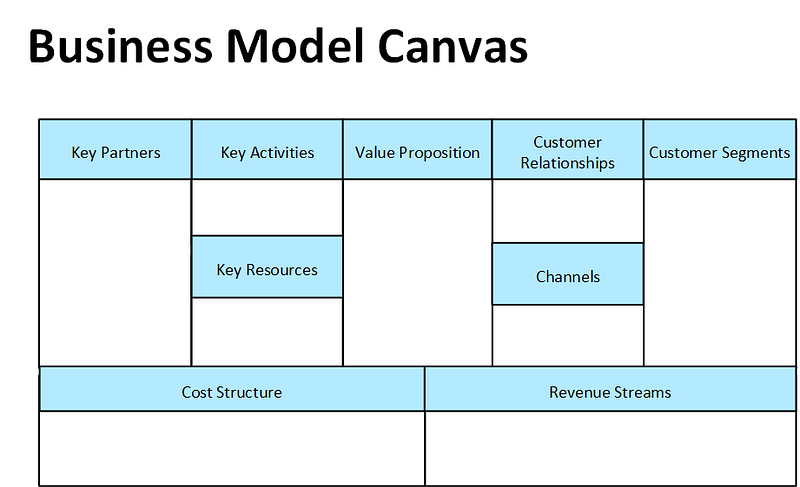
The purpose of a business model canvas is to represent how the enterprise creates and delivers value.
This model captures the following components that participate in creating and delivering business value:
- Key partners
- Key activities
- Key resources
- Value proposition
- Customer relationships
- Channels
- Customer segments
- Cost structure
- Revenue streams
For more on how to use this rich tool, visit the official website or refer to the Business Model Generation book.
Here is how this model is structured. Creating it will force you to answer the fundamental question: how does a particular business make money?
Business Use Case Diagram
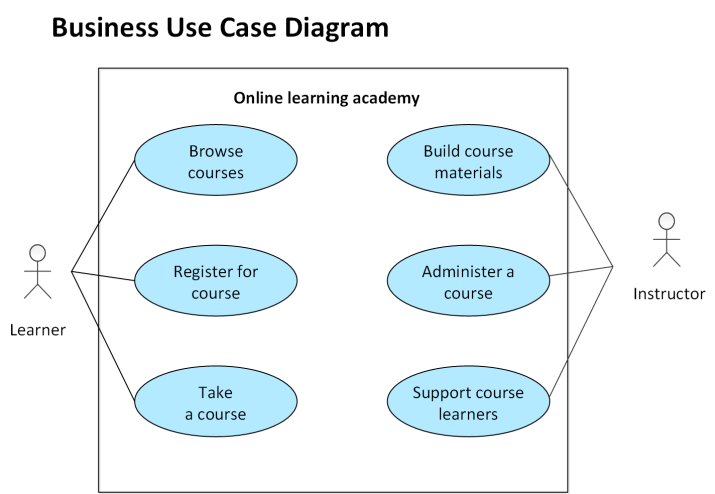
The purpose of a business use case diagram is to capture how the business is used by its customers and partners.
This model (unlike the system use case diagram) does not concern itself with individual systems and business applications. Instead, it considers the enterprise as a single system. This model is helpful for focusing on the key customer types and products and services that they consume.
When planning project scope and requirements analysis, each business use case may represent a separate user journey, and familiar stick people will point to the persona perspectives that will be important to consider. An extended use case diagram with multiple system boundaries can be used for the next level of elaboration on application functionality.
Here is a simple example:
Learning to create and apply these and other models will support a business analyst or business architect in providing strategic analysis at a project and program level.
Having sample business models in your professional portfolio is a smart strategy for job seekers. If you are planning your next career move, choose your preferred learning method (whether it’s videos, courses or one-on-one coaching) and develop your business modelling skills. These skills will serve you well in many careers where you get involved in solving business problems, product development, or strategic planning.
Originally published at why-change.com.
Website | Contact | Training | Mentorship | Courses | Job Interview Clinic | Books | Downloads | LinkedIn | YouTube | Instagram | Twitter


