
How To Create Context Models That Stakeholders Understand
Context models are communication tools

A context model can be used as a simple communication tool to depict the context of a business, a system, or a process.
The context is the environment in which the object of our interest exists. Context models capture how the central object interacts with its environment, be it exchanging data, physical objects, or funds.
Here is a simple context model of a catering company:
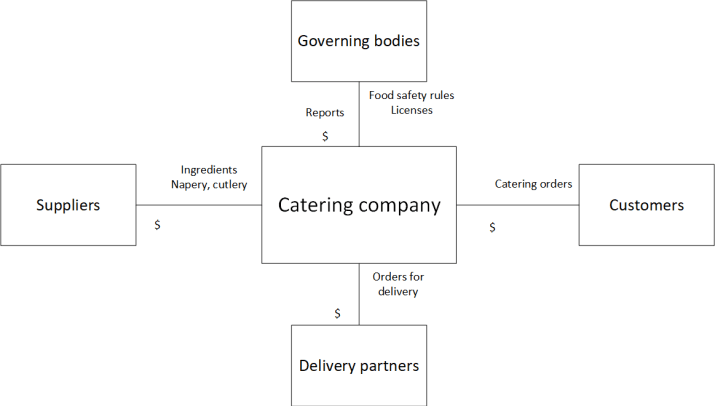
This model shows how a catering company interacts with external entities:
- What it purchases from suppliers.
- What is the product (service) it provides to the customers.
- What partner services does it use to support its business model.
- What are the main interactions with governing bodies.
The flows between the company and other entities in this example represent:
- Material objects (napery, cutlery, prepared food)
- Monetary funds (fees paid to suppliers, partners, order payments by customers)
- Data (regulatory reporting).
Context models can be used to confirm project scope, identify potential impacts of changes, and start requirements discovery.
The key elements are:
- Boxes: external entities that the main entity interacts with (organizations, departments, systems, or processes)
- Connectors: interactions between entities
- Flows: interactions are labelled to show the flow of data, physical objects, or funds between the entities.
That’s it. Simple and powerful. This basic diagram can help discover gaps, missed impacts, interactions and requirements early in the project.
And early is the best time, so that the scope of the project can be defined more accurately and realistically, and so that the analysis does not miss any important interactions.
Context diagrams are an excellent starting point for requirements planning and analysis.
While customer journeys are a good approach when we need to take a customer perspective, it will not give us the full picture.
As each organization interacts with its environment, industry, and value chain elements, we need to see it in the context to have a full picture.
The same logic can be applied to a context of a business process or a system.
For example, imagine we want to build a solution for processing online orders. Without specifying what this solution would be, we can start with the context in which this solution will exist.
This will be based on other solutions and applications that are already in place and will need to interact with the new solution:
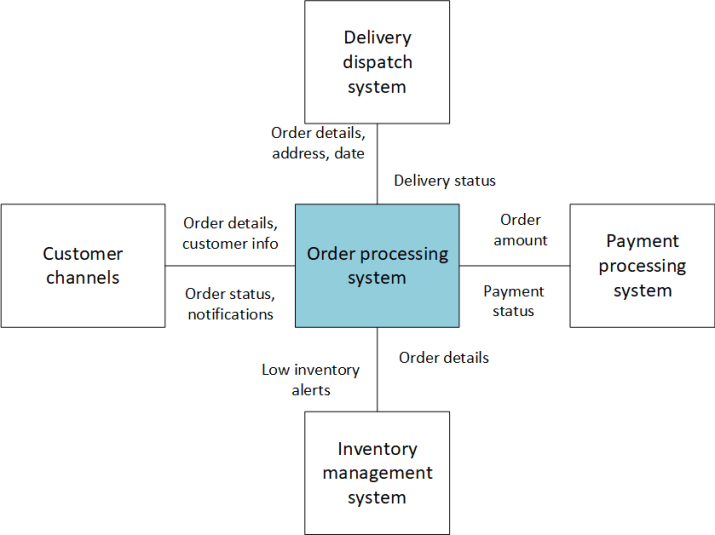
You can literally create this model in 5 minutes — on paper, whiteboard, or any tool that supports diagramming. Watch this video to see how.
If you have more than 5 minutes, you can be more detailed with the direction of the flows — by using arrows:
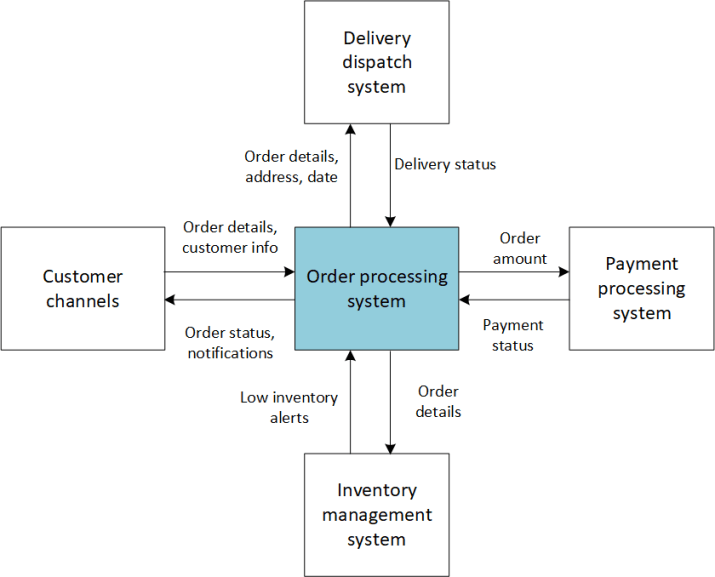
Once you have creates a context model, you will find it remains useful through the lifecycle of an initiative:
- During discovery, to capture the scope and identify potential impacts.
- During project planning, to identify stakeholder groups.
- During analysis, to start functional decomposition, identify key data flows and discover essential processes and communications.
- During estimation, to understand the number and complexity of integrations.
- During test planning, to create an adequate test strategy and coverage.
- Throughout project communication and change management activities, to ensure everyone involved understands the scope of the project.
Whether you are a business analyst, business architect, project manager, or project sponsor, the context model is an easy and efficient tool.
Use it to direct the discussion, avoid confusion, identify missed stakeholders, and clear up misunderstandings before they derail the project.
And yes, you can create a context model in 5 minutes. Here is how:
Want to learn about other business analysis techniques? Check out this webinar recording:
For more resources on business modelling, check out my book Business Analyst: a Profession and a Mindset, the Pictures Speak series on YouTube Why Change channel, or self-paced video courses for business analysts.
Website | Contact | Training | Mentorship | Courses | Job Interview Clinic | Books | Downloads | LinkedIn | YouTube | Instagram | Twitter


