
Bota
What time is it? Wine o’clock!
Today’s New York Times Spelling Bee letters:
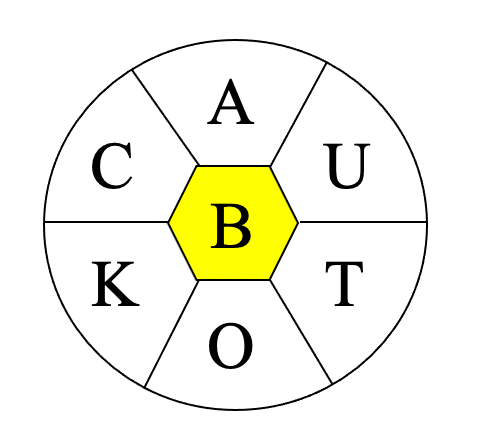
A, C, K, O, T, U, and center B (all words must include B)
Merriam-Webster says…
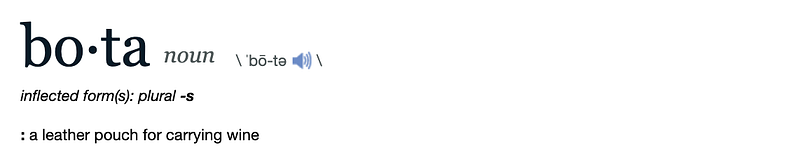
Silly little dictionary! Don’t you know bota can’t possibly be a word if the New York Times says it ain’t?
For further fascinating facts, check out the Spelling Bee Master.
What’s your favorite dord* from today’s puzzle?
My Two Cents
When I entered the word bota into the Unsplash search feature, most of what popped up were photos of boots. (And that’s because bota is Spanish for “boot”.) This made me realize that, for the second time in just two weeks, the Spelling Bee has had the opportunity to include the same word in English and Spanish. The first one was on January 15th, when it rejected cucaracha.
I’ve always wondered if this has happened with other languages besides Spanish. I’m slightly fluent in French, but I’ve never really looked for words in that language. If you happen to read this column and happen to speak a foreign language other than Spanish and happen to play the Spelling Bee game… please let us know if you’ve encountered words in that foreign language that are a match for an English word in the same game.
The odds are so small that anyone will reply, I’ll buy lottery tickets and share any winnings with the person who does. One caveat: I need to be able to confirm somehow that the game you reference actually existed.
Before we continue, I want to let any vegan or vegetarian readers know that they may not enjoy the upcoming section since it references an object made of leather. (I’m saying this sincerely, not cynically or sarcastically.) So you can skip to the second part if you’d like.
And wine, to boot
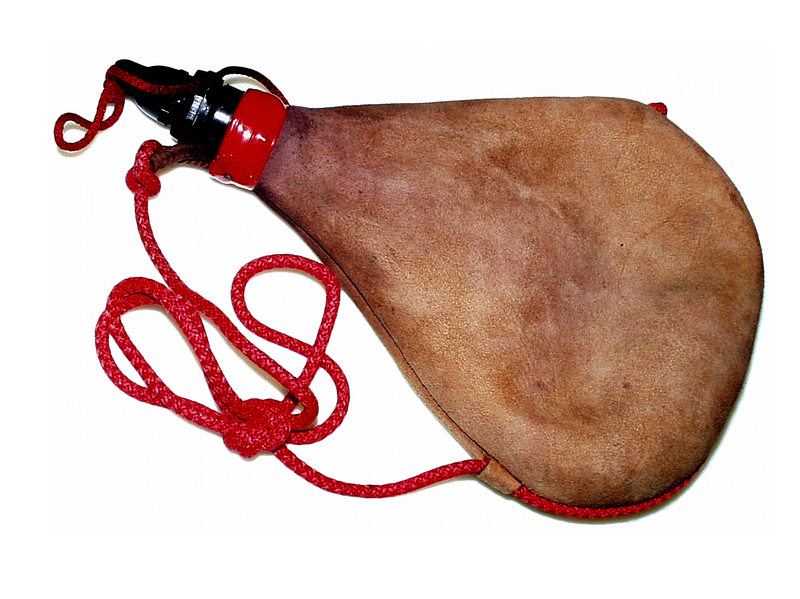
A bota is a leather container typical of Spain that used to hold any kind of liquid, but especially wine. Basque shepherds have a traditional goatskin bottle called a zahato. (I think the photo of at the top of today’s column is actually a zahato, but I’m not 100% sure.)
The original design of the bota is drop-shaped or tear-shaped, with either a straight or curved mouthpiece. Modern botas come in other shapes, including some very extravagant ones. They were traditionally made of hand-sewn goatskin, lined with tar on the inside. Sometimes the goat’s bladder was used instead of the tar. Today latex is a common choice for the waterproof lining, while the goatskin has been substituted for other leathers or even synthetic materials.
Like many wineskins, the bota is mainly used to store wine (preferably dry) and keep it fresh. Unlike other wineskins, the botas are much smaller, which allows for ease of transportation and drinking. Of course, botas can be used for any type of liquid: spirits, beer, soft drinks, water.
Its regular use has declined quite a bit, even in Spain, but it is still considered a traditional in certain rural areas and activities, such as bullfights.
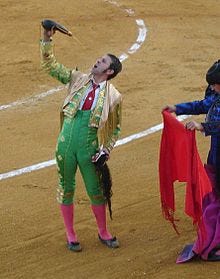
This bullfighter is one-handing the bota. Most people use both hands, placing one around the neck, near the nozzle, while the other one is cupped around the bottom. That hand at the bottom lifts the bota up and squeezes as the hand around the nozzle holds it steady.
Botas do not not require a lot of maintenance other than regular rinsing the inside with water, usually before a refill. However, if a bota is going to go unused for a while, the recommendation is to wash it with water, pour a glass of brandy inside, and leave the bota in a horizontal position with some air inside.
In botas made with tar, the tar may sag towards the bottom after a while, especially if the bota spends a lot of time upright. The traditional way to fix this was to rinse the bota, empty it, and heat it under the sun until the tar softened. Then the tar would be pinched from the outside and redistributed. Then the bota would be carefully inflated again and left to cool off.
Here is a video showing how hand-crafted botas are made using a traditional artisanal manufacturing process. The video is in Spanish and has English subtitles. (And I think the subtitles are already set for you.)
Origins
As I mentioned before, the word bota in Spanish means “boot” in English. However, it also means bota in English. In other words, the same Spanish term has two distinct meanings. In other other words, it’s a homonym. Which means the words bota and bota are simultaneously homophones (two or more words pronounced alike but different in meaning or derivation or spelling) and homographs (two or more words spelled alike but different in meaning or derivation or pronunciation).
How does this homonymic phenomenon happen, you ask? Oh, you didn’t? That’s okay, I’ll answer anyway. Most of the time it has to do with different etymologies, or word origins, for two terms that eventually ended up being spelled the same.
The bota that means “boot” came from the French botte, from Middle French bote, meaning the same thing. It’s first known use as “a covering for the foot and leg of varying height” was in the 14th century.
In the case of our daily dord*, the other bota, the one that has the same meaning as bota in English (wineskin), well, the Spanish word came from the Late Latin buttis, meaning “cask” or “flask”. English then borrowed the word, as it does so well. Our friends at Merriam-Webster explain that the English term’s first known use was in 1832.
Some examples of English homonyms include bear (the animal) and bear (the verb, as in “to grin and bear it”), and cleave (to separate) and cleave (to join). The latter two are a special kind of homonym called a contronym. Contronyms are words that have two meanings that are opposites. They are also sometimes called Janus words. You can read more about them in this article I wrote exactly a year ago on this date. What a coincidence, this rehash! So convenient for earning 13 more cents today.
We just finished discussing some grammar on a Friday night, so we all deserve some wine! You can pour yourself a glass, chug it right out of the bottle, or lap it up from your significant other’s belly. Just don’t drink it from a bota, because the editors of the Spelling Bee determined that bota is a dord*.
You can check out my previous entry on another dord* here:
*What the heck is a dord, you ask? Here’s the answer: