avatarAvi Kotzer

Free AI web copilot to create summaries, insights and extended knowledge, download it at here

4160

Abstract

s a possible Hebrew origin for the term.</p><blockquote id="3d5f"><p><b>Gamow: </b>And this — the photographs are old but I composed them together — this is Alpher and Herman and me, and this is YLEM…</p></blockquote><blockquote id="7582"><p><b>Weiner:</b> What is YLEM in this case?</p></blockquote><blockquote id="86e1"><p><b>Gamow:</b> A mixture of protons, neutrons and electrons.</p></blockquote><blockquote id="8988"><p><b>Weiner: </b>But the letters stand for what?</p></blockquote><blockquote id="8364"><p><b>Gamow:</b> You can look in the Webster dictionary. This is a word — I think it’s an old Hebrew word, but Aristotle was using it — in Webster dictionary it says “material from which elements were formed.”</p></blockquote><blockquote id="a3c1"><p><b>Weiner:</b> The primordial substance?</p></blockquote><blockquote id="8f2f"><p><b>Gamow:</b> The primordial substance, yes — <i>ylem</i>.</p></blockquote><blockquote id="2916"><p><b>Weiner: </b>The thick soup or whatever you want to call it?</p></blockquote><blockquote id="3d62"><p><b>Gamow:</b> I mean this is the old Hebrew word meaning something like “space between heaven and earth.”</p></blockquote><p id="1fbb">The Alpher that Gamow mentions is <a href="https://www.legacy.com/us/obituaries/timesunion-albany/name/ralph-alpher-obituary?id=4935399"><b>Ralph Alpher</b></a>, the main author of a famous scientific paper published in 1948 that posited that the Big Bang created hydrogen, helium, and other elements in the correct proportions to explain their abundance in the early universe. This paper about Big Bang <a href="https://w.astro.berkeley.edu/~mwhite/darkmatter/bbn.html">nucleosynthesis</a> was officially titled “The Origin of Chemical Elements”, but it’s known familiarly as the <b>Alpher–Bethe–Gamow paper</b>.</p><p id="59c5">Gamow, who was Alpher’s mentor and thesis advisor, was the one who decided to give this very serious paper a funny title. He added the name of his friend and physicist Hans Bethe as a coauthor, and placed the names in alphabetical order so that they would sound like “alpha-beta-gamma”, the first three letters of the Greek alphabet.</p><p id="5b10">Like Gamow, Alpher also laid claim to finding the word <i>ylem</i> in the dictionary and using it to describe that primordial plasma which underwent Big Bang nucleosynthesis. This charged plasma eventually turned into neutral atoms and made the universe “transparent” at the age of 380,000 years.</p><p id="bbf0">In other words, <i>ylem</i> is what Alpher and Gamow thought existed right after the the literal “big bang” happened. Interestingly, Alpher and another scientist, Robert Herman (mentioned in the earlier interview) predicted that the high-energy photons in the <i>ylem</i> would still be observable today as an ambient cosmic microwave background radiation. They posited this in 1948! And they were right!</p><h2 id="96ac">Origin of a term</h2><p id="a90d">Today billions of people across the globe are familiar with the term “Big Bang”, even if they may not know the explicit details about what happened before, during, and after. Believe it or not, that phrase was already famous before this TV show intro came along…</p> <figure id="64da"> <div> <div> <img class="ratio" src="http://placehold.it/16x9"> <iframe class="" src="https://cdn.embedly.com/widgets/media.html?src=https%3A%2F%2Fwww.youtube.com%2Fembed%2FFKxsuy1UxJY%3Ffeature%3Doembed&amp;display_name=YouTube&amp;url=https%3A%2F%2Fwww.youtube.com%2Fwatch%3Fv%3DFKxsuy1UxJY&amp;image=https%3A%2F%2Fi.ytimg.com%2Fvi%2FFKxsuy1UxJY%2Fhqdefault.jpg&amp;key=a19fcc184b9711e1b4764040d3dc5c07&amp;type=text%2Fhtml&amp;schema=youtube" allowfullscreen="" frameborder="0" height="480" width="854"> </div> </div> </figure></iframe></div></div></figure><p id="489b">But the story of the person who actually coined the term is a lesson in getting too clever for your own good.</p><p id="1126"><a href="https://www.catholiceducation.org/en/science/faith-and-science/a-day-without-yesterday-georges-lemaitre-amp-the-big-bang.html"><b>Georg

Options

es Henri Joseph Édouard Lemaître</b></a> (or “Le maître” as he was known by no one else but me) was a Belgian Catholic priest, theoretical physicist, mathematician, astronomer, and professor of physics. He did all this back in the early 20th century, when being a scientist and a person of faith were not mutually exclusive.</p><p id="767c">Lemaître was the first to theorize that the universe was expanding from a beginning that he described as a “burst of fireworks”. To him, the galaxies were like burning embers that were spreading out in a growing sphere from the very center of that burst. So not only was he a priest, theoretical physicist, mathematician, astronomer, and professor of physics… he was also a poet of sorts.</p><p id="e3a4">Of course, Lemaître’s theory wasn’t readily accepted at first. Even Albert Einstein dissed him, telling him “Your calculations are correct, but your physics is atrocious”. Undaunted, Lemaître kept working on his stuff, and eventually formulated what is known as Hubble’s law, which states that “that galaxies move away from Earth at speeds proportional to their distance”. Now, Lemaître published this in 1927, two years before Hubble. And yet, this theory is named after the American astronomer. Or was, anyway; it was only in 2018 that the International Astronomical Union corrected a decades-long injustice and renamed the law as the Hubble–Lemaître law.</p><p id="df8f">By the 1940s and 50s, as I mentioned earlier, Alpher and Gamow further developed Lemaître’s idea of a “burst of fireworks” into the Big Bang Theory. Except it wasn’t called that yet.</p><p id="17c9">Along came <b>Sir Fred Hoyle,</b> an English astronomer who formulated the theory of stellar <a href="https://web.archive.org/web/19990129020628/http://helios.gsfc.nasa.gov/nucleo.html">nucleosynthesis</a>. But he also opposed the Big Bang Theory, a term he himself coined possibly in a disparaging way in a talk for a 1949 BBC Radio broadcast. During the talk, he said this: “These theories were based on the hypothesis that all the matter in the universe was created in one big bang at a particular time in the remote past.”</p><p id="d448">Hoyle himself denied he used the term pejoratively, explaining it was “just a striking image meant to highlight the difference between the two models”.</p><p id="5b53">Still, he aided in popularizing the scientific theory he strongly opposed by giving it a catchy name. Unfortunately, Hoyle did not have George Gamow’s sense of humor. Otherwise, he would have placed that fact on his tombstone.</p><p id="796a">Well, we’ve discussed the <i>ylem </i>and managed to prove the New York Times knew about this word 70 years ago. And yet, despite this damning evidence, the editors of the Spelling Bee decided that <i>ylem </i>is a dord*.</p><p id="aaa1">You can check out my previous entry on another <b>dord* </b>here:</p><div id="00ec" class="link-block"> <a href="https://readmedium.com/liana-8c7472f36b8f"> <div> <div> <h2>Liana</h2> <div><h3>Let’s get back into the swing of things with this word</h3></div> <div><p>medium.com</p></div> </div> <div> <div style="background-image: url(https://miro.readmedium.com/v2/resize:fit:320/0*EWtRgWRkl5-HLQmm)"></div> </div> </div> </a> </div><p id="230f">*What the heck is a <b>dord, </b>you ask? Here’s the answer:</p><div id="f611" class="link-block"> <a href="https://www.merriam-webster.com/words-at-play/dord-a-ghost-word"> <div> <div> <h2>'Dord': A Ghost Word</h2> <div><h3>One of the questions people like to ask lexicographers is this: Can you sneak something into the dictionary? Can you…</h3></div> <div><p>www.merriam-webster.com</p></div> </div> <div> <div style="background-image: url(https://miro.readmedium.com/v2/resize:fit:320/0*DBbbb_Jrbr5U6eFJ)"></div> </div> </div> </a> </div></article></body>

Ylem

The stuff we’re all made of… hypothetically

Photo by Graham Holtshausen on Unsplash

Today’s New York Times Spelling Bee letters:
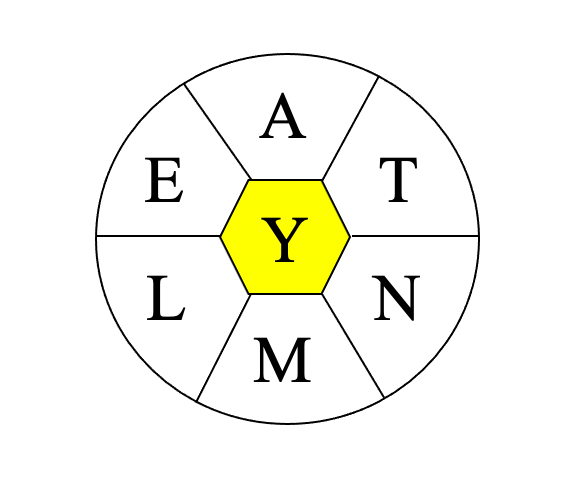
Art: Iva Reztok

A, E, L, M, N, T, and center Y (all words must include Y)

Merriam-Webster says…
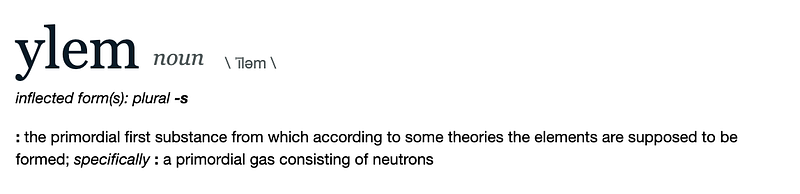
Credit: merriam-webster.com

Silly little dictionary! Don’t you know ylem can’t possibly be a word if the New York Times says it ain’t?

For further fascinating facts, check out the Spelling Bee Master.

What’s your favorite dord* from today’s puzzle?

My Two Cents

The New York Times is well aware of the existence of the word ylem. Trust me, I checked. Or don’t trust me, and check for yourself. Do a search in the online edition of the paper. These are the first few results that popped up for me:
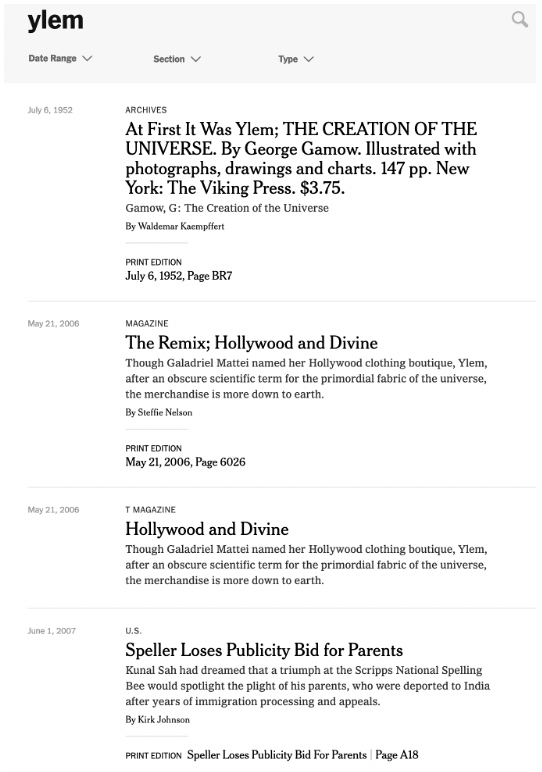
Screenshotted by Iva Reztok

Quite an eclectic result. An article about a book by George Gamow, one of the developers of the Big Bang Theory (the cosmology concept, not the TV show), an article mentioning a Hollywood clothing boutique named Ylem, and an article about a Scripps National Spelling Bee contestant who lost, among other reasons, for not spelling ylem correctly.

Yes, the irony is not lost on me either, dear reader. There is an article in the New York Times (which features the Spelling Bee game I write about) about a Spelling Bee in which the word ylem is mentioned… a word rejected today by the Spelling Bee of the New York Times.

It gets even better. That article about George Gamow’s book? Well, take a gander at this little excerpt:

Some unknown primordial stuff amenable to scientific law was squeezed. Mr. Gamow calls the result of that pulp “ylem,” which according to Webster, is “the first substance from which the elements were supposed to be formed”.

Yes, the New York Times is referencing the definition of ylem given by Webster’s dictionary! It’s the same company that is known today as Merriam-Webster (G & C Merriam Co. bought bought the rights to An American Dictionary of the English Language from Webster’s estate after Noah Webster passed away in 1843). In fact, that definition quoted in 1952 is pretty much the same as the current one.

I think I’ve finally caught the New York Times in fraganti! If only I was as popular as Tim Denning or Jessica Wildfire, I’m sure this incredibly important piece of breaking news would go viral and make me a Medium Millionaire.

Origin of a universe

The dictionary tells us that ylem (pronounced ih-lem or I-lem) comes from Middle English, from Middle French ilem, probably from Medieval Latin hylem, the accusative form of hyle, meaning “matter”, from Latin, from Greek hylē.

In a 1968 interview done four months before he passed away, George Gamow mentions a possible Hebrew origin for the term.

Gamow: And this — the photographs are old but I composed them together — this is Alpher and Herman and me, and this is YLEM…

Weiner: What is YLEM in this case?

Gamow: A mixture of protons, neutrons and electrons.

Weiner: But the letters stand for what?

Gamow: You can look in the Webster dictionary. This is a word — I think it’s an old Hebrew word, but Aristotle was using it — in Webster dictionary it says “material from which elements were formed.”

Weiner: The primordial substance?

Gamow: The primordial substance, yes — ylem.

Weiner: The thick soup or whatever you want to call it?

Gamow: I mean this is the old Hebrew word meaning something like “space between heaven and earth.”

The Alpher that Gamow mentions is Ralph Alpher, the main author of a famous scientific paper published in 1948 that posited that the Big Bang created hydrogen, helium, and other elements in the correct proportions to explain their abundance in the early universe. This paper about Big Bang nucleosynthesis was officially titled “The Origin of Chemical Elements”, but it’s known familiarly as the Alpher–Bethe–Gamow paper.

Gamow, who was Alpher’s mentor and thesis advisor, was the one who decided to give this very serious paper a funny title. He added the name of his friend and physicist Hans Bethe as a coauthor, and placed the names in alphabetical order so that they would sound like “alpha-beta-gamma”, the first three letters of the Greek alphabet.

Like Gamow, Alpher also laid claim to finding the word ylem in the dictionary and using it to describe that primordial plasma which underwent Big Bang nucleosynthesis. This charged plasma eventually turned into neutral atoms and made the universe “transparent” at the age of 380,000 years.

In other words, ylem is what Alpher and Gamow thought existed right after the the literal “big bang” happened. Interestingly, Alpher and another scientist, Robert Herman (mentioned in the earlier interview) predicted that the high-energy photons in the ylem would still be observable today as an ambient cosmic microwave background radiation. They posited this in 1948! And they were right!

Origin of a term

Today billions of people across the globe are familiar with the term “Big Bang”, even if they may not know the explicit details about what happened before, during, and after. Believe it or not, that phrase was already famous before this TV show intro came along…

But the story of the person who actually coined the term is a lesson in getting too clever for your own good.

Georges Henri Joseph Édouard Lemaître (or “Le maître” as he was known by no one else but me) was a Belgian Catholic priest, theoretical physicist, mathematician, astronomer, and professor of physics. He did all this back in the early 20th century, when being a scientist and a person of faith were not mutually exclusive.

Lemaître was the first to theorize that the universe was expanding from a beginning that he described as a “burst of fireworks”. To him, the galaxies were like burning embers that were spreading out in a growing sphere from the very center of that burst. So not only was he a priest, theoretical physicist, mathematician, astronomer, and professor of physics… he was also a poet of sorts.

Of course, Lemaître’s theory wasn’t readily accepted at first. Even Albert Einstein dissed him, telling him “Your calculations are correct, but your physics is atrocious”. Undaunted, Lemaître kept working on his stuff, and eventually formulated what is known as Hubble’s law, which states that “that galaxies move away from Earth at speeds proportional to their distance”. Now, Lemaître published this in 1927, two years before Hubble. And yet, this theory is named after the American astronomer. Or was, anyway; it was only in 2018 that the International Astronomical Union corrected a decades-long injustice and renamed the law as the Hubble–Lemaître law.

By the 1940s and 50s, as I mentioned earlier, Alpher and Gamow further developed Lemaître’s idea of a “burst of fireworks” into the Big Bang Theory. Except it wasn’t called that yet.

Along came Sir Fred Hoyle, an English astronomer who formulated the theory of stellar nucleosynthesis. But he also opposed the Big Bang Theory, a term he himself coined possibly in a disparaging way in a talk for a 1949 BBC Radio broadcast. During the talk, he said this: “These theories were based on the hypothesis that all the matter in the universe was created in one big bang at a particular time in the remote past.”

Hoyle himself denied he used the term pejoratively, explaining it was “just a striking image meant to highlight the difference between the two models”.

Still, he aided in popularizing the scientific theory he strongly opposed by giving it a catchy name. Unfortunately, Hoyle did not have George Gamow’s sense of humor. Otherwise, he would have placed that fact on his tombstone.

Well, we’ve discussed the ylem and managed to prove the New York Times knew about this word 70 years ago. And yet, despite this damning evidence, the editors of the Spelling Bee decided that ylem is a dord*.

You can check out my previous entry on another dord* here:

*What the heck is a dord, you ask? Here’s the answer:

Spelling Bee
Language
Science
History
Cosmos
Recommended from ReadMedium