
Liana
Let’s get back into the swing of things with this word
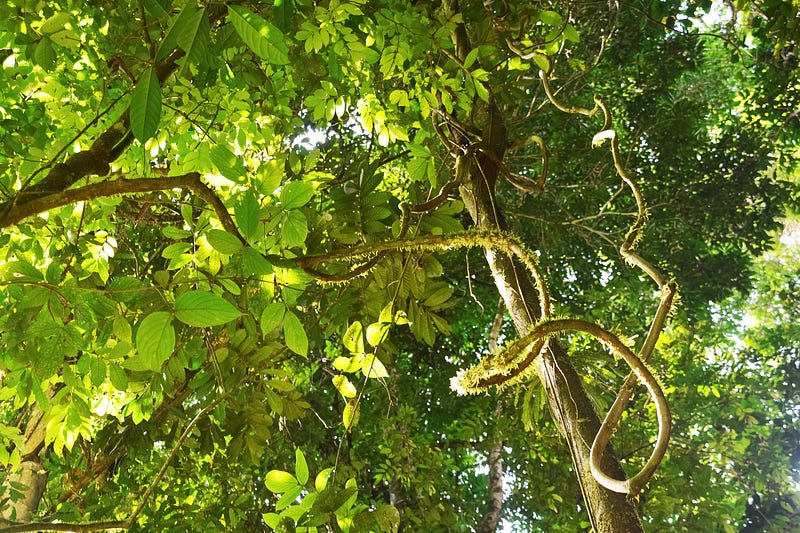
Today’s New York Times Spelling Bee letters:
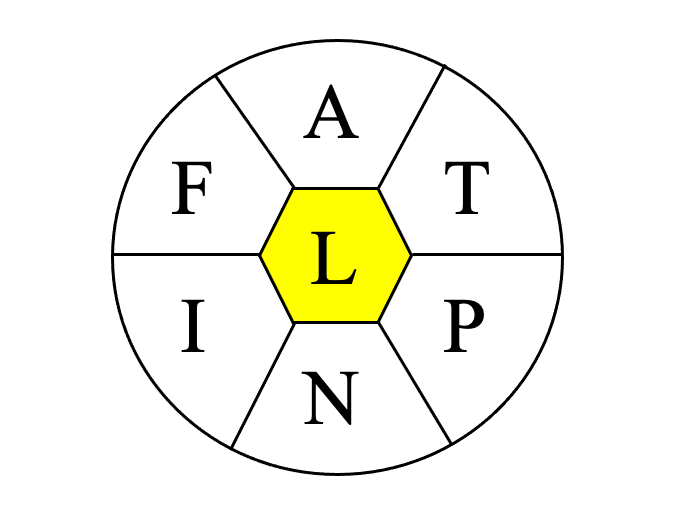
A, F, I, N, P, T, and center L (all words must include L)
Merriam-Webster says…
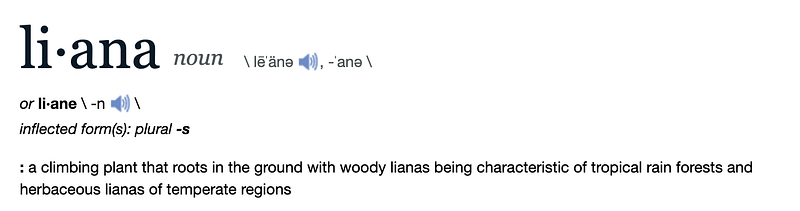
Silly little dictionary! Don’t you know liana can’t possibly be a word if the New York Times says it ain’t?
For further fascinating facts, check out the Spelling Bee Master.
What’s your favorite dord* from today’s puzzle?
My Two Cents
Lianas are famous for their association with Tarzan the Ape Man. So famous, in fact, the dictionary itself uses Tarzan in one of it’s example sentences, quoting an article from Wired magazine:
“It might be dominated by an invasive species such as lianas — the big woody vines that Tarzan swings from which can quickly take over tropical land — or molinia — a grass that spreads across the Welsh uplands after fields stop being grazed.” — Isabella Kaminski, Wired, 25 Dec. 2019
So what’s with the rebuff, Spelling Bee? I realize that Tarzan is no longer a politically correct character for myriad reasons, but there’s no need to involve the poor liana in the whole mess.
No tax-on-omy, please
When you look up the word liana in any reference book, you won’t see a taxonomic, or scientific, name next to it. (For example, the taxonomic name of the lion is Panthera leo.) That’s because the word liana refers to a general type of plant, not a specific species. In a similar way that people use the words tree and shrub, for example.
The word liana comes to us from the French liane, itself from the French dialect liône, lieune, liane, probably from lier, meaning “to bind”.
A liana is a woody vine with a long stem; it’s rooted in the soil but climbs up trees and other tall forest objects to reach direct sunlight. Some lianas can be quite large:
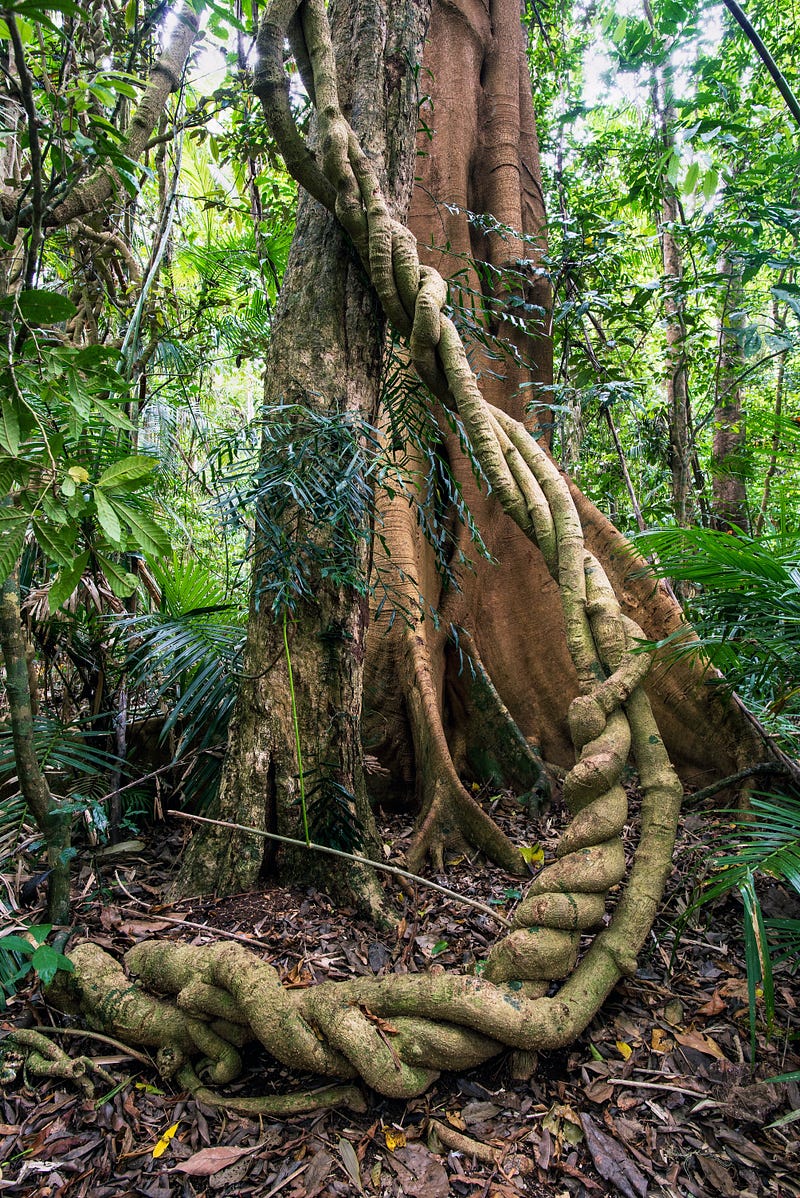
Twisted lianas can entangle to form a hanging rope of vegetation, similar to what you see above. In fact, some lianas can grow to lengths of over 330 feet (100 meters). However, although they are many different species of lianas or vine-forming plants, and we know that, in general, lianas are detrimental to trees, there is still a lot we need to learn about these vines.
As the Encyclopedia Britannica explains:
“Although humans use different lianas for purposes ranging from a source of fresh drinking water (vines are often hollow and conduct water through the plant) to poisons and drugs (curare comes from a liana), there is a relative lack of information on this very abundant and diverse life form. Knowledge of lianas and their ecology has lagged well behind other plant groups largely because the study of lianas is complicated by erratic growth patterns and taxonomic uncertainties.”
What we do know is that a certain ape man used lianas to swing around the jungle on TV. No, I’m not talking about Tarzan, but rather…
Watch out for that tree!
George of the Jungle!
If you’re around my age, give or take a decade, you may remember the cartoon that originally aired in 1967 (and later in many, many reruns) and had a very catchy tune:
George, George, George of the Jungle, Strong as he can be. (Tarzan yell) Watch out for that tree! George, George, George of the Jungle Lives a life that’s free. (Tarzan yell) Watch out for that tree! When he gets in a scrape, He makes his escape With the help of his friend, An ape named Ape. Then away he’ll schlep on his elephant Shep While Fella and Ursula stay in step…
With George, George, George of the Jungle Friend to you and me. (Tarzan yell) Watch out for that tree! Watch out for that… (Tarzan yell … “Oooh!”) tree! George, George, George of the Jungle, Friend to you and me!
George of the Jungle was part of a line-up of three unrelated cartoons that ran on Saturday mornings on American TV. All three were created by Jay Ward and Bill Scott, who had also created The Rocky and Bullwinkle Show. The other two cartoons were Super Chicken and Tom Slick.
The character of George was inspired by a cartoon of George Eiferman, a Philly-born bodybuilder who was crowned Mr. America in 1948 and won the Mr. Universe competition in 1962. He also had a TV show in the 1980s, and palled around with Lou Ferrigno and Arnold Schwarzenegger.
Eiferman served on a minesweeper in the Navy during World War II. There was a cook on that same ship who had a fondness for cartoons and combined Eiferman with Tarzan to draw the original George of the Jungle.
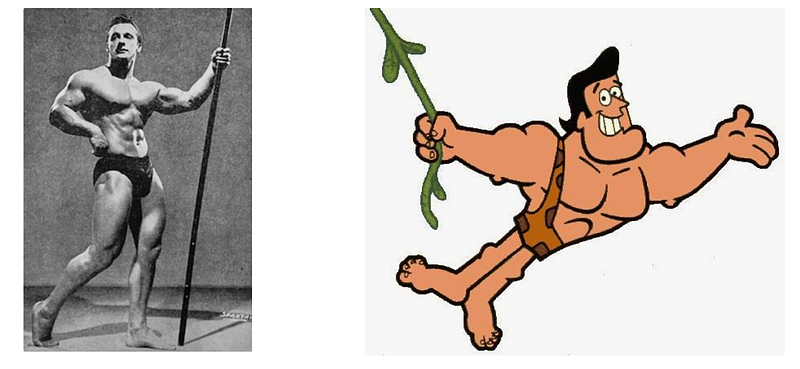
Although the cartoon series was popular, Ward became too pleased with it and went over budget. That was the main reason the half-hour show ran for only 17 episodes in the 1967–1968 season. But it remained a cult classic, spawning the blockbuster 1997 movie starring Brendan Fraser, a direct-to-video Part 2 of the film, not starring Brendan Fraser, and a 2007 reboot of the original show, which has a new version of the catchy theme:
You may have noticed that the two women in the 2007 cartoon look different from each other, unlike the mysterious red-headed twins that appear in the original theme song. That’s because the 1967 George did not have a pair of identical twins keeping him company. There was only one, named Ursula.
So who is this “Fella” mentioned in the song, who stays in step with Ursula and George? She’s Ursula herself. The “insider” joke of the 1967 theme song is that George doesn’t know Ursula’s name, so he calls her “fella”.
And many people —including me— wondered for the longest time why Fella appeared in the theme song but never in the episodes themselves. Now you know!
I hope you had a swinging good time reading today’s column. Just remember, you use a rope or a vine to swing, but never a liana. And that’s because the editors of the Spelling Bee decided that liana is a dord*.
You can check out my previous entry on another dord* here:
*What the heck is a dord, you ask? Here’s the answer: