
Incipit
The beginning of the beginning
Today’s New York Times Spelling Bee letters:
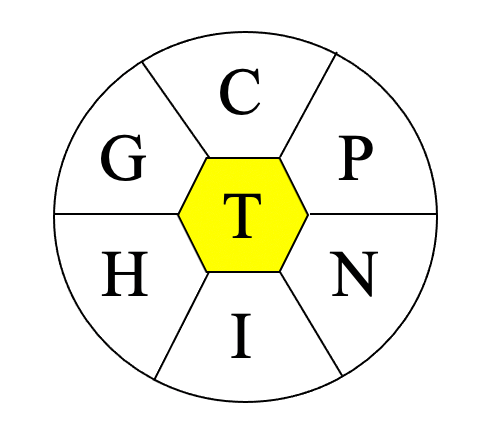
C, G, H, I, N, P, and center T (all words must include T)
Merriam-Webster says…
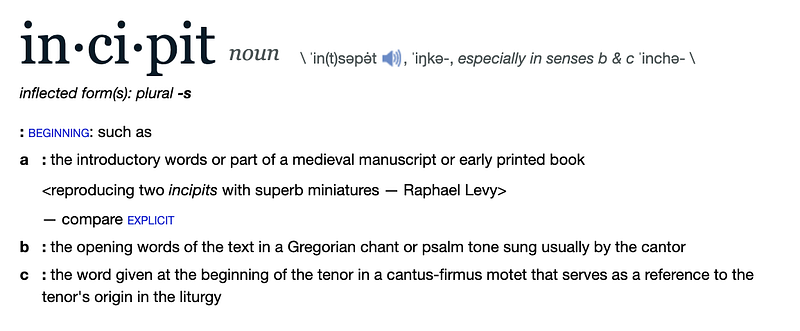
Silly little dictionary! Don’t you know incipit can’t possibly be a word if the New York Times says it ain’t?
For further fascinating facts, check out the Spelling Bee Master.
What’s your favorite dord* from today’s puzzle?
My Two Cents
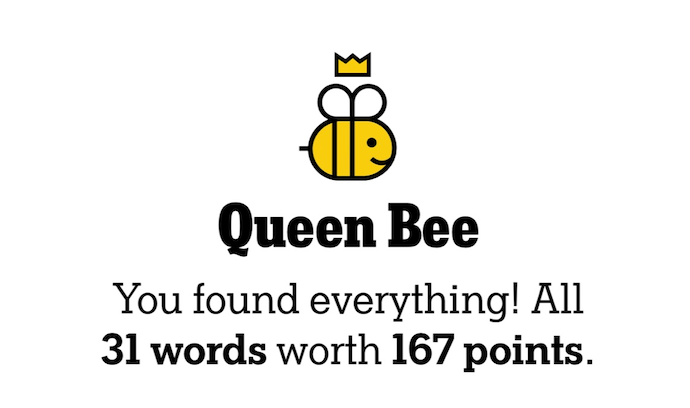
Interesting Spelling Bee today; there are six consonants and only one vowel, I. Personally, I like these type of game conditions as it minimizes combinations. In fact, I was able to find all the words and get the little Queen Bee logo. (Spoiler alert: don’t look at the photo if you don’t want to see how many words and total points there are in today’s game.)
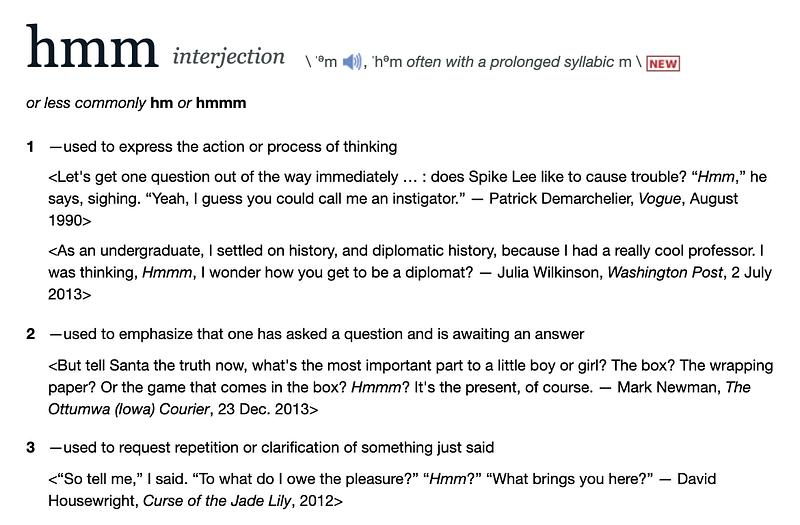
All the words had the vowel (I) at least once. Can you think of any words in the English language that have no vowels at all? Hmm…
Yes! You are correct: hmm is one of them! Shh and psst are two more, although there is some debate about wether or not these are actually words. Those two don’t appear in Merriam-Webster’s dictionary. Hmm does, with alternate spellings and three definitions, to boot!
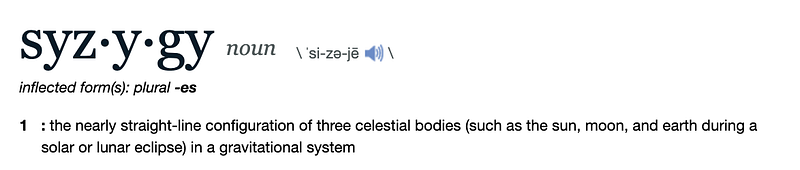
If you include the letter “y” as a vowel, there are some interesting words you can making without the use of a-e-i-o-u: rhythms, spryly, and syzygy, for example. Yes, that last one is a word, and it has some pretty cool definitions (but I’m gonna show you only the first one):
The dual role of the letter “y” was forever ingrained in the brains of those of us who grew up in the 1980s thanks to a one-hit wonder British band named Freeez and their grammatically-themed song “IOU”. Why they excluded A and E from the song’s title is anyone’s guess. I mean, the band’s name does contain enough “e’s” to make up for it… but not a single “a”. It’s possible they couldn’t use the title “A E I O U and sometimes Y” because that had already been taken by the American synth pop duo, Ebn Ozn.
But Freeez got their vengeance, as their tune became more commercially successful. Here is an incredibly useful video that will help you fully understand vowels and the breakdance craze of the 1980s.
So how old were you when you discovered that “A E I O U and sometimes Y” is not the title of the above song? How about today old!
Red marks the spot
You may be more familiar with incipit’s better-known cousin incipient, meaning “beginning to be”, synonymous with initial or commencing. Both incipit and incipient share the same Latin root, incipere, meaning “to begin”. Incipient comes from the present participle of that word, while incipit is its third-person singular present indicative.
Being that the incipit consists of the first few words of a text, it was used as an identifying label for said text. A famous example is the Agnus Dei (Lamb of God) prayer, back when praying was done in Latin.
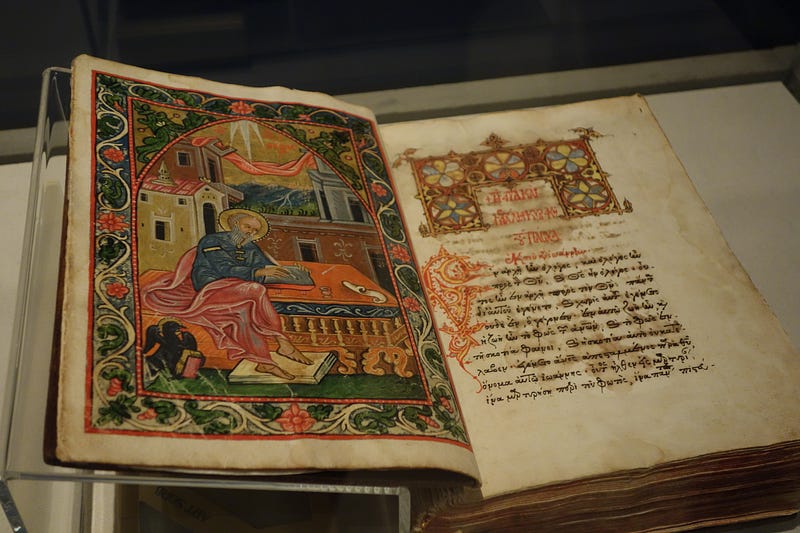
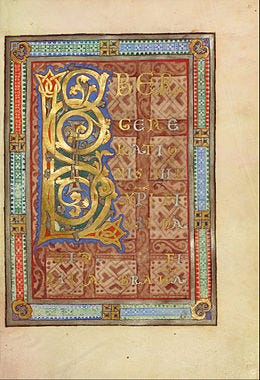
Here is an example of a decorated incipit page of the Gospel of Matthew from the 12th century.
It took a while, but eventually someone figured out that perhaps coming up with a title for a book might be a better way to identify it. This was probably helped along when printing started, as putting an entire sentence on the spine wasn’t very practical.
Still, today we still remember and quote the first lines of poems or opening sentences of novels. “Call me Ishmael” is easily identified as belonging to Moby-Dick; or, The Whale. Similarly, “How do I love thee? Let me count the ways.” brings to mind Elizabeth Barrett Browning’s sonnet by the same name, also known as Sonnet 43. In Spanish, perhaps the most famous opening line is that of Cervantes’s epic Don Quixote: “En un lugar de La Mancha, de cuyo nombre no quiero acordarme…” (Somewhere in La Mancha, in a place whose name I do not care to remember…).
In a book, the counterpart of the incipit is the explicit. The word in its noun form, that is, and not the adjective explicit whose meaning you know as “fully revealed or expressed without vagueness” or “unambiguous”. The noun form of explicit refers to a note by the author or scribe at the end of the text that provided information about its place, date, and authorship. Today this has been mostly replaced by the copyright page, although books printed in Spanish still have this type of information (now called a colophon) on the last page.
Incipits are also used in music. Sometimes they can help the musician recall their own musical memory of a given work better than the title itself.
Below are the first few bars of Chopin’s Nocturne in B-flat minor, Op. 9, №1:
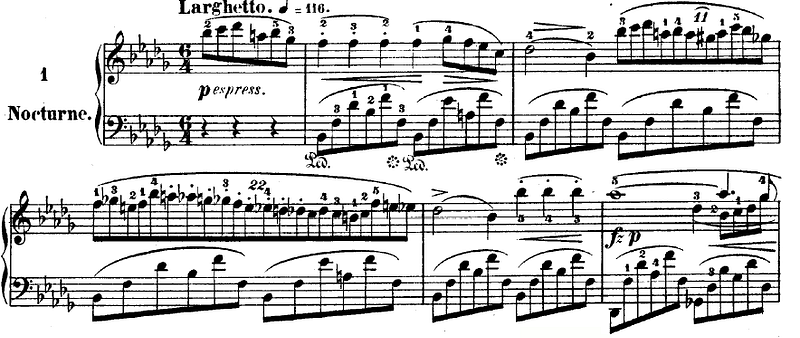
And here is the incipit (single-staff version) for that same composition:
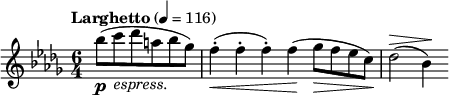
Chopin’s Noctures are well-known among people who love classical music, so this may not be the best example. But imagine hearing the first few notes of that “IOU” song I discussed earlier. Certainly it would help you remember much better than the title ““A E I O U and sometimes Y”… because that refers to a completely different tune!
In the beginning
In the Hebrew Bible (the Pentateuch, or five books of Moses; the Prophets; and Writings) many of the books are named using incipits. So, for example, the Hebrew names of the first five books have almost no relation to their English or Spanish counterparts.
Genesis is called Bereshit, which means “In [the] beginning”. And by the way, that beginning many of you may know as “In the beginning God created the Heavens and the Earth” is not considered an accurate translation by Hebrew-speaking folk who study the Torah. (And by Torah I mean the Pentateuch, not Hogan Torah.) A better translation into English is rendered as “In the beginning of God’s creation of the heavens and the earth”. It’s an important distinction; if you’re interested, you can read the explanation in the small text here.
In Hebrew the Book of Exodus is called Shemot (Names) because the first sentence starts with “And these are the names of the sons of Israel who came to Egypt…”. The Book of Leviticus is called Vayikra (and he called), Numbers is called Bamidbar (in the desert) and Deuteronomy is Devarim (things), which is nice, because “things” is much easier to say and write than Deuotoronomeronomy. See?!?
The use of incipits in Hebrew also appears in the Talmud. The chapters of the Gemara (the rabbinical commentary on the oral law) are known by their first word or words. For example, the first chapter of the first tractate (named Berachot, or “Benedictions”) is called Me-matai (“From when”), and that word is printed in much larger text, as seen here:
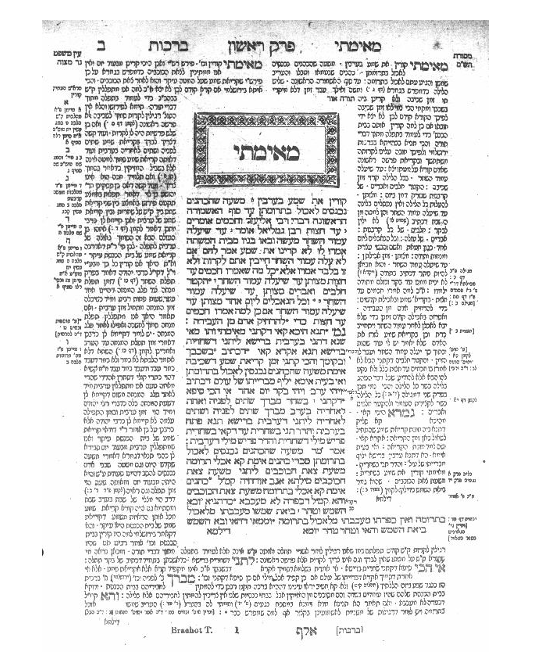
The head of every subsequent page within that chapter of the tractate also has the title word.
And now we’ve arrived at the explicit of my column, where I usually offer my rant. Which today will be about the beginning, or incipit. And that’s because the editors of the Spelling Bee decided that incipit is a dord*.
You can check out my previous entry on another dord* here:
*What the heck is a dord, you ask? Here’s the answer: