Books and Study on a Healthy Economy for People and Planet
Top 7 books and schools for a shining future
Especially young people often ask me where to go, what to study? They want to do what I do: freelancing for a regenerative, healthy economy. They want to help restore ecosystems.
They want to find the freedom I found in creating my own job and aligning that job with the talents I have. Well, the truth is, there is not only one path. There are many.
I studied regular studies (international business) and worked in regular jobs (business management, marketing, communication) before I decided to skip regular and start ‘business as unusual’.
My path had several stepping stones, and I will name a few:
- Blue Economy Summer School, two weeks at the University of Pecs. It changed my life and I am very grateful to Professor Tibor Kiss and Professor Gunter Pauli who made this program possible. In the meantime, funding stopped but please keep checking them out, I hope the program might start again…
- Illuminating talks with people about The Natural Step framework
- Working together with people who embraced Cradle to Cradle and made huge steps in healthy building and non-toxic materials
- Studying circular economy and the works of the Ellen MacArthur Foundation
- Blue Economy Living University gatherings: in Austria studying system dynamics, in El Hierro seeing the regenerative economy in action, in Blue City Rotterdam and several other occasions where we discussed, studied and shared
- Schumacher College in Devon, UK where I did several courses and met amazingly inspiring people
- My permaculture course to teach me about ecosystems and systemic design
- Study on systemic thinking by Fritjof Capra: Capra Course
- And don’t forget that my path encompassed a lot of personal development. Meditation, deep listening, long walks in nature, embodying, embracing, accepting. Learning and unlearning, about myself and others, have all been part of my journey
Reading is discovering
When in 2013 I went to the Blue Economy Summer School, my world view really changed. Many things I learned there I had never really thought about before.
Can we, humans, really live as part of ecosystems? Do we really try to control nature? Are we finding partial solutions instead of looking at things holistically? Are we caring enough about our home, planet Earth?
What does rewilding has to do with things? And feminine values? And how does that fit with our economy? It was as if puzzle pieces clicked in place, but there was also a lot I didn’t understand. So the time came for me to study.
Biodiversity
And where better to start than with patient books. I read many, looked at movies online, discussed with very inspiring people. Agreeing sometimes, but often also disagreeing or not knowing at all.
I wanted to find my own opinions. My own path. My own voice. And it took me a while to find the first vocals. It is a never-ending path, so perhaps my voice will sing a different melody when the transition moves along.
To everyone who asks, I just say: don’t copy blindly. Start somewhere and then follow your own fascination. It might lead you to other corners than the ones I went to. No problem.
We need biodiversity, we need diversity of paths, of opinions, of voices. So what are the books I read on my path? A small selection…
The Blue Economy and Gunter’s Fables
Let’s start with The Blue Economy by Gunter Pauli because here my journey started. The Dutch translation was published in 2012. In the meantime, version 3.0 has been published.
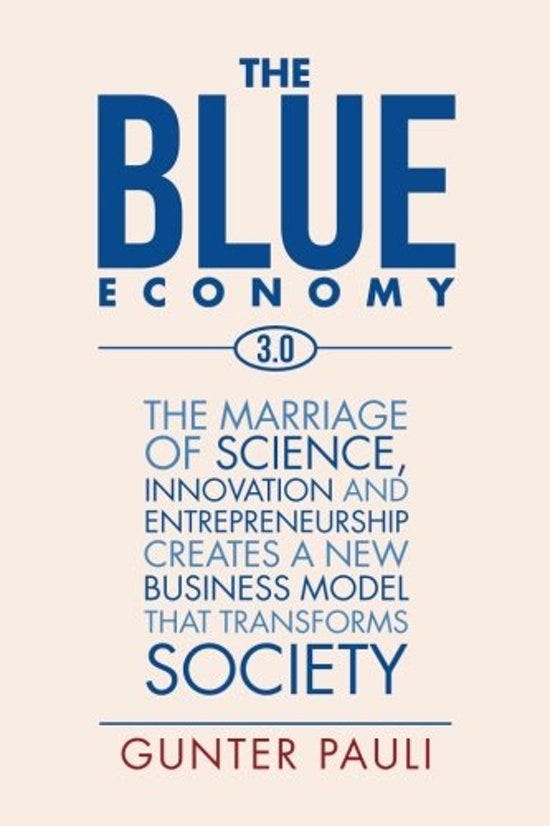
I must honestly say that the stories I heard and the discussions I had with Gunter and the others in the Blue Economy network, taught me much more than the book itself. But for people who don’t have access to those, the book is a good substitute. Although you might want to watch a lecture…
And I learned a lot from Gunter’s Fables as well. What a wealth of information, packed in fables for children! Gunter just won an award in China for the 200 fables that have already been published in Chinese. Worthy reading for adults as well!
You will learn so much about nature’s technologies and very smart solutions. And afterward, you can share your findings with others. Experiment together! I did it, read about my experience with Gunter’s Fables. It’s fun!
Systems View of Life by Fritjof Capra
Well, The Systems View of Life is my standard in systemic thinking. The book is written by the Austrian-American scientist Fritjof Capra together with Italian Chemistry Professor Pier Luigi Luisi.
A regenerative economy and learning to live as part of nature, not overstepping our planetary boundaries, start with systemic thinking. Capra explains it well and gives lots of scientific contexts.
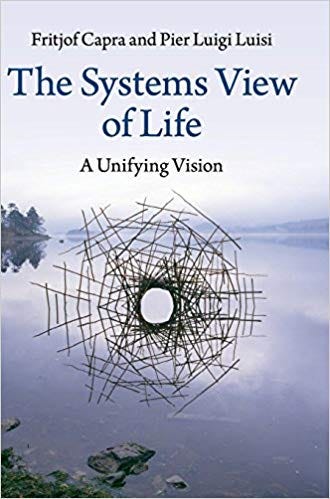
Maybe also nice to know: the cover of the book is an artwork made by Andy Goldsworthy. I got familiar with his work when studying permaculture. Wow! What inspiring land-art he creates!
Soil, Soul, Society by Satish Kumar
My favorite teacher at Schumacher College has been Satish Kumar. His gentle, loving way of teaching has always inspired me. And his morning meditations really opened my heart.
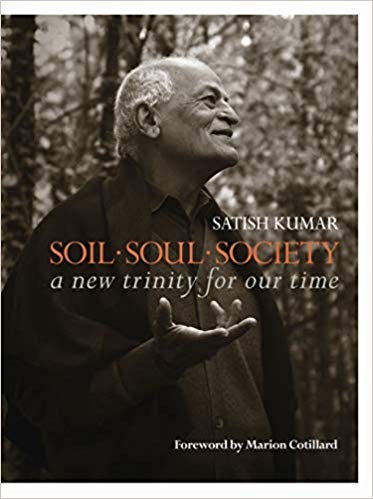
A fireside chat with Satish was always fun and made me think for weeks after. His book Soil, Soul, Society is a great compass in a complex world. He brings the soul back to science and economy.
Drawdown by Paul Hawken
Drawdown is a practical guide for large scale thinking. I like Paul’s approach and the way he opens the discussions about lots of technologies. I also like the roles he sees for ecosystem restoration and for women.
If our new economy has to stay within planetary boundaries, we have to embrace regenerative farming and the creation of abundant resources together with nature.
Doughnut Economy by Kate Raworth
Economic change has two sides: on the one hand, we have to stay within the planetary boundaries. On the other hand, we have to create an economy for basic human needs.
Kate has combined both very cleverly in a doughnut. Doughnut Economics is a good read. It makes you think and is a starting point for finding practical solutions.
Designing Regenerative Cultures by Daniel Christian Wahl
It is not easy to recreate our economy in line with nature. We need a culture change for that. And someone who understands that more than most is Daniel.
His book Designing Regenerative Cultures is an eye-opener, the book is rather philosophical though. He poses more questions than answers, but that’s the whole aim.
Read, think, discuss and reread. We will have to find the answers for ourselves, all of us in our own environments and cultures.
The One Straw Revolution by Masanobu Fukuoka
This is a fabulous book! The One Straw Revolution was written around the time when permaculture also spread the word from Australia. It came from a completely different country, Japan, in a different setting.
But the idea is the same: what if we create circumstances for nature to do its restorative work without too much interference from humans? Can we grow food like this? Can we find ways to recreate nature’s abundance and live from the proceeds?
Read and be amazed. I love this book!
More, more, more
Well, I only mention 7 books this time. Maybe I will write new posts featuring others. There are so many inspiring authors that put me on my path, inspired my transition projects and fired my writing.
So if you want to read what all these books did for my voice, here is some further reading of my own articles.