
Book Review — The Silent Generation by Anthony Stolz
Anthony Stolz gives us a firsthand account of what it was like for Traditionalists (“the Silent Generation”) to persist during and after the harshness of World War II
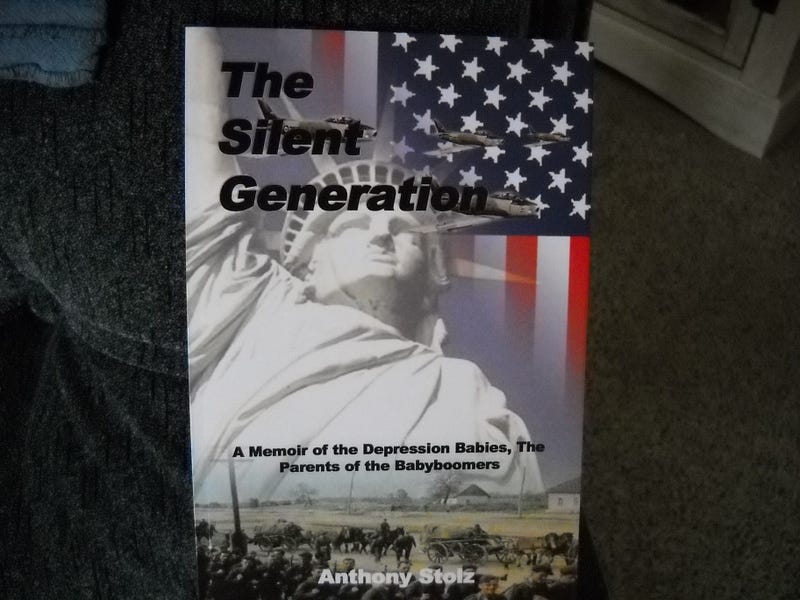
As I keep delving into the rich histories of American generations across these last two centuries, I wanted to give a voice to the third chronological cohort known as “The Silent Generation.” Unfortunately, full-length books of nonfiction that focus on this generation appear to be in short supply.
In 2001, a fairly-innocuous writer named Anthony Stolz published a memoir entitled The Silent Generation: A Memoir of the Depression Babies, The Parents of the Baby Boomers. This short retrospective gives a decade-by-decade rundown of Stolz’s perspective belonging to the group of Americans born roughly between 1930 through 1943. He intersperses his own political opinions with vivid memories of past decades through which he lived.
Members of “The Silent Generation” are often alternately called “Traditionalists” or (Stolz’s preferred term) “Depression Babies.” For ease of reference, I’ll refer to them, collectively, as Traditionalists during a majority of occasions where I need a descriptor for them within this book review.
WHY YOU SHOULD READ THIS BOOK
I’m not going to lie: The author is extremely biased. He wears those biases on his sleeve. Politically, he and I probably disagree on a lot.
But I would still recommend reading this book. If you can filter out Stolz’s own hyperbole and bigotry from the genuine fond memories upon which he is reminiscing, his memoir can provide you with a historical glimpse of the internal struggles with which many Traditionalists (“Depression Babies”) were wrestling throughout their lives.
STYLE / FORMAT
Clocking in at an easily-digestible 90 pages, Stolz keeps his memoir concise and blunt. It’s written in plain, conversational language. There are seven chapters, each focusing on a specific decade ranging from the 1930s to the 1990s. Sandwiching those chapters are a Prologue, Epilogue, and Addendum.
Stolz’s background includes service to the U.S. Air Force where he was a public information officer. He retired from the military in 1956, and his biography alludes to a variety of public- and private-sector professions in which he has worked over the years.
Prologue — in this introductory forward, the author advocates for usage of the “Depression Babies” moniker when referring to members of his generation. He talks about growing up during a time of post-WWI isolationism in America. Most people were geographically immobile, unless you could afford a train ticket. Vehicles became the norm once Sooners began to migrate from Oklahoma to Central California with their rudimentary transportation.
Chapter One — entitled “The 1930s,” Stolz traces back the start of the Traditionalist generational cohort to Black Tuesday of 1929. This was when the stock market crashed, and the Great Depression would come to define the Silent Generation’s childhoods and adolescences. Historically, Traditionalists’ parents (the Hemingrebels) had been living it up throughout the 1920s. Their hedonism was triggered by the constitutional enactment of Prohibition (through the Eighteenth Amendment) in 1920, which persisted for the next thirteen years. Traditionalists’ older siblings, the GI-Gens, had been born as women’s suffrage was converging to realize the passage of the Nineteenth Amendment in 1919. Meanwhile, Europe throughout the 1920s and 1930s gave rise to tyrants such as Hitler, Lenin, Franco, and Mussolini.
Aside from farm families, few children were produced by the younger Hemingrebels or the older GI-Gens. Stolz reminds us how these low birth rates account for why Traditionalists consist of a lesser population compared to the generations who surround them. Infantile paralysis was also a factor that prevented many Depression Babies from living full lives into adulthood. These conditions, he points out, motivated younger GI-Gens and Traditionalists of all ages to have lots of children — resulting in the massive Baby Boomer cohort. Traditionalists only had the faintest memories of most severe supply shortages endured by the previous generations in those years immediately following Black Tuesday; their own parents told them these harrowing tales. The clothes provided to the Depression Babies were functional as hand-me-downs. These kids enjoyed war movies, which gave them a visual glimpse of their own parents’ and grandparents’ past travails. Stolz recalls how radio became extremely popular, while print newspapers flourished and phonographs (record players) were still used.
Chapter Two — entitled “The 1940s,” the author narrates how things changed as he approached puberty. Stolz remembers his father being called away by the Navy on the day Pearl Harbor was bombed, as their family was stationed in Honolulu at the time. He describes practicing air raids in and out of school. Kids would play war games with each other, while military families waited on pins-and-needles for news of any fatalities amongst their deployed loved ones. He recounts the Death March on the Filipino province of Bataan. Stateside, blackouts caused shortages of batteries and candles. Wartime gasoline, butter, and bacon were rationed, although some dairy farmers exploited the shortages in order to enrich themselves. Flour, sugar, rice, and fresh produce were virtually nonexistent — accounting for why Victory Gardens became so popular.
Stolz fondly reminisces about the exquisite flavor and crunch of freshly-grown produce from right out of folks’ Victory Gardens. Rabbits trapped in one’s backyard as well as homemade root beer became domestic delicacies. Pickling grew in popularity, and cooks sought out substitutes for sugar. He also criticizes the isolation and pacifism found in U.S. foreign policy across the 1930s. Once World War II forced innovation, America began manufacturing cargo ships and submarines. Everybody would be huddled around their radios listening to war reports. Traditionalists, he says, are the generation that refuses to allow younger people to forget how necessary they viewed the atomic bomb as being, in terms of ending World War II. As Traditionalists got older, they married too early and thus incurred high rates of divorce. Mass housing became popular, but racial segregation was still widespread. These life circumstances accounted for why Traditionalists were trained to be so obedient — going along with the status quo as they refrained from challenging authority.
This is the chapter in which Stolz’s own personal anger becomes very evident. First, he embarks upon a rather “Get-Off-My-Lawn!”-style stream-of-consciousness about how meanings of words change over time. Then, he expands that commentary to berate changes in product affordability, gender roles, and pop culture trends. Yet, he speaks with nostalgia about how his own generation experimented with exploratory sexual play throughout their youth.
A little later in the chapter, Stolz takes potshots at the beatniks (including Tom Brokaw) — yet, he seems to regard prostitution and underage drinking with fondness and amusement. He also casually drops the N-word in passing; but he does acknowledge the importance of Juneteenth in black culture, which so often was overlooked during the aughts.
Chapter Three — entitled “The 1950s,” Stolz channels the dismay that he and his fellow Traditionalists felt as they watched the horrors of World War II poised to be repeated by those of the Korean War. He indicts President Harry Truman for getting us into the Korean conflict, and praises President Dwight Eisenhower for getting us out of it. Stolz follows that up by bashing Presidents John F. Kennedy and Lyndon B. Johnson for embroiling America in the Vietnam War while lauding President Richard Nixon for withdrawing from it. He also condescends younger readers for supposedly being ignorant to the reality that there was a time when students could flunk out of school. Stolz excoriates President Bill Clinton for being a draft dodger. He disingenuously paints all Democrats as racist by pinpointing Dixiecrat Orval Faubus’s pro-segregation stance.
Amidst these glorified political rantings, he reflects on some more objective memories — such as how football rose to prominence amongst Depression Babies who were teens and young adults during the 1950s. Baseball made a comeback, seeing how so many players had been drafted during World War II and the Korean War. He also praises the surge in jazz music and comics during this period, while recalling how fraternity parties gave young adult Traditionalists the chance to blow off some steam…even though their GI-Gen elders viewed fraternities and sororities as silly and stupid. Adults, including Stolz’s own father, hid pornography and erotica due to a “Victorian hangover” from which they were suffering.
But then, Stolz shifts back into a combative mode. He objectifies LGBT+ people for taking over the arts scene. He boasts about America having held Communism at bay. Additionally, he describes U.S. Senator Ted Kennedy as a lascivious precursor to Bill Clinton, while gratuitously slamming Chelsea Clinton as “pitiable.” With much hubris, Stolz praises his own generation for having done what they were told. He extols virtues of obedience, education, military service, career, marriage, procreation, and keeping oneself from rocking the boat.
Chapter Four — entitled “The 1960s,” the author expands his social commentary by insulting the image of hippies and other counterculture movements. He glibly refers to environmentalists as “eco-nuts” for referring to jungles as “rainforests.” Stolz expresses how U.S. involvement in Vietnam should have been a cautionary tale based on the failures of the French when challenging the Vietcong on their home turf. He accuses Kennedy of meddling in Vietnam, which he believes enabled Johnson to drag his feet on authorizing the air raid bombings of North Vietnam. This, maintains Stolz, made the U.S.’s position unwinnable by that point.
Electorally, he observes how Traditionalists rewarded Nixon for beginning the U.S. withdrawals from Southeast Asia. While antiwar Traditionalists largely stayed out of the actual protests, they made their displeasure known at the ballot box. Stolz berates Woodstock as an avatar for dropouts and depravity, flaying these cultural elements for the spread of drugs and promiscuity. He abhors the Baby Boomers’ liberal usage of obscenities around their elders (GI-Gens and Traditionalists) — viewing the Boomer generation as enjoying a privileged youth that they took for granted.
While I agree with Stolz’s assessment of Johnson’s folly in botching up the Vietnam War, this chapter makes it clear how the author is just looking for every excuse he can find to blame Democrats and young people for all of the cultural shifts that he came to loathe.
Chapter Five — entitled “The 1970s,” Stolz chronicles this period as a time when Traditionalists quietly moved into political power positions. As adults, Depression Babies reversed the dearth of children from the WWII era — spawning a plethora of Baby Boomers through procreation. Also, he points out how the absence of birth control made pregnancies difficult to control when compared to later decades. Abortion had been illegal during both World Wars.
He goes on to praise GI-Gens for getting America through the turmoil of war and nuclear standoffs. Stolz engages in some more bashing of JFK’s Camelot and LBJ’s Great Society. One area where I do agree with him is pointing out the hypocrisy of the Gore family in terms of the racism upon which they’d built their tobacco business. However, Stolz makes himself sound like a hypocrite when he slaps Republicans on the wrist as being merely “stupid” for letting Watergate happen. He skips over to hyperbole through which he paints a caricature of Democrats zealously trying to find shallow excuses to hound Nixon from office. Then, he accuses Hillary Clinton of stonewalling and destroying evidence during Watergate. He takes aim at Bernie Nussbaum’s role in Whitewater…and Elizabeth Holtzman for purportedly planning a coup intended to replace President Gerald Ford with Carl Albert (Speaker of the House, at the time).
The underlying framework for Stolz’s historical portrayal appears to be boiled down to a lazy binary of “Republicans are saviors, Democrats are evil!”
Chapter Six — entitled “The 1980s,” the author opens the chapter by expressing his hostility about how — while his GI-Gen heroes Ronald Reagan and George H.W. Bush served honorably (from his perspective) — Republicans “skipped over” the Traditionalist generation by selecting Dan Quayle (a Baby Boomer) as Bush’s vice-presidential running mate. Stolz would have preferred Jack Kemp, Donald Rumsfeld, Bill Ruckelshaus, or any number of other long-serving Traditionalists being appointed as Bush’s righthand man instead of Quayle. He theorizes that this perceived snub may have caused Republican-leaning Traditionalists to decamp to Ross Perot — or simply refrain from voting, altogether — during the 1992 Presidential Election.
He rattles on about how he doesn’t feel that Baby Boomers earned their privileges. He accuses them of immersing themselves in materialism, having avoided the draft by virtue of their birthyears. He views Boomers as largely rejecting marriage. In retrospect, Stolz’s animosity toward Baby Boomers seems to mirror the animosity that many present-day Baby Boomers harbor toward Millennials and younger GenXers.
Chapter Seven — entitled “The 1990s,” Stolz caps off his temporal excursion by crediting Reaganomics for saving the economy as the millennium wound down. He claims that Robert Rubin persuaded Clinton to “stay out of the way” and let Reagan’s economic policies thrive. The Republican Revolution of 1994, he insists, paved the way for the economy to be supercharged once capital gains taxes were cut. He believes that real estate being freed up was what allowed assets to be reinvested in new wealth.
Stolz dismisses Baby Boomers as enjoying the fruits of those labors — projecting that the Boomers’ own Xer and Millennial children are poised to reap even greater benefits. He ends the chapter with an anecdote alleging that Baby Boomers are irresponsible parents raising unruly Millennial children.
Epilogue — wrapping up the book, Stolz tosses in some more invective and ad hominem attacks against Bill and Hillary Clinton. He blames Alan Greenspan for mismanaging interest rates, while crediting Neil Howe and William Strauss with coining the term “Millennials” to refer to the children of Baby Boomers. Stolz predicts that Millennials will have tons of children, thriving and succeeding in life where he views Baby Boomers as having failed.
Then, he ends the book by denying climate change.
Addendum — in a post-9/11 footnote, Stolz declares how Baby Boomers are now the ones we’re counting on to defeat Islamic terrorists. He praises George W. Bush as being well-positioned to serve as their leader in that endeavor. He also gives accolades to Bush’s pick of Rumsfeld (a fellow Traditionalist) to be U.S. Secretary of Defense.
Although this book was written more than 20 years ago, Stolz’s narration offers us a time capsule of what many people from his generation were thinking and feeling, at various points in time, regarding their place on the age spectrum. Obviously, the paleoconservatism displayed by Stolz won’t be reflected in all Traditionalists. Otherwise, we never would have seen folks such as Jane Fonda, Muhammad Ali, Carole King, and Allen Ginsberg step forward to speak their truths.
Similarly, Stolz’s dislike of Baby Boomers and aggrandizement toward Millennials didn’t age well. First, his prediction proved to be wrong. Baby Boomers — along with many other generations, young and old alike — have weaponized an ageist narrative against Millennials, making us persona non grata amidst pop culture trends. Furthermore, the wealth gap has intensified — hurting Baby Boomers, GenXers, Millennials, and Zoomers collectively.
So much for the durable romanticism of Reaganomics!
I’m no fan of the Clintons and the Gores (or LBJ, for that matter), but a majority of the author’s specific gripes about them are starkly misplaced. When Stolz isn’t dwelling on his poisonous sentiments toward his political opponents, or people whose priorities are different from his, or concepts that he just simply doesn’t understand — his reflections can be valuable if viewed in a historical context.
But you have to filter through the rhetorical dung in order to locate the teachable takeaways from amongst Anthony Stolz’s diatribes.
Click here to subscribe to my stories.


