
Book Review — The Greatest Generation by Tom Brokaw
Tom Brokaw pens a tribute to the patriotism and sacrifice of GI-Gens (“the Greatest Generation”) who kept America afloat as World War II persisted
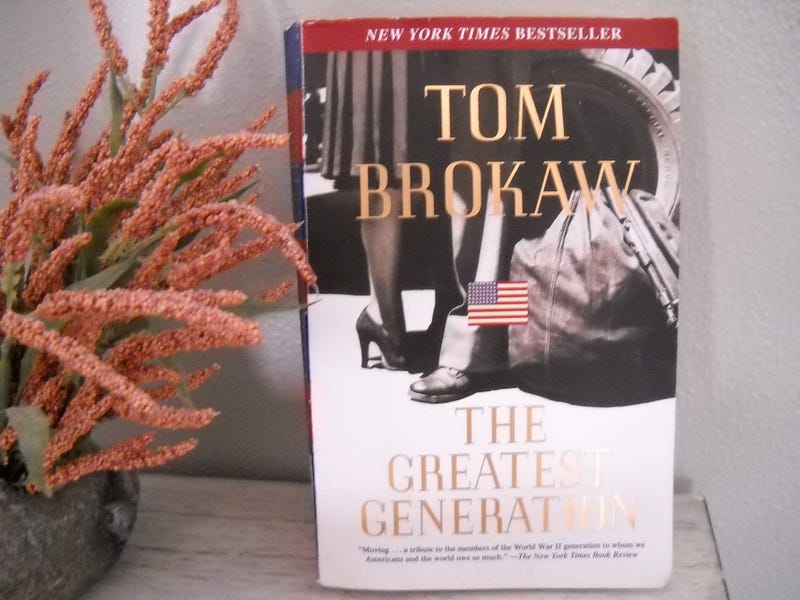
Continuing my academic survey of America’s named generations, I decided to explore the second chronological cohort known as “The Greatest Generation.” I figured there was no better way to delve into this historical period than by reading the original book that established their place along the generational spectrum.
American journalist Tom Brokaw authored The Greatest Generation, a 1998 anthology that honors so many members from this group of Americans born roughly between 1907 through 1924. Most of his subjects appear to have been still-living Americans when he’d interviewed them at the time of the book’s original publication; obviously, a majority of them have died throughout the quarter-century that has passed.
I’ve dubbed members of “The Greatest Generation” as “GI-Gens” or “Great Goldens.” For ease of reference, I’ll refer to them, collectively, as GI-Gens during a majority of occasions where I need a descriptor for them within this book review.
WHY YOU SHOULD READ THIS BOOK
If you are into World War II history, this book is definitely for you. Even if you aren’t, there’s still plenty to learn — as Brokaw’s narrative oscillates between wartime events, homefront activities, and experiences that GI-Gens lived through in the latest years of their lives.
Brokaw includes quite a few famous American historical figures — including George H.W. Bush, Julia Child, Bob Dole, Norman Mineta, Andy Rooney, Caspar Weinberger, and Arthur Schlesinger. But he also gives a voice to the brave soldiers and citizens who were never household names across the 1940s and beyond.
Do you feel moved to honor their legacies? Reading this anthological compilation is a small way in which we can value their livelihoods.
STYLE / FORMAT
Not counting the index, Brokaw’s massive anthology is 390 pages in length. He divides its body into eight thematical sections. Each section contains anywhere from 2–9 chapters. A majority of these chapters are focused on one individual — either a famous GI-Gen, or a much more obscure Great Golden. Some chapters are combined to jointly feature two or three individuals who share some common trait.
There are also Preface, Acknowledgments, and Prologue sections planted right before the main 43 chapters. Brokaw appears to provide this introductory material so he can justify why he has dubbed the GI-Gens as “the Greatest” of all generations.
Prologue — entitled “Generations,” the author recounts how, before becoming a journalist, he’d been oblivious to everything the GI-Gens gave to us. Through his research, he came to appreciate their generation. Brokaw reflects on his and his wife’s childhood memories, and how they differ from the childhoods, adolescences, and young adult years of the GI-Gens who’d weathered the Great Depression.
The presence of global warfare and economic collapse prevented GI-Gens from enjoying the same decadence as the Hemingrebels had. Instead, out of necessity, they toiled in the sciences, manual labor, and education. GI-Gens (and Brokaw himself) would come to have mixed views about the hippie culture forced by the younger Traditionalists (“Silent Generation”) and oldest Baby Boomers. He summarizes this with a smattering of personal stories told by individual military veterans whose testimonies illustrate why Brokaw believes, indeed, this generation was “the greatest.”
Chapter One — entitled “The Time of Their Lives,” Brokaw reflects on his generational perspective as a younger Traditionalist. The GI-Gens preceding his own generation witnessed their economy crushed as they entered puberty or their mid-teens. He talks about his own parents’ childhoods during the Depression, which created an era that redefined societal roles for women and required constant sacrifice from everybody.
Chapter Two — entitled “Thomas & Eileen Broderick,” the author opens his section on “Ordinary People” by profiling this married couple: Tom, a Merchant Marine who joined the Airborne, became blind during battle, learned Braille, and started his own insurance firm; and Eileen, a nurse who had five children with Tom. They co-founded the Blinded Veterans Association and mentored other military families struggling with similar challenges — all the while, preaching the value of personal responsibility.
Chapter Three — entitled “Charles O. Van Gorder, MD,” Brokaw introduces us to an Army Captain who helped to spearhead the earliest M.A.S.H. units in Normandy during D-Day. Gorder became a P.O.W. in 1944 but managed to escape into Poland. After the war, he moved to the Smoky Mountains where he started a small clinic, and later, a hospital.
Chapter Four — entitled “Wesley Ko,” the author showcases this American of Chinese descent who became an Army platoon leader while modeling honesty for his comrades. After being promoted to Captain, he helped to liberate the Wöbbelin concentration camp. Following the war, Ko refused to declare bankruptcy upon getting entangled with a bad loan that caused his printing plant to be shut down.
Chapter Five — entitled “James & Dorothy Dowling,” Brokaw profiles this married couple who survived the rigors of war together. James was an orphaned child who grew up to become an Air Force pilot. After being released from a Nazi P.O.W. camp where he was imprisoned for eight months, James organized Little League teams and became his town’s local superintendent of highways. Dorothy never gave up on her faith that her husband would someday return to his family and community.
Chapter Six — entitled “Rev. Harry Reginald ‘Reg’ Hammond,” the author tells us the story of a grocer who transitioned from Army hero to education administrator. Eventually, Hammond entered the Diocese and, at the age of 79, became the oldest ordained priest in the Anglican Orthodox Church.
Chapter Seven — entitled “Lloyd Kilmer,” Brokaw gives us a glimpse of this bellhop who became a combat pilot, soon subjected to ten months in a P.O.W. camp. Kilmer had a distant relationship with both of his Baby Boomer sons, as they relished excess while Kilmer conducted himself with stoicism and was just thankful to be alive. His postwar experience was a result of having bottled in his lingering trauma.
Chapter Eight — entitled “Gordon Larsen,” the author reveals the merits of a Marine who served in the Pacific Theater, having watched his own brother, Jim, gunned down at Guadalcanal. After the war, Larsen became an electrician and utilities technician. He treats his friends like family, staying true to the virtue of loyalty. He believes patriotism has been lost on the younger generations.
Chapter Nine — entitled “John ‘Lefty’ Caulfield,” Brokaw spotlights the founder of ROMEO (Retired Old Men Eating Out), a group of comrades who’d enlisted in the military when they came-of-age. This brotherhood consists of predominantly Irish-Catholic Democrats who grew up in poverty or working-class households. Caulfield himself became a teacher and a principal following his military service. The men of ROMEO all agree with the common goals of sharing camaraderie, obedience, affection, creativity, and personal responsibility.
Chapter Ten — as his section entitled “Home Front” begins, the titular chapter “Charles Briscoe” sees the author narrate the life of a mechanic who grew up during the Dust Bowl to a Kansas farming family (“the fix-it generation”). He went to work for Boeing, moving from the airplane assembly line to its tool-design department. Caulfield was key in developing the B-29 long-range airplane and the Boeing 737. Later in life, he worked as a house flipper — drawing upon the past necessity of experimenting without FAA approval.
Chapter Eleven — entitled “Dorothy Haener,” Brokaw features a woman who, after being laid off from her job as an airplane factory inspector, rose through the ranks of the UAW (United Automobile Workers) and eventually co-founded NOW (National Organization For Women). Haener was a pioneer in fighting for gender equality in terms of fair wages and hiring practices.
Chapter Twelve — beginning with his section entitled “Heroes,” the author dedicates his “Bob Bush” chapter to a Naval officer who lost an eye in Okinawa while assisting a wounded Marine. Bush learned how to manage his disability in postwar life, building a successful family lumber business.
Chapter Thirteen — entitled “Joe Foss,” Brokaw pays tribute to a fighter pilot and Marine who eventually became Governor of South Dakota. Foss served as a personal mentor to Brokaw during the author’s participation in Boys’ State. The maverick governor weathered a divorce after one of his children suffered from polio and another of his children was diagnosed with Cerebral Palsy. Despite losing a 1958 U.S. House race to George McGovern, Foss became Commissioner of the AFL (American Football League). After surviving arsenic poisoning, he embraced born-again fundamentalism.
Chapter Fourteen — entitled “Leonard ‘Bud’ Lomell,” the author profiles a veteran born into poverty who supported himself on an athletic scholarship and in blue-collar jobs until he enlisted in the Army. Lomell served in Germany, watching his comrades get massacred — and ultimately attaining the rank of Army Ranger. He used the G.I. Bill to attend law school, started his own legal practice, and embraced philanthropy and mentoring. He and his wife, Charlotte, viewed each other as equal partners; they were married on the two-year anniversary of D-Day.
Chapter Fifteen — initiating a section called “Women in Uniform and Out,” Brokaw jointly dedicates a chapter to “Colonel Mary Hallaren / General Jeanne Holm.” An adventurous soul who spearheaded advocacy for other women who wanted to enlist, Hallaren was the first American woman to attain the rank of Colonel in the Army. Although she hit the glass ceiling, Halleran became a key leader and organizer for WICS (Women in Community Service). Holm rose to the rank of Major General in the Air Force. Like Halleran, Holm also lobbied for gender pay equity, advocated merit-based promotions, and combated sexual harassment. Ultimately, Holm served as a policy adviser in the Ford administration.
Chapter Sixteen — entitled “Marion Rivers Nittel / Claudine ‘Scottie’ Lingelbach / Alison Edy Campbell,” the author introduces us to three incredible women who kept the home fires burning. Rivers worked at a supply factory to prepare military care packages; she became a technical writer with a fondness for patriotism and family. Lingelbach joined the Navy WAVES (Women Accepted for Volunteer Emergency Service) auxiliary, later going to work for the Joint Chiefs of Staff where she requested to attend the D-Day press conference. After her husband died of melanoma, Lingelbach became a civics teacher, and later, a real estate agent; she mourns the breakdown of the family unit in subsequent decades. Campbell was born into affluence, but became a shipyard supervisor for oil tanker construction. After her husband left her, she went to work for IBM. Campbell’s greatest beef with younger generations is an overreliance on materialism.
Chapter Seventeen — entitled “Margaret Ray Ringenberg,” Brokaw showcases one of the first female pilots for WASP (Women Airforce Service Pilots). She worked around the glass ceiling by becoming an instructor pilot. Upon the Japanese surrendering to Allied Nations at the end of World War II, Ringenberg was tasked with dropping leaflets over Fort Wayne, Indiana via airplane. She also competed in the Powder Puff Derby’s around-the-world flight.
Chapter Eighteen — entitled “Mary Louise Roberts Wilson,” the author tells us about the life of an operating room nurse who eventually joined the Army Nurse Corps. She assisted medics treating soldiers in Italy while constantly under siege from Nazi troops. Wilson was the first woman to receive the Silver Star, and she accepted it on behalf of everyone who’d collaborated within her profession.
Chapter Nineteen — with a new section entitled “Shame,” Brokaw’s chapter on “Martha Settle Putney” gives us a glimpse into the work of a member of the Army’s Women’s Auxiliary Corps who helped to racially and sexually integrate facilities which included housing, swimming pools, and bands. She used the G.I. Bill to become a history professor at Bowie State College and Howard University where she gained a reputation as a tough grader with high standards.
Chapter Twenty — entitled “Johnnie Holmes,” the author reveals the life journey of a patriotic Army enlistee who endured racial segregation and racist abuse — including threats of being guarded by German P.O.W.s. He befriended Jackie Robinson before the baseball superstar was famous. After the war, he returned to his hometown of Chicago where he worked as a machinist and a civil servant. Later, his experiences as a landlord drove Holmes to loathe welfare and speak out against the Holocaust.
Chapter Twenty-One — entitled “Luis Armijo,” Brokaw spotlights a biracial American raised in an Apache-Basque household who grew up learning skills such as herbal medicine, horseback riding, and animal tracking. As an adult, Armijo became an aviation communication specialist in the Air Force. Subsequently, he taught high school business courses and was beloved by his students. Armijo believed in the four-winds approach to teaching, expressing criticism of younger teachers whom he viewed as abandoning too many formalities.
Chapter Twenty-Two — entitled “Nao Takasugi / Norman Mineta,” the author features two survivors of Japanese internment camps as a result of Executive Order 9066. Takasugi’s family initially was imprisoned at California’s Tulare County Fairgrounds, later shipped off to a relocation center in Arizona where some Quakers helped Takasugi get accepted into Temple University. After furthering his education at the U-Penn Wharton business school, he still couldn’t get hired anywhere due to his race. The Takasugis, meanwhile, were fortunate enough to have their family store cared for by a friend named Ignacio Carmona during their absence. Despite the adversity he faced, Takasugi was elected to the Oxnard City Council, then as Mayor of Oxnard, and finally as a member of the California State Assembly. He was instrumental in getting reparations passed to benefit the survivors of WWII internment camps. Mineta, on the other hand, was technically a member of the Traditionalist (“Silent”) generation when his family was interned at a camp during his boyhood. When they were youngsters, an imprisoned Mineta befriended future U.S. Senator Alan Simpson. Following release, Mineta himself became both city councilman and mayor within San Jose, then was elected to the U.S. House of Representatives. One of Mineta’s most notable congressional accomplishments was joining with Spark Matsunaga and Daniel Inouye to secure reparations through the Civil Liberties Act of 1988.
Chapter Twenty-Three — debuting his section entitled “Love, Marriage, & Commitment,” Brokaw dedicates a chapter to “John & Peggy Assenzio,” a married couple who exchanged their vows one month after the bombing of Pearl Harbor in anticipation of John’s deployment to the Pacific Theatre. John has vivid memories of touring the wreckage following Hiroshima’s atomic bombing. One particular occurrence that sticks out for him was having been invited to tea at the local home of a Hiroshiman postmaster, even though they’d been global enemies only months earlier. Peggy was a schoolteacher who wrote to John once per week while he was abroad; they shared the ideals of being pro-discipline and anti-divorce.
Chapter Twenty-Four — entitled “The Dumbos,” the author pays tribute to Brokaw’s own mother-in-law and three of her friends who formed a network of military wives waiting for their husbands to return from overseas during World War II. Once the husbands’ respective tours-of-duty ended, the group continued as a dinner club of married couples who also hosted monthly Bridge games. Eventually, they expanded to support each other’s extended families via community improvement projects, vacations, birthdays, and holidays. This network ended up mirthfully christening themselves as “The Dumbos” because they wanted a moniker that rhymed with “jumbo” (which described their approaches to life).
Chapter Twenty-Five — entitled “Gaylord & Carrie Lee Nelson,” Brokaw profiles another married couple who went on to accomplish amazing things together. Carrie, who’d admired Amelia Earhart and Alice Marble when she was young, met Gaylord on a double date. Initially, they didn’t click. But, by chance, they would each end up stationed in Okinawa (Carrie as a nurse, Gaylord as an Army soldier) where they fell in love while serving their country. Once Gaylord became Governor of Wisconsin and a U.S. Senator, Carrie brought some maverick spunk to the political spousal circles of Madison and D.C. Throughout it all, the Nelsons never lost confidence in one another.
Chapter Twenty-Six — entitled “Jeanette Gagne Norton / Daphne Cavin,” the author introduces us to two WWII women who persevered in the face of extreme hardship. Norton became a single mother and widow after losing her husband, Camille, to battle as World War II wound down. Then, she lost her second husband, William, to a heart attack in 1993. Cavin was a beautician who likewise lost her first husband, Raymond, to the war; her second husband, Marvin, died of cancer. Cavin’s sister later found a scrapbook of Raymond, and some local teenagers from their town photographed Raymond’s final resting place when they traveled to France as part of a school trip.
Chapter Twenty-Seven — in his penultimate section entitled “Famous People,” Brokaw’s chapter “George H.W. Bush” showcases the forty-first President of the United States. Bush had traditionally been humble and evasive in terms of disclosing his wartime experiences as a combat pilot. But he was willing to open up to Brokaw, being candid about how he viewed his service as both an honor and an obligation. One of the military tasks that had the greatest impact on Bush was when he’d been assigned to read through the postal mail that deployed soldiers would receive from their loved ones.
Chapter Twenty-Eight — entitled “Ben Bradlee,” the author tells us about the renowned journalist’s Navy commission, upon which Bradlee embarked as soon as he’d received his college diploma. On the same day as his university graduation, he also got married. Bradlee’s service in “The Slot” amidst the Pacific Theater prepared him with leadership skills that he would later utilize to monitor the journalists who ended up blowing the lid off of the Watergate scandal.
Chapter Twenty-Nine — entitled “Art Buchwald,” Brokaw gives us a glimpse into the editorial humorist’s salad days of dealing with antisemitism while serving in the Marines. Buchwald navigated those treacherous waters by priding himself on being a “proud asshole” who would subsequently study journalism at USC. That set the stage for Buchwald to receive his international column, Paris After Dark, which made him into a steward for other celebrities and an American national treasure.
Chapter Thirty — entitled “Andy Rooney,” the author reveals how the renowned journalist takes issue with Brokaw’s own contention that GI-Gens are superior to all earlier and later generations. Rooney felt modest about how he’d crossed over from privilege to patriotism while serving as an Army reporter for Stars and Stripes. He was there on the last day when Allied troops landed on Normandy and liberated Paris (where he stood shoulder-to-shoulder with Ernest Hemingway himself). Rooney rebuts the myopia of military loyalists and credits the Army with teaching men how to challenge authority and improvise.
Chapter Thirty-One — entitled “Julia Child,” Brokaw spotlights the world-famous chef, who started out as an advertising copywriter. As a young adult, Child was denied her request to enlist in WAVES because they claimed she was too tall in height. Eventually, she was deployed to Bombay as a clerk for the O.S.S. (Office of Strategic Services). Child credits the military for saving her from alcoholism, although she doesn’t draw much insight from how her overseas service segued into her destiny as a culinary icon.
Chapter Thirty-Two — entitled “Gertrude Belle ‘Trudy’ Elion,” the author features this teenaged prodigy who confronted misogyny as she pursued her career as a young scientist; in due time, she partnered with George Hitchings for lab research. Together, they developed cancer-blocking drugs as well as treatments for arthritis, AIDS, cold sores, leukemia, and kidney stones. Elion became a mentor to other female scientists, and she and Hitchens eventually won a Nobel Prize that they shared in 1988. She reflects upon how the dearth of male workers on the homefront during World War II gave her an opening to collaborate with Hitchings and alter her career trajectory.
Chapter Thirty-Three — entitled “Chesterfield Smith,” Brokaw pays tribute to the great legal mind who served in the National Guard (including at the Battle of the Bulge) across Europe during World War II. He went to law school under the G.I. bill and became a legend amongst the pro bono world of Florida legal services. Smith heavily diversified Florida’s legal community; but, perhaps most famously, he spearheaded the movement to hold President Richard Nixon accountable and push for an independent counsel to investigate the Watergate allegations against Nixon, which forced the thirty-seventh president to resign.
Chapter Thirty-Four — entitled “Al Neuharth / Maurice ‘Hank’ Greenberg,” the author profiles two successful businessmen who each came from rural backgrounds. Neuharth grew up poor in rural South Dakota, served in the Army under General Patton in Germany, and returned home to study journalism. His weekly sports newspaper went belly up, but Neuharth persisted by completing successful tenures at The Miami Herald and The Detroit Free Press. He helped to revolutionize the Gannett media chain before founding USA Today. Neuharth’s secret to success was defying conventional wisdom and the establishment. Greenberg was raised by Catskills farmers, enlisting in the Army where he served during D-Day’s first wave. Then, he became a military defense attorney during the Korean War. When his service ended, Greenberg propelled AIG into a billion-dollar insurance juggernaut. He credits discipline, loyalty, and focus as being the keys to his success.
Chapter Thirty-Five — Brokaw’s final section entitled “The Arena” has its first chapter take a glimpse at “Mark Hatfield,” a popular Oregon politician. He was originally a Navy wave commander; his tours at Iwo Jima and postwar Hiroshima had a profound impact on him. After being elected to the U.S. Senate, Hatfield opposed the Vietnam War, was a critic of nuclear proliferation, lambasted President Ronald Reagan’s decision to invade Grenada, and refused to support either the Gulf Wars or the Bosnian War. His stark independent streak landed him a prominent spot on Nixon’s infamous enemies list.
Chapter Thirty-Six — entitled “Bob Dole,” the author showcases the 1996 Republican presidential nominee, who suffered permanent damage to his arm while stationed in Italy as a Second Lieutenant. While recovering, he shared a hospital ward with future colleagues Daniel Inouye and Philip Hart. Dole held the conflicting views of advocating for more governmental assistance on behalf of Americans with disabilities while simultaneously trying to reduce the government’s role in poverty-based social welfare programs. He was known for chiding protestors during the Vietnam War, and this weakness perhaps hobbled him when trying to connect with younger voters while running against incumbent President Bill Clinton. Ironically, only a handful of years after defeating Dole, Clinton would go on to award him the Congressional Medal of Honor for Dole’s role in bringing D.C.’s World War II Memorial to fruition.
Chapter Thirty-Seven — entitled “Daniel Inouye,” Brokaw tells us the life story of the third person elected to the U.S. Senate from the state of Hawai’i. At the age of 17, Inouye helped the Red Cross tend to casualties at Pearl Harbor. Even after being declared as an “enemy alien,” he enlisted in the Army where he served in an all-Japanese regiment. Enduring a shattered arm during battle, Inouye befriended future colleague Bob Dole who would inspire Inouye to run for Congress himself. Whether it was dealing with Watergate, Iran-Contra, or Japanese internment reparations, Inouye maintained a reputation for being fair-minded and even-handed amongst a gallery of congressional peers who weren’t always on the same page as him when it came to their public conduct.
Chapter Thirty-Eight — entitled “Caspar Weinberger,” the author gives us a glimpse into the early life of this Renaissance man. In college, he wrote anti-FDR pieces for The Harvard Crimson where he was critical of progressive labor policies. Serving in the Army, he was mentored by Douglas MacArthur. In his later years, Reagan appointed Weinberger as his Defense Secretary where he championed the Star Wars missile defense program. He was pardoned by the senior President Bush for congressional perjury, and thrived with a post-administrative career as an editor for Forbes magazine.
Chapter Thirty-Nine — entitled “Lloyd Cutler,” Brokaw reveals what drove another of the Twentieth Century’s great legal minds. From a very young age, Cutler was mentored alongside of his patrician family by Fiorello LaGuardia, Philip L. Graham, and J. Edgar Hoover. He first served in the Army, then at the Pentagon — giving him the experience to intercept Axis messages during World War II. In hindsight, Cutler believed dropping the first atomic bomb on Hiroshima was an effective deterrent. Through his work on the Lawyers’ Committee for Civil Rights Under Law, he came to view the federal government as a strong tool that should be better used to combat terrorism and economic greed.
Chapter Forty — entitled “George Schultz / Arthur Schlesinger,” the author spotlights two men who came from affluent backgrounds but went on to become upstanding public figures. Schultz was an athletic kid who earned the rank of Marine Captain, and then attended MIT on the G.I. Bill before advising the Eisenhower, Nixon, and Reagan administrations. By contrast, Schlesinger had a studious passion for history and journalism; he enlisted as an Office of War Information writer, and covered racial strife in the Deep South. Later, Schlesinger taught at Harvard where he mentored a young JFK, which was a precursor to him being invited to serve in the Kennedy White House. Ultimately, Schlesinger became a biographer of the Kennedy family.
Chapter Forty-One — entitled “Ed Guthman,” Brokaw features the life paths of the venerable journalist who was wounded in Italy as an Army Lieutenant. After recovering, he worked for the Stars and Stripes publication, which ignited his passion for investigative reporting. During his career, Guthman won a Pulitzer for exposing the corruption behind the House Un-American Activities Committee. In later years, he worked with RFK, served as a newspaper editor, and taught as a journalism professor.
Chapter Forty-Two — in an epilogue entitled “The Twilight of Their Lives,” the author pays tribute to a handful of additional veterans who shared the commonality of rejecting pity as they lived with their tragic-but-hopeful memories. Brokaw includes a few more anecdotes from individuals, including his own friends. He concludes that World War II spurred racial integration and gender equality. His takeaway from writing the book was that GI-Gens want Americans to care about one another, despite our ideological differences.
Tom Brokaw’s talent as a journalist, historian, and gifted interviewer shines through in The Greatest Generation. Although I side squarely with Andy Rooney in opposition to Brokaw’s claim that the GI-Gens were unequivocally “the greatest” — I can’t deny the reality that they were, indeed, great.
Much like Deborah Cohen’s Last Call at the Hotel Imperial, this is a massive book that would be nearly impossible for anyone to read in just one sitting. Unlike Cohen’s effort, Brokaw’s anthology is nonlinear — if you see individuals about whom you want to read, you can easily skip to any of the chapters Brokaw has dedicated to them.
Brokaw doesn’t dwell for too long on any one person; but he provides enough personal background and documentation about each individual to give us a vivid portrait of her or his life. Although it would have been nice to have read about a broader range of people with more diverse attributes, Brokaw succeeds in conveying the beliefs and social conventions that arose from the minds of Great Goldens as they forged ahead from surviving their exhilarating — and heartbreaking — lived experiences.
Click here to subscribe to my stories.


