
Medium.com vs Blogging Side Hustles in 2023
A deep dive into blogs, Medium.com, SEO, and making money writing online in 2023

I’ve been doing the side hustles of both blogging and Medium.com for a while now. It’s been an interesting (and frustrating) journey on both paths. But it has been very rewarding as well.
I’m now getting some income from both streams. I have a few articles placed #1 on Google for their search areas. I’ve also started building a nice following from the different niches I target.
I wrote this guide for the newcomer that doesn’t have time to waste and wants to focus on either making money through blogging (via affiliate marketing, ads, etc) or on Medium.com through their Medium Partner Program.
Let’s get started!
Medium vs blogging in 2020
I try to cover many topics in this article, with the hope of answering any questions for a beginner.
Let’s take a look at the following:
- What is needed to make a blog successful in 2020?
- How many monthly visits would a successful blog have?
- Do you have to have a niche or can you write about many subjects?
- Can you make money with blogs in 2020?
- How much money can you make with blogs today?
- What is affiliate marketing?
- What kind of social media marketing is better?
- What is SEO?
- What are some of the top blogs today?
- What underlying common factors do all of these blogs have?
- Why are these different than what I see on Medium.com?
Still with me?
You can see what I mean by going down a rabbit hole now! As I mentioned, I’ll give my own take of what I found (without going into many details) and the more useful links with high-quality information.
1. What is needed to make a blog successful in 2020?
This very general question is where I first started, and I’m sure is a popular topic among writers out there on the internet. I came across a lot of information, a lot of articles, and several different bloggers giving advice.
Here are the best blogs I found on the subject of blogging (AKA ‘blogception’):
This is a blog that completely exists to help other bloggers set up their blogs. It’s created by a couple, Alex and Lauren, who claim they went from $0 to $100,000 blog revenue per month in 3 years. Not bad! They have a lot of very useful (and very popular) pages on there about everything blog related. Great source of information.
Here’s one of their great articles for this subject: blogging success
2. https://www.nateliason.com/blog
I came across Nat Eliason through another article on Medium. This guy earned a degree in philosophy and instead of pursuing an academic or professional career, he went traveling and started blogging — a subject all too familiar to myself.
His blog isn’t dedicated to blogging about blogging, however. Which is nice to see. He’s a ‘generalist’ as some people say on Medium. He writes about a lot of different topics. Stuff that I found was particularly useful from him were his articles on how he grew his blog using SEO and other tactics. It eventually led him to create a consulting company out of it due to his success.
Here’s a good starting point for this dude: lifestyle
3. https://www.blogtyrant.com/
There’s a whole team of people behind this website! And a huge amount of information for beginners. Their articles can be pretty wordy and long — be forewarned. Not that I mind that, but some people do. The titles can also be a bit clickbaity — and I’m not a fan of that. Regardless, there is some great information on this website, and there’s a hell of a lot of it.
The team of people is a company called Awesome Motive and it looks like their knowledge resources are quite extensive.
Here’s a good place to begin with them: start here
Takeaway
- Time! — The most common thing mentioned is that it can take years to make a blog successful. There are best-in-class stories where people become successful, but even those take 6–9 months before a lot of traffic.
- Google-optimized content — I saw this phrase time after time, but most bloggers just state it means using SEO properly. For me, the meaning is that successful blogs all answer questions. As in, it’s not the personal stories that bring in the traffic, but that’s what keeps people coming back. It’s the question-answering ability of your articles that brings in volume. This discovery saddened me a bit but started making sense of my lack of success with certain articles.
- Clean and well-organized webpage — Seriously, this is understated here. Go look at Nat Eliason’s blog and see how visually simplistic it is. It’s great to see, almost reminds me of the earlier days of the internet. Several of the top blogs I came across had a similar visually simple style.
- Links upon links upon links — every article, especially the more popular ones, contain links to other relevant work on the website. They also often included links to high page authority websites like Wikipedia or academia (this is for SEO and authority, I would later learn).
- SEO geared articles — This is how the rabbit hole started, and I’ll get into that later. The bottom line, every single article on these websites are written in a Google-search-friendly style. It also means to dumb down your writing a bit to appeal to a wider audience and be quicker to read.
2. How many monthly visits would a successful blog have?
I wanted to know this metric as a place to start with goal setting. I’ve had some days on Medium in the last month here I received almost 1,000 views. I was super excited about it, as just two months ago I was getting about 20. The disappointment came when I realized that about ~800 were views of my comments and not my stories. 🙁
Medium also has a different level of statistics (ex. the most followed person Gary Vaynerchuk only has 300k followers, think of that vs Twitter followers in the tens of millions).
This means I needed to find out what a private blog could get in terms of traffic. And more importantly, what target levels would mean for different levels of success.
I found the most commonly used metric is visits-per-month. Usually, when blogs get to 100,000 visits per month, they can be considered quite successful. I also learned the range can be quite varied in terms of what individual bloggers consider to be a success.
That’s because some made most of their income from email lists, and just use their blog as a landing page. Some others also have very specific niche’s and wouldn’t ever dream of having 100,000 visits a month (nor require it to sell their super-niche stuff).
Here’s one of the better articles I found that explains this subject pretty well. This extensive piece claims that you should be making a passable income if you’ve hit 100,000 pageviews a month. He figures you can make around $3,500 at that level and then goes on to give a lot of advice on how to achieve that. (My not-so-old eyes got strained reading the strange style of this page FYI)
Takeaway
- Aim for 50–100,000 page views per month as a goal to ‘make it’
3. Do you have to have a niche or can you write about many subjects?
This is a subject I’ve been debating about ever since I first started writing heavily on Medium. I’m a person that gets easily bored and thrives on exploring variety. I even had a semi-failed experiment to see which would perform better on Medium.com, niche vs generalist writing.
Even after all these months of being on the lookout for an answer to the subject, all I can conclude is that there is no right answer. Nat Eliason made probably one of the most well thought out posts I’ve found on the subject.
Essentially, there is no answer because it’s up to the individual. And there are pros and cons to niching vs generalizing.
Takeaway
- Niche blogs are easier to monetize and get ranked in Google
- Niche blogs are harder to write in the long-term due to running out of ideas
- Niche blogs are great for applying to businesses or trying to sell specific things
4. Can you make money with blogs in 2020?
Since I left my career last April and was looking for a way to make money on my own, blogging seemed like one interesting area to pursue.
Several friends suggested I try out Medium.com as a hobby to pursue and to potentially make money. I had high hopes! Alas, after almost 3 months on the platform, my income is nowhere near I need to survive off of (without digging into savings). I know now that it takes time, and I have several strategies lined up to slowly increase my earnings and readers on the platform.
It’s also been a really fun hobby to pursue and that’s what keeps me going on it. But the underlying goal is still to make a livable wage at some point, just in case my other side projects don’t work out. So this was a very important question for me to find the answer on since a lot of Medium bloggers recommend having your own website in addition to this.
If you search the subject on Google, this article is one of the most popular. It describes a success story (of course) about how the author is making almost $30,000 a month from his blog now. The caveat (of course) is that it took him 4 years of 14 hour days to get there.
A lot of the other articles I came across on the subject repeat many of the same points as I mentioned in the beginning. You can make money, but it takes a lot of time, consistency, and practice to get there. How much you make will be dependent on your views, your monetization strategies, and if people actually like your work.
Takeaway
- Yes — if you put in the time and effort over the long-term
5. How much money can you make with blogs today?
It’s always nice to hear how much the big players in the industry make, but I’m more interested in seeing what is achievable for the rest of us. I came across two useful resources to answer this question.
The first one is a bit dated, from 2014, but likely still very applicable. It’s based on a survey of 1500 bloggers.
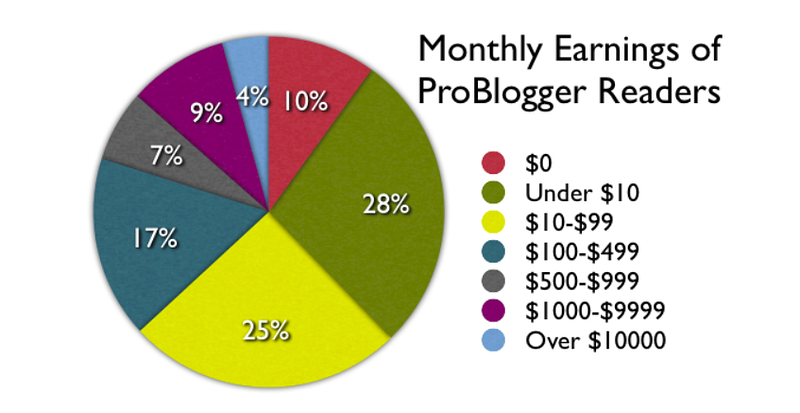
Not huge, but not too disappointing either. The metrics follow similar statistics for many businesses out there, and since we should treat blogging as a business (if you want it to be more than a hobby), this makes sense.
Another resource I found is more up to date and was made in 2019. It’s from a financial service blog writer, which from what I’ve read might be on the high end of earnings due to associated affiliate companies, but it gives a general idea nonetheless.
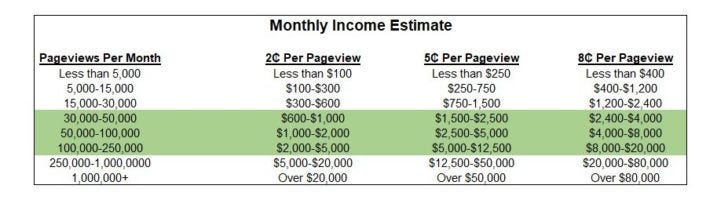
The general idea is that you can earn from $0.01 to $0.10 per page visit if you use affiliate links and display advertisements. At our goal of 50–100,000 visits per month, this equates to a wide range of $500-$10,000 per month.
Takeaway
- $500 to $10,000 per month if you can get 50 to 100,000 page-visits /mth
6. What is affiliate marketing?
Affiliate marketing, the pseudo-evil word that we keep coming across in blogging. It means a product or service company pays a commission to people that drive traffic & sales to their sites.
I haven’t tried it myself (all of the links in this article aren’t affiliate links), but it seems its a must-have for successful bloggers. There’s way too much advice out there on how to do this properly, and I wasted a lot of time looking at information that wasn’t created by experts.
The best article I did find on the subject was by the Create and Go blog. They have a pretty extensive how-to guide on the subject and show you how to get started.
Across many of the better advice sites, the main underlying idea is that if you put your work-quality first and foremost, and only worry about monetization later, then you will be rewarded in the long term.
Also, never forget to disclose that your links are affiliate links. Apparently, it’s illegal in the US not to!
I was also surprised to hear that you can be booted out of affiliate programs if you don’t drive enough traffic to the links. This is a huge rabbit hole on its own and I’ll be diving into it in the future, but I’d rather get my website up and running with some traffic before doing so.
There’s also a lot of different affiliate programs out there! I initially only had heard of Amazon’s affiliate program and didn’t realize there were so many. That same link above goes into more detail about which ones to find.
The important thing is to find programs that are adequate for your level of traffic, and that provide the biggest bang for your link-buck!
Takeaway
- It’s a method to earn commission by driving traffic & sales to businesses
- It’s a major moneymaker for successful bloggers
- It’s legally important to disclose that links are affiliate links
- You can get kicked out of affiliate programs if not enough traffic
- Choose affiliate programs that suit your website traffic and subject
7. What kind of social media marketing is better?
Now that I read more into affiliate selling and that blogs can make money through it in the long term, it was time to see the next step. How do we get to 100,000 visits per month?
So the topic of growth comes up. And damn, that’s a clickbait word if there ever was one these days. After wasting too much time, I decided it was more logical to search about tried and true methods of growing traffic (instead of biting all the worms on the clickbait hooks). There are only so many big social media platforms out there, so it’s a simple enough place to start there.
The main ones I considered in my research were:
A simple list right? Hot damn we got ourselves another rabbit hole for the future. Even with this funneled-down subject, there was still way too much information to consume. I did manage to come up with some key takeaways though, that I found quite interesting.
Many big bloggers don’t bother with social media anymore.
That’s because their SEO optimization and quality of work are enough for their readers to share for them. It’s an interesting point that I found many times. Many still do spend a lot of time sharing every single article.
Which meant I wasn’t surprised when I found that a tool had been made to help with this, called Zapier, something I won’t be using just quite yet, but probably will after my blog is set up and getting some views.
The software allows you to make one social media post and it puts it on all your profiles across the different platforms. A big time saver if that’s one of your marketing methods.
Some big bloggers only use 1 social media platform for promotion.
The pros I saw using this tactic often had really big followings on one of the 5 platforms I mentioned above. It makes sense if you don’t use automation. We only have a certain amount of hours a day, and if you focus on just one platform like Twitter, you can be more efficient.
There’re risks with that of course. If a platform ever goes down, there goes all your hard work of building a following. You’re also limiting your audience to people that use that platform.
Every single blogger had an email list.
The biggest takeaway from which social media advertising bloggers were using was that they all drive traffic to an email list signup. Many of the blogs are geared around this too. Read great, informative articles, then sign up as a ‘payment’. Fair enough.
One common mantra I’ve heard is that email lists are so important because you own them as a blogger. As in, if your blog site shuts down or Twitter goes bankrupt tomorrow, you can create a new blog and attract the same type of people instantly with that list.
The last point for this question is also one that I had ignored before.
Many successful bloggers choose their social media based on their audience.
Have you ever looked at the demographics for the different social media platforms out there? I hadn’t until recently. I just assumed young people use Instagram and the rest of us use Facebook. I was (a bit) wrong.
Here’s a quick gender breakdown of 5 popular platforms:
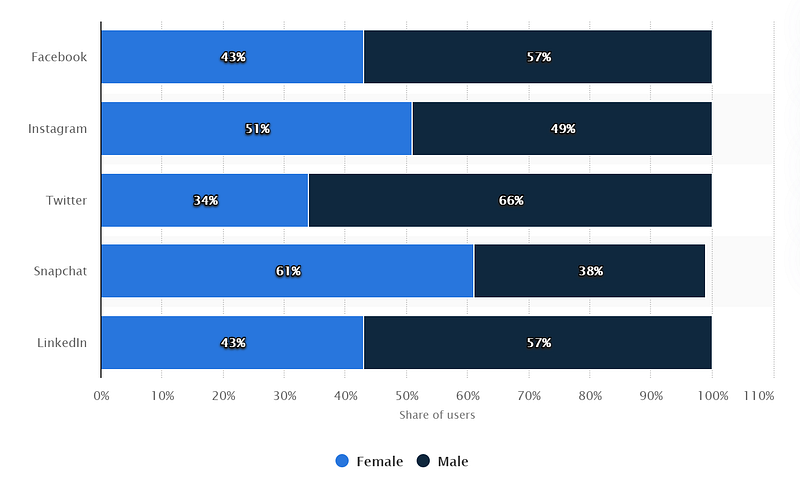
It’s a good place to start as some products and blogs tend to be much more suited for a certain gender. I won’t go into further details for the sake of brevity, but this information is easy enough to google.
Before you start your blog’s social media strategy, simply try to determine who is your basic audience. Give it a wide age group and gender. Then look up each of the social media platform’s demographics that you might be interested in.
As an example, a makeup and beauty blog might want to target working women from the ages of 25 and up. Pinterest would be a great place to start building a following as it has a roughly 70% penetration of women vs men with that age group in mind.
Takeaway
- Many big bloggers don’t use social media anymore — but we don’t have that luxury! (at least until your blog is huge)
- Some big bloggers only use 1 social media platform for promotion to save time and be more efficient
- Every single big blogger had an email list
- Many of them chose their social media platforms based on who their blog’s target audience was — we can do this easily too with just a bit of research
8. What is SEO?
Social media platform marketing (what a mouthful) is only one part of the battle of growing your blog. Posting summaries and pictures etc of your articles on those platforms, building a following, and interacting with people is a great way to drive traffic to your blog. But what is at least as important (if not the most important) as mentioned by almost every blog blogger I came across is SEO.
So what is SEO?
It’s the process of making your articles and topics appear at the top of Google searches.
This is simply done to drive massive amounts of traffic to your blog — if you can attain one of those top spots on a popular topic that is.
There aren’t enough shovels on Amazon to dig this big of a rabbit hole. Plain and simple, of all the topics I researched during this venture, SEO was by far the most commonly mentioned one. Way too many resources and ‘experts’ pilfering their goods out there.
But don’t worry, I found some that narrow it down and make it easier to research.
“Thanks J.J. Pryor!” I hear in my mind.
Probably the most efficient hour I spent during all this research was watching our friend Nat Eliason’s playlist that he made to break down SEO into a simple strategy. It’s only one hour and divided into many videos based on the subtopics.
One that is a bit broader and gives multiple methods of doing it is on the Ahref site. Note that they plug their services a bit here and that there are many alternatives you can use (some free). That being said, it’s a good place to start and help you make a list of potential things you can do.
Many of the most common problems I came across with researching SEO is that people make it sound super complicated and like it’s a huge amount of work. As with everything in life, there are different levels of effort and results that people can get from things.
Try to remember that here.
A little bit of SEO work can go a long way. My advice is to just dig into the subject and make a list of different methods and approaches people make. Then take some time to think about which method suits the amount of effort you’re willing to put in weekly.
I have my own interpretation of what might suit me for doing SEO, but I am an absolute noobie and am looking forward to playing around with it when I start my website.
That being said, I am often a very lazy man and am a big believer in the 80–20 rule (as is everyone these days). I’ll state my approach below, but by no means mistake it for expert advice, please. It’s based loosely on Nat Eliason’s youtube playlist above (go check it out!), but optimized for laziness and fewer hardcore results:
Leveling Up Lazily:
- Use Google Keyword Planner (just sign up for free with a Gmail account)
- Write one long sentence ‘keyword’ (ex. how to start a blog in 2020 on Medium)
- It will show you several suggestions for other keywords, you can then select them based on size metrics Google shows you — pick 3 that have under 1000 searches a month but more than 0
- For each of these, use a different ‘keyword’ on your articles — A) Website address B) Title of your article C) Meta title and description
- Wait 1 month, take a look at your results (open up an incognito browser and search your exact keyword phrase and see how high you rank on that Google result page)
- If you’re high on those pages, then restart this list from #1 but aim for higher searches per month
The above is a much-less effort version of what I found on many of the SEO advice websites and I’ll be using it for the first 6 months to see how I do. I’m sure, as with most topics we learn about, that I’ll figure out better ways to optimize vs time required as I go along, but I’m satisfied with this strategy to start with. Why?
Because doing SEO is boring! — at least for me 😄
Takeaway
- It’s the process of making your articles and topics appear at the top of Google searches
- SEO is very complex game theory and there’s way too much advice on the subject
- Research some of the advice (there are 2 links to start with above) and make a list of potential approaches you can use
- Pick one approach (or the one I’m trying) and do that for 3 to 6 months
- If it works — great, stick with it! If it doesn’t — go back to the list and pick another approach.
9. What are some of the top blogs today?
Now that I found out what the goals are, that I can potentially make money, and how to do that, I wanted to see examples of what top blogs are today. Here’s a couple of lists for you to start with if you’re interested in seeing some.
- https://createandgo.com/highest-paid-bloggers/
- https://www.under30experiences.com/blog/top-10-travel-bloggers-you-should-already-be-following
- https://blogonyourown.com/best-lifestyle-blogs/
The above includes 48 different very successful blogs with several different niches and styles. I looked at many of them and others in the course of the research and struggled hard.
Why struggle? Because I had to stop myself from clicking on all of the great content to read!
These are among the best blogs out there so they’re geared towards enticing you to read their website. The proof is in the pudding. So have a look, check for their styles, their stories, their format, and monetization. Use them as ‘case studies’ to give you ideas for your own blog. And maybe you’ll find a writer or two that you want to follow now as well!
Takeaway
- Check out the 3 links for 48 different top blogs on the internet
- Review the different aspects of these blogs for inspiration and best practices
10. What underlying common factors do all of these blogs have?
All of the successful blogs I came across in this research share similar qualities. They’re clean, easy to read and have high-quality writing. They’re successful for a reason — if they lacked any of the requirements, I wouldn’t have seen them!
Each blog has its style and flavor of course, but I was able to pinpoint several underlying points that we can use as a takeaway for our own blog in the future.
The biggest learnings I had from this research came in the form of the substance of the blogs. Despite all the differences in each place, they had one common factor.
All the blog posts are answering a question.
I was surprised to see this as my entire understanding/perception of blogging (as a mid-30’s dude) was that blogs were mostly life-diaries and stories. Most of the big blogs, if not all, that I came across were all geared towards answering questions.
This is because of Google SEO I’m sure. Google is after all an answering machine. People search there to find things, and mostly in the form of answers. What to buy, how to do something, where to go, etc.
There’s nothing wrong with this per se, but it did help me realize that blogging on Medium is not the same as making your own blog. I’ll address this in the next section.
The other general idea that I got from reading through many of these blogs is that most of the posts follow 1–3 different styles. The most common one I found, and prefer myself, is information with a personal touch.
What’s that formula?
- A short but related personal story to begin with
- A lead into the information/answer you’ll provide
- (Sometimes) a short outline of the subheadings, with links to make it faster
- Those same subheadings with the relevant information below them
- A quick thank you or ‘ask’ to sign up to an email list
The above seems to be a pretty common and safe way to structure your blog posts. I can see why it would be effective. It doesn’t waste too much time (for those only looking for an answer) and gives a personal flavor at the beginning. For those looking to go straight to an answer, the index helps them get there quickly and not turn away. For those that end up reading the entire piece, there’s a ‘thanks’ and an incentive (usually) to sign up for an email list.
Takeaway
- Clean and non-disruptive to read (all)
- Ad-free or unobtrusive ads (most)
- Geared for SEO — simpler writing style, shorter sentences, informative headlines, and sometimes a lack of creative flair in headlines/titles because of SEO (all — except for the last point)
- Have email lists (all)
- Use affiliate links (most)
- Disclose affiliate links (all)
- Several articles on each subject (all — even generalist blogs)
- The same voice throughout the website (all)
- Answers questions (most)
- Follows the formula mentioned above (many)
11. Why are these different than what I see on Medium.com?
After all of the research, I had to press a full stop and write down my summary before I forgot it all! The trigger for my full stop (I have about 50 tabs open that I want to still read) is that I came to a big realization at this point.
What was it?
I realized what I had intended to do with Medium won’t work.
I’ve been loosely formulating a strategy over the last three months for my blogging project. At one point, I realized that several of my long term goal-projects and the blogging one would actually complement each other.
This got me excited.
I’ve been successful with growing my followers on Medium.com pretty nicely (I have about 1,700 at the time of this writing — not bad for 3 months on Medium).
I’ve also played around with some of the social media platforms I mentioned — ones that I have never used (like Twitter and Instagram) — and decided to stick with Twitter for now (I just hit 500 after 1 month — not great but acceptable).
😃😃😃Add me on Twitter←shameless self-plug 😃😃😃
The rough plan was initially something along these lines:
Grow a base on Medium
Start growing an email list
Start one of the project’s niche-blog topics on my main account
Start using affiliate links
Start driving traffic to my project’s blog page and store when built
I had planned to do steps 4 and 5 for my future main blog as well.
But after this research, I realized I have to change my strategy again.
Firstly, Medium isn’t too fond of affiliate links. You’re allowed to use them, and there’re rare examples of people being curated with affiliate links inside the articles, but those are few and far between.
The truth is, you don’t often see affiliate links on Medium as it’s meant to be an ad-free platform. I haven’t tried playing around with them yet on here, but I will try at some point. I just don’t expect much success from it, even if one or two get curated (I can’t seem to escape curation jail anyway so this won’t be a problem).
Secondly, ranking for Medium and ranking for a blog are two completely different ball games.
As part of this rabbit hole dive, I went deep into looking at all the most popular articles on Medium.com and found a very different definition of success there.
Go take a look for yourself.
Do any of those stories in the top 100 match the same look and style of the top blog posts we’ve seen above? The answer is some of them for sure, but not the majority.
Many of the best-performing articles on Medium are opinion pieces, political stances, celebrity expose, topical issues, extreme events in a person’s life and of course, self-improvement. This is all perfectly fine, it just hadn’t clicked for me before.
To rank high on Medium takes a different kind of strategy than ranking high on a blog.
Takeaway
- Medium.com is a social media platform and its audience determines what gets popular on here
- With blog building, you can choose your audience, albeit taking more time to reach them
- You can use Medium as a blog funnel, a hobby, or a profession — but it’s important to keep in mind it usually can’t be all 3
- The exceptions? Write about writing, blogging, or online freelancing (it fits all 3 potentially)
Conclusion
I’m left with a question now. Do I want to continue blogging on Medium for the sake of building it like a social media funnel? Or do I continue blogging here because I enjoy the creative freedom that comes with it? I’m going to go with the latter option.
I’m also left with a few things unanswered. What does it take to do well on Medium outside of time and persistence?
Do you really need to ‘SEO’ your Medium articles like many Mediumites suggest you do here?
Is getting published and featured the only real way to make decent money on Medium in the short-medium (heh) term?
If I really wanted to do the SEO route, I’d be better off republishing the same stories that I’ll use on my main blog. Maybe that is the answer, I’m not sure yet.
It would also mean I should take the ‘blog as an answer’ route and give more meaning to all my posts. Also an option, but one with less creativity involved I feel.
I have many things to think about before I continue on my blogging journey now, but I am armed with a lot more weapons now after digging down into this treasure trove.
I hope that this super long-ass article was also useful for many of you too!
If you choose to go down the Medium.com path, I highly recommend reading through these 2 articles I’ve since made:
Liked this and didn’t fall into a coma? Join my free occasional newsletter!
Come follow Feedium publication for similar pieces and useful tips on Medium. Or just like me on Twitter and make me smile!


