avatarJillian Enright

Free AI web copilot to create summaries, insights and extended knowledge, download it at here

4639

Abstract

d programs.</p><p id="83c6">The idea that equal means fair assumes that each person’s needs are exactly the same. Rationally we know this cannot be the case, yet in many institutions our insistence on equality continues.</p><p id="704e">Not wanting to give “special treatment”, or be perceived as favouring one person over another is an illogical and irresponsible reason to deny <a href="https://twoemb.substack.com/p/accommodations-are-not-privileges">accommodations</a> and forgo accessibility. This desire to be perceived as fair serves the decision-maker and not the individuals needing <a href="https://aninjusticemag.com/accessibility-versus-accommodation-99f439cf944b">accommodation</a>.</p><figure id="f8f7"><img src="https://cdn-images-1.readmedium.com/v2/resize:fit:800/0*IgU3FUvpIkKNlL_n.png"><figcaption></figcaption></figure><p id="a4a1">The “one size fits all” problem in public education could easily be an entire book, so I won’t go into great detail here. I will say that the entire education system is based on this premise.</p><p id="9f07">Students are assigned a grade based on the year and month of their birth, rather than on their developmental stage. Rules are rigidly applied to all students (that “<i>fairness</i>” thing <i>again</i>), regardless of whether or not the student has the developmental capacity to meet those expectations.</p><p id="5eb0">Everyone has to follow a similar set of rules, work on the same assignments, and be constrained to the same physical space as their classmates. This is not because it’s what’s best for students. It’s primarily because we have too many students in a classroom and it’s the only way a teacher could possibly manage that many children at once… <i>but I digress</i>.</p><h2 id="0cd3">Failure to recognize, accept, and honour diversity</h2><p id="3b5f">Many institutions and businesses <i>claim</i> to be inclusive, to promote diversity, but in many ways their actions and policies do not line up with these purported values.</p><p id="20aa">We have policies which gather dust and do little to inform the work of those whom the policies are meant to guide. We have <a href="https://readmedium.com/national-accessibility-week-c9c454664f87"><i>performances</i></a> of inclusion and diversity — catchy logos, posters, mottos, etc. — which frequently amount to little more than slogans and marketing.</p><p id="8a44">Most people are in support of inclusion <i>in theory</i>, but <a href="https://readmedium.com/inequitable-accessibility-is-not-good-enough-4b9db05c50fd">not so much in practice</a>. Rather than well-intentioned (and probably informative!) workshops or philosophy statements, <i>real</i> inclusion is often found in the everyday minutiae and in the overall institutional culture.</p><h2 id="de98">Part 1 of…?</h2><p id="36bb">This is a heady and expansive subject, so I cannot promise a certain number of articles. I can promise that part two will cover the final three barriers to culturally competent practice.</p><p id="c53f">I can also promise that future articles will address how multicultural competencies can be applied to more effectively supporting neurodivergent people, in particular Autistics.</p><p id="f500"><i>So stay tuned!</i></p><p id="3f18">© Jillian Enright, Neurodiversity MB</p><h2 id="3f83">Part two</h2><div id="724b" class="link-block"> <a href="https://readmedium.com/empathy-and-autistic-counsellors-85abab6959e9"> <div> <div> <h2>Empathy & Autistics in the Helping Professions</h2> <div><h3>Despite potential challenges, we can excel in certain skillsets</h3></div> <div><p>medium.com</p></div> </div> <div> <div style="background-image: url(https://miro.readmedium.com/v2/resize:fit:320/1*ylHDbWu9XKCbHhQ6iy6jrQ.png)"></div> </div> </div> </a> </div><h2 id="2188">Related articles</h2><div id="3a11" class="link-block"> <a href="https://readmedium.com/cultural-and-communication-differences-f87158533c04"> <div> <div> <h2>Communication Differences Are Not Deficits</h2> <div><h3>Thinking about neurodivergent people as a cultural group, rather than as being disabled by our neurotypes</h3></div> <div><p>medium.com</p></div> </div> <div> <div style="background-image: url(https://miro.readmedium.com/v2/resize:fit:320/1*UB_A9_2Q7J7oQL8BssYtxg.jpeg)"></div> </div> </div> </a>

Options

</div><div id="1e5d" class="link-block"> <a href="https://readmedium.com/national-accessibility-week-c9c454664f87"> <div> <div> <h2>Performative Accessibility Is Good For Business, Not Disabled People</h2> <div><h3>A discussion of accessibility, invisible disabilities, and ableism</h3></div> <div><p>medium.com</p></div> </div> <div> <div style="background-image: url(https://miro.readmedium.com/v2/resize:fit:320/1*lb9i9h8jqlR_poGzcF_nWg.png)"></div> </div> </div> </a> </div><div id="9735" class="link-block"> <a href="https://readmedium.com/inequitable-accessibility-is-not-good-enough-4b9db05c50fd"> <div> <div> <h2>Half-Assed Accessibility is Insulting and Inadequate</h2> <div><h3>Services and accommodations provided to the disabled should be on par with those provided to the general population</h3></div> <div><p>medium.com</p></div> </div> <div> <div style="background-image: url(https://miro.readmedium.com/v2/resize:fit:320/1*MeKe8Jyvqxjh6lu3HqzlGw.png)"></div> </div> </div> </a> </div><h2 id="957e">Ways to support my work</h2><p id="914a">You can leave a “tip” on Ko-Fi at <a href="https://Ko-Fi.com/NeurodiversityMB">https://Ko-Fi.com/NeurodiversityMB</a></p><p id="ea1a">Become a paid subscriber to <a href="https://twoemb.substack.com">my SubStack publication</a></p><p id="254d">Check out my online store at <a href="https://NeurodiversityMB.ca/shop">https://NeurodiversityMB.ca/shop</a></p><p id="ec52">Read and share my articles from <a href="https://twoemb.medium.com">twoemb.medium.com</a></p><figure id="54ec"><img src="https://cdn-images-1.readmedium.com/v2/resize:fit:800/0*-RLKcIKnFDECz-rD.png"><figcaption></figcaption></figure><h2 id="498b">Read more</h2><div id="217f" class="link-block"> <a href="https://twoemb.substack.com/p/this-is-what-ableism-looks-like-f32"> <div> <div> <h2>This Is What Ableism Looks Like</h2> <div><h3>A real-life example of what ableism and micro-aggressions look like in action</h3></div> <div><p>twoemb.substack.com</p></div> </div> <div> <div style="background-image: url(https://miro.readmedium.com/v2/resize:fit:320/0*8x9EOBPj1RHIyRtQ)"></div> </div> </div> </a> </div><div id="2d08" class="link-block"> <a href="https://aninjusticemag.com/a-brief-update-to-my-ableism-story-1eec5abd9ec7"> <div> <div> <h2>Ableism And Invisible Disabilities</h2> <div><h3>An update to my micro-aggressions and ableism story</h3></div> <div><p>aninjusticemag.com</p></div> </div> <div> <div style="background-image: url(https://miro.readmedium.com/v2/resize:fit:320/1*tyCcCkjNVe5xSvUc-i2m8g.png)"></div> </div> </div> </a> </div><div id="f573" class="link-block"> <a href="https://aninjusticemag.com/accessibility-versus-accommodation-99f439cf944b"> <div> <div> <h2>Accessibility Versus Accommodation</h2> <div><h3>We’re tired of coming up with retroactive solutions for your lack of forethought</h3></div> <div><p>aninjusticemag.com</p></div> </div> <div> <div style="background-image: url(https://miro.readmedium.com/v2/resize:fit:320/1*5mjxj-hMYCLR5nqtfLf8sg.png)"></div> </div> </div> </a> </div><div id="40fd" class="link-block"> <a href="https://readmedium.com/code-switching-and-masking-10dc92d225e1"> <div> <div> <h2>Code Switching and Masking</h2> <div><h3>Finding common experience</h3></div> <div><p>medium.com</p></div> </div> <div> <div style="background-image: url(https://miro.readmedium.com/v2/resize:fit:320/1*mCBQ-RVkAmOj_AtmXdOJug.jpeg)"></div> </div> </div> </a> </div><h2 id="f328">References</h2><p id="9e68">Shebib, B. (2023). <i>Choices: Interviewing and counselling skills for Canadians </i>(8th ed.). Pearson Canada.</p></article></body>

Barriers to Appropriate Support for Autistics

What gets in the way of schools and service providers effectively supporting Autistics?
Common ground across marginalized groups

I’m upgrading some of my courses in order to pursue an advanced degree. One subject area in a course I’m taking is multicultural competence in counselling. The material refers to clients and people of all racial and cultural identities, but of course, I found myself relating what I was reading to my current work with neurodivergent folks.

Many of the evidence-based recommendations used to train counsellors in these skills are also applicable to supporting Autistics and other neurodivergent folks in a variety of settings.

Unfortunately many of the attitudes which limit cultural competence in counselling are also prevalent in the wider psychological profession, in public education, and in society in general.

Barriers to culturally competent practice

  1. Ignorance regarding the underlying philosophical, structural, and technological alterations that are necessary;
  2. Reluctance to develop from a “one-size-fits-all” approach (in terms of out-dated pedagogy, as well as inflexible institutional policies);
  3. Failure to recognize, accept, and honour cultural (and neurological) diversity;
  4. Lack of self-awareness regarding how one’s socialization impacts their practice;
  5. Failure of training programs to prepare staff to adequately and competently support Autistics;
  6. Lack of willingness to learn from, and listen to, Autistic people and their loved ones

I will expand on each of the above points in my next two articles, outlining how these barriers also apply to schools, community and social services, and other support services for neurodivergent students and clients.

My follow-up articles will then address the Multicultural Counselling Competencies (MCCs) and how they can be applied to more effectively supporting and respecting the differences of neurodivergent people.

Ignorance of the underlying changes needed

“The system’s broken, but we don’t know how to fix it”

Leaders, politicians, and policy-makers can see there are problems which need to be addressed. Staff within these systems can see there are ways in which the current models don’t meet the needs of their clients.

Yet most are unsure exactly what needs to happen for these issues to be addressed.

They purchase packaged programs, send their staff to workshops, and attend seminars. Knowledge is helpful, but only insofar as people know how to actually apply it in real life situations.

Sometimes people are completely oblivious to the philosophical and structural issues. For example, our education training continues to push behaviourism as the gold standard, despite the mounting evidence that it is more harmful than helpful.

Staff and support workers don’t necessarily understand the potential impact of the environment on neurodivergent people. Many of us have heightened sensitivities, such as being hypersensitive to bright lights, loud noises, scents, or certain physical sensations.

When one’s nervous system is already overwhelmed by incoming sensory stimuli, it’s much more difficult to work, learn, self-regulate, communicate — really, it’s more difficult to function or do our best if we’re constantly struggling against discomfort or distress.
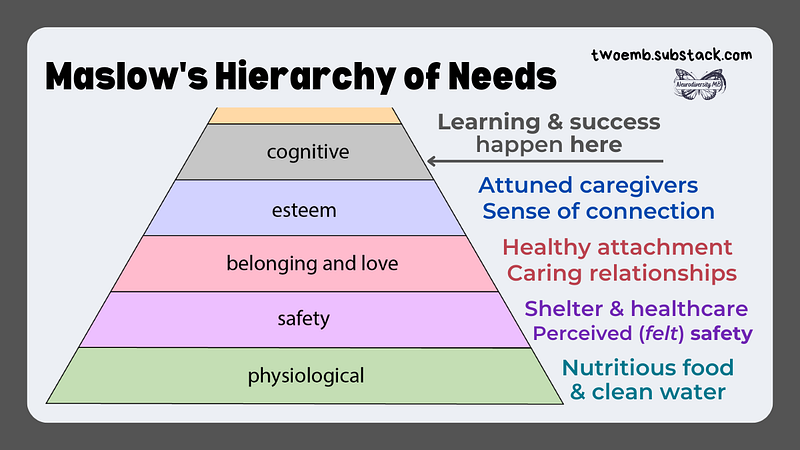
A “one-size-fits-all” approach

There are multiple ways in which this manifests.

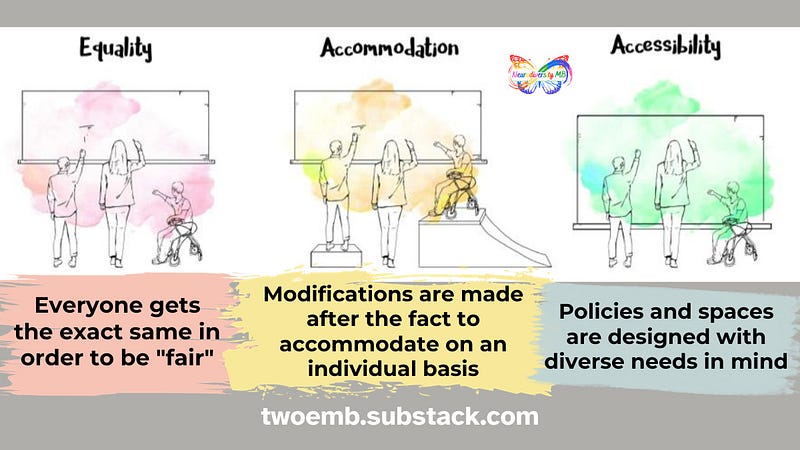
One way is the misconception that in order for things to be “fair”, they must be equal. That’s a fundamental flaw in a lot of over-generalized policies and programs.

The idea that equal means fair assumes that each person’s needs are exactly the same. Rationally we know this cannot be the case, yet in many institutions our insistence on equality continues.

Not wanting to give “special treatment”, or be perceived as favouring one person over another is an illogical and irresponsible reason to deny accommodations and forgo accessibility. This desire to be perceived as fair serves the decision-maker and not the individuals needing accommodation.
The “one size fits all” problem in public education could easily be an entire book, so I won’t go into great detail here. I will say that the entire education system is based on this premise.

Students are assigned a grade based on the year and month of their birth, rather than on their developmental stage. Rules are rigidly applied to all students (that “fairness” thing again), regardless of whether or not the student has the developmental capacity to meet those expectations.

Everyone has to follow a similar set of rules, work on the same assignments, and be constrained to the same physical space as their classmates. This is not because it’s what’s best for students. It’s primarily because we have too many students in a classroom and it’s the only way a teacher could possibly manage that many children at once… but I digress.

Failure to recognize, accept, and honour diversity

Many institutions and businesses claim to be inclusive, to promote diversity, but in many ways their actions and policies do not line up with these purported values.

We have policies which gather dust and do little to inform the work of those whom the policies are meant to guide. We have performances of inclusion and diversity — catchy logos, posters, mottos, etc. — which frequently amount to little more than slogans and marketing.

Most people are in support of inclusion in theory, but not so much in practice. Rather than well-intentioned (and probably informative!) workshops or philosophy statements, real inclusion is often found in the everyday minutiae and in the overall institutional culture.

Part 1 of…?

This is a heady and expansive subject, so I cannot promise a certain number of articles. I can promise that part two will cover the final three barriers to culturally competent practice.

I can also promise that future articles will address how multicultural competencies can be applied to more effectively supporting neurodivergent people, in particular Autistics.

So stay tuned!

© Jillian Enright, Neurodiversity MB

Part two

Related articles

Ways to support my work

You can leave a “tip” on Ko-Fi at https://Ko-Fi.com/NeurodiversityMB

Become a paid subscriber to my SubStack publication

Check out my online store at https://NeurodiversityMB.ca/shop

Read and share my articles from twoemb.medium.com

Read more

References

Shebib, B. (2023). Choices: Interviewing and counselling skills for Canadians (8th ed.). Pearson Canada.

Inclusion
Equality
Autism
Culture
Education
Recommended from ReadMedium