
Performative Accessibility Is Good For Business, Not Disabled People
A discussion of accessibility, invisible disabilities, and ableism

What is accessibility?
Accessibility is defined in multiple ways. The Oxford dictionary defines accessibility as:
- The quality of being able to be reached or entered (as in a physical structure, such as a public building).
- Easy to obtain or use (for anyone and everyone).
- Being easily understood or appreciated.
Accessibility Canada defines accessibility as “the design of products, devices, services, or environments for people who experience disabilities.”
Disability and privilege
I have two “disabilities”, both of which are invisible. I am hard of hearing and neurodivergent. I use quotations on the word disabilities because I don’t define being Autistic as a disability, I describe it as a neurodivergence — a neurotype which is outside the majority.
Many in the Deaf community don’t consider deafness a disability either. Many prefer the social model of disability, which explains how our communities, culture, and environments are disabling, rather than our physical or neurological differences.
Many disabled people, including myself, view this as a fairly good model, but one that is oversimplified. Firstly, the social model assumes that given all necessary accommodations for one’s disability, we’d all be on equal ground.
That doesn’t account very well for the privileges enjoyed by white people, cis-men, heterosexuals, high income earners, among others.
One can be disabled, marginalized, oppressed, and yet still privileged all at the same time.
It’s complicated.
For example, I experience sexism because I present as female. I experience ableism and discrimination because I am hard of hearing and neurodivergent. I grew up in a low income family amongst middle and high-income families, so I experienced classism.
I also have white privilege. My husband is considered a high income earner, so our family now has financial stability, which affords us many privileges as well. Although I am bisexual, I am in a heterosexual marriage, so I “pass” as hetero, complete with a child and two dogs. This also grants me cis-het privileges.
Invisible disabilities
One downside to having invisible disabilities is people often assume you’re intentionally doing something, rather than being unable to do it.
When I am out in my community, I am often treated poorly because I didn’t hear something. If I’m not using sign language or wearing my hearing aids, people just assume I’m not listening or not paying attention.
Once I was at a full service gas station where the attendants fill up your vehicle, but you still need to go inside to pay. There was a line up at the cash and people were also waiting around to have their pump number called.
I had my son with me, at that time he was quite young, probably around 4 years old. He was, of course, very interested in the brightly coloured candy at the front. I was keeping a careful eye on him to make sure he didn’t touch something when he wasn’t supposed to.
Apparently the attendant, a teenage boy, called my pump number. I didn’t hear him because I was busy preventing my son from grabbing a particularly temping chocolate bar at that moment.
Instead of saying a bit louder, “excuse me, miss, is that your pump number?” the attendant simply called the number once more and then moved on to the next one.
The man in line behind me cut in front and went to pay for his fuel. He also didn’t ask, “is that your pump?”, he rudely stepped around me, acting as though it was my fault for ensuring my son didn’t make a mess of the candy display.
I’ve experienced similar difficulties when travelling, especially in airports where, aside from flight information, announcements and instructions are not made accessible to deaf and hard of hearing travellers.
Micro-aggressions
Rather than overt, obvious, significant incidents, those of us who are both marginalized and privileged often experience a multitude of micro-aggressions.
These wear away at us until we lose our patience with society’s ableist bullshit, and then people wonder why we’re “freaking out” over a minor inconvenience.
It’s no longer minor when it happens every damn day. It’s more like death by a thousand paper cuts.
I had a moderately aggravating experience with our public library system in March and April this year, which I described in This Is What Ableism Looks Like, and expanded upon in my follow-up piece, Ableism and Invisible Disabilities.
Neurodivergence and accessibility
I am Autistic and have ADHD. Many neurodivergent people have co-occurring conditions, such as anxiety, depression, and PTSD (among others).
It was previously believed that being Autistic or having ADHD were the cause of these other conditions because they were so highly comorbid. A more nuanced understanding is coming to light, as researchers and clinicians recognize the social factors contributing to these issues.
Rather than autism or ADHD directly causing mental health problems, lack of understanding, accommodation, and acceptance contribute to lower quality of life and increased risk of depression and anxiety.
Disabled and neurodivergent people are also at increased risk for experiencing trauma in their lifetimes for a variety of reasons, and as such, are at an increased risk for developing PTSD.
Meaningful accessibility & inclusion
There’s a significant difference between performative accessibility and meaningful accessibility.
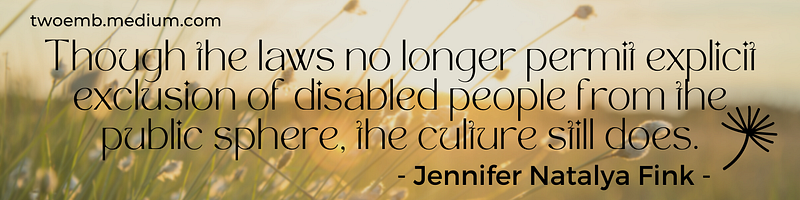
As Jennifer Natalya Fink and Itzia Crespo explain,
“Accessibility dissonance happens when the law guarantees equal access, but the ableist social structures of the public sphere make it nearly impossible to gain the accommodations that would enable meaningful access and inclusion.” — Jennifer Natalya Fink
The performance of accessibility is, for example, when businesses do the bare minimum to meet legal requirements, without truly providing an inclusive environment.
This includes virtue signalling, when companies publicly express sentiments intended to demonstrate their moral correctness, primarily for the purpose of attracting customers and increasing sales.
For meaningful accessibility, corporate leaders and managers must put genuine thought and effort into creating accessible services, consult with the disability community, and cultivate an inclusive culture within their companies and workplaces.
“If capitalism created new kinds of people to be excluded, like the disabled and mentally ill, then under new historical conditions capitalism can also facilitate inclusion.” — Roy Richard Grinker
© Jillian Enright, Neurodiversity MB
When you join medium, as a member you’ll have access to unlimited reads for only $5 per month. If you use my referral link, I’ll earn a small commission, and you’ll earn my undying gratitude.
Related Stories
References
Fink, J. N. (2022). All Our Families: Disability lineage and the future of kinship. Beacon Press.
Grinker, R. (2021). Nobody’s Normal: How culture created the stigma of mental illness. W. W. Norton & Co.
Haruvi-Lamdan, N., Horesh, D., Zohar, S., Kraus, M., & Golan, O. (2020). Autism Spectrum Disorder and Post-Traumatic Stress Disorder: An unexplored co-occurrence of conditions. Autism, 24(4), 884–898. https://doi.org/10.1177/1362361320912143
Mason, D., McConachie, H., Garland, D., Petrou, A., Rodgers, J., & Parr, J. R. (2018). Predictors of quality of life for autistic adults. Autism research : official journal of the International Society for Autism Research, 11(8), 1138–1147. https://doi.org/10.1002/aur.1965
Mohamed, S. M. H., Börger, N. A., & van der Meere, J. J. (2021). Executive and Daily Life Functioning Influence the Relationship Between ADHD and Mood Symptoms in University Students. Journal of Attention Disorders, 25(12), 1731–1742. https://doi.org/10.1177/1087054719900251
Reuben, K. E., Stanzione, C. M., Singleton, J. L. (2021). Autism in Adulthood 3(3), 247–256. http://doi.org/10.1089/aut.2020.0073
Rumball, F., Brook, L., Happé, F., Karl, A. (2021). Heightened risk of posttraumatic stress disorder in adults with autism spectrum disorder: The role of cumulative trauma and memory deficits. Research in Developmental Disabilities, 110, 103848. https://doi.org/10.1016/j.ridd.2020.103848