
Have Hearing Aid, Will Travel
Being hard of hearing during a pandemic was hard enough
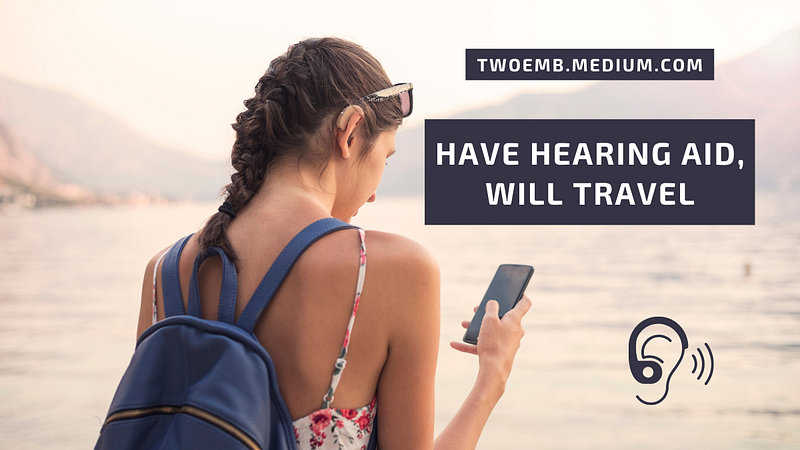
“She’s hard of hearing,” my 8 year old son explains to airport security.
Apparently, they had been trying to ask me to do something, but I couldn’t hear them. I still couldn’t figure out what they wanted, even after my son had directed my attention to them.
Usually, I don’t hear someone if my back is turned, but I’m a very good lip-reader and can understand as long as I am looking at them. Thanks to the Covid pandemic, that is no longer a possibility, as everyone is wearing masks.
I’m grateful the simple act of wearing a piece of cloth over our mouth and nose helps reduce the spread of the virus. What frustrates me (and probably airport staff as well), is this communication barrier need not exist.
Why Are We So Behind the Times?
We live in a world where technology rules. Everywhere you look, there are digital signs updated by the second, indicating whether a flight is on-time or the gate has been changed.
The entire airport and airplanes run on computer systems. 99.9% of the people in the airport are carrying at least one electronic device on their person, including – maybe especially – young children.
My father-in-law, who is nearly 70 years old, recently had a full conversation with a gentleman using Google Translate because they didn’t speak the same language.
With so many useful tools at our disposal, why am I still being shouted and waved at in the middle of an airport, being made to look and feel like a complete idiot?
Important Background Information
Lip-reading ability and accuracy vary greatly between individuals.
Some factors influencing a person’s accuracy are whether they were born deaf or experienced hearing loss later in life, whether they were taught a signed language and whether it is their first language, whether they were instructed in lip-reading and speech, their level of education and literacy, and the level of their hearing loss.
Like many things in life, hearing loss occurs on a spectrum. Not all Deaf people can read lips, not all Deaf people know sign language, and many Deaf people do still have some hearing.
Many Deaf children have been victims of language deprivation.
Language deprivation occurs due to a chronic lack of full access to a natural language during the critical period of language acquisition, approximately the first five years of a child’s life.
I was raised in a fully hearing family, with a family who knew no sign language. My first language was English, my second French, and my third German. I did not begin learning American Sign Language (ASL) until I was about 10 or 11 years old.
I had the privilege of being introduced to and welcomed into, the Deaf community. I became fluent in ASL, made friends, later discovered I actually have Deaf relatives and discovered my own Deaf identity.
I also had the privilege of strong literacy skills and post-secondary education, a privilege many Deaf people and other marginalized groups are not afforded.
Despite being deprived of ASL during my critical language development period, the ability to “pass” likely afforded me the additional privilege.
In this context, “passing” means to be able to pass as hearing. I can lip-read, I can speak well, and this made it easier for me to obtain employment in order to save up for my education and future. Many Deaf people are underemployed due to ableism, audism, and lack of accessibility.
My experiences notwithstanding, research has clearly demonstrated that providing deaf children access to signed languages significantly improves their ability to learn additional languages, improves literacy skills, and leads to better mental health outcomes.
Masking and passing
As someone who is neurodivergent as well as hard of hearing, I have spent much of my life masking my neurodivergence as well as passing for hearing.
What this means is that I suppress, or attempt to suppress my neurodivergent tendencies. These are behaviours or other symptoms related to my ADHD that are seen as socially unacceptable, or that cause others (namely, the neurotypical majority) discomfort.
At the same time, I also expend energy to lip-read and speak properly in order to understand and be understood by the hearing majority.
Have you ever watched The Amazing Race or a similar reality T.V. show where people travel across the world to somewhere they’ve never been? I’ve watched people, who are visitors in another country, petulantly screaming “doesn’t anyone here speak ENGLISH?!” No, Karen, because you’re not in North America anymore, you’re the one who doesn’t speak their language, not the other way around.
Have you ever travelled to a country where you didn’t speak the dominant language and the culture was very different from your own? Were you exhausted by day’s end from working so hard to communicate and navigate, both geographically and socially? Did you feel a sense of relief when you returned home and were able to communicate easily with others, understood the local customs, and fit in well with your community?
Yes?
Now imagine moving to a foreign land where you don’t know the language, don’t understand the local customs, and have no way of ever fully learning them or being able to adapt. You must live there for the rest of your life, stumbling and fumbling your way through. You might learn some strategies to adapt along the way, you might figure a few things out, but you’ll never fully understand nor be understood.
That’s kind of what it’s like being both neurodivergent and hard of hearing in a world that is not made for us.
What Can We Do?
If you’re a hearing and/or neurotypical person reading this and wondering how you can be supportive without being ableist, I can share what works for me, but of course, I do not speak for the entire Deaf or neurodiverse communities.
First and foremost, be kind. That one’s pretty easy.
Being kind is a lot easier when you don’t make assumptions about people. Part of ableism, or audism in this context, is the assumption that being hearing is inherently better than being Deaf. It’s different.
Being Deaf is often more difficult because our society is not geared towards those of us in minority groups, but that says more about society’s lack of consideration and accommodation than it does about our capabilities.
Along those same lines, if someone is being “difficult”, don’t assume they’re doing it intentionally. Most people don’t travel or come to your shop with the goal of making your job harder, and if they are, it might be because they are having trouble meeting expectations or conforming to social norms.
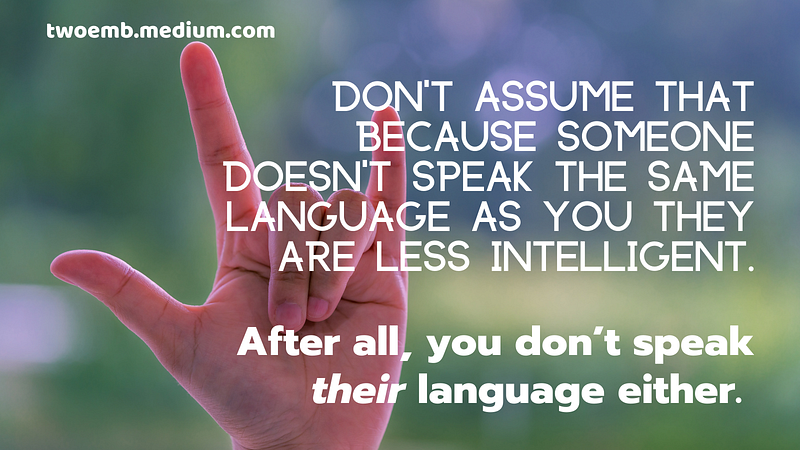
Don’t condescend and don’t infantilize. Assume competence. Don’t assume that a physical disability equals an intellectual disability. Don’t assume that because someone doesn’t speak the same language as you they are less intelligent. After all, you don’t speak their language either.
Speak directly to the individual with whom you are intending to communicate. If someone has an interpreter or support person with them, don’t pretend the disabled individual does not exist, ignoring them to speak to their support person. Give people the respect and dignity of being seen, even if you need an intermediary to assist with communication.
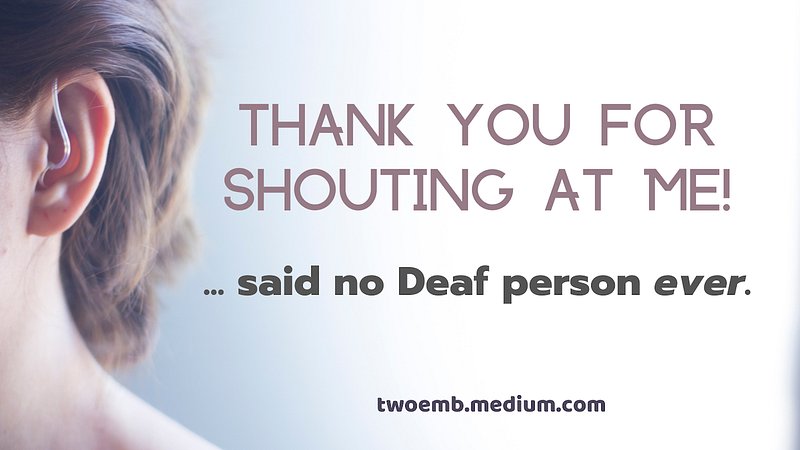
For the love of gawd, do not speak to a Deaf or hard of hearing person by yelling, over-exaggerating your speech, or doing some ridiculous impression of a mime. It’s embarrassing for everyone and does not aid communication.
Remember, I’ve learned to read lips by watching people speak in their normal fashion for nearly four decades, and many people who do read lips have learned the same way.
If you’re unsure about how to effectively and respectfully interact with someone, ask them. As I mentioned, not all Deaf people know sign language, and many Deaf people have been deprived of access to appropriate and accessible education. (As an aside, please keep in mind that education and intelligence are two completely separate concepts, there are many highly intelligent people who just don’t have a piece of paper to “prove” they’re smart).
That said, if something is not your business to know, don’t ask. It’s not polite to ask someone you’ve never met how they lost their hearing, how they became disabled, or whether they were “born that way”, mmm-kay? You’re not Lady Gaga.
© Jillian Enright, Neurodiversity MB

When you join medium, as a member you’ll have access to unlimited reads for only $5 per month. If you use my referral link, I’ll earn a small commission, and you’ll earn my undying gratitude.
If you’d prefer give a one-time tip, you can support my writing on Ko-Fi — also, it’s free to follow me on Facebook!
Related Stories
When you join medium, as a member you’ll have access to unlimited reads for only $5 per month. If you use my referral link, I’ll earn a small commission, and you’ll earn my undying gratitude.
References
Bottema-Beutel, K., Kapp, S. K., Nina, J., Sasson, N. J., & Hand, B. N. (2021). Avoiding Ableist Language: Suggestions for Autism Researchers. Autism in Adulthood, 3(1), 18–29. https://doi.org/10.1089/aut.2020.0014
Dammeyer, J., Crowe, K., Marschark, M., & Rosica, M. (2019). Work and Employment Characteristics of Deaf and Hard-of-Hearing Adults. The Journal of Deaf Studies and Deaf Education, 24(4), 386–395. https://doi.org/10.1093/deafed/enz018
Hall, W.C., Levin, L. L., & Anderson, M. L. (2017). Language deprivation syndrome: a possible neurodevelopmental disorder with sociocultural origins. Social psychiatry and psychiatric epidemiology, 52(6), 761 – 776. https://doi.org/10.1007/s00127-017-1351-7
Hall, W.C. (2017). What You Don’t Know Can Hurt You: The Risk of Language Deprivation by Impairing Sign Language Development in Deaf Children. Maternal and Child Health Journal, 21, 961 – 965. https://doi.org/10.1007/s10995-017-2287-y
Suess, N., Hauswald, A., Zehentner, V., Depireux, J., Herzog, G., Rösch, S., & Weisz, N. (2021). Influence of linguistic properties and hearing impairment on visual speech perception abilities in the German language. Centre for Cognitive Neuroscience and Department of Psychology. University of Salzburg, Austria. https://doi.org/10.31234/osf.io/rcfxv


