
Backspin: De La Soul — De La Soul is Dead (1991)
Destroy the brand, save the Soul. (91/100)
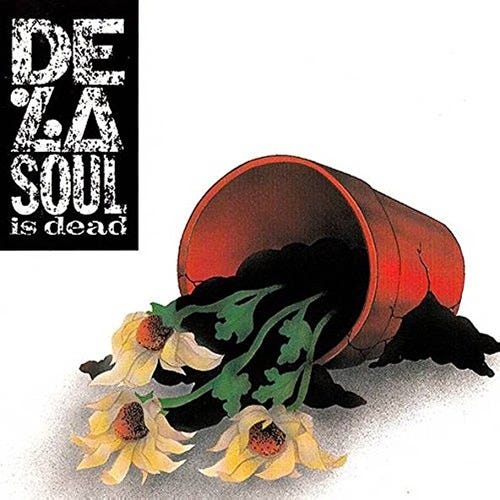
As the ’80s drew to a close, nobody in hip-hop had a stronger brand than De La Soul. The Long Island, NY trio’s surrealist sensibility and colorful aesthetic instantly stood out from the hip-hop pack.
Behind Tommy Boy Records’ savvy marketing campaign stickily tagging the group “the hippies of hip-hop,” their masterful debut, 3 Feet High and Rising, soared to platinum success. Fans of all stripes eagerly followed De La into the D.A.I.S.Y. (DA Inner Sound, Ya’ll) Age, enraptured and inspired by its ethos of individuality, innovation, and uplift.
By 1991, the milk was turning. While the pop and alternative crowds eagerly anticipated another 3 Feet High and Rising (4 Feet High and Climbing?), a backlash was brewing at home. Notoriously fickle hip-hop purists, who had hailed De La Soul’s innovation in ’89, were now rolling their eyes at the flower power and pastels. The genre hardening, the “hippy” image was conflated with “soft,” leading to Posdnuos, Trugoy the Dove, and Maseo routinely getting tested in public.
The brand was also a prison. The tight confines of its peace and love aesthetic were suddenly at odds with a more nuanced worldview. Having come of age at the intersection of the music industry’s corporate chicanery and the nihilism of the streets that were part and parcel of hip-hop culture, the group’s youthful exuberance was suddenly weighted by a hard earned cynicism. There simply wasn’t room in the botanical garden Tommy Boy built for the complexities weighing heavy on De La’s soul.
For the band to grow, the brand had to go.
De La Soul is Dead, is a kamikaze mission of salvation through sabotage. The group’s ingenious sophomore opus is a high-wire act of destruction and deconstruction, not only salting the D.A.I.S.Y. fields from which the “hippy” brand sprouted, but savaging the very hip-hop landscape that made the death of the De La Soul brand a necessity.
Any illusions of a 3 Feet redux are dispensed with a quickness by the opaque opener, “Oodles of O’s”. Standing in stark contrast to the inviting expanse of 3 Feet High’s inaugural “The Magic Number,” “Oodles of O’s” is a maze of insularity. While the tense bassline mimics the circularity of the song’s titular character, Pos and Dove catch us up on their post 3 Feet reckonings with sudden notoriety.
Do the “oodles of O’s” represent the innumerable discs sold? The “oooh”s of their suddenly adoring fans? The zeros at the end of their checks? A close reading of the lyrics, in which most of the rhyme schemes center around “O” sounds, suggest all of the above and far more:
[Dove] I was John Doe, now I’m Mr. Jolicoeur Pissed with the witness, and now I adore O’s got the world, cause O’s was on tour Girls gave the O’s, and guys, “oh” for sure Where they arose? Well nobody knows What do they mean? Well, here’s how it goes Oh she’s got the “ohs” when you hold the dough You know who you are, but they didn’t know And now with respect they flex like a pro You’re first another n****, but now an Afro
“Pease Porridge” dives deeper into the dark side of success, juxtaposing the whimsical facade of the children’s record from which it’s derived against Pos and Dove’s most aggressive lyrics to date. Deploying a stutter-stepping rhyme pattern, in which 3 is once again the magic number (the opening words of each bar are repeated three times), De La put the peacenik image to rest and all the wanna be tough guys with whom they scrapped on notice.
It’s the first of DJ Maseo’s 5 appearances behind the mic, marking his official emergence as Plug 3 to Pos and Dove’s Plugs 1 and 2. (Their aliases refer to microphone plugs.) Maseo’s gruff vocal tone and aggressive delivery offer a powerful contrast to the more cerebral approach of his partners, lending the group’s sound a dash of much needed ruggedness to match the coarsening aesthetic of the early ’90s.
If the disenchantment of the early tracks came as a shock to listeners, it really shouldn’t have. The lead single, “Ring Ring Ring (Ha Ha Hey)” tips the album’s hand. Just beneath the sing-song mellifluousness of the hook , “Ring Ring Ring” is a surly rebuke of the demo-peddling “fan” seemingly lurking around every corner; a parasite in sycophant’s clothing. That De La Soul launched Dead with a single dissing their fans should have been a flashing warning sign that they were determined to burn it all to the ground.
And burn it down they do, daisies and all. Even when seemingly revisiting 3 Feet High’s most fertile ground, the Plugs greet it with a wink and a nod. Tropes are inverted; expectations subverted. Corporate demands are met with a thumb in the eye.
Take the second single, “A Rollerskating Jam Named ‘Saturdays’”. It’s got all the ingredients of a crossover hit in the mold of “Me, Myself, and I”. Yet, those ingredients are assembled in a manner just off-kilter enough to keep the listener playing catch-up rather than settling into the Chicago-sampling groove.
The chorus, introduced as a chant (“Saturday it’s the Saturday, Saturday it’s the Saturday”), initially feels like a bridge, transitioning directly from Q-Tip’s opening verse to Pos’s middle section. A carefree pre-chorus, crooned by the sultry Vinja Mojica, doesn’t appear until nearly the song’s midpoint. Its melodic infectiousness makes it feel like a long-delayed chorus, until Mojica shifts into a nearly unrecognizable resurrection of the “Saturday” chant. The pre-chorus-to-chorus pattern repeats again following Dove’s closing verse (itself accompanied by a jarring beat switch), but with different lyrics.
It’s a masterful construction by De La Soul and producer Prince Paul that keeps you on your toes, but not necessarily dancing (or skating). The Plugs have succeeded in wrenching elusive surrealism from the jaws of easy accessibility.
Similarly, had they simply wrapped Ann Roberts’ euphoric vocals into a traditional verse-chorus-verse structure atop “Talkin’ Bout Hey Love”’s warm and fuzzy Stevie Wonder sample, it almost certainly could have replicated the commercial success of 3 Feet’s lovey-dovey “Eye Know”.
Instead we get an extended vocal riff from Roberts punctuated with a lovers’ quarrel of an epilogue. Pos and Tesha Stills talk past each other, unsuccessfully attempting to navigate young love through the obligations and excesses of Pos’s new life. The theme recurs in Pos’s lyrics throughout the subsequent decades, speaking to the stark realities that De La Soul is Dead strives to present in between the abstractions and subversions.
It’s those moments of sobering realism that provide arguably the album’s most memorable moments. While “My Brother’s a Basehead” complies with Tommy Boy’s request for an anti-drug record in mold of 3 Feet’s “Say No Go” in function, the form represents a stark left turn. Rather than PSA-ready sloganeering, we get a harrowing tale of Pos’s brother’s unforgiving battle with addiction:
Brother, brother, stupid brother of mine Started getting high at the age of nine Now at twenty-one, you’re lower than low Nowhere to turn, nowhere to go My dividends and wares started to disappear Where it ended up, I had an idea Bucking you with a quickness was first intent Instead went to Pop and gave him the print Now Pop grew tired of being a mouse Finally told you to get the hell outta the house From there a mother figure came into play Claimed for you she saw a better day
There’s no chorus, no happy ending, and no overt preaching (other than during the tongue-in-cheek church interlude leading into the 3rd verse). Simply an all too universal scenario made achingly personal by Pos’s masterful storytelling.
It’s that same emerging gift for narrative, along with a judiciously deployed loop from Funkadelic’s haunting “I’ll Stay,” that makes “Millie Pulled a Pistol on Santa” Dead’s most riveting four minutes. Pos and Dove offer parallel recountings of the escalating tension between a beloved school counselor and his beleaguered daughter, and the horrific secret that drives the story to its jarring end.
While a number of rappers have explored sexual abuse in recent years, in ’91 it was largely an unspoken shame. As such, De La Soul’s decision to release “Millie” as Dead’s third and final single was, perhaps, the clearest signal that they were defiantly rejecting the commercial success that engulfed them two years earlier.
It’s not just the D.A.I.S.Y. field that gets salted on De La Soul is Dead. The entire hip-hop ecosystem gets summarily skewered. “Afro Connections at Hi 5 (In the Eyes of a Hoodlum)” sends up the increasingly ubiquitous cliches of gangsta rap, while “Kicked Out the House” lampoons the club-tailored hip-house trend that De La’s Native Tongue compatriots, the Jungle Brothers and Queen Latifah, were instrumental in popularizing. A series of interludes from fictional radio station WRMS lay bare the pandering tropes of urban radio.
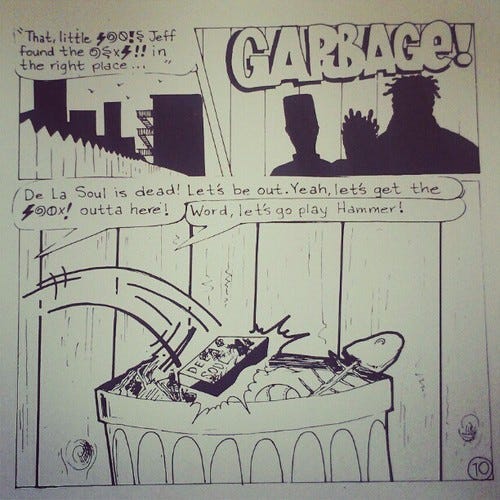
The interludes and skits are as integral in realizing the album’s vision as the songs. The “Intro” skit establishes a storybook format in which school cliques are deployed as avatars for the hip-hop audiences of the day. A cluster of pre-teens extolling Vanilla Ice represent the mainstream pop crowd. A crew of bullies stand in for the scores of gangsta rap acolytes suddenly thugging their way through suburbs the nation over.
“Jeff,” a little more sophisticated than the mainstream kids and more comfortable in his skin than the bullies, has just found the new De La Soul tape in the garbage. He excitedly announces his discovery to the mainstreamers, but refuses to let them listen, perhaps sensing it will go over their heads. Before he can play it, he’s beaten and robbed by the bullies, who eagerly throw the tape in their boom box.
For the next 70 minutes, we experience the album with the bullies. They reappear in a series of skits throughout proclaiming their disdain and, ultimately, anger toward the project. Occasionally, one of the two sidekicks will express tepid enjoyment of a track, only to be ridiculed and slapped back into submission by the leader, voiced by Mr. Lawnge of Black Sheep. The final skit brings the album full circle (another “O”), the tape tossed back into the trash, and Lawnge proclaiming “De La Soul is Dead.”
The format is a stroke of brilliance. Not only does it provide structure to an otherwise sprawling album, it deftly cuts critics off at the knees. While scores of fans and reviewers alike didn’t “get” the album, most stopped short of claiming De La Soul had fallen off. After all, any critique that could be levied at them was already stingingly delivered within the album itself. To parrot the bullies’ complaints would be to align oneself with the very troglodytes lampooned in the skits.
Ultimately, most of 3 Feet High’s casual fans simply dropped off, leaving De La Soul to the “Jeffs” of the world - the connoisseurs inclined to listen a little more closely; musical adventurers not above digging through a trashcan to unearth an undervalued gem.
It was the “Jeffs” who became the next generation of envelope-pushing artists. There’s ample evidence — from the normalizing of narrative skits to tether unwieldy concept albums to the recurring phenomenon of sophomore albums taking stark, and often dark, left turns— that De La Soul is Dead found its audience in their time, if not its.
Little Brother’s The Minstrel Show, KMD’s Black Basterds, The Pharcyde’s Labcabincalifornia, and Masta Ace’s Disposable Arts all have strands of De La Soul is Dead in their DNA. ATLiens’ deconstruction of the southern fried tropes that drove Southernplayalisticadillacmuzik finds Outkast fleeing their brand in much the same way De La Soul did a half decade prior.
The “Jeffs” of the world have been rolling with De La for the subsequent 30 years. They weren’t enough to return the Plugs to the top of the charts they briefly dominated during the D.A.I.S.Y. Age, but more than sufficient to make them a fixture at the forefront of the underground vanguard.
De La Soul seem noticeably more comfortable there; a band free of a brand’s constraints.
By the Numbers
Production: 9.5 Lyrics (how the words are put together): 9.5 Delivery & Flow: 9.5 Content (Substance): 10 Cohesiveness: 10 Consistency: 9.5 Originality: 10 Listenability: 8.5 Impact/Influence: 8 Longevity: 6.5
Total — 91
Next
Related
SEE ALL
Backspin is a look back at the albums that shaped and defined hip-hop. It explores what made them resonate, the impact they had on the culture, and where they fit in today’s ever-expanding hip-hop canon.