
Backspin: Stetsasonic — In Full Gear (1988)
Hip-Hop’s first band was instrumental in expanding rap’s sonic palette. (79/100)
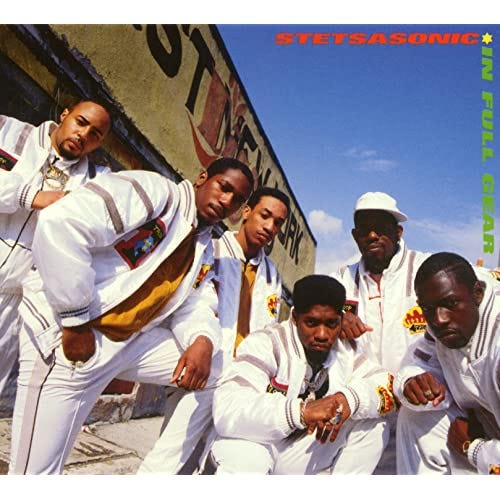
Before The Roots, there was Stetsasonic. A collection of multi-talented musicians, some wearing multiple hats as MCs, producers, and instrumentalists, the Stet troop stormed the scene in ’86 with the infectious single “Go Stet I”. That New York classic and the accompanying album, On Fire, touted the “hip-hop band” concept. Stetsasonic leaned largely on live percussion to provide a more robust iteration of the barebones breaks favored at the time.
1988’s In Full Gear, finds Stetsasonic truly embracing the sonic possibilities offered by the addition of live instruments to hip-hop’s foundational elements of samples and turntablism. The result is a sprawling project that expands the sonic palette of hip-hop, setting the stage for the aural experimentation that would soon define the genre’s “alternative” wing.
Hip-hop’s most transformative year produced albums more popular. More impactful, even. But few embody the feeling of a nascent genre sonically coming of age with greater vigor than In Full Gear.
Ironically, the opening title track is constructed almost entirely of samples and a programmed drum loop. It’s a credit to the production from group member Prince Paul (a year ahead of his emergence as a super producer via De La Soul’s 3 Feet High and Rising) that it still manages to set the tone for the record with layered textures and the fluidity of a live jam session. A bassline, deployed intermittently during the verses, seems to wrap itself around the rhymes as live session players would. In actuality, it’s cribbed from Johnny Hammond’s “Shifting Gears”.
For their part, MCs Daddy-O, Frukwan, Wise, and Delite keep it simple, emphasizing party-rocking punch over technical nuance. The result is a groove hard not to move to. There’s no pretense of Rakim-like lyrical transcendence. As Daddy-O lays out in his opening salvo, Stetsa’s brand is igniting the party with sonic dynamite:
Let me start by saying You wanna leave? Go ‘head, I’m staying ’Cause I been fully baptized in the river Stets’ll get loose while Paul’s on the set And you can bet This party’s gonna pump like a LinnDrum A better band? You know it ain’t been one And on stage, the Stet is a rage Says Spin magazine on the 21st page
“DBC Let the Music Play” expands on the template, adding live bass and keys to loosen up a track rooted in a pair of familiar samples (Maceo and the Mack’s “Cross the Track (We Better Go Back)” and James Brown’s “Funky Drummer”). It’s a party record sonically reflective of the in-the-moment freedom of an actual party.
“Freedom or Death” provides perhaps the album’s most daring departure, both sonically and lyrically. A sonic backdrop of throbbing congos and cascading bogos courtesy of Alvin Moody proves as powerful as it is spare. A hushed chant explicitly connects the song’s content to not only the racial injustice of the Reagan ’80s in America, but the centuries old struggles for freedom throughout the colonized world. Daddy-O’s sharp voice cuts through like glass, his raw emotion commanding the understated rhythms with lyrics that vacillate between meditation and call-to-arms.
Clocking in at just 1:45, “Freedom or Death” ultimately proves as frustrating as it is riveting. Had the band trusted its creative impulses enough to expand the track into a full song allowing other members to provide their perspectives, we may well have been discussing it among the conscious classics of the era.
While nothing else on the record packs quite the ingenious punch of “Freedom or Death” to the contemporary ear, Stetsasonic generally does a stalwart job at bringing originality to well-trodden soil, both sonically and lyrically. “Stet Troop ‘88” uses live instrumentation to flesh out a foundation of vocal percussion (i.e. human beatboxing). The combination creates an atmospheric ambiance that makes the braggadocious barrage feel like a distant forefather of The Roots’ “100% Dundee”.
“Pen and Paper” imbues tried and true boasts of rhyme superiority with a cultural weight. Hip-hop lyricism is connected with a tradition of wisdom passed down through written and oral communication dating back to the earliest civilizations. The dynamic sample collage assembled by Prince Paul would probably have felt like a sonic revelation had we not been bumping the aural assault that was Public Enemy’s It Takes of Nation of Millions to Hold Us Back simultaneously.
Indeed, timing way well have been In Full Gear’s greatest opponent in its battle for a slot on the top shelf of late ’80s classics. Had it dropped just a year earlier, the sonic layers and conceptual ingenuity would have felt revolutionary.
The production, clearly the album’s highlight, certainly felt innovative by ’88 standards. The standout tracks still feel fresh now. Yet, in striving for breadth, the band failed to usher in a signature sound like the year’s other sonic pioneers, PE, EPMD, and Ultramagnetic MC’s did. As a result, their influence came at the macro level — expanding the sonic scope of hip-hop — rather than the micro. If you can name any subsequent albums of note sonically modeled after In Full Gear, by all means, send them my way.
While the no-frills A-B rhymes schemes would still have felt elementary in ’87 compared to the multi-syllabic word puzzles of Rakim and KRS-One, they wouldn’t have yet felt dated. By ’88, nearly every MC in New York had transitioned to more sophisticated rhyme schemes and conversational deliveries. As a result, much of Stetsasonic’s MCing felt antiquated upon In Full Gear’s arrival.
Standout second single “Talkin’ All That Jazz,” one of the earliest precursors to ’90s jazz rap, provides an example of the magic that could have been had the MCs adapted their deliveries with greater regularity. Here, the rappers lay their rhymes with measured precision, subtly calibrating their vocal tones to match the twists and turns of the album’s most sonically fluid track.
With Kid Wonder’s live bass and trumpet synths adding a nimble dexterity to Delite’s eclectic sample smorgasbord, the production exemplifies the then-under-appreciated musicality of hip-hop’s sample-based sonic hallmarks. The MC’s expound on the theme, trading lines in rapid succession to surgically unravel the reactionary dismissal of hip-hop by musicians of previous eras:
You see, you misunderstood, a sample’s just a tactic A portion of my method, a tool, in fact it’s Only of importance when I make it a priority And what we sample’s loved by the majority But you, a minority in terms of thought Narrow minded and poorly taught About hip-hop, playing all the silly games To erase my music, so no one can use it
Lead single “Sally” takes the opposite approach, reveling in hip-hop traditionalism. It proves just as timeless. Featuring no live instrumentation, Daddy-O’s production throws James Brown, Roy Ayers, Dyke & the Blazers, and The B-Boys into a petrie dish to create a pugilistically relentless platter of break-heavy bombast. It proves the perfect backdrop for the band’s inspired homage to a Brooklyn b-girl turned corporate rainmaker (she rents them the venue in which they’re performing) who rose to the top with her swag intact.
Looking back, “Sally” was ahead of its time — possibly the first major hip-hop hit by a male act to celebrate female empowerment. Maybe we didn’t notice because we were too young. Or we were too busy dancing.
Such was the gift and the curse of In Full Gear. It’s one of the era’s more innovative albums by one of its most creative crews. Yet the forward-looking flourishes are often integrated into the aesthetic of the day so seamlessly as to go overlooked. Tommy Boy Record’s near-criminal neglect of its veritable treasure trove of a back catalogue certainly didn’t help matters. Just ask De La Soul and Digital Underground.
As a result, both album and band are often ignored in Golden Era retrospectives. But play In Full Gear today, and it holds its own against most of its more universally canonized peers. You’ll also find a surprising number of harbingers of the genre’s subsequent sonic iterations.
And all the jazz.
By the Numbers
Production: 8.5 Lyrics (how the words are put together): 7.5 Delivery & Flow: 7.5 Content (Substance): 8 Cohesiveness: 8.5 Consistency: 8 Originality: 9 Listenability: 8 Impact/Influence: 7.5 Longevity: 6.5
Total — 79
Next
Previous
SEE ALL
Backspin is a look back at the albums that shaped and defined hip-hop. It explores what made them resonate, the impact they had on the culture, and where they fit in today’s ever-expanding hip-hop canon.