
Backspin: De La Soul — 3 Feet High and Rising (1989)
De La Soul debuted with one of rap’s most innovative albums. And one of its most misunderstood. (96/100)
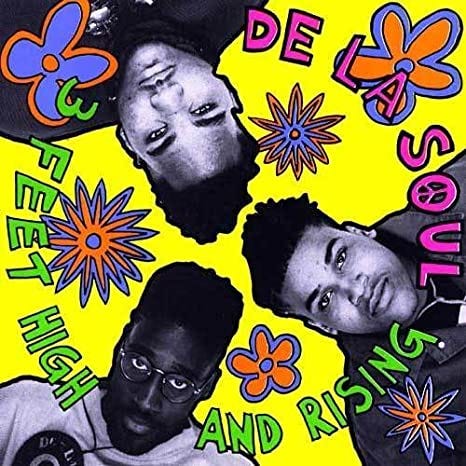
If the hardcore hip-hop of the late ’80s Golden Era was “Black America’s CNN,” 3 Feet High and Rising was its Nickelodeon. De La Soul’s ingenious debut swept over the scene like a much needed breath of fresh suburban air, injecting a free-wheeling whimsy into a genre increasingly ignited by urban angst and revolutionary rage.
By the album’s release in 1989, many of hip-hop’s most rabid fans were far removed from the inner city blues served up by an increasing number of its most provocative mic wielders. De La Soul met us where we lived, serving up zany tales of puppy love, after school trysts, and the occasional affirmational monkey over an array of eclectic sonic collages assembled by legendary producer Prince Paul. It was simultaneously infectious and impenetrable; catchy and confounding. Like the classic Nickelodeon show Double Dare, the zany convergence of colors, textures, and sheer youthful exuberance drew you in by making it impossible to look away.
Those same colorful flourishes also led to a gimmicky marketing campaign, a swift backlash, and an identity crisis that ultimately distorted the legacy of a trio that, album for album, should be in the conversation of all time greatest rap groups. It shouldn’t have been that way.
The pair of singles that preceded that album immediately established De La Soul as innovators, but also lyricists of the highest order. “Plug Tunin’” is a display of pure linguistic dexterity, with Posdnuos and Trugoy deftly slipping syllables in and out of a bass heavy track lightened by interspersed samples of keys, strings, and a goofily harmonic hook. “Potholes In My Lawn” defiantly took on the imitators by unleashing a torrent of linguistic acrobatics so unconventional they practically beg biters to try:
I’ve found that it’s not wise To leave my garden untended Cause eyes Have now pardoned all laws of privacy Even paws are after my writer, see I’ve found that everyone’s sayin’ What to do when suckers are preyin’ On my well-guarded spreadsheets Oh why, hell does it send up fleets Of evil-doers through the big hole To get to evil-doers who dig holes Which leaves my lawn with lawn-chew I think I’d better plant traces to give clues Or better yet call 9-1-1 And when they get here I inform them I’m the Plug One Open a chair and let them realize the reason For concern of the Soul Cause we’ve come down with a case of potholes
The cadence, the delivery, and the metaphors all turned the day’s hip-hop norms on their heads. And that’s before you even get to the yodeling on the chorus.
By the time the album dropped, anticipation was sky high. Building off of the verbal and sonic derring-do of the singles, 3 Feet High and Rising does not disappoint. The game show themed intro immediately (dis)orients the listener in a world full of colorful characters, unpredictable flourishes, and the freedom to ponder popular culture’s most existential questions, like “how many fibers are intertwined in a shredded wheat biscuit?”
“The Magic Number” puts music to the madness, with Prince Paul serving up a rollicking sample platter seasoned with sonic components ranging from Bob Dorough to Johnny Cash to The Fatback Band. Pos and Dove embrace the eclecticism. The MCs deftly alternate between a melodic sing-song delivery and a rapid fire rhythmic cadence emphasizing syncopated alliteration over traditional rhyme patterns to ride the uptempo beat. Lyrically, they waste little time introducing the album’s recurring themes of creative freedom, expression of individuality, and enthusiastic embrace of the adventures that lie along the road less traveled.
Establishing a pattern that recurs throughout the album, the flourish of “The Magic Number” is immediately followed by “Change of Speak,” a track more grounded in mid-tempo boom bap production, which pushes the lyrical acumen of the MCs to the forefront.
Similarly, “Jenifa Taught Me (Derwin’s Revenge),” a playful paean to teenage lust rendered in a near nursery rhyme delivery, gives way to the somber “Ghetto Thang.” The pairing offers two of the album’s best tracks and exemplifies the breadth of experience 3 Feet High presents through De La’s kaleidoscope. The former showcases their talent for reveling in the colorful absurdities of the everyday, the latter highlights the piercing insights into humanity that would become increasingly prevalent in their work over time.
From the stark portrayal of inner city struggle, we are taken to the reaches of outer space for the pure psychedelic weirdness of “Transmitting Live From Mars,” a skit which essentially amounts to 70 seconds of jibberish atop a trippy Turtles sample. On paper, the album relies too heavily on such skits. Yet, they’re impeccably applied, enhancing the flow of the record rather than detracting from it. “Transmitting Live From Mars” is no exception, proving the perfect pallet cleanser in preparation for the saccharine sentiments of “Eye Know.”
In the interest of full disclosure, I must admit to having had a distinct distaste for “Eye Know” during my own pubescent years. It was probably too sweet and vulnerable for my still evolving conceptions of hip-hop and masculinity. My fondness for the song has steadily grown the further removed I get from the days of puppy love. A breezy jaunt through the euphoric haze of early-adolescent romanticism, “Eye Know” floats on a plane closer to Shuggie Otis’s funk-pop confection “Strawberry Letter 23” than any other rap ballad. I would now argue it stands as one of the genre’s best and most unique love songs.
“Tread Water” continues along the same ethereal path, offering affirmations of perseverance and nature’s harmony through a series of interactions with talking animals. Had Dr. Seuss come of age in 1980s New York and set his poetic parables to music, he may well have sounded a lot like this. It’s precisely the type of unbridled imagination and youthful exuberance that enabled 3 Feet High and Rising to connect with listeners well outside the usual hip-hop circles. It’s also what enabled their label, Tommy Boy Records, to position them as “the hippies of hip-hop,” a catchy tag that instantly caught on with the mainstream press, but also reduced an incredibly layered and diverse album and group to a one note gimmick.
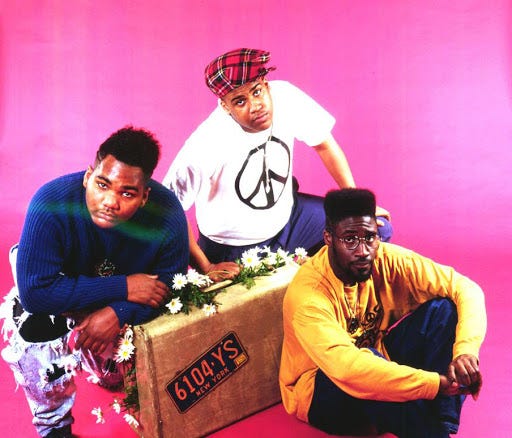
“Me Myself and I” certainly didn’t help matters. The third single didn’t so much undermine the album’s themes and textures as synthesize them into an easily digestible commercial package; De La for Dummies. The lyrics preach the same tenets of individuality and expression as the rest of the album, but in more direct language and delivery. Prince Paul once again picks the perfect samples, but rather than digging deep into his vast crates to mash up an array of pop culture oddities, he builds the backbone of the track off of Funkadelic’s instantly recognizable dance floor anthem “(Not Just) Knee Deep.”
Despite De La Soul’s very public antipathy towards the track in subsequent years, “Me Myself and I” isn’t a bad single. It’s actually a pretty great one. But, like many great singles, it carries a formulaic polish that many hip-hop heads reflexively treated as treason in the late ’80s. As “Me Myself and I” became ubiquitous on pop radio and MTV and Tommy Boy threw their full marketing weight behind the hippy campaign, many of the same hip-hop heads who had received the album as a breath of fresh air mere months earlier began to hold it at arm’s length. Soon De La influenced acts, including their Native Tongue brethren A Tribe Called Quest, began dropping dynamic albums colored by 3 Feet High’s eclecticism and outlook without the flower power trappings.
It’s a shame, because in the context of the album, the more “hippy-dippy” moments don’t feel at all contrived or out of place. That De La Soul quickly became defined more by the commercially packaged peace and love of “Me Myself and I” than their ability to humanize all walks of urban existence (i.e. addicts on “Say No Go”), or cleverly articulate the struggle of making a place in a rapidly changing world (“This is a Recording for Living In A Fulltime Era [L.I.F.E.]),” speaks more to the machinations of the then-burgeoning music industrial complex than to De La Soul themselves. In hindsight, 3 Feet High and Rising was simply too sprawling, too imaginative, too multi-faceted to be peddled as product in a fast food culture. It was packaged as a one dimensional caricature of itself instead.
Time served De La Soul well. Delivering a string ingenious albums through the ’90s and beyond, each distinct from its predecessors, they successfully shed the stereotypes to establish themselves as one of the genre’s most innovative and consistent acts. And while 3 Feet High and Rising may not receive burn comparable to other late ’80s heavyweights today (partly due to contractual issues keeping it off of streaming platforms), its DNA is evident in several generations of underground and alternative rappers to follow, from Tribe to The Pharcyde to Kanye West.
Perhaps the greatest testament to De La Soul’s paradigm shattering debut is that today, despite all of the imitations and mischaracterizations, 3 Feet High and Rising is still a singular listening experience; still as uniquely confounding as it was three decades ago.
By the Numbers
Production: 10 Lyrics (how the words are put together): 10 Delivery & Flow: 8.5 Content (Substance): 9.5 Cohesiveness: 10 Consistency: 10 Originality: 10 Listenability: 9 Impact/Influence: 10 Longevity: 9
Total — 96
Backspin is a look back at the albums that shaped and defined hip-hop. It explores what made them resonate, the impact they had on the culture, and where they fit in today’s ever-expanding hip-hop canon.