
Backspin: Arrested Development — 3 Years, 5 Months and 2 Days in the Life of… (1992)
Arrested Development celebrated life. Hip-hop left the party early. (86/100)
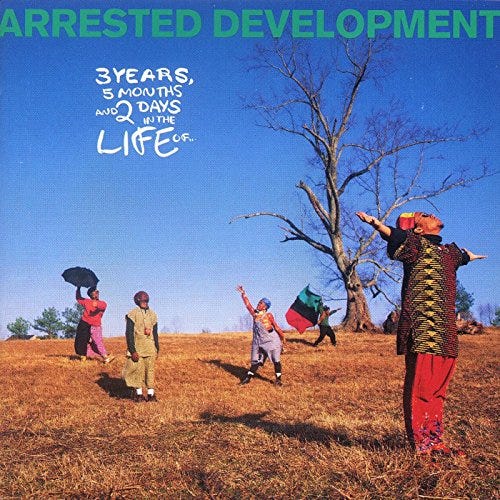
Was Arrested Development the right group at the wrong time?
In 1992, hip-hop’s collective consciousness was beginning to wane. After more than four years of intensive revolutionary anthems and cerebral meditations dedicated to uplift and edification, we were ready for a pause from the cause. We were still down to fight the power, but we were also down with O.P.P. Conscious icons like Public Enemy and Boogie Down Productions saw their dominance teeter. Burgeoning avant-garde artists like A Tribe Called Quest hardened their sounds, moving the messages to the subtext. Brand Nubian was in the process of transitioning from “Wake Up” to “Punks Jump Up to Get Beat Down”. Our third eye wasn’t closed, but it was growing heavy.
Arrested Development committed a cardinal sin of popular culture. They went all in on a fading trend. 3 Years, 5 Months and 2 Days in the Life of… is a celebration of Black life. It was released into a culture in the embryonic stages of a profound and complicated reckoning with the omnipresence of death that had cast a pall over the childhood of a generation of urban youth.
Where stalwarts like Jungle Brothers and Poor Righteous Teachers had been informed by Afrocentricity, Arrested Development’s ambitious debut was essentially the musical embodiment of the diaspora. “Man’s Final Frontier” opens the album with a frenetic aural collage of jazz, funk, soul and hip-hop. Tribal rhythms pulsate from a drum machine, evoking the buoyancy of house music and connecting the circle of past and present. Aerle Taree’s opening salvo makes clear that we’re about to embark on a journey transcending space and time:
Space ain’t man’s final frontier. Man’s final frontier is the soul Guided by someone more powerful than any human being Someone felt but never seen. You will be surprised of what resides in your insides
“Mama’s Always On Stage” strips back the instrumental density, but keeps the ebullient energy percolating in a rollicking acclamation of black motherhood. While a piercing harmonica roots the track in the dirty south soil, in which generations of black women have helmed families splintered by slavery and its after effects, frontman and producer Speech holds his brethren to account. The song’s infectious bridge clearly positions social progress and familial solidarity as of a piece.
Can’t be a revolution without women Can’t be a revolution without children
“Mr. Wendal” slows the pace to a mid-tempo bounce, thrusting Speech’s lilting delivery to the forefront for a modern parable. While the hit single weathered criticism for its seemingly idyllic portrayal homelessness, the song’s true message rests beneath the surface narrative of a beggar befriended by Speech. At its core, the song is a plea to see the humanity in those we are more comfortable looking past. It’s through their stories we may gain a new and enlightening perspective on our world.
Mr. Wendal has freedom A free that you and I think is dumb Free to be without the worries of a quick to dis society For Mr. Wendal’s a bum His only worries are sickness And an occasional harassment by the police and their chase Uncivilized we call him But I just saw him eat off the food we waste
Humanity’s place in the world’s natural order emerges as a recurring theme. Toward its center, 3 Years’ rural mystique upends the very milieu of “urban” music into which radio consultants and record executives were in the process of casting hip-hop in the early ‘90s.
“Children Play with Earth” implores “African boys and girls” to “set down your Nintendo joy sticks right now” and “dig your hands in the dirt” over a thick bassline that, itself, seems to burrow deep into the topsoil. You can feel the soil dampening, growing fertile as the sounds of cascading thunder and pounding raindrops introduce the enrapturing “Raining Revolution”.
Equal parts bass heavy jazz excursion and modern day spiritual, the track features Speech at his most poetic. He uses the first verse to espouse the replenishing properties of nature’s showers, before extending the metaphor to position the rain water as nourishing the seeds of an “unnatural supernatural solution” to the earthly injustices wrought by man.
The age old rural ritual of fishing provides an evocative metaphor in back to back tracks. Despite a percussively celebratory uptempo beat, “Fishin’ for Religion” takes a decidedly cerebral approach to worship. Lyrically, Speech casts his line deep into the murky waters of spirituality in search of a theology that offers spiritual sustenance rather than simple soothing in the face of evil.
“Give a Man a Fish” begins as the the story of Arrested Development’s battle for self sufficiency in the shark infested waters of the music industry, and segues into a rousing call for revolution against an entire economic and political system built upon exploitation. Speech deftly links the everyday struggles of the inner city to the revolutionary struggle for racial and economic equality. The aging hippies turned corporate cogs who embraced Arrested Development as non-threatening peaceniks either skipped the track while playing the CD at an unobtrusive volume in their Volvos, or were too busy boogying to the funk-fried groove to parse Speech’s incendiary closing verse.
Brothers with the AKs and the 9 Ms Need to learn how to correctly shoot’em Save those rounds for a revolution Poor whites and Blacks bumrushin’ the system
Speech’s ethos of unity and channeling rage into a righteous movement still resonates powerfully. It could have served as a galvanizing force as hip-hop entered an age in which peers too often unleashed their anger on one another. Unfortunately, the album’s two iconic singles muddy the message, inadvertently distancing the band from the very audience they hoped to edify.
The boundary busting lead single, “Tennessee,” is nearly a perfect song, encapsulating everything that makes Arrested Development special. Speech’s delivery, equal parts rhythmic and melodic, simultaneously rides the throbbing drums and coasts atop the wistful chords of the subtly persistent acoustic guitar. His willingness to lay his soul bare was immediately riveting in an era when rappers rarely allowed their ice grills to thaw.
What begins as an intensely personal plea for spiritual guidance in the wake of familial loss quickly evolves into an existential pilgrimage as expansive as the countryside itself. As Speech’s journey leads him to the site of his ancestors’ most bracing struggles, the song’s underlying theme emerges like the epiphany for which he’s searching the countryside: truly easing the pain of the present requires embracing the source of traumas past.
At a moment when many would rather remove a nation’s original sin from its history books than confront its lasting legacy, Speech’s message resonates even more saliently than it did in ‘92.
Lord it’s obvious we got a relationship Talking to each other every night and day Although you’re superior over me We talk to each other in a friendship way Then outta nowhere, you tell me to break Outta the country and into more country Past Dyersburg into Ripley Where the ghost of childhood haunts me Walk the roads my forefathers walked Climbed the trees my forefathers hung from Ask those trees for all their wisdom They tell me my ears are so young (home) Go back to from whence you came (home) My family tree, my family name (home) For some strange reason it had to be (home) He guided me to Tennessee (home)
Alas, Speech’s tendency towards sanctimony adds a sour undercurrent that understandably alienated some, as his quest for personal peace takes on a tone of condescension toward those without the luxury of a similar pilgrimage. The final verse could even be read as Speech, at the end of his vision quest, identifying the source of his strife as other Black people who don’t share his idea of enlightenment.
Many journeys to freedom made in vain By brothers on the corner playing ghetto games I ask you, Lord, why you enlightened me Without the enlightenment of all my folks
If “Tennessee” carries a bitter aftertaste, “People Everyday” is a Libson Lemon. A crudely drawn narrative disguised as modern parable, the album’s second single finds a self-righteous Speech and his Afro-Boheme date heckled by a group of profanity spewing “n***ers”. Despite positioning himself as the voice of reason, the song ends with Speech assaulting the supposed thugs after twice threatening murder, and piously crowing:
That’s the story, y’all, of a Black man Actin’ like a n**** and get stomped by an African
While “People Everyday” was a massive crossover hit, it may well have been the single greatest factor in alienating a hip-hop community that could have greatly benefited from the band’s accessibly rendered consciousness and musical eclecticism.
At the end of 1992, Dr. Dre’s The Chronic sent up the smoke signal that would forever change the course of hip-hop, combining the most hedonistic elements of gangsta rap with the sumptuous musicality of crossover funk. Dre’s template would catapult the once frightening subgenre into heavy rotation on mainstream media outlets. The G-Funk sound it popularized was every bit as catchy as Arrested Development’s best, but without the challenging cerebral bent.
By the time the band regrouped for 1994’s Zingalamaduni, consciousness rap had been driven deep underground. Underground heads thought Arrested Development was corny. The Swahili album title and airily melodic lead single, “Africa’s Inside Me,” only cemented the stereotypes that had begun to dog the group in the two years since their meteoric rise.
Was Arrested Development the right group at the wrong time?
Perhaps. Had 3 Years, 5 Months and 2 Days in the Life of… come out in 1989, when the band began production, they probably would have fallen easily into place as the country cousins of the similarly situated Native Tongue collective. They could have had a solid 4 to 5 year run before the backlash against conscious rap grew all encompassing.
Had they hit in 1997, when the culture was reckoning with the real world violence in which four years of bullet riddled anthems had culminated, they may well have been received like a tall glass of sweet tea on a southern summer day.
The events of 1993–1997 also present another possibility. Maybe Arrested Development was the right group at the right time, and we simply tuned them out in favor of instant gratification and vicarious thrills.
Had we given them time and space to evolve and refine with the same corporate backing as their street seasoned counterparts, could they have led a vanguard of Pan-African rebel music? Could they have offered a celebration of life to balance out the their peers’ musical meditations on death and destruction?
Those explorations were absolutely necessary, and often brilliantly rendered. At their best they served as both analysis of, and catharsis from, what Reaganomics and crack wrought on a generation of ‘70s babies raised in ‘80s inner cities. But the diaspora’s descendants are as varied as the hues of our pigmentation; far from the monolith that the corporate world often treats us as.
Could Arrested Development have opened the door for a subset of mainstream hip-hop that could have kept the Renaissance era from ultimately imploding under the weight of its own righteous anger?
Perhaps the gatekeepers of the very system 3 Years, 5 Months and 2 Days in the Life of… implored us so jubilantly to dismantle were all too comfortable never finding out.
By the Numbers
Production: 8.5 Lyrics (how the words are put together): 7.5 Delivery & Flow: 7.5 Content (Substance): 10 Cohesiveness: 10 Consistency: 9 Originality: 10 Listenability: 9 Impact/Influence: 7.5 Longevity: 7
Total — 86
Next
Previous
SEE ALL..

Backspin is a look back at the albums that shaped and defined hip-hop. It explores what made them resonate, the impact they had on the culture, and where they fit in today’s ever-expanding hip-hop canon.