
Politics | Gaming
Attack and Dethrone God: 6 Games for ‘Class Wargamers’
#Resist
RIOT, n. A popular entertainment given to the military by innocent bystanders.
— from The Devil’s Dictionary
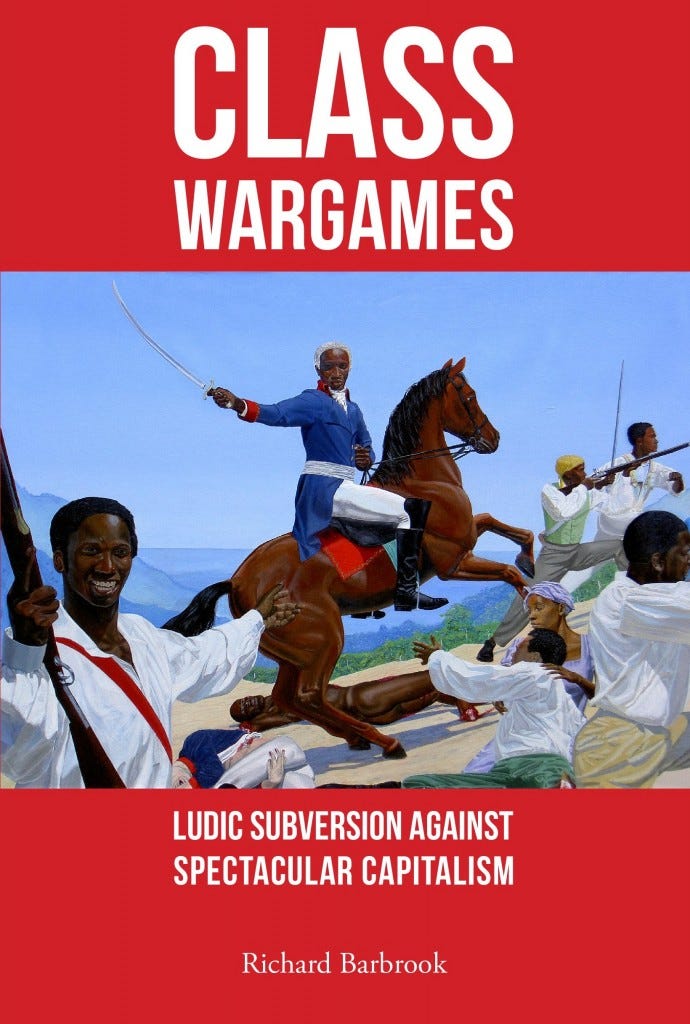
Class Wargames has been called an “academic text, resistance memoir, and rulebook for system smashing”. The book chronicles public “performances” of Guy Debord’s Game of War at various art shows. The author spends a lot of the book banging on about participatory creativity.
To the Situationists, gaming isn’t gaming. Gaming is a collective performance. Maneuvering units and rolling dice becomes a “ludic manifestation of class struggle”. Running commentary by this or that academic is usually part of that performance.
Besides The Game of War, Class Wargames performed…
- Little Wars, H.G. Wells’ super-simple toy solider wargame. I’ve covered it before.
- Commands & Colors: Napoleonics, one of Richard Borg’s many C&C games.
- Reds vs Reds, a custom game designed special for Class Wargames.
The recent BLM protests got me thinking about real wargaming, in the CNA/RAND sense. Protest leaders are unlikely to gain much from the performance angle of class wargaming, but maybe the practice itself can help sharpen strategic instincts.
I’m not going to review the book. Reviews can be found here and here. There’s also a short film about The Game of War here. A legal PDF of the book itself is here.
Below is a supplemental selection of relevant games. None of them feature miniature soldiers, so they lack the spectacle of the games showcased in the book. Some are abstract or lack historical scenarios. But they can provide developing subversives with some amount of strategic practice.
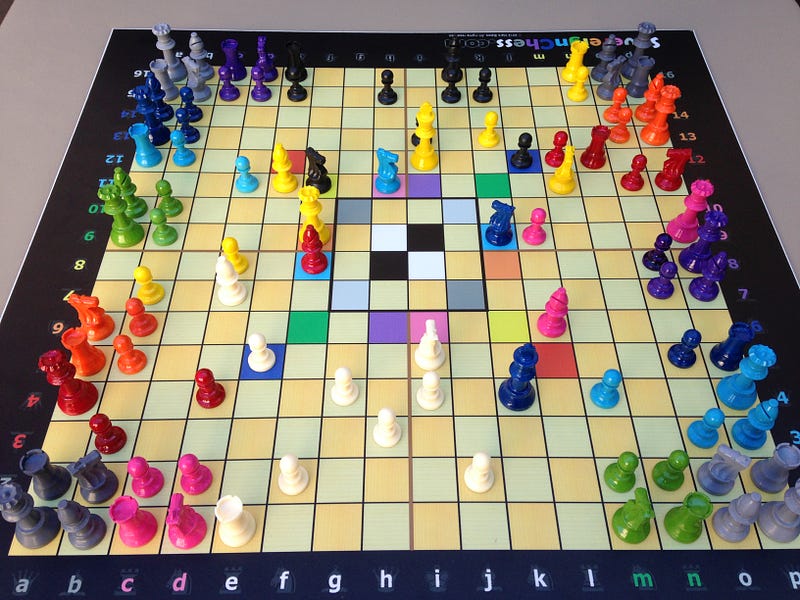
Sovereign Chess
A chess variant inspired by the Cold War. Played on a 16x16 board with over a hundred pieces. Along with the traditional white and black armies, 10 “half-armies” line the edges of the board. Players can recruit these armies by putting a piece on the matching colored square.
Controlled armies can be used to control OTHER armies. Whether you think of this as recruitment or coercion, the colored squares function as obvious Arsenals. Lines of Communication can not only be broken but subverted by capturing and reversing control of half-armies. The main takeaway is that allies are vital in any conflict. Denying your opponent allies is a must.
An inventive class wargamer can hack any board game — that’s why they’re better than video games — but chess variants are especially remixable. You can never take chess varaints too far.
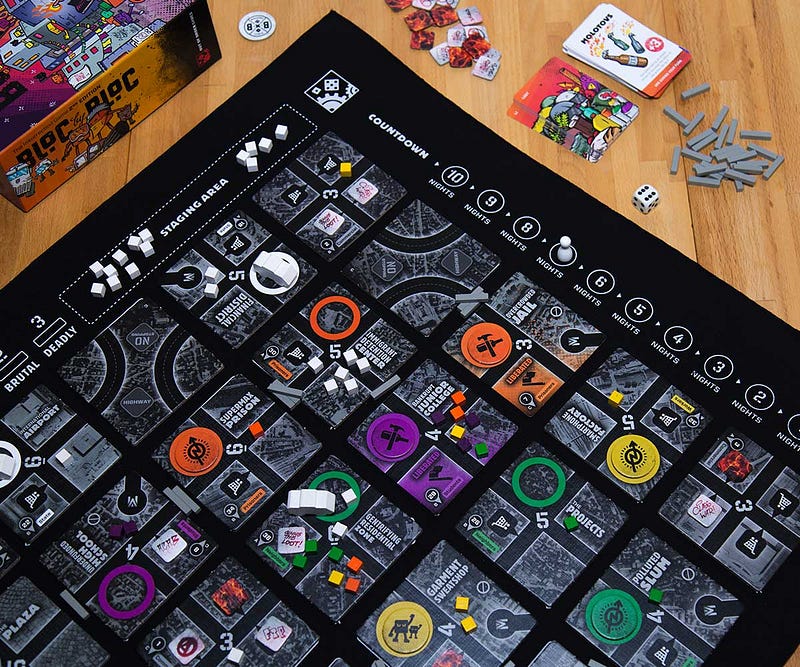
Bloc by Bloc: The Insurrection Game
Apparently protests in the 80s and 90s were bullshit. After the Civil Rights Movement, most mass demonstrations were negotiated before they even happened. Police and organizers agreed on what was in and out of bounds. That practice broke down during the Battle in Seattle. Without any identified leadership, there was no one for the cops to negotiate with. When protesters “got out of hand”, the cops brought the hammer down without a second thought. And ever since, cops have been ratcheting up their response. Because they’re mostly there to protect and serve the Rich.
Bloc by Bloc “is a semi-cooperative game simulating protest movements, riots and popular uprisings in urban areas around the world during the first decades of the 21st century”. It’s not historical, but it’s relevant. It’s not categorized as a wargame, but it should be. It’s out of print, but a print-and-play version is free to all.
Forget metaphors of psycho-geography. Bloc by Bloc is literally about fighting the power in the here and now. But its logic falls down when modeling the Police. When blocs defeat Riot Cops or destroy Police Vans, Police Morale goes down. They go from Deadly to Brutal, Brutal to Bold, Bold to Alert, and Alert to Timid. That’s the opposite of reality. When Cops lose, other Cops get meaner. Maybe the designer wanted to encourage players to fight the Police. You may want to house-rule this.
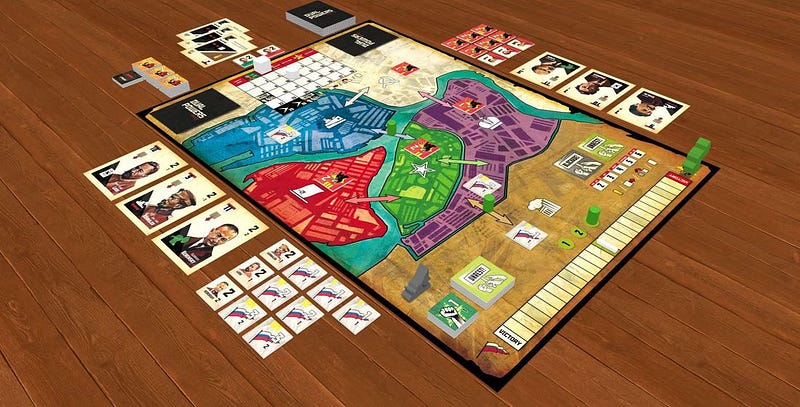
Dual Powers: Revolution 1917
A card-driven game playing out the February and October Revolutions. Combat is abstracted into area control actions. Like Bloc by Bloc, it’s about controlling districts in a city. Whoever has the most control points by November wins control of Petrograd.
Dual Powers has a few odd mechanics. Each action moves the calendar token a certain number of days. Less drastic actions don’t move time forward much while big actions run down the clock. This can be good or bad, depending on whether your winning or losing at the time. Also, there’s no direct combat. You’re just controlling districts by having the strongest forces in them. Units and leaders can be exhausted, but that’s it.
Complicating all this is The Will of the People. Both sides fight over the neutral forces on the board, which help them control districts. Plus, a barricade is placed randomly between two districts every turn, which prevents moving between the two.
Dual Powers has one glaring historical inaccuracy. And that inaccuracy, conflating Soviets and Bolsheviks, will enrage history buffs.
If nothing else, a class wargamer should learn to appreciate the value of unrest among a populace. Even when neutral parties aren’t your allies, they can play havoc with your opponent. Treat them nice or treat them like a force of nature.
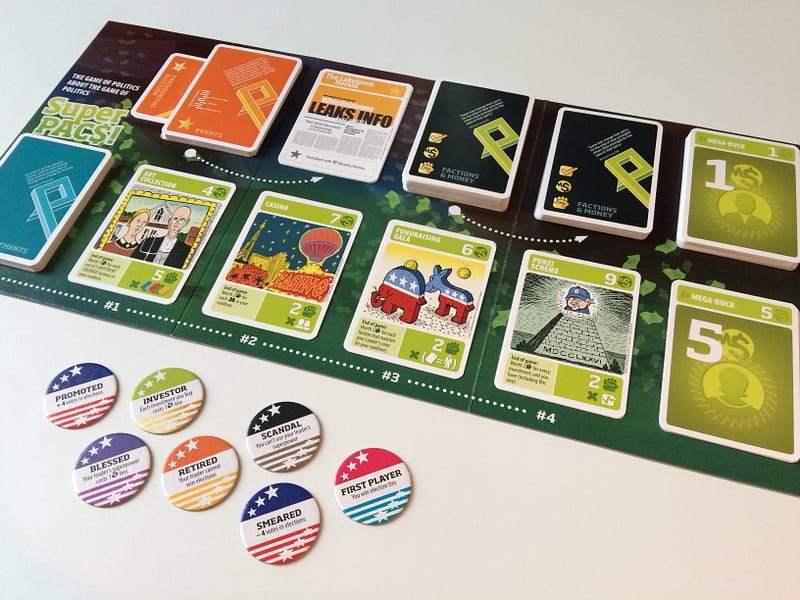
Super PACS
Not a wargame by any stretch of the imagination, but required playing for class wargamers. Players struggle for Money, Votes, and Power. Whoever has the most Power at the end wins. Money can buy Votes and Power. Votes win you Elections, which translate to more Power. But you don’t HAVE to win Elections to win the game. A player can lose all three big elections and still end up with more Power than anyone else.
So even if Trump loses in November, he could end up with more wealth, influence, and connections than ANYONE ELSE ON EARTH.
Super PAC$’ fucked-up victory condition reflects the freakshow that is American politics pretty well. And if you’re doing the whole ludic performance thing, or just drunk enough, you can roleplay as the various leaders.
Super PAC$ models political combat as an arms race. Arsenals are made up of various organizations, voting blocks, industries, and other allies. Because politics is all about who’s in your corner and who’s not. Until, of course, you cash out and retire to your secret mansion in Russia.
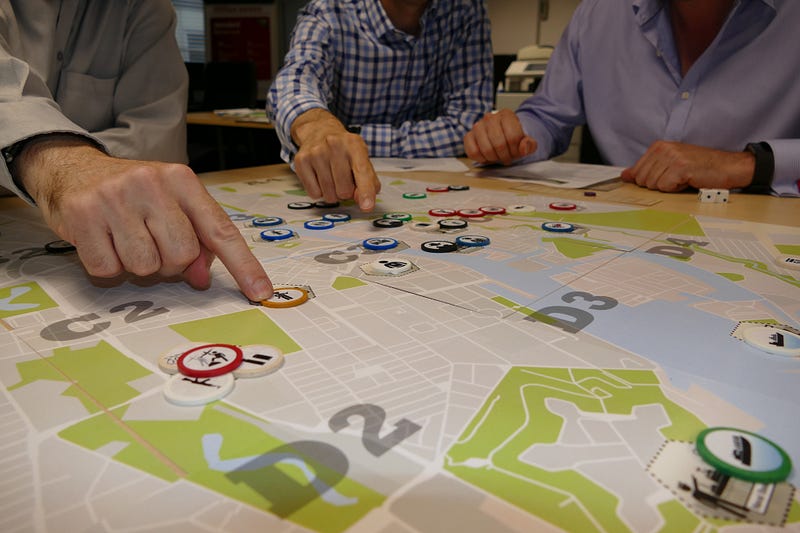
The Matrix Game Construction Kit
This is how grown-ups at government think tanks game out heavy Deep State shit. Matrix games use a flexible ruleset to address national security issues, humanitarian crises, pandemic responses, and other serious stuff. Some would call it “free-form wargaming”.
The MaGCK includes the rules of Matrix gaming plus a shit-ton of stickers, tokens, score trackers, dice, and generic maps to build whatever serious/analytical wargame you need. It also includes two scenarios, one of which is the infamous Isis Crisis.
The kit is not cheap. One alternative is to buy the rulebook separately — or find Matrix rules elsewhere because it’s not a patented ruleset — and use tokens and whatnot from other games. OR you can apply Matrix rules to an existing wargame, making it a free-form variant. OR you can do something else entirely.
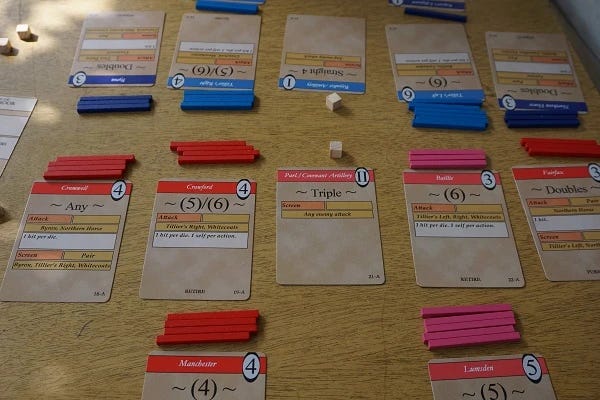
Table Battles
A minimalist abstract wargame. Like the MaGCK, Table Battles can be played with different scenarios. Unlike the MaGCK, it’s super cheap. PLUS there’s a print-and-play version that’s even cheaper.
The 2nd edition includes ten scenarios set from 48 BC to the mid 1800s. Cards represent Formations. Formations attack, counterattack, screen, etc via Yahtzee-esqe dice allocation. Wooden sticks represent each Formation’s current strength. Each side (usually) gets 2 Morale cubes. Morale is lost when a Formation breaks. When you run out of Morale, you’re done.
Table Battles flattens war by limiting movement. There is no Terrain to consider. The only “movement” is bringing up a reserve Formation to replace a retired Formation. To reflect historical realities most Formations can only attack (or counterattack or screen or whatever) specific enemy Formations. Lines of communication are abstracted by having two separate Wings, and you can only allocate 1 die to each Wing every turn.
There aren’t a lot of choices to be made in Table Battles. Creativity and inventiveness won’t save you. Table Battles teaches the class wargamer about timing, opportunity, and probabilities.
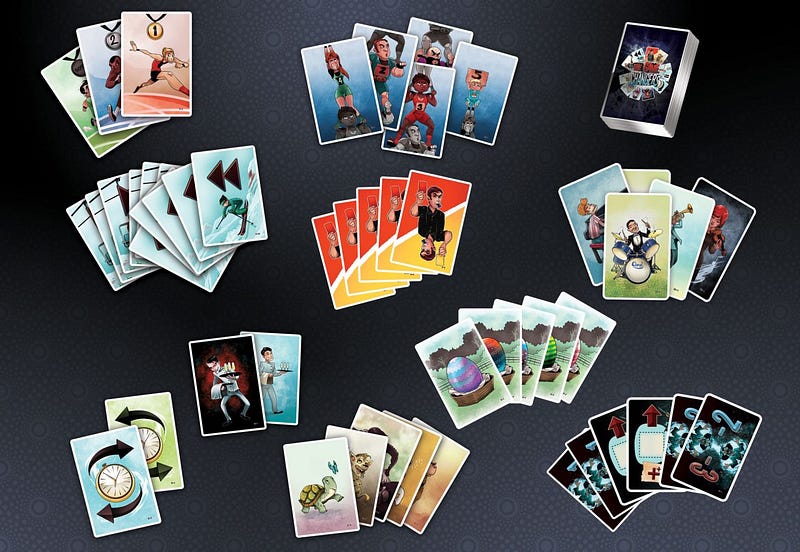
Also Recommended: The Game Changers
The Game Changers adds new cards and new rules to whatever game you’re futzing with. For example, if you’re modelling the 2020 election, give the Trump player a Foul Play card. This allows the player to cheat. Once they get caught, they lose that protection. But think of all the times they didn’t get caught! That should reflect the on-the-ground reality fairly accurately.


