
Games are Political
Crashing the Gates: An Ad-Hoc ‘Wargame’ Scenario About Migration
Based on Foreign Policy’s Series “Europe Slams Its Gates”
IMMIGRANT, n. An unenlightened person who thinks one country better than another.
— from The Devil’s Dictionary
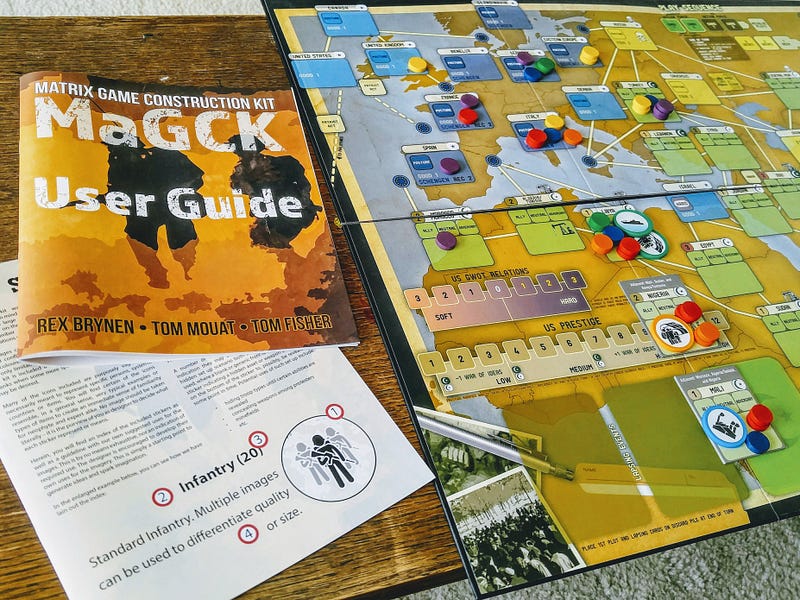
$240 is a lot for a game that’s not supposed to be fun.
Right now I’m diving into game-systems-in-a-box like Stonehenge, 504, and Pyramid Arcade. Between excavation sessions, I got sucked into reading Foreign Policy’s series on Africa-to-Europe migration. It’s a five-part tale of desperate migrants, befuddled NGOs, and typical third-world bureaucrats. I read it in one sitting, got up, heard the doorbell, opened the door, and got handed my recently-ordered Matrix Game Construction Kit. I took it as a sign that the lizard people who control the world wanted me to build a scenario based on the series. So here we go.
The Matrix Game Construction Kit is kinda part RPG, part heavy euro. Matrix rules are mostly used by national security professionals for REAL wargaming. This just happens to be the first convenient boxed set. For $240 you get a rulebook, two scenarios, lots of chip tokens in eight colors, tons of stickers for said tokens, a sticker reference guide, some smaller tokens, and some double-sided map tiles.
In matrix gaming, players represent factions in various (often armed) conflicts. Each player or team takes an action on their turn to do whatever they want using a Pro/Con argument system. Players declare an action, the planned outcome of that action, and all the reasons the outcome will happen. Opponents, and maybe the Umpire, then list all the reasons the outcome WON’T happen. The Umpire decides how likely that action is to succeed, the player rolls some dice, and the outcome either happens or doesn’t.
As a news junkie, I pride myself on knowing enough about a subject to be dangerous. I’m not an expert on migration (or any other subject for that matter), but I know enough to turn news into a game scenario. Basically…
- Malian Nationals want Remittances or Development.
- Libyan Militias want Funding from the IOM or Cash from Ransoms.
- Nigerien Smugglers want to Smuggle people to Europe or get their own Development Funding.
- The IOM wants to keep Europe European AND Liberal. Or maybe just European.
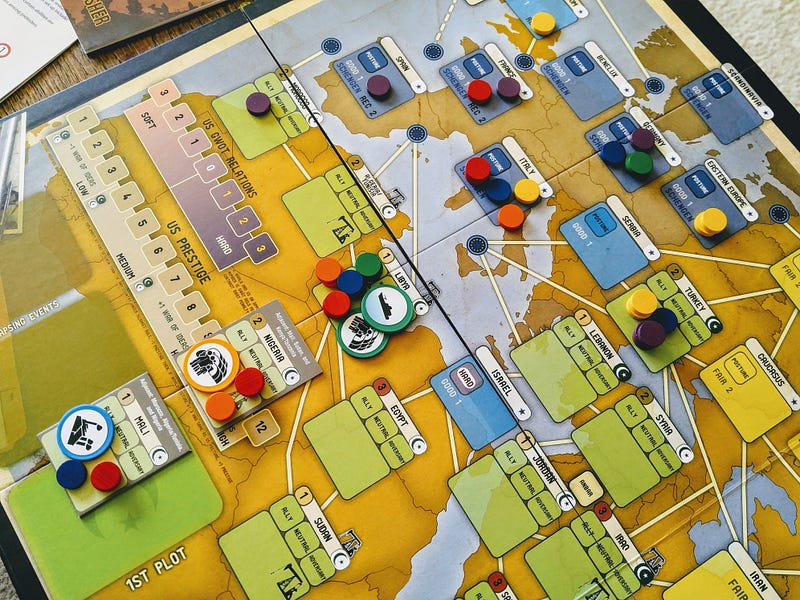
Rather than make a map for the scenario (it’s kinda bizarre that FP’s mega-series doesn’t include one), I borrowed the board from Labyrinth: The War on Terror. Note that even though Senegal is mentioned in the series, my board doesn’t include Senegal. Thus, I didn’t include it in the scenario. Also, it doesn’t show Niger, so I used Nigeria instead. I know they’re not the same country! But they’re next to each other and I had to make do. If you don’t happen to own Labyrinth, any relevant map will do. You’ll have to adjust the starting token allocation.
How to Win
Each Faction has three Milestones. Once a Milestone is reached, the player gets 1 Victory Point. If a Milestone is somehow undone, the VP isn’t lost. Further, the player can gain another VP by reaching the Milestone again.
Note that no one in the real world is going to “win”. They just get to lose last. Play until you’re bored, tired, or too depressed to carry on, then count up the VPs. Each turn represents 1 year.
Influence
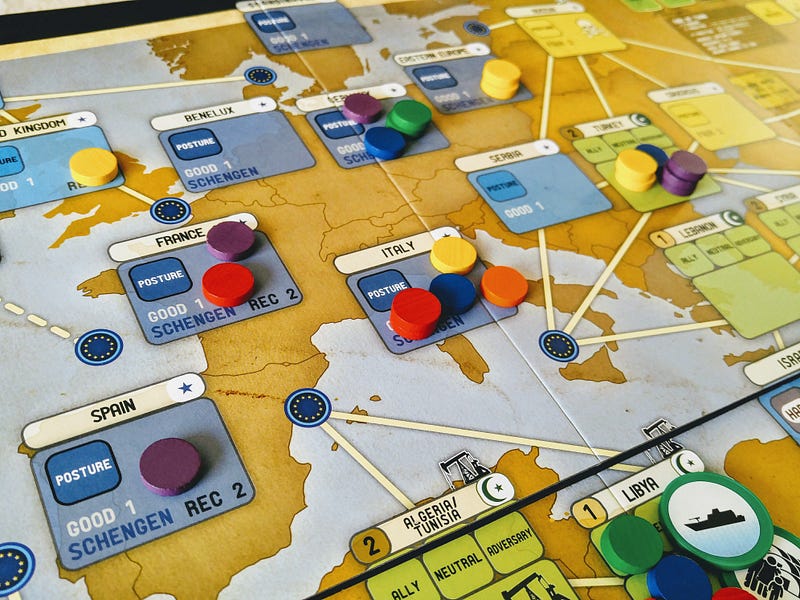
Small Tokens represent Influence. Influence is an abstracted mix of people, money, power, standing, and resources. Influence is “liquid”, and can represent whatever you’d expect that Faction to have. These mean different things to each faction.
For example, Libyan Militia Influence can be used for military actions, but Malian Migrant Influence can’t without a good Argument. Plus, a mob of unarmed Malians will be far less likely to succeed at any military style action then Libyan soldiers.
Influence exists on an abstract scale:
- 1 token is “Little” or “Few”, as in “Little Migrancy”.
- 2 tokens is “Some”, as in “Some Funding”.
- 3 tokens is “A Lot”, as in “A Lot of Security”.
These are “civilian” terms, and represent how the average citizen would eye-ball these things.
Assets and Projects
Large Tokens represent major Assets or Projects. These are specific, non-liquid things like Factories and Boats. They’re roughly equal in effectiveness to 2 Influence Tokens because their specialized. However, they’re measured on the same abstract scale.
- 1 Detention Center token represents “A Few Detention Centers”.
- 2 Patrol Boat Tokens represent “Some Patrol Boats”.
- 3 Cash Tokens represent “A Lot of Cash”.
For example, the Libyan Militias obviously have soldiers, but they’re part of Influence. It’s the Detention Centers and Boats that are important to stopping and holding migrants. The Libyan player can build a more formal ground force, but that doesn’t help stop migrants crossing the sea. However, an upscale military could help round up migrants before they cast off.
PLAYER FACTIONS
Malian Nationals (Red)
Remittances are the bread and butter of Mali. The EU has promised more business development that will create jobs, but that hasn’t happened yet. And if it does, it’s still not enough to keep many Malians home. It just provides them a faster way to save up for the trip to Europe.
Key Facts
- In 2015, a record 1.3 million people applied for asylum in Europe — nearly double the previous high, set in 1992.
- Germany admitted 1.1 million refugees and migrants in 2015.
- Nearly a quarter of Mali’s roughly 18 million nationals are thought to live abroad. The money they send back accounts for roughly 7 percent of GDP.
- Out of the 200 million euros being used to combat migration at its source, none of it is being managed by the Malian government or by Malian nongovernmental organizations.
- The EU is moving ahead with a new $15 million project to provide jobs to Mali. It could have positive, trickle-down effects on as many as 200,000 people.
- Development gains are associated with increased migration. Until a country attains a per capita income of roughly $7,500 (or three times that of Mali), more development equals more migration, mainly because it’s migrants to can save for the trip faster.
- An estimated 120,000 Malians live in France, sending back remittances that exceed France’s development aid to its former colonial possession.
- 5,947 Malians were expelled from Europe between 2002 and 2013.
- Less than 40 percent of failed asylum-seekers were actually deported in 2013.
- One migrant can support more than 20 people at home.
Milestones
- 8 Influence in Europe
- 3 Influence in North America and/or Asia
- 3 Factories, Industries, or other business/work related Projects in Mali, from any Faction
Starting
- Mali — 1 Influence
- Libya — 2 Influence
- France — 1 Influence
- Niger — 2 Influence
- Italy — 2 Influence
- Germany — 1 Influence
Red Influence Tokens represent migrancy and overall remittance.
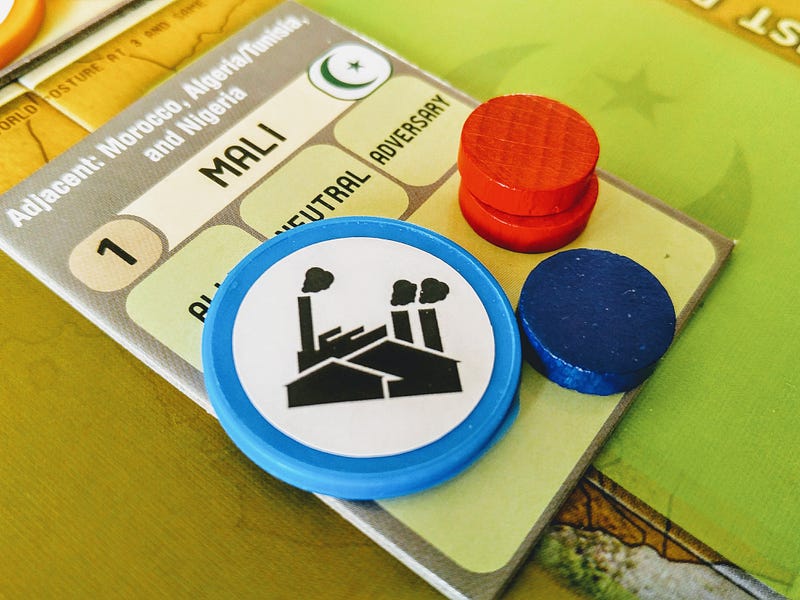
Note: The starting Factory Token in Mali doesn’t belong to the Malian player. It’s the IOM that wants it there to keep Malians from leaving.
Example Actions
- Protest lack of Legal Migration
- Flock to the Morocco/Spain Route
- Partner with EU for Development Funding
Nigerien Smugglers (Orange)
Smuggling migrants, as well as guns and drugs, pays the bills. The individual migrants are irrelevant. It’s the constant flow of migrants that counts. The other alternative is the job training and local development the EU has promised, but has yet to deliver.
Key Facts
- In early 2016, the European Union reached a deal with Turkey, offering up to $6.6 billion to help stem the tide of immigrants.
- In 2016, $633 million went to Niger in exchange for stopping the flow of migrants.
- Between February and May 2016, the International Organization for Migration (IOM), recorded 116,347 “outgoing” migrants in Niger.
- As of Sept. 5, IOM reported that nearly 100,000 migrants had arrived in Italy this year from North Africa.
- The cost of being smuggled from Niger to Libya has doubled in the past year.
Milestones
- A total of 7 Influence in Italy, Libya, and Niger
- 2 Weapons, Drugs, or other contraband Tokens in Europe
- 2 Factory or Industry Tokens, from any Faction, in Niger
Starting
- Niger — 2 Influence / 1 Ghetto
- Libya — 2 Influence
- Italy — 1 Influence
Orange Influence Tokens represent Smuggling Network, as well as the means to travel those routes (vehicles, connections, etc).
Notes: The actual smuggling vehicles are abstracted as Influence. The Ghetto token represents the network of holding areas migrants wait in until they secure transport.
Example Actions
- Find new Smuggling Routes
- Build a dedicated fleet of Trucks or Boats
- Expand Smuggling Network eeper into Europe
Libyan Militias (Green)
The Libyan Militias mostly want the money, and detained migrants are a good source. By catching and detaining more migrants, they get more funding from the IOM. Plus, ransoming detainees to relatives back home or loaning them out for labor provide a nice side income.
Key Facts
- The European Union has so far pledged roughly $160 million for new detention facilities.
- Individual EU member states have earmarked tens of millions of dollars more as they consider a recent request, reportedly in the range of $900 million, by Libya’s U.N.-backed government for equipment needed to combat migrant smuggling.
- More than 500,000 migrants have reached Italy via what experts call the “Central Mediterranean route” from North Africa since 2014.
- Nearly 100,000 people have crossed via the Central Mediterranean route in the first nine months of this year.
- Since 2014, almost 13,000 migrants have perished at sea along this route.
- As of the beginning of August, an overwhelmed IOM had repatriated just 4,346 migrants from detention centers in 2017, a fraction of the estimated 400,000 migrants currently stranded in Libya.
Milestones
- No Nigerien or Malian Influence in Italy
- A total of 5 Boats, Detention Centers, or related Assets in Libya
- 3 Cash Tokens, from any Faction
Starting Tokens
- Libya — 2 Influence / 1 Patrol Boat / 2 Detention Centers
- Germany — 2 Influence
Green Influence Tokens represent military resources for catching and detaining migrants, as well as representatives from the Militias in Europe.
Note: Even though the Detention Center has the same icon as Niger’s Ghetto token, its definitely a prison and not a shelter.
Example Actions
- Increase Ransoming Operations
- Squeeze Europe/IOM for more Funding
- Standardize and Unite the disparate Militias
International Organization for Migration (Blue)
The IOM wants to reduce African (or any) migration as much as possible without tarnishing the EU’s image or values. The unspoken fear for some policy makers is that the average European may not care about Europe’s image or values.
Key Facts
- In 2015, a record 1.3 million people applied for asylum in Europe — nearly double the previous high, set in 1992.
- Germany admitted 1.1 million refugees and migrants in 2015.
- In early 2016, the European Union reached a deal with Turkey, offering up to $6.6 billion to help stem the tide of immigrants.
- From 2015 to 2016, the number of people crossing the Aegean to Greece dropped by nearly 80 percent.
- Immigration from North Africa across the Mediterranean Sea to Italy expanded, with a record 181,000 people taking it last year.
- This year, Italy is on pace to receive more than 150,000 migrants from Africa, joining the 500,000 who arrived in the previous three years.
- 54 percent of Germans didn’t want migration to be politicized in the national election campaign.
- The population of sub-Saharan Africa is expected to expand dramatically in the coming decades, with 800 million working-age people entering the labor force between 2010 and 2050 and some unknown fraction of that number inevitably trying to reach Europe.
Milestones
- Only 2 remaining Malian, Nigerien, or Other (Purple) Influence in Europe
- A total of 6 Influence in Libya, Mali, and Niger
- No remaining Malian Influence in Europe
Starting
- Germany — 1 Influence
- Libya — 2 Influence
- Mali — 1 Influence / 1 Factory
- Niger — 1 Influence
- Italy — 1 Influence
- Turkey — 1 Influence
- SPECIAL — 3 Cash Tokens (White)
Blue Influence Tokens represent governmental leverage and funding.
Notes: IOM Influence resources or leverage more than people. The 3 Cash Tokens represent the IOM’s ability to fund a few major projects to stem the tide of migrants coming to the EU.
Example Actions
- Build Factories or Industry in Africa
- Increase Mass Deportations from Europe
- Provide Job Training to Nigerien Smugglers
UMPIRE MARKERS
Other Migrants (Purple)
Refugees from the Middle East and other parts of Africa compete with Malian Migrants for space in the EU.
Starting
- Turkey — 3 Influence
- Germany — 1 Influence
- France — 1 Influence
- Spain — 1 Influence
- Morocco — 1 Influence
Anti-Migrant Efforts (Yellow)
This represents people, organizations, and efforts that are opposed to migration. This is not a Faction, but a way to mark anti-migration efforts.
- Turkey — 2 Influence
- Eastern Europe — 2 Influence
- Italy — 1 Influence
- United Kingdom — 1 Influence
Events and Other Actors (White)
There are no starting White Tokens, other than the IOM’s Cash, but they can be brought into the game by the Umpire. These can represent foreign aid, droughts and famines, war, or other events or Neutral Actors.
When I called this an “ad-hoc scenario”, I meant it. No foreign policy experts, immigration advocates, or international journalists have playtested this. Also, because all my friends are dumb, I playtested it alone. So if you play it and it ends with the break-up of the EU, take it with a grain of salt.


