
Artificial Intelligence & Creativity
Artificial Intelligence & The Misconception Of Creativity
How AI Might Teach Us Something About Human Creativity
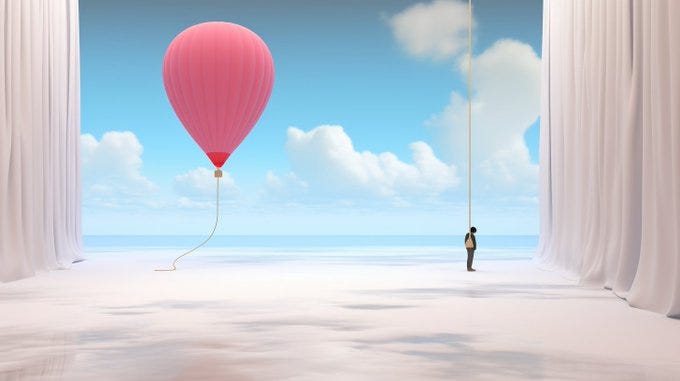
You read a lot these days about AI as a job killer: it swoops in, takes away a creative person’s skills, and puts them out of work. Bam! Another creative genius reduced to a mundane 9-to-5 grind.
Given the new AI tools and the unimagined possibilities for creating images, music/sound and text, this fear is absolutely understandable.
Upon closer examination, however, it is typical human ego-tripping.
The fear of AI “stealing creatives’ jobs” or even “killing creativity” often stems from a limited view of what we as creatives actually do (and are paid to do). It’s a fear fueled by a misconception of creativity.
And that’s exactly why Generative AI might force us to reevaluate what creativity really is.
The Misconception Of Creativity
If you ask creatives about their workflow, you’ll get many different answers. But there are basically two types of tasks that you’ll encounter over and over again:
- tasks involving original thinking, emotional understanding, socio-cultural anchorage, embodiment, personal world view
- tasks that are rather repetitive and mechanical
To quickly illustrate this, let’s look at some creative professions and how these two aspects are part of their daily work routine:
(note: these are example tasks and by no means a complete job description, of course; their separation is also for demonstration purposes only, in reality they often overlap)
Writer
- Tasks involving original thinking, sociocultural anchorage, etc: Developing unique narratives with emotional depth, cultural contexts, and personal perspective.
- Repetitive and mechanical tasks: Researching, proofreading, editing, formatting, and revising text.
Visual Artist
- Tasks involving original thinking, sociocultural anchorage, etc: Creating artworks that evoke emotions, reflect socio-cultural themes and express personal interpretation of the world.
- Repetitive and mechanical tasks: Sketching preliminary designs (archetypes), prepping materials, cleaning tools.
Musician/Composer
- Tasks involving original thinking, sociocultural anchorage, etc: Recombining musical devices and exploring musical vocabulary, reflect cultural influences, and convey personal experiences or viewpoints.
- Repetitive and mechanical tasks: Applying musical conventions in melody and structure (idioms), practicing scales, tuning instruments, and rehearsing pieces.
Game Designer
- Tasks involving original thinking, sociocultural anchorage, etc: Developing unique game worlds, storylines, and mechanics that reflect personal views, socio-cultural contexts, and stimulate emotional engagement.
- Repetitive and mechanical tasks: Coding, debugging, testing the game, creating repetitive game assets.
Most people would agree that AI systems are excellent and probably better than humans at any repetitive or mechanical task.
This means that machine intelligence already outperforms us in one of the two aspects necessary to be creative. That’s probably no surprise at all, given that AI systems are masters at recognizing patterns and relationships.
But what about the other aspect? The “original thinking” part?
Well, as we can see these days, AI is also increasingly able to reproduce the results of that aspect, which means it is producing something that looks like it was created by a human through original thought, emotional understanding, and sociocultural evocation.
Generative AI — whether creating images, text, or sounds — has become so advanced in recombining patterns and relationships that it can produce new combinations that humans have not previously thought of.
Does that mean it’s a kind of creativity?
Yes, I’m afraid it does.
AI is threatening jobs… and egos
The scary thing is that Generative AI undoubtedly arrives at seemingly creative results, but not in the way that humans must: it does not have to use the emotional path of being anchored in a social context and worldview.
And this confuses people.
A lot.
Instead, AI achieves creativity from a different angle: through its superhuman abilities to recognize patterns and structural relationships and recombine them in ways that no human could.
In addition, AI can recombine meaningful patterns and relationships without knowing or caring about their emotional, social, or ideological connotations. It does not care about your artistic preferences, your bohemian ideology, or your religious feelings. It is creative on a level that is detached from human feelings (for now, at least).
And AI also doesn’t need a muse, a morning coffee, or a patron to be creative 24/7. Its creativity is independent of that, too.
“But that means it’s killing creativity!”
It’s not. It cannot.
It cannot kill the joy and satisfactions humans receive from being creatively involved in the world. Human creativity is not something you need to find or train, it is an integral part of human behavior. That means it cannot be taken away.
Or do you really think that people will stop to draw or craft things with their hands or that children will stop exploring the world creatively?
What AI is doing instead:
It is automating cognitive processes that are fundamental for creativity and it does that so astonishingly good that its results are felt as a thread.
And there are two sides to this threat:
- AI will lead to job displacement because companies that would normally hire a creative employee will cut costs. That’s inevitable. In that sense, the threat is real. If you’re in the creative industry, you need to step up and adapt. Now.
- AI threatens creative egos. People who identify so strongly with their supposed creativity that they feel personally threatened by a machine intelligence that appears to deliver creative results. In this sense, the threat is an illusion. It is an ego trip.
Simulated Creativity
So how should we as creatives stay positive in all this? Well, in reality, the seemingly creative results of an AI system are a “simulation of human creativity.”
As explained above, AI takes a different path to creativity than humans with their embedding in socio-cultural contexts.
Simulated creativity also only makes sense if there is a human counterpart who can use it as a means of inspiration or introspection, as a starting point for exploration and research, or as creative ping-pong.
And the way I see it, simulated creativity is a real blessing to its human counterpart.
Let me illustrate this again with some of the job examples above.
Writing
As a writer, I use AI extensively to help me research, translate, structure, and edit. This allows me to focus on what I enjoy most about my work: finding connections between ideas, telling a story that I can emotionally relate to (and hopefully my readers can too), refining sentences and words, and most importantly, playing with language.
Music
Similarly, an AI tool could help a musician by automatically prescribing genre-specific elements for composition, allowing them to focus on the interesting subtleties and modulations. Again, this opens up new avenues for musical expression by automating the creation of basic parts, allowing the musician to explore new avenues of musical expression and — who knows where we’re headed with VR/AR — new ways to reach out to the listener.
Graphic Design
In a graphic design studio, AI could take on the task of creating multiple iterations of a design so the designer can focus on the big picture. Also, when sketching ideas for a client, AI can quickly iterate over archetypal ideas and styles to speed up the brainstorming process and enable the client to communicate their preferences in the graphic designer’s mindset and vocabulary, i.e., visually. Visual storytelling can be automated to help the graphic designer develop new types of creativity and interactive, responsive storytelling.
After all, creative people want to play with their respective medium. And AI is opening up a whole new playground for those who want to explore.
➡️ Follow me to stay up to date on “AI &Creativity”. If you want to support my work, become a Medium member using my referral link and get full access to all my articles (140+ and growing) and those of thousands of other writers. 🙏
➡️ If you like my content, why not leave a “clap” at the end of this article, so more people can see it?


