avatarKara Summers

Free AI web copilot to create summaries, insights and extended knowledge, download it at here

3631

Abstract

willing to subordinate the needs and feelings of others without much consideration. And they justify their ability to do this because they believe themselves to be special and more deserving. In other words, they can be frustrating — or downright difficult — to be in a relationship with. Now, some people who are narcissistic will stop there. -<a href="https://www.psychologytoday.com/gb/contributors/andrea-bonior-phd">Andrea Bonior Ph.D.</a></p></blockquote><p id="35e0">But do we write about narcissism to speak about the individuals who are difficult to be in a relationship with but don’t mistreat others? I don’t. I write to help victims of abuse recognise, heal and understand what has happened to them. But I don’t think that the problem is that we are using a one size fits all terminology or adding negative connotations to a person who might not have bad intentions for their romantic partner or family. I believe that the problem is that we find it easier to recognise narcissistic personality traits in a person than recognising <a href="https://www.confusiontoclaritynow.com/blog/covert-abuse-tactics">covert abuse</a>.</p><p id="01f8">The first time I spoke <a href="https://readmedium.com/two-birthdays-apart-e2e840131e86">to my ex’s mistress</a>, I told her everything I had learned about him up until then. When I said I thought he was a narcissist, she nodded in agreement. When I said he was abusive, she replied, “He never got to that stage with me.” Later on, we went through hundreds of messages from him and discussed scenarios and behaviours he had shown towards her. Many of them were the same abuse tactics he had used on me.</p><h2 id="d6e7">In theory, the diagnosis is much simpler</h2><p id="f956">Although we can read all the books and articles in the world and list 100 signs that the person we have encountered really is a narcissist, the official diagnoses would require a professional assessment of the individual themselves. And such professional assessment would require them to agree to be assessed, which can be very tricky when dealing with a person who generally thinks there is nothing wrong with them. According to the <i>Diagnostic and Statistical Manual of Mental Disorders, </i>only<i> <a href="https://www.sane.org/information-stories/the-sane-blog/mental-illness/is-narcissism-common-the-answer-may-surprise-you"></a></i><a href="https://www.sane.org/information-stories/the-sane-blog/mental-illness/is-narcissism-common-the-answer-may-surprise-you">between 0.5 and 1% of the general population is diagnosed with NPD</a>, although experts estimate that <a href="https://my.clevelandclinic.org/health/diseases/9742-narcissistic-personality-disorder#:~:text=Experts%20estimate%20that%20up%20to,that%20hurt%20themselves%20or%20others.">up to 5% of people have NPD</a>.</p><p id="3e70">In theory, you do not need to seek professional help to diagnose abusive behaviour.</p><h2 id="d643">Here are some definitions of emotional abuse that I have particularly resonated with me:</h2><ul><li>Controlling their partner’s time, space, money, thoughts, or choices such as what they wear</li><li>Monitoring where their partner goes or what they spend money on</li><li>Belittling and patronising comments</li><li>Isolating their partner</li><li>Making jokes that <a href="https://www.bustle.com/p/7-emotional-abuse-tactics-in-relationships-that-can-seem-innocent-at-first-17008749">are actually insults</a></li><li>Accusing their partner of flirting, having an affair, or being unfaithful when there is little or no evidence they have done so.</li><li>Getting angry or resentful when their partn

Options

er is successful in a job or hobby</li><li>Intimidating their partner</li><li>Threatening to hurt themselves</li><li>Threatening to leave</li><li>Demeaning their partner with frequent put-downs, name-calling, blame, or humiliation</li><li><b>Gaslighting</b>: Saying things that are designed to make their partner feel “crazy” or “stupid.”</li><li>Always being right, never apologizing</li><li>Punishing their partner by refusing to talk to them or by withholding affection.</li><li>Withholding essential resources like food or money</li><li>Frequent mood swings</li><li>Frequently and quickly escalating into a rage</li><li>Blaming others for their behavior</li><li><a href="https://www.ananiasfoundation.org/definitions/?gclid=Cj0KCQiApY6BBhCsARIsAOI_GjZfauLlBN67rHTws1frA7GTF8ur0pPflHO5M69-mkvwmUHfH-pqgc4aAiS4EALw_wcB">Acting like the behavior is no big deal, denying the behavior, or telling their partner it’s their fault</a></li></ul><h2 id="f93b">Am I masking the problem?</h2><p id="6366">Since I started writing on Medium, I have published 8 stories that include the word narcissist in the title and only 2 that also include the word abuse. Why do I make that distinction?</p><p id="c54f">When I split from my ex, I still thought I had lost the love of my life and I was the only one to blame. Only when my therapist mentioned narcissism, I started learning everything about it. Learning about narcissism is what led me to learning about emotional abuse.</p><p id="1a14">Even if narcissism has become a buzzword, it can help victims to gain an understanding of what has happened to them. I also believe that there is a nuance to narcissistic abuse that may fail to come across if we replace the word <i>narcissist</i> with <i>abuser</i> in the articles we write. And sometimes I want to be very specific and speak about my experience or behaviours that link to narcissism but not all abusers.</p><p id="eb5c">Maybe in a society where many do not see psychological abuse on the same level as physical abuse, identifying the narcissist can be a good hook to get into the subject. Or maybe victims don’t even have to call it abuse or call themselves victims, as long as whatever they identify and read can help them on <a href="https://readmedium.com/healing-is-more-like-a-rollercoaster-ride-than-a-journey-cfea0297c501">their healing journey.</a></p><h2 id="e439">More from Kara Summers on Narcissism:</h2><div id="201b" class="link-block"> <a href="https://readmedium.com/narcissists-dont-have-kids-they-make-babies-4cdb162df4f5"> <div> <div> <h2>Narcissists Don’t Have Kids — They “Make Babies”</h2> <div><h3>They create an extension of themselves.</h3></div> <div><p>medium.com</p></div> </div> <div> <div style="background-image: url(https://miro.readmedium.com/v2/resize:fit:320/1*Mn5RoznTRpJLSw9zgNf8cw.jpeg)"></div> </div> </div> </a> </div><div id="75d2" class="link-block"> <a href="https://readmedium.com/the-narcissistic-abuse-cycle-in-quotes-ce4c3f4f3b3e"> <div> <div> <h2>The Narcissistic Abuse Cycle In Quotes</h2> <div><h3>100 Quotes from Narcissists</h3></div> <div><p>medium.com</p></div> </div> <div> <div style="background-image: url(https://miro.readmedium.com/v2/resize:fit:320/1*nV7xtlxWi0w_KJuC1L5FcQ.png)"></div> </div> </div> </a> </div></article></body>

Are We Masking the Problem by Calling Them a Narcissist?

If what happened to us is abuse, shouldn’t we call them abusers instead?

Image by Francescoch via Canva

I am on the weekly zoom session of my abuse support group. Sometimes when I hear the horror stories of physical abuse, I feel out of place. Other times, when we discuss all the characteristics and behaviours of abusive men, I know that I belong here.

A woman speaks up. “My ex was very different,” she says. “He was a narcissist, so he didn’t do all these mean things.” Our host jumps in. “We don’t make a distinction. Narcissist has become such a buzzword in recent years, we call them all what they are: Abusers.

I think about both statements long after the session has ended. I understand the point the lady was trying to make. When you have been in a relationship with a narcissist, the abuse can be so subtle or covert that it is difficult to recognize. A lot of the abuse tactics and scenarios commonly mentioned in such support groups may not apply to your own experience.

At the same time, the host made a valid point: Are we masking the real problem when we speak about narcissists instead of abusers?

When I worked through the breakup with my ex, it took me a long time to firmly identify him as a narcissist, but labelling what had happened to me as abuse was a lot further down the road.

There is still a stigma around abuse

Although many health professionals and organisations recognize that the impact of psychological abuse can be as harmful as sexual or physical abuse, a lot of our society is still catching up. In the UK, it was only the recent years that laws were brought in to make coercive control and psychological abuse a crime. Even with those new laws, it is a lot harder to prosecute and prove psychological abuse. And before we can even begin to prosecute abusers, we need recognition and awareness of what abuse looks like. A recent study showed that only 42% of participants listed emotional and verbal maltreatment as abuse. For many victims it may require professional support and can take years to recognise it:
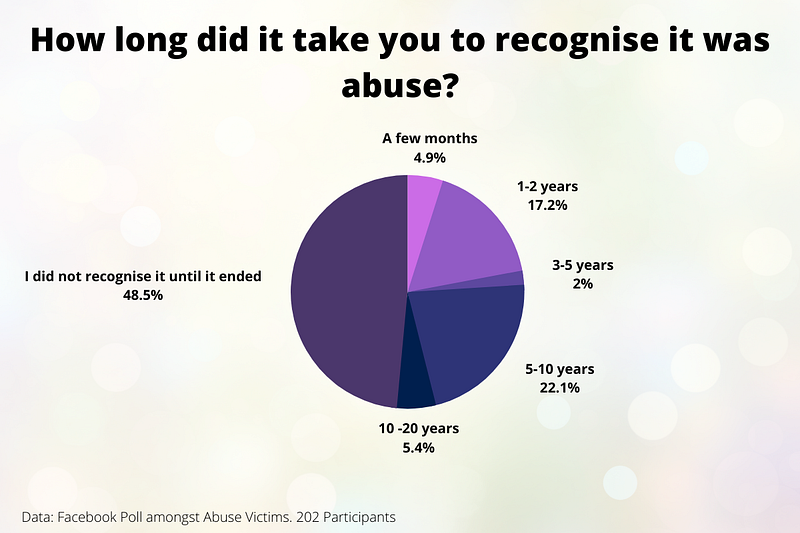
Image by Author

Not all narcissists are abusive

Not all individuals with narcissistic personality traits are abusive and not all abusive individuals have narcissistic personality disorder. Psychologists suggest that some narcissists may seem egoistic and put themselves first without ever becoming emotionally abusive.

By definition, a narcissistic person is more likely to act in a way that is not particularly considerate of other people. They will typically look out for their own needs above all else and are willing to subordinate the needs and feelings of others without much consideration. And they justify their ability to do this because they believe themselves to be special and more deserving. In other words, they can be frustrating — or downright difficult — to be in a relationship with. Now, some people who are narcissistic will stop there. -Andrea Bonior Ph.D.

But do we write about narcissism to speak about the individuals who are difficult to be in a relationship with but don’t mistreat others? I don’t. I write to help victims of abuse recognise, heal and understand what has happened to them. But I don’t think that the problem is that we are using a one size fits all terminology or adding negative connotations to a person who might not have bad intentions for their romantic partner or family. I believe that the problem is that we find it easier to recognise narcissistic personality traits in a person than recognising covert abuse.

The first time I spoke to my ex’s mistress, I told her everything I had learned about him up until then. When I said I thought he was a narcissist, she nodded in agreement. When I said he was abusive, she replied, “He never got to that stage with me.” Later on, we went through hundreds of messages from him and discussed scenarios and behaviours he had shown towards her. Many of them were the same abuse tactics he had used on me.

In theory, the diagnosis is much simpler

Although we can read all the books and articles in the world and list 100 signs that the person we have encountered really is a narcissist, the official diagnoses would require a professional assessment of the individual themselves. And such professional assessment would require them to agree to be assessed, which can be very tricky when dealing with a person who generally thinks there is nothing wrong with them. According to the Diagnostic and Statistical Manual of Mental Disorders, only between 0.5 and 1% of the general population is diagnosed with NPD, although experts estimate that up to 5% of people have NPD.

In theory, you do not need to seek professional help to diagnose abusive behaviour.

Here are some definitions of emotional abuse that I have particularly resonated with me:

  • Controlling their partner’s time, space, money, thoughts, or choices such as what they wear
  • Monitoring where their partner goes or what they spend money on
  • Belittling and patronising comments
  • Isolating their partner
  • Making jokes that are actually insults
  • Accusing their partner of flirting, having an affair, or being unfaithful when there is little or no evidence they have done so.
  • Getting angry or resentful when their partner is successful in a job or hobby
  • Intimidating their partner
  • Threatening to hurt themselves
  • Threatening to leave
  • Demeaning their partner with frequent put-downs, name-calling, blame, or humiliation
  • Gaslighting: Saying things that are designed to make their partner feel “crazy” or “stupid.”
  • Always being right, never apologizing
  • Punishing their partner by refusing to talk to them or by withholding affection.
  • Withholding essential resources like food or money
  • Frequent mood swings
  • Frequently and quickly escalating into a rage
  • Blaming others for their behavior
  • Acting like the behavior is no big deal, denying the behavior, or telling their partner it’s their fault

Am I masking the problem?

Since I started writing on Medium, I have published 8 stories that include the word narcissist in the title and only 2 that also include the word abuse. Why do I make that distinction?

When I split from my ex, I still thought I had lost the love of my life and I was the only one to blame. Only when my therapist mentioned narcissism, I started learning everything about it. Learning about narcissism is what led me to learning about emotional abuse.

Even if narcissism has become a buzzword, it can help victims to gain an understanding of what has happened to them. I also believe that there is a nuance to narcissistic abuse that may fail to come across if we replace the word narcissist with abuser in the articles we write. And sometimes I want to be very specific and speak about my experience or behaviours that link to narcissism but not all abusers.

Maybe in a society where many do not see psychological abuse on the same level as physical abuse, identifying the narcissist can be a good hook to get into the subject. Or maybe victims don’t even have to call it abuse or call themselves victims, as long as whatever they identify and read can help them on their healing journey.

More from Kara Summers on Narcissism:

Narcissism
Relationships
Love
Abuse
Psychology
Recommended from ReadMedium